
August 8, 2025
The Ultimate Guide to AI Content Creation Tools
The Ultimate Guide to AI Content Creation Tools
Welcome to the new frontier of digital content. In a landscape where demand for high-quality, relevant material is insatiable, ai content creation tools have emerged as powerful allies. But what exactly are they, and how can they transform your workflow? Let’s dive in.
What Are AI Content Creation Tools and How Do They Work?
At their core, AI content creation tools are sophisticated software applications that leverage artificial intelligence, primarily large language models (LLMs) and generative AI, to produce, edit, and optimize content. Think of them as a creative co-pilot. You provide a prompt, a command, or a piece of initial data, and the AI processes it to generate human-like text, images, code, or even video scripts.
How do they pull this off? These models are trained on massive datasets—billions of data points from the internet, books, and articles. Through this training, they learn the intricate patterns, nuances, grammar, and stylistic conventions of human language and visual communication. When you ask an AI tool to write a blog post about sustainable gardening, it isn't "thinking"; it's predicting the most statistically likely sequence of words to form a coherent and relevant article based on the patterns it has learned. This process allows them to draft articles, design visuals, write social media copy, and much more in a fraction of the time it would take a human.
Beyond the Hype: The Real Impact on Productivity and Quality
The initial buzz around AI often centered on replacing human creators, but the reality is far more collaborative and nuanced. The true power of ai content creation tools lies in their ability to augment human creativity, not supplant it.
Productivity: The most immediate impact is a dramatic boost in efficiency.
- Overcoming Writer’s Block: Staring at a blank page? AI can generate outlines, first drafts, or a list of brainstormed ideas in seconds.
- Automating Tedious Tasks: AI excels at repetitive work, such as writing product descriptions, generating meta titles for SEO, or creating multiple ad copy variations for A/B testing.
- Accelerating Research: Some tools can synthesize information from sources, providing you with a summary of key points to kickstart your writing process.
Quality: Used correctly, these tools can elevate the quality of your content.
- Enhancing Clarity and Style: AI can rephrase sentences for better flow, suggest stronger vocabulary, and ensure your writing is free of grammatical errors.
- Maintaining Brand Voice Consistency: You can train certain AI models on your brand’s style guide, ensuring every piece of content—from a tweet to a whitepaper—is perfectly on-brand.
- Scaling High-Quality Output: An AI assistant helps you produce more polished content without sacrificing quality, enabling a more robust and consistent publishing schedule.
Who Should Use These Tools? From Solo Creators to Enterprise Teams
AI content creation tools are not one-size-fits-all; their application varies depending on the user’s goals and scale.
- Solo Creators & Freelancers: For the one-person-show, AI is a force multiplier. It helps bloggers, YouTubers, and freelance writers to generate ideas, draft content, and repurpose material across different platforms, allowing them to compete with larger teams.
- Small & Medium-Sized Businesses (SMBs): Marketing teams in SMBs are often stretched thin. AI tools empower them to execute a sophisticated content strategy without a massive budget, handling everything from email campaigns and social media updates to blog posts and ad creative.
- Enterprise Teams: At the enterprise level, the focus shifts to scale, governance, and consistency. AI content creation tools are invaluable for generating thousands of localized product descriptions, maintaining a unified brand voice across global marketing departments, and personalizing customer communications at an unprecedented scale.
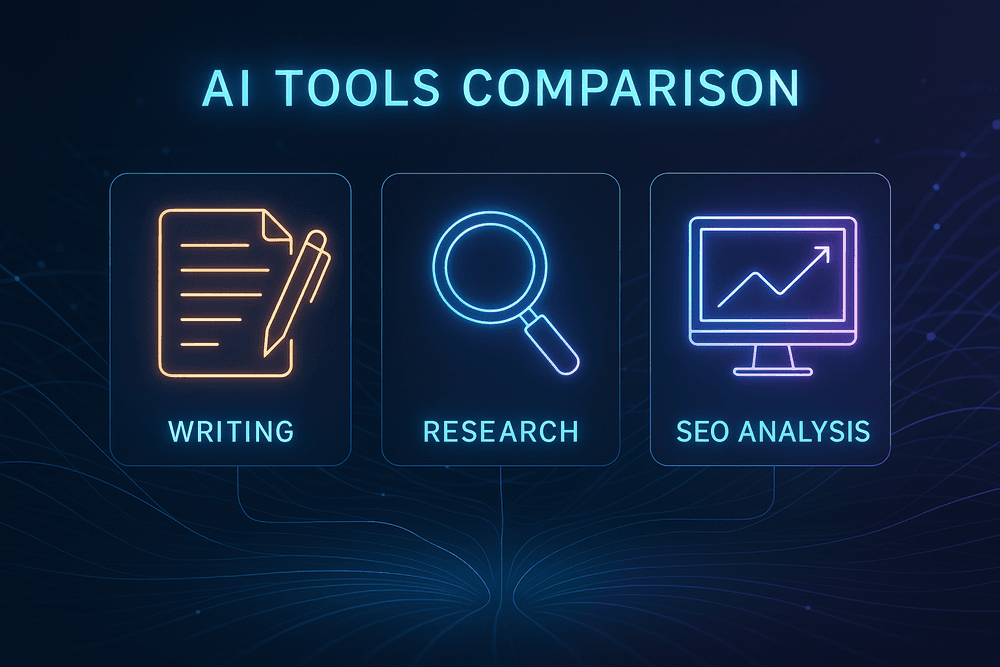
Finding Your Fit: Comparing the Best AI Content Creation Tools by Function
Not all AI content creation tools are created equal. The best platform for you depends entirely on your primary goal, whether it's crafting long-form articles, conducting deep research, or simply polishing your prose. Let’s break down the leading tools by their core function to help you find the perfect match for your workflow.
For Long-Form Writing & SEO: Jasper vs. Surfer SEO
When your goal is to produce high-quality, long-form blog posts that rank, two names dominate the conversation: Jasper and Surfer SEO.
- Jasper (formerly Jarvis) is a creative powerhouse. It excels at generative AI, using its advanced language models to help you brainstorm ideas, overcome writer's block, and write entire article drafts with a consistent brand voice. Jasper offers a massive library of templates for everything from blog posts to ad copy, making it incredibly versatile. Choose Jasper if your priority is creative assistance, speed, and generating polished first drafts across various content formats.
- Surfer SEO, on the other hand, is an optimization-first tool. Its core strength lies in analyzing the top-ranking pages for your target keyword and creating a data-driven content brief. It tells you which keywords to use, how long your article should be, and what topics to cover. While it now has a built-in AI writer (Surfer AI), its primary value is as an SEO blueprint. Choose Surfer SEO if your main objective is to create content that is meticulously optimized to outrank competitors. Many teams use Surfer to create briefs and Jasper to write the content, combining the best of both worlds.
For Research & Ideation: Exploring MarketMuse and Frase.io
Before you can write, you need a solid plan. These tools use AI to streamline your research and content strategy.
- MarketMuse operates at a strategic, high level. It’s an enterprise-grade platform that analyzes your entire website to build content inventories, identify topic gaps, and create content clusters that establish authority. It provides detailed briefs based on a deep understanding of your existing content and the competitive landscape. Choose MarketMuse if you're a content strategist focused on building a long-term, authoritative content plan.
- Frase.io is built for speed and efficiency at the individual article level. You input a keyword, and Frase instantly analyzes the top SERP results, pulling out common headings, questions people ask, and relevant topics. It condenses hours of manual research into a comprehensive brief in minutes, making it a favorite among content writers and managers. Choose Frase.io if you need to quickly research and outline individual articles to ensure they are comprehensive and competitive.
For Rewriting & Repurposing: QuillBot vs. Wordtune
Improving and repurposing existing content is a smart strategy, and these AI writing assistants are designed for the job.
- QuillBot is the undisputed king of paraphrasing. It can rewrite sentences or entire paragraphs in various modes, from "Standard" to "Creative," helping you rephrase content for different audiences or avoid duplicate text. It also includes a summarizer and grammar checker, making it a versatile editing toolkit. Choose QuillBot if you frequently need to rework existing text, simplify complex language, or generate multiple versions of a piece of content.
- Wordtune functions more like an editorial partner. Instead of just paraphrasing, it focuses on improving your writing's clarity, tone, and impact. It suggests alternative ways to phrase your sentences to make them more compelling, formal, or casual. Its "Spices" feature can even add statistical facts or counterarguments to strengthen your points. Choose Wordtune if your goal is to elevate your own writing and refine your style, not just reword it.
For All-in-One Solutions: Evaluating Scalenut and Content at Scale
For teams that want a single platform to manage the entire content lifecycle, these all-in-one AI content creation tools are powerful contenders.
- Scalenut offers a complete content workflow in one dashboard. Its "Cruise Mode" guides you from keyword research to a finished, SEO-optimized first draft in under five minutes. It combines AI-powered research, writing, and optimization features, giving you a centralized hub for content creation. Choose Scalenut if you want a balanced, feature-rich platform that assists your team through every stage of the content process.
- Content at Scale is built for one thing: producing massive volumes of high-quality, long-form content that reads like it was written by a human expert. It’s designed to take a keyword and generate a near-complete, 2,500+ word article with minimal user input. The platform focuses heavily on creating content that can bypass AI detectors. Choose Content at Scale if your primary business model relies on high-volume content production and scaling your output is the number one priority.
Decoding the Must-Have Features of Top AI Content Creation Tools
Choosing the right platform goes beyond simply asking it to write a blog post. The best AI content creation tools are sophisticated ecosystems packed with features designed to enhance quality, improve workflow, and deliver measurable results. As you evaluate your options, focus on these four critical areas to ensure you’re investing in a tool that truly empowers your content strategy.
Evaluating AI Models: GPT-4 vs. Claude and Proprietary Tech
At the heart of every AI writer is a Large Language Model (LLM)—the engine that powers the text generation. The specific model used dramatically impacts the output's quality, style, and accuracy.
- OpenAI's GPT-4 (and its variants): Widely regarded as the industry benchmark, GPT-4 excels at complex reasoning, creative writing, and understanding nuanced instructions. Tools built on GPT-4 often produce highly polished, human-like content suitable for a wide range of applications, from marketing copy to technical articles.
- Anthropic's Claude: Claude has gained significant traction for its emphasis on safety, helpfulness, and its ability to handle very large context windows. This makes it excellent for tasks involving summarizing long documents or maintaining a consistent conversational thread. Its outputs are often described as being slightly more cautious and collaborative.
- Proprietary Models: Some leading AI content creation tools develop their own in-house models. These are often fine-tuned on specific datasets (e.g., high-ranking marketing content) to excel at particular tasks like writing SEO-optimized blog posts or high-converting ad copy. They offer a unique flavor and capability you won't find in tools using off-the-shelf models.
Beyond Text Generation: SEO Integration and Fact-Checking
Modern content creation isn't just about words; it's about performance. Top-tier tools integrate features that directly support your marketing goals.
- SEO Integration: The most valuable tools don't just write; they help you rank. Look for features like built-in keyword research, SERP analysis, and content brief generation. Many platforms integrate with specialized SEO tools like Surfer or Clearscope, providing real-time optimization scores, keyword suggestions, and competitor insights directly within the editor.
- Fact-Checking Capabilities: AI "hallucinations" (making up facts) are a real concern. To combat this, advanced platforms are incorporating fact-checking mechanisms. This can range from providing inline citations and links to sources used for generation to connecting to a live web index to pull in current, verifiable information. This feature is crucial for building trust and authority with your audience.
Collaboration & Workflow: Must-Have Features for Growing Teams
For an AI tool to be effective in a business setting, it must fit seamlessly into your team's workflow.
- Team Workspaces: Look for shared folders, project-based organization, and a centralized asset library. This prevents content from being siloed on individual accounts and ensures everyone is working from the same playbook.
- Brand Voice & Style Guides: A standout feature for maintaining consistency. These tools allow you to upload your style guide or provide examples of your content, "training" the AI to write in your specific tone, voice, and formatting.
- Review and Approval: Features like user roles, in-document commenting, and version history are non-negotiable for teams. They streamline the editing and approval process, creating a clear audit trail and making collaboration as easy as in Google Docs.
Understanding Plagiarism Scores and Originality Reports
In the age of AI, proving originality is paramount. Reputable AI content creation tools prioritize this by including built-in plagiarism detection. These scanners compare the generated text against billions of web pages and academic databases to flag any potential similarities. While AIs are designed to create net-new content, this feature provides a critical final check, giving you the confidence that your published work is unique and protecting your site’s integrity.

From Blank Page to Published: Real-World Use Cases for AI Content Creation Tools
The true value of any technology is measured by its real-world impact. While the concept of AI writing is impressive, its practical application is what transforms workflows and drives results. The best ai content creation tools are not just novelties; they are powerful partners that integrate directly into your content lifecycle. Let’s move beyond theory and explore how these platforms are actively used by professionals to create better content, faster.
Accelerate Blog Post Creation and First Drafts
Staring at a blank cursor is the universal dread of every content creator. This is where AI excels, acting as the ultimate catalyst to overcome writer's block. Instead of starting from scratch, you can provide an AI tool with a target keyword, a brief description, and a desired tone of voice. Within moments, it can generate a comprehensive outline, complete with H2 and H3 headings.
From there, you can command it to flesh out each section, producing a full first draft in a fraction of the time it would take to write manually. This draft serves as a robust foundation. Your role then shifts from writer to editor—refining the prose, injecting your unique brand voice, verifying facts, and adding personal anecdotes. By using ai content creation tools to handle the initial heavy lifting, teams can dramatically increase their content velocity and focus their creative energy on strategy and polish.
Craft High-Converting Social Media and Ad Copy in Minutes
The demand for fresh, engaging social media and ad copy is relentless. A single campaign might require dozens of variations for A/B testing across multiple platforms like Facebook, LinkedIn, and Instagram. Manually writing unique hooks, body copy, and calls-to-action for each is a time-consuming task.
AI tools solve this by generating a high volume of creative options based on a single input. You can ask for ten different Facebook ad headlines targeting a specific pain point or five engaging questions to post on Twitter. Many platforms are even trained on proven copywriting formulas like AIDA (Attention, Interest, Desire, Action) or PAS (Problem, Agitate, Solution), ensuring the generated copy is engineered for conversion. This allows marketers to test more variables, identify winning copy faster, and optimize campaign performance with unprecedented agility.
Automate Content Briefs and SEO Research for Your Team
Before a single word is written, significant research must be done to ensure content is positioned to rank. This traditionally involves hours of manual SERP analysis, competitor research, and keyword clustering. Advanced ai content creation tools can automate this entire process.
By simply entering a primary keyword, these tools can analyze the top-ranking articles and generate a detailed content brief. This brief often includes:
- A recommended word count and readability score.
- A list of essential semantic keywords (LSI) to include.
- An outline of competitor headings and structures.
- A compilation of questions from "People Also Ask" sections.
This data-driven brief provides your writing team with a clear, SEO-focused roadmap, ensuring every piece of content is strategically sound from the very beginning.
Repurpose Webinars and Videos into Written Content Seamlessly
Your most valuable content may already exist in video or audio format. Webinars, podcasts, and video interviews are goldmines of expert insights, but their value is often trapped in a single medium. AI-powered repurposing is the key to unlocking it.
Modern tools can transcribe your video or audio files with remarkable accuracy. But they don't stop there. The true magic happens when the AI uses that transcript to generate entirely new content formats. It can summarize an hour-long webinar into a concise blog post, pull out the most impactful quotes for a series of social media graphics, or draft a multi-part email newsletter based on the core topics discussed. This allows you to maximize the ROI of every content asset, reaching new audiences and reinforcing your message across multiple channels with minimal extra effort.
Mastering the Craft: Best Practices for Using AI Content Creation Tools Effectively
Simply having access to the most powerful ai content creation tools isn't a golden ticket to success. The real magic happens when you learn to wield them with skill and strategy. Like any craft, using AI effectively requires practice, precision, and a human touch. Think of yourself as a director, guiding your AI actor to a stellar performance. Here’s how to master the art and science of AI-assisted content creation.
The Art of the Prompt: Writing Inputs that Deliver Quality Outputs
The quality of your AI-generated content is directly proportional to the quality of your prompt. The principle of "garbage in, garbage out" has never been more relevant. A vague, one-line request will yield a generic, uninspired response. To get exceptional results, you need to become a master prompter.
- Be Specific and Contextual: Don't just ask for "a blog post about marketing." Instead, provide details: "Write a 500-word blog post for small business owners explaining three low-cost social media marketing strategies for a local coffee shop."
- Define the Audience and Tone: Who are you writing for? What feeling do you want to evoke? Include this in your prompt: "Adopt a friendly, encouraging, and slightly witty tone, suitable for creative entrepreneurs."
- Provide Structure and Format: Guide the AI on how to organize the information. For instance: "Structure the article with an introduction, three main points with H3 headings, and a concluding summary. Use bullet points for the key takeaways in each section."
The Human Touch: Why Editing and Fact-Checking Are Non-Negotiable
Treating AI output as final, publish-ready copy is one of the biggest mistakes you can make. AI models are powerful assistants, not infallible authors. Human oversight is the critical final step that separates mediocre content from great content.
Editing is essential for refining flow, improving readability, and injecting genuine personality. An AI can string words together grammatically, but a human editor can ensure the narrative is compelling and the message resonates emotionally.
More importantly, fact-checking is absolutely mandatory. AI models can "hallucinate"— confidently stating false information—or pull from outdated data sources. Always verify statistics, names, dates, and critical facts with reliable sources before you hit publish. Your credibility is on the line.
How to Maintain Your Brand Voice with AI Assistance
One of the primary risks of using ai content creation tools is producing content that sounds robotic or generic, diluting your unique brand voice. To avoid this, you must actively guide the AI to sound like you.
Start by feeding the AI your brand's style guide or a few paragraphs of your best-performing content, asking it to "analyze and adopt this tone and style." For ongoing consistency, include voice descriptors in every prompt (e.g., "Write in an authoritative yet approachable voice," or "Use simple, jargon-free language"). The best practice is to use AI to generate a solid first draft and then dedicate time to rewriting key sentences and adding your brand's specific phrasing, anecdotes, and unique perspective.
Avoiding Common Pitfalls: From Generic Content to Over-Reliance
To truly excel, be aware of the common traps users fall into. Beyond generic content, the most significant danger is over-reliance. Don't let the tool replace your strategic thinking. AI is excellent for brainstorming, outlining, and drafting, but your expertise and unique insights are what make the content valuable. Use AI to augment your creativity, not abdicate it. Avoid using the output verbatim to prevent potential issues with plagiarism and ensure the content reflects your original thought leadership. By combining the speed of AI with your irreplaceable human intellect, you can create content that is both efficient and exceptional.

Conclusion: Choosing the Right AI Content Creation Tool for Your Goals
The landscape of artificial intelligence is evolving at a breakneck pace, and selecting the right tool can feel like hitting a moving target. However, the perfect platform isn't about finding a single "best" option—it's about finding the one that aligns perfectly with your unique workflow, brand voice, and strategic goals. To empower you to make that final decision, we’ve distilled the process into a final checklist and a glimpse into the exciting future of this technology.
Final Checklist: Key Questions to Ask Before You Subscribe
Before committing to a subscription, run your top contenders through this gauntlet of questions. A thoughtful evaluation now will save you time, money, and frustration down the line. The goal is to find the AI content creation tools that don’t just add to your tech stack but multiply your impact.
- What is my primary use case? Are you focused on long-form blog posts, snappy social media captions, technical documentation, or high-converting ad copy? Ensure the tool’s core strengths match your primary content needs.
- How intuitive is the user interface? Sign up for a free trial and spend 30 minutes with the platform. Can you easily navigate its features? If you’re onboarding a team, is it simple enough for everyone to adopt quickly?
- Does it integrate with my current workflow? The best tools slot seamlessly into your existing processes. Check for integrations with platforms like WordPress, Google Docs, Shopify, or your favorite social media scheduler.
- Is the output quality aligned with my brand? Generate several pieces of content. Does the AI's tone match your brand voice? How much editing is required to get it "publish-ready"? A tool that requires heavy edits may defeat its time-saving purpose.
- What is the true return on investment (ROI)? Look beyond the monthly price. Calculate the hours you'll save and the potential increase in content output. Does the value provided justify the cost?
The Future of Content: What to Expect Next from AI Platforms
The AI content creation tools of today are just the beginning. The horizon is brimming with innovations that will further blur the line between human and machine-assisted creativity. Here’s what’s coming next:
- True Multimodality: Imagine typing a prompt for a blog post and receiving not only the text but also a custom-generated hero image, a short video summary for social media, and an audio version for a podcast—all from a single command.
- Hyper-Personalization at Scale: Future AI platforms will be able to tailor content to individual user behavior and preferences in real-time, creating uniquely resonant experiences for every visitor to your site.
- Proactive Strategic Assistance: AI will evolve from a content generator to a strategic partner. Expect tools that can analyze market trends, identify content gaps in your niche, suggest A/B tests, and even predict which topics will perform best with your audience.
Start Your AI-Powered Content Journey Today
The power to revolutionize your content strategy is at your fingertips. By leveraging the right AI platform, you can break through creative blocks, scale your production, and dedicate more time to the high-level strategy that truly drives growth. The journey from content creator to content powerhouse begins with a single step.
Don’t let analysis paralysis hold you back. Revisit the tools we’ve explored in this guide, pick the one that resonates most with your goals, and sign up for a free trial. Experiment, learn its nuances, and discover how AI can become your most valuable creative partner. Your next great piece of content is waiting.