
July 2, 2025
An Introduction to Medical Literature AI
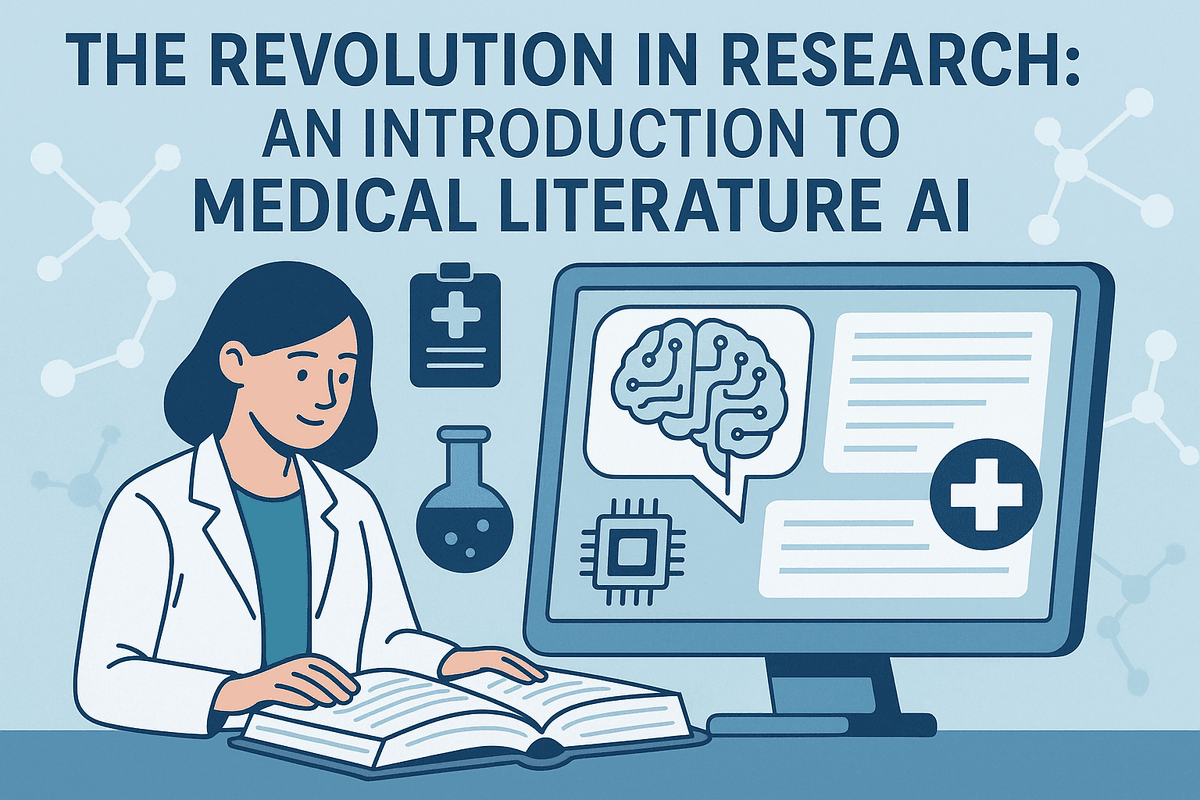
The Revolution in Research: An Introduction to Medical Literature AI
The world of medicine is built on a mountain of knowledge that grows taller every single day. Over two million new biomedical research papers are published annually, creating a data deluge that is impossible for any single human to navigate. For clinicians, researchers, and pharmaceutical developers, finding the critical piece of information that could inspire a new treatment or save a patient's life has become like searching for a specific grain of sand in a vast, ever-expanding desert. This is the challenge that Medical Literature AI was born to solve.
What is Medical Literature AI and Why Does It Matter?
At its core, Medical Literature AI refers to a sophisticated class of artificial intelligence tools designed specifically to understand, process, and analyze the vast body of medical and scientific text. It's far more than a simple keyword search. Using advanced Natural Language Processing (NLP), these platforms can read and comprehend millions of research articles, clinical trial reports, and patents in minutes.
Why does this matter? Because it dramatically closes the gap between published research and practical application. For a doctor trying to diagnose a rare disease, it means instantly finding relevant case studies that would have otherwise been buried. For a scientist developing a new drug, it means identifying promising molecular pathways or potential side effects by connecting disparate studies. Ultimately, Medical Literature AI empowers medical professionals to make faster, more informed decisions, which directly translates to improved patient outcomes and accelerated innovation.
From Manual Searches to Automated Discovery: The Old Way vs. The New Way
For decades, the standard for a literature review was a painstaking manual process. Researchers would spend countless hours hunched over databases like PubMed, crafting complex Boolean search queries, and then manually sifting through thousands of titles and abstracts—most of them irrelevant. This process was not only inefficient but also prone to human error and bias, meaning critical connections were often missed.
The new way, powered by Medical Literature AI, is a paradigm shift from searching to discovering. Instead of just matching keywords, AI platforms:
- Understand Context: They grasp the semantic meaning behind the text, distinguishing between a gene mentioned as a primary subject versus a passing reference.
- Synthesize Information: AI can summarize key findings from hundreds of papers, highlighting consensus, contradictions, and gaps in the existing research.
- Visualize Connections: They can map out relationships between diseases, drugs, genes, and proteins, revealing hidden patterns that a human review might never uncover.
This transition transforms the researcher from a data miner into a data strategist, freeing them to focus on analysis and hypothesis generation.
The Promise of AI: Accelerating Breakthroughs in Medicine
The potential of this technology is transformative. By automating the most laborious parts of research, Medical Literature AI acts as a powerful catalyst for medical breakthroughs. In drug discovery, it can slash the time it takes to identify and validate new therapeutic targets. For personalized medicine, it can help clinicians find hyper-specific evidence to tailor treatments to an individual’s unique genetic makeup and clinical history. During public health crises like a pandemic, it enables scientists to analyze and make sense of emerging global research in real-time.
AI is not here to replace the brilliant minds driving medical progress. Instead, it serves as their indispensable co-pilot, navigating the overwhelming sea of information to chart a faster, more direct course toward the next great discovery.
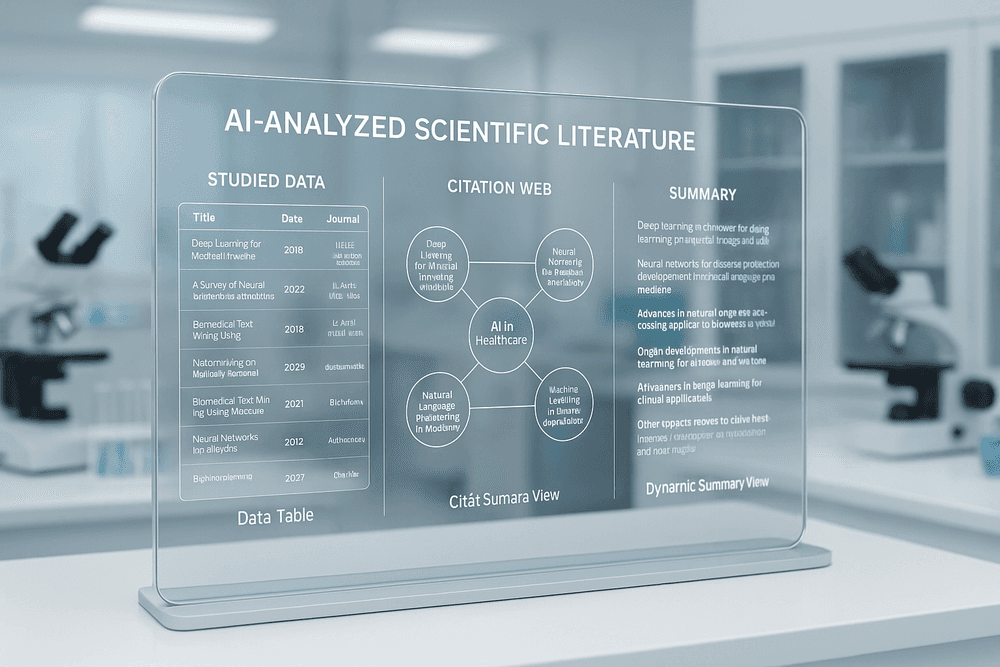
Comparing the Top Medical Literature AI Platforms
With a growing number of platforms entering the market, selecting the right medical literature AI tool can feel as complex as the research itself. The best choice depends on your specific needs, workflow, and budget. Let’s break down the leading contenders and the core criteria you should use to evaluate them.
Evaluating the Titans: Elicit, Scite, and Semantic Scholar
While many tools exist, these three platforms represent distinct approaches to augmenting the research process.
- Elicit: Best for Question-Driven Exploration and Synthesis. Elicit functions like a true research assistant. Instead of just searching for keywords, you ask a research question (e.g., "What is the effect of metformin on cellular aging?"). Elicit then finds relevant papers and synthesizes the key findings into a structured, easy-to-scan table. It’s exceptionally powerful for brainstorming, identifying themes across studies, and rapidly building a foundational understanding for a literature review.
- Scite: Best for Verifying Claims and Tracing Scientific Dialogue. Scite’s killer feature is its "Smart Citations." It analyzes how a publication has been cited by subsequent research, classifying each citation as "Supporting," "Contrasting," or "Mentioning." This provides an immediate, powerful signal of a study's impact and reliability within the scientific community. For any researcher concerned with the validity and reproducibility of findings, Scite is an indispensable medical literature AI tool for critical appraisal.
- Semantic Scholar: Best for Broad, Free, and Context-Rich Searching. Backed by the Allen Institute for AI, Semantic Scholar is a free and incredibly robust search engine. Its strengths lie in its massive scale and user-friendly features like AI-generated "TLDR" summaries for quick paper evaluation, author influence metrics, and a highly effective recommendation engine. It's the perfect starting point for most research queries and an excellent daily driver for staying current.
Key Criteria for Choosing Your AI Research Assistant
Your evaluation should be guided by three core principles:
- Accuracy: In medicine, accuracy is non-negotiable. The AI must correctly extract information and, most importantly, provide direct, verifiable links back to the source text. Always spot-check summaries and data extractions against the original papers.
- Scope: How comprehensive is the tool's database? Does it primarily index PubMed, or does it also include PMC, pre-print archives like bioRxiv/medRxiv, and conference proceedings? A wider scope ensures you’re not missing crucial, cutting-edge research.
- Usability: A powerful tool is useless if it's clunky. The best medical literature AI platforms feature intuitive interfaces that seamlessly integrate into your workflow, saving you clicks and cognitive load.
Free vs. Paid AI Tools: A Cost-Benefit Analysis
The decision to invest in a paid tool comes down to a simple trade-off: time vs. money.
- Free Tools (e.g., Semantic Scholar, free tiers of Elicit/Scite): These are fantastic for students, independent researchers, and preliminary searches. They provide immense value at no cost. The primary limitation is usually a cap on the number of advanced searches or feature access.
- Paid Tools (Premium Tiers): For research teams, pharmaceutical companies, and those conducting large-scale systematic reviews, a paid subscription is often a worthwhile investment. The cost unlocks advanced features, unlimited queries, and collaboration tools. The return on investment is measured in hundreds of hours saved, leading to faster discovery, more robust analyses, and a significant competitive advantage.
How Medical Literature AI Unlocks Deeper Insights
The true power of AI in medical research isn't just about finding papers faster; it's about synthesizing information at a scale and speed that is humanly impossible. By processing vast datasets of published studies, a medical literature AI platform can reveal hidden connections, validate hypotheses, and chart new paths for investigation. It transforms the review process from a laborious task of information retrieval into a dynamic engine for discovery. Here’s how these advanced tools unlock a more profound understanding of medical science.
Automated Systematic Reviews and Meta-Analysis
Systematic reviews and meta-analyses represent the pinnacle of evidence-based medicine, but they are notoriously slow and resource-intensive, often taking months or even years to complete. Medical literature AI dramatically accelerates this gold-standard process. AI-powered platforms can automate tedious steps like screening thousands of abstracts against inclusion/exclusion criteria, extracting key data points (like patient demographics, interventions, and outcomes), and even assessing the risk of bias in studies. This not only cuts down the timeline from months to days but also reduces the potential for human error and fatigue, leading to more robust and reliable evidence synthesis.
AI-Powered Summarization: Grasping Key Findings in Seconds
Clinicians and researchers are inundated with new publications daily. It's impossible to keep up, let alone read each relevant paper in full. AI-powered summarization tackles this information overload head-on. Sophisticated algorithms can read a dense, 15-page clinical trial and distill its core findings into a concise, structured abstract in seconds. These summaries often highlight the essential PICO (Population, Intervention, Comparison, Outcome) framework, allowing users to instantly grasp the study's purpose, methodology, and conclusions. This capability enables rapid-fire evaluation of multiple papers, helping researchers quickly determine which studies warrant a deeper dive.
Identifying Research Gaps and Future Directions with AI
One of the most transformative applications of medical literature AI is its ability to identify what isn't known. By analyzing the entire body of literature on a specific topic, AI can create comprehensive knowledge graphs, mapping out all the established evidence. This bird's-eye view makes it easy to spot the "white space"—areas where research is sparse, findings are contradictory, or specific patient populations have been overlooked. For pharmaceutical companies, academic institutions, and grant-funding bodies, this insight is invaluable. It provides a data-driven roadmap for designing novel studies that address genuine gaps in medical knowledge, ensuring research efforts are targeted and impactful.
Natural Language Search: Asking Complex Questions, Getting Direct Answers
Traditional database searches rely on rigid Boolean operators and precise keywords, often returning a deluge of loosely related articles. The next generation of medical literature AI employs natural language processing (NLP), allowing users to ask complex clinical questions as if they were speaking to a colleague. For example, instead of crafting a complex query, a user can simply ask, "What is the evidence for using SGLT2 inhibitors to treat heart failure in non-diabetic patients?" The AI understands the intent and context behind the question, sifting through millions of papers to provide a direct, synthesized answer, complete with supporting evidence and citations. This conversational approach makes finding precise information more intuitive and efficient than ever before.

Mastering Medical Literature AI: Best Practices for Researchers
Leveraging medical literature AI effectively goes beyond simply typing a query into a search box. To truly harness its power, researchers must adopt a new set of skills centered on precise communication, critical evaluation, and ethical awareness. Think of the AI as a brilliant but junior research assistant—it’s incredibly fast but requires clear direction and diligent oversight.
Crafting Effective Prompts for Precise Literature Searches
The quality of your output is directly proportional to the quality of your input. Vague prompts lead to generic, often irrelevant results. To command your medical literature AI with precision, structure your queries strategically.
A highly effective method is to adapt the PICO framework (Population/Patient, Intervention, Comparison, Outcome) for your prompts. Instead of asking, "What are the treatments for type 2 diabetes?" a more powerful prompt would be:
- Prompt: "Synthesize recent (2020-2024) randomized controlled trials comparing the efficacy of SGLT2 inhibitors versus GLP-1 receptor agonists (Comparison) in reducing cardiovascular events (Outcome) in adult patients with type 2 diabetes and established cardiovascular disease (Population)."
This level of detail directs the AI to filter by date, study type, specific drug classes, and patient populations, yielding a much more focused and relevant set of initial findings. Don't be afraid to iterate. Start with a broader query, and then progressively add constraints to refine the results until they align perfectly with your research question.
Critically Appraising AI-Generated Summaries and Citations
While AI can generate summaries and bibliographies in seconds, these outputs must be treated as drafts, not final products. The single most critical step in using medical literature AI is to rigorously validate its work. AI models can "hallucinate"—confidently presenting fabricated information or incorrect citations.
Adopt a "trust but verify" mindset with this checklist:
- Verify Every Citation: Cross-reference each citation provided by the AI with its source on PubMed, Google Scholar, or the publisher's website. Confirm that the authors, title, journal, and publication year are correct. Look out for fabricated digital object identifiers (DOIs).
- Assess Summary Accuracy: Read the abstract and conclusion of the original paper. Does the AI's summary accurately reflect the study's methodology, key findings, and limitations? AI can sometimes oversimplify complex results or miss crucial nuances that a human expert would catch.
- Evaluate for Contextual Integrity: Ensure the AI hasn't taken findings out of context. A statement might be technically correct but misleading without the original paper’s qualifying remarks. Your domain expertise is irreplaceable in this step.
Ethical Considerations: Navigating Bias and Ensuring Data Privacy
Using medical literature AI carries significant ethical responsibilities. The AI models are trained on vast datasets of existing medical literature, and they inherit any biases present in that data. If historical research has underrepresented certain demographic groups, the AI's output will reflect and potentially amplify that disparity. Researchers must remain vigilant, consciously questioning if the AI-generated results are skewed and actively seeking studies that include diverse populations.
Data privacy is another paramount concern. Avoid inputting sensitive, unpublished, or patient-identifiable information into public-facing AI tools. Your queries could be stored and used for model training, posing a risk to intellectual property and patient confidentiality. Whenever possible, use enterprise-grade or institutionally-approved medical literature AI platforms that offer robust data security and HIPAA compliance, ensuring your research remains secure and ethically sound.
Real-World Impact: Medical Literature AI in Action
The theoretical promise of artificial intelligence in medicine is rapidly becoming a practical reality. Across the healthcare ecosystem, from the research lab to the patient's bedside, AI-powered tools are fundamentally changing how we interact with the vast and ever-expanding body of medical knowledge. The impact isn't incremental; it's transformative. By automating and augmenting the painstaking process of literature review, medical literature AI is breaking down barriers to discovery, improving clinical care, and empowering the next generation of medical professionals. Let's explore three key arenas where this technology is already making its mark.
Case Study: Speeding Up Drug Discovery and Development
The journey from a promising biological hypothesis to a market-ready drug is notoriously long, expensive, and fraught with failure, often taking over a decade and costing billions. A significant portion of this timeline is consumed by preclinical research—sifting through mountains of existing literature to identify novel drug targets and validate their potential.
This is where medical literature AI serves as a powerful accelerator. Pharmaceutical companies and biotech startups are now deploying AI platforms that can ingest and comprehend millions of research papers, patents, and clinical trial documents in a fraction of the time it would take human teams. By mapping relationships between genes, proteins, chemical compounds, and disease pathways, these systems uncover hidden connections that can lead to breakthrough discoveries. For example, an AI might identify a gene implicated in a rare neurological disorder and cross-reference it with compounds known to affect similar pathways, instantly generating a list of candidates for drug repurposing. This ability to synthesize information at a massive scale dramatically shortens the discovery phase, reduces R&D costs, and ultimately helps get life-saving therapies to patients faster.
In Clinical Practice: Finding Evidence-Based Answers at the Point of Care
For a clinician on the front lines, time is the most critical resource. When a patient presents with a complex condition or fails to respond to standard treatment, the doctor needs a precise, evidence-based answer—and they need it now. The traditional method of searching databases like PubMed or UpToDate during a patient encounter is often impractical.
Enter the clinical application of medical literature AI. New AI-powered tools integrated into electronic health records or available as standalone apps are changing the game. A physician can now pose a specific clinical question in natural language, such as, "What is the latest evidence for using SGLT2 inhibitors in heart failure patients without diabetes?" In seconds, the AI scours, synthesizes, and summarizes the most relevant and highest-quality evidence from recent clinical trials and meta-analyses. It delivers a concise, actionable summary complete with citations and levels of evidence. This provides immediate decision support, ensures care is aligned with the cutting edge of medical science, and allows clinicians to spend less time searching and more time engaging directly with their patients.
For Academic Writing: Powering the Next Generation of Medical Theses
The cornerstone of any medical thesis, dissertation, or systematic review is a comprehensive and meticulously constructed literature review. For generations of medical students and researchers, this has meant months of manual searching, screening thousands of titles and abstracts, and painstakingly categorizing findings.
Today, medical literature AI is transforming academic research from the ground up. Students and junior researchers can now leverage AI to conduct a far more efficient and exhaustive initial search. These tools can automatically screen results based on predefined inclusion and exclusion criteria (like the PICO framework), drastically reducing the number of irrelevant papers that need manual review. Furthermore, advanced platforms can help identify thematic clusters, highlight seminal papers in a field, and even pinpoint gaps in the existing research—providing a powerful starting point for a novel research question. By handling the heavy lifting of information retrieval, medical literature AI empowers students to focus on the higher-order tasks of critical analysis, interpretation, and knowledge synthesis, fostering a more insightful and productive generation of medical scholars.

The Future is Now: Embracing Medical Literature AI
The integration of artificial intelligence into medical research isn't a distant vision; it's a present-day reality transforming how we interact with the vast ocean of scientific knowledge. The leap from manual searches to intelligent, AI-powered discovery is well underway, and the trajectory points toward an even more integrated future. For researchers, clinicians, and students, a pivotal question emerges: how do we not only adapt to this change but also leverage it to pioneer the next wave of medical breakthroughs? Embracing medical literature AI is the critical first step.
Predicting Future Trends in AI-Driven Medical Research
The evolution of medical literature AI is accelerating, moving far beyond simple keyword matching and summarization. Here are the trends set to define the next frontier:
- Predictive and Proactive Insights: Future AI tools won't just find what you ask for; they will predict what you need to know. Imagine an AI that analyzes your current research and proactively suggests emerging, tangentially related fields, identifies gaps in the existing literature, or even formulates novel, testable hypotheses by connecting disparate findings across thousands of papers.
- Multimodal Data Synthesis: The next generation of medical literature AI will break free from text-only limitations. It will be capable of interpreting and synthesizing information from diverse sources, including clinical trial data, genomic sequences, medical imaging (X-rays, MRIs), and electronic health records, correlating these with findings from published papers to provide a holistic, evidence-based picture.
- Hyper-Personalized Knowledge Feeds: Instead of generic alerts, AI will curate a dynamic and personalized stream of information tailored to your specific clinical questions, research projects, or patient populations. This ensures you see the most relevant, high-impact studies the moment they are published.
Your Next Steps: How to Get Started with a Medical Literature AI Tool
Adopting a new technology can feel daunting, but integrating a medical literature AI tool into your workflow is more accessible than ever. Here’s a simple four-step guide to get started:
- Define Your Primary Need: What is your most time-consuming task? Is it conducting comprehensive systematic reviews, staying current with daily publications in your specialty, finding papers for a grant proposal, or quickly getting up to speed on a new clinical topic? Pinpointing your main challenge will help you choose the right tool.
- Explore and Compare Your Options: Research different types of AI tools. Some specialize in advanced semantic search (like Scopus AI or Semantic Scholar), others excel at summarization and synthesis (like Elicit or SciSpace), and some are designed for comprehensive review management (like DistillerSR). Look for platforms that offer free trials or freemium versions.
- Start with a Pilot Project: Don't try to overhaul your entire workflow at once. Select a small, defined task, such as finding five key papers on a specific gene-disease association or summarizing the methodology of three recent clinical trials. Use this pilot project to learn the tool's features and assess its value.
- Integrate and Iterate: Once you’re comfortable, begin integrating the tool into your regular routine. Use it to supplement your existing methods, and over time, you’ll discover where it delivers the most significant time savings and deepest insights.
Resources and Communities for Staying Ahead of the Curve
The field of medical literature AI is dynamic. To stay informed and connected, tap into these resources:
- Professional Organizations: Join working groups or special interest sections within organizations like the American Medical Informatics Association (AMIA) or HIMSS.
- Academic Journals: Follow leading publications such as The Lancet Digital Health, npj Digital Medicine, and the Journal of Medical Internet Research (JMIR).
- Online Communities: Engage in discussions on platforms like LinkedIn, Reddit (e.g., r/HealthIT), or specialized forums where professionals share insights, review new tools, and discuss emerging trends in medical AI.