
July 23, 2025
An Introduction to AI Contract Review
The Revolution in Legal Tech: An Introduction to AI Contract Review
The legal landscape is undergoing a seismic shift, driven by technology that promises to redefine efficiency and precision. At the heart of this transformation is AI contract review, a powerful application of artificial intelligence designed to automate and augment the traditionally laborious process of analyzing legal agreements. But what exactly is it, and how does it function?
At its core, AI contract review leverages sophisticated technologies like Natural Language Processing (NLP) and machine learning. Think of it as a highly trained paralegal that can read and comprehend thousands of pages in seconds. These AI models are trained on vast datasets containing millions of executed contracts, legal clauses, and regulatory documents. Through this training, the AI learns to identify key provisions, recognize patterns, spot anomalies, and flag potential risks based on a pre-defined legal playbook or a company's standard positions. It doesn't replace the lawyer; it empowers them by handling the initial, repetitive, and time-intensive pass, presenting a summarized analysis for expert human verification.
The Tipping Point: Why Manual Review is No Longer Sustainable
For decades, the manual review process has been the unchallenged standard. A lawyer or legal team would painstakingly read through every line of a contract, a method that is not only slow but also inherently vulnerable to human error. In today's fast-paced business environment, this legacy approach has reached its breaking point.
The sheer volume and velocity of contracts—from sales agreements and NDAs to vendor contracts and M&A due diligence documents—have become overwhelming. Manual review creates significant bottlenecks, delaying deals and frustrating business teams. Furthermore, human fatigue is a real risk. A reviewer can easily miss a subtle but critical deviation in a non-standard clause on page 40, potentially exposing the organization to significant financial or legal liability. The high cost associated with billable hours spent on this repetitive work makes it an unsustainable model for modern, agile businesses seeking to control legal spend without compromising on risk management.
From Hours to Minutes: The Core Value Proposition of AI
The most immediate and compelling benefit of implementing an AI contract review platform is the dramatic acceleration of the review cycle. A process that once took hours or even days can now be completed in minutes. This speed is more than a convenience; it's a competitive advantage, enabling businesses to close deals faster and respond to opportunities with unprecedented agility.
However, the value proposition extends far beyond simple speed. AI delivers a level of consistency and accuracy that is difficult for humans to replicate at scale. By systematically comparing every clause against an approved standard, the software flags non-compliance, missing clauses, and risky language with unwavering precision. This systematic approach significantly mitigates risk.
Ultimately, the most profound impact of AI contract review is its ability to elevate the role of legal professionals. By automating the low-value, high-volume tasks, AI frees up lawyers to focus on what truly matters: strategic negotiation, complex legal reasoning, and providing high-impact counsel to the business. They transition from being gatekeepers of risk to strategic partners in growth.
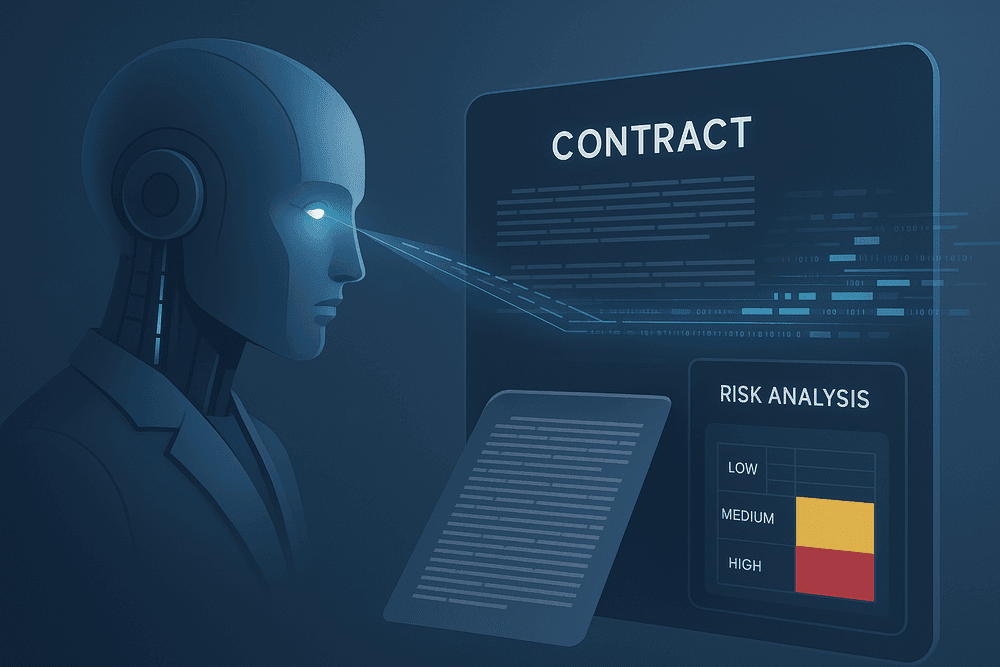
2024's Leading AI Contract Review Tools Compared
Choosing the right AI contract review software is not a one-size-fits-all decision. The market has matured, offering a diverse range of solutions tailored to different organizational sizes, complexities, and budgets. The ideal platform for a global corporation will differ significantly from the tool that best serves a fast-growing startup. Here’s a breakdown of the leading options based on your team's needs.
Top Platforms for Enterprise-Level Legal Teams
For large enterprises, an ai contract review tool is often a core component of a broader Contract Lifecycle Management (CLM) system. These platforms are designed for high volume, complexity, and stringent security requirements.
- Icertis Contract Intelligence (ICI): A market leader, Icertis offers a powerful, AI-infused platform that goes beyond simple review. It excels at structuring contract data at scale, enabling enterprises to analyze obligations, risks, and opportunities across their entire contract portfolio. Its AI helps with clause identification, deviation analysis, and intelligent routing for approvals, integrating deeply with ERP and CRM systems like SAP and Salesforce.
- ContractPodAi: This platform provides an end-to-end legal tech solution where AI is central to the workflow. It offers robust features for third-party paper review, automated redlining based on custom legal playbooks, and advanced risk scoring. Its strength lies in its ability to manage immense complexity and provide deep analytical insights, making it a go-to for global legal departments handling M&A due diligence or extensive regulatory compliance.
Best AI Contract Review Options for Small Businesses and Startups
Smaller businesses and startups need agility, affordability, and ease of use. The best tools for this segment focus on streamlining common contract workflows without the enterprise-level price tag.
- LawGeex: A pioneer in the field, LawGeex focuses on accelerating pre-signature contract review. Its AI is pre-trained on millions of contracts to review incoming agreements like NDAs, MSAs, and SOWs against your company’s legal playbook in minutes. It provides a simple, color-coded report highlighting missing clauses, problematic language, and deviations, allowing lean legal teams or even business users to handle routine reviews with confidence.
- Spotdraft: Positioned as an intuitive CLM for modern businesses, Spotdraft combines a user-friendly interface with powerful ai contract review capabilities. It excels at making contract management seamless, from creation and review to signature and storage. Its AI can quickly identify key clauses, flag risks, and help standardize your agreements, making it an excellent choice for startups looking to establish a solid contracting process from the ground up.
Key Differentiators: Comparing Features, Pricing, and Integration
When comparing platforms, focus on these three critical areas:
- Features: Beyond basic clause detection, look for the depth of the AI. Does it offer semantic analysis to understand context, or just keyword matching? Key features to compare include automated redlining, playbook customization, risk scoring algorithms, and the ability to track post-signature obligations.
- Pricing: Enterprise solutions typically involve custom quotes with annual subscriptions often reaching six figures, based on contract volume and user count. SMB tools are more transparent, usually offering tiered monthly or annual subscription plans (e.g., Starter, Pro, Business) that make ai contract review accessible for smaller budgets.
- Integration Capabilities: A tool’s value multiplies when it connects to your existing tech stack. Check for native integrations with Microsoft 365, Google Workspace, Salesforce, HubSpot, and Slack. Seamless integration ensures that the contract review process fits naturally into your sales, procurement, and operational workflows without creating data silos.
Unlocking Efficiency: Key Features of AI Contract Review Software
Modern businesses move at a pace that manual contract review struggles to match. The sheer volume and complexity of agreements can create bottlenecks, introduce unacceptable risks, and drain valuable legal resources. This is where AI contract review software transforms the landscape, moving beyond simple keyword searches to offer a suite of intelligent features designed to enhance accuracy, accelerate turnaround times, and empower legal and business teams. These platforms aren't just faster; they're smarter, providing a strategic advantage in every negotiation.
Automated Risk Identification and Anomaly Detection
At its core, the power of ai contract review lies in its ability to serve as a tireless, vigilant watchdog. Unlike human reviewers who can suffer from fatigue, AI algorithms meticulously scan every line of a contract to identify potential risks and deviations from established standards. This technology uses Natural Language Processing (NLP) to understand context and meaning, allowing it to flag:
- Missing or non-standard clauses: Is a crucial limitation of liability clause absent? Is the force majeure clause unusually narrow? The AI instantly highlights these gaps.
- Unfavorable terms: The system can be trained on your company’s playbook to redline terms that fall outside acceptable parameters, such as unlimited indemnities or unfavorable payment terms.
- Anomalies and Ambiguities: AI excels at spotting unusual phrasing or ambiguous language that could lead to disputes down the line. It compares clauses against a massive dataset of similar contracts to detect what’s out of place.
Intelligent Clause Analysis and Extraction
Imagine needing to find every confidentiality clause across hundreds of active agreements. A manual search would be a monumental task. An effective ai contract review platform accomplishes this in seconds. The software doesn’t just see a block of text; it understands the document’s anatomy. It intelligently identifies, categorizes, and extracts specific clauses and key data points, such as termination dates, renewal terms, and governing law. This capability allows teams to instantly compare a clause in a new draft against their pre-approved standard, build a library of best-in-class language, and conduct portfolio-wide analysis with unprecedented speed.
Ensuring Compliance and Consistency Across Documents
Maintaining consistency is a critical challenge for any organization managing a large volume of contracts. AI contract review software acts as a guardian of your company’s standards. By analyzing agreements against a pre-defined digital playbook, the AI ensures every contract adheres to internal policies and regulatory requirements. It automatically checks for the inclusion of mandatory clauses related to data privacy (like GDPR or CCPA), security standards, or industry-specific regulations. This prevents "contract drift"—the gradual, often unnoticed deviation from standard positions—ensuring your contractual risk profile remains consistent and controlled.
Collaboration Tools for Seamless Team Workflows
Contract negotiation is rarely a solo endeavor. It involves legal, sales, finance, and procurement teams, often leading to chaotic email chains and version control nightmares. Leading AI review platforms solve this by providing a centralized, collaborative environment. Features like in-document commenting, clear redlining, and a detailed audit trail allow all stakeholders to work on a single version of the document. This centralizes all communication, provides complete transparency into who changed what and when, and creates a single source of truth. The result is a more streamlined, accountable, and efficient workflow that gets deals done faster.

Best Practices for Implementing AI Contract Review
Adopting an ai contract review platform is more than a technology purchase; it’s a strategic transformation of your legal operations. A successful implementation requires careful planning, team buy-in, and a clear understanding of your objectives. By following a structured approach, you can seamlessly integrate AI into your workflow, empower your team, and demonstrate tangible value to the organization.
A Step-by-Step Guide to Integrating AI into Your Legal Operations
A smooth rollout minimizes disruption and maximizes adoption. Follow these steps to set your implementation up for success:
- Define Your Goals and Scope: Start by identifying your primary pain points. Are you trying to accelerate sales cycles by speeding up MSA reviews? Do you want to standardize compliance checks in vendor agreements? Clearly define what you want to achieve. It’s often best to start with a narrow scope, such as a single contract type like NDAs, before expanding.
- Select the Right AI Tool: Not all ai contract review solutions are created equal. Evaluate potential vendors based on their AI model’s accuracy, ease of use, integration capabilities (with your CLM, CRM, or document storage), and security protocols. Request a demo using your own contracts to see the platform in action.
- Run a Pilot Program: Before a full-scale deployment, conduct a pilot with a small group of tech-savvy team members. Use this trial period to test the software against your defined goals, customize the AI to your legal playbook, and gather critical user feedback.
- Develop Standard Operating Procedures (SOPs): Create a clear playbook for your team. This document should outline when and how to use the AI tool, the process for human verification of AI-flagged issues, and the escalation path for complex or high-risk clauses that require senior legal review.
Training Your Team: Human Oversight in an AI-Powered World
The most advanced AI is only as effective as the people using it. The goal of ai contract review is to augment, not replace, human expertise. This "human-in-the-loop" approach is critical for success.
Training should focus on empowering your team to work with the AI. Teach them to be critical reviewers of the technology’s output. This includes:
- Interpreting AI Suggestions: Understanding why the AI flagged a particular clause and evaluating the recommended action.
- Identifying False Positives/Negatives: Recognizing when the AI has made an error and providing feedback to improve the model over time.
- Focusing on Higher-Value Work: By automating the first-pass review, legal professionals are freed to concentrate on strategic negotiation, complex risk analysis, and providing business-critical advice.
How to Measure the ROI of Your AI Contract Review Investment
To secure ongoing budget and prove the initiative's worth, you must measure its return on investment (ROI). Track a combination of quantitative and qualitative metrics to build a compelling business case.
Quantitative Metrics:
- Review Speed: Measure the average time to review a contract before and after implementation. A reduction from hours to minutes is a powerful metric.
- Deal Velocity: Track the time from contract creation to signature. Faster legal reviews directly contribute to faster revenue recognition.
- Cost Savings: Calculate the reduction in spending on outside counsel for routine contract work.
Qualitative Metrics:
- Risk Mitigation: Document instances where the ai contract review tool identified critical risks or non-standard clauses that were previously missed.
- Contract Standardization: Measure the improvement in compliance with your company’s standard positions and playbooks.
- Team Satisfaction: Survey your legal team on their workload and job satisfaction. Automating tedious tasks often leads to higher morale and reduced burnout.
AI Contract Review in Action: Real-World Use Cases
Theory is one thing, but the true value of any technology is revealed in its practical application. The shift towards AI contract review is not just a trend; it's a fundamental change in how legal and business teams operate, delivering measurable results across various high-stakes scenarios. By automating the most labor-intensive aspects of analysis, AI empowers professionals to focus on strategic decision-making.
Here’s how AI contract review is making a tangible impact in the real world.
Accelerating Due Diligence in Mergers & Acquisitions
In the high-pressure world of M&A, time is money. The due diligence process traditionally involves teams of lawyers manually sifting through thousands of contracts to identify risks, liabilities, and critical obligations—a process that is both astronomically expensive and prone to human error.
This is where AI contract review becomes a game-changer. An AI platform can ingest and analyze an entire virtual data room in a matter of hours, not weeks. It rapidly flags crucial provisions such as:
- Change of Control: Clauses triggered by the acquisition.
- Assignment: Restrictions on the transfer of contracts.
- Indemnification: Unusual or uncapped liability clauses.
- Non-Standard Terms: Deviations from market standards that could pose a risk.
By automating this initial pass, legal teams can quickly generate a comprehensive risk profile. This allows them to focus their expertise on negotiating key points and advising on the strategic implications of the findings, rather than getting bogged down in tedious document discovery.
Streamlining High-Volume Sales and Procurement Agreements
Corporate legal departments are often seen as a bottleneck, especially by sales and procurement teams who rely on speed to close deals and secure resources. The endless flow of standard agreements like Non-Disclosure Agreements (NDAs), Master Service Agreements (MSAs), and Statements of Work (SOWs) can overwhelm a legal team.
Implementing an AI contract review solution directly addresses this challenge. The system can be configured with a company’s pre-approved legal “playbook.” When a counterparty’s contract is uploaded, the AI instantly compares it against the playbook and:
- Flags risky or non-compliant clauses.
- Suggests pre-approved alternative language.
- Automatically approves agreements that meet a certain risk threshold.
This empowers business teams to self-serve on low-risk contracts, dramatically accelerating the sales cycle and procurement processes. Legal counsel is freed up to concentrate on high-value, complex negotiations where their expertise is most needed.
Enhancing Accuracy in Real Estate Lease Abstraction
Managing a large portfolio of commercial real estate leases is an exercise in data management. Each lease is a dense document containing dozens of critical data points, from rent escalation schedules and renewal options to maintenance responsibilities and CAM (Common Area Maintenance) charges. Manually abstracting this data is monotonous and notoriously inaccurate.
AI contract review tools excel at this task. They can be trained to identify, extract, and structure hundreds of specific data points from complex lease agreements with superior accuracy. This abstracted data can then be seamlessly integrated into property management systems or databases. The result is a clean, reliable, and easily searchable repository of portfolio-wide lease intelligence, enabling property owners and managers to make more informed decisions, forecast revenue accurately, and ensure compliance across all properties.

The Future of Legal Work: Your Next Steps with AI Contract Review
The shift towards AI-powered legal technology is no longer a distant future—it's the current reality for forward-thinking legal teams and businesses. Embracing AI contract review is not just about adopting a new tool; it's about fundamentally transforming your operational efficiency, mitigating risk, and securing a decisive strategic advantage. As you prepare to make this leap, taking a structured approach to selection and implementation is crucial for success.
Choosing the Right AI Partner for Your Needs
Not all AI contract review platforms are created equal. The ideal solution for your organization will align with your specific workflows, contract types, and long-term goals. When evaluating potential AI partners, consider the following key factors:
- Integration Capabilities: How seamlessly does the software integrate with your existing systems? Look for robust APIs and native integrations with your Contract Lifecycle Management (CLM), document management systems (DMS), and communication tools like email. A siloed tool creates more work, not less.
- Specialization and Customization: Does the AI excel at analyzing the contracts most common to your business, such as NDAs, MSAs, or SOWs? More importantly, can you train or customize the AI to recognize your specific legal playbook, standard clauses, and risk tolerance?
- User Experience (UX): A powerful tool is useless if your team won't use it. Prioritize platforms with an intuitive interface, clear reporting dashboards, and a gentle learning curve. A free trial or pilot program is invaluable for assessing usability firsthand.
- Security and Compliance: Your contracts contain highly sensitive information. Ensure any potential vendor meets the highest standards for data security, such as SOC 2 Type II certification and GDPR compliance. Inquire about data encryption, access controls, and their data privacy policies.
A Final Checklist for Adopting AI Contract Review
A successful rollout requires more than just purchasing software. It demands a thoughtful implementation strategy. Use this checklist to guide your adoption process and ensure a smooth transition.
- ☑ Define Clear Objectives: What do you want to achieve? Are you aiming to reduce review time by 50%, decrease reliance on outside counsel, or improve risk detection? Set specific, measurable goals to track your return on investment (ROI).
- ☑ Secure Stakeholder Buy-In: Involve key players from legal, IT, finance, and relevant business units early on. Demonstrate the value proposition for each department to build enthusiasm and ensure cross-functional support.
- ☑ Launch a Pilot Program: Start small. Select a specific use case and a dedicated pilot team to test the AI contract review tool. This allows you to work out kinks, gather feedback, and build a case study for a wider rollout.
- ☑ Develop a Training and Workflow Plan: Provide comprehensive training for all users. Critically, you must redefine your legal contract review process to incorporate AI. Where does it fit? Who is responsible for reviewing the AI's output? Documenting this new workflow is essential.
- ☑ Measure, Iterate, and Scale: Continuously monitor your initial objectives. Use the data and user feedback to refine your processes and demonstrate the tool's value. Once proven, you can confidently scale its use across the entire organization.
Gaining Your Competitive Edge with AI-Powered Legal Tech
Adopting AI contract review is the definitive step toward modernizing your legal function. By automating the high-volume, repetitive tasks that consume valuable time, you empower your legal professionals to evolve. They can shift their focus from routine redlining to high-impact strategic counsel, complex negotiations, and proactive risk management.
This technological empowerment translates directly into a competitive advantage. Businesses that leverage AI can accelerate deal cycles, respond to opportunities faster, and operate with a deeper, data-driven understanding of their contractual obligations. You’re not just buying software; you’re investing in speed, intelligence, and the future of your legal and business operations.