
October 26, 2025
An Introduction to AI Content Generation
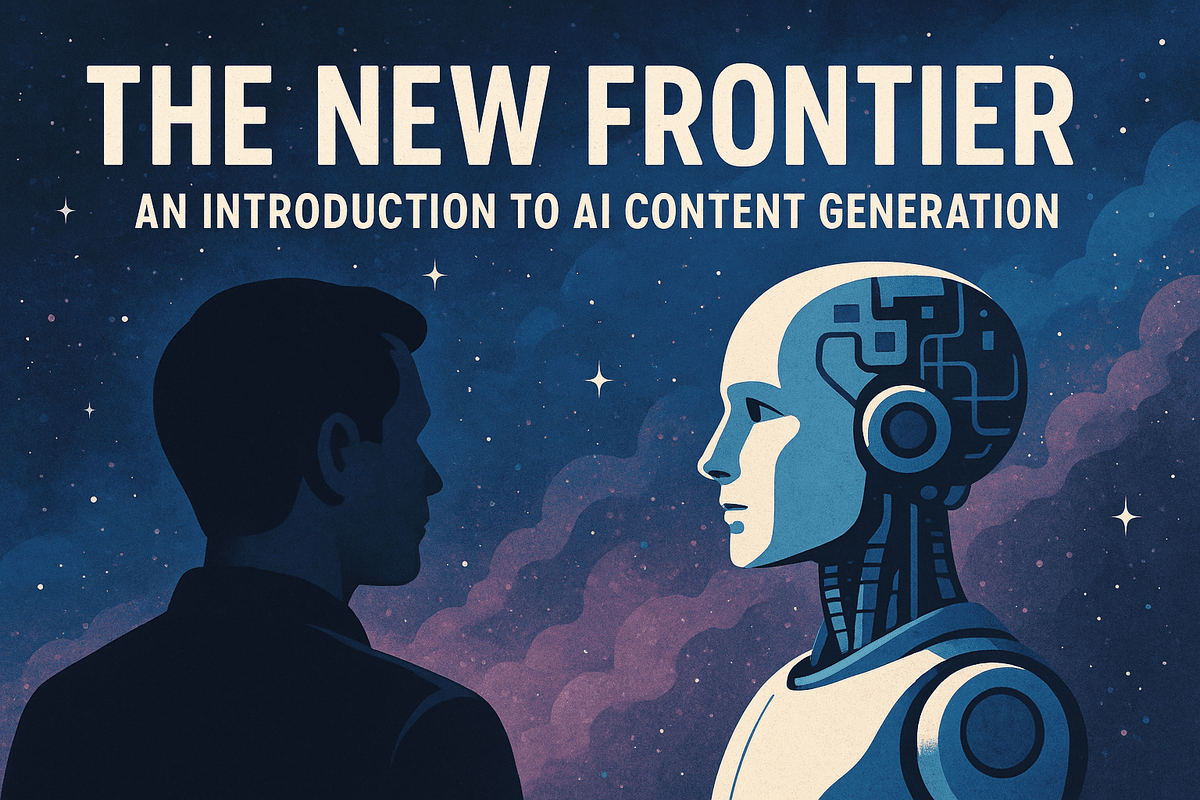
The New Frontier: An Introduction to AI Content Generation
Welcome to the cutting edge of digital creation. You've likely heard the buzz, seen the stunning AI-generated images, or even interacted with a chatbot that felt surprisingly human. This is the world of AI content generation, a technological revolution that’s reshaping how we create, communicate, and innovate. It's more than just a fleeting trend; it’s a fundamental shift, providing creators with a powerful new toolkit to bring their ideas to life faster and more efficiently than ever before.
What Exactly is AI Content Generation?
At its core, AI content generation is the process of using artificial intelligence, specifically models known as generative AI, to create new, original content. Unlike simple automation that might just rephrase existing text, these advanced systems can produce unique material—from articles and emails to images and music—based on a user's input, known as a "prompt."
Think of it as collaborating with a highly skilled, incredibly fast assistant. You provide the direction, the context, and the creative spark, and the AI uses its vast training on internet-scale data to generate a response. The technology behind this magic often involves Large Language Models (LLMs) for text, like GPT-4, and diffusion models or Generative Adversarial Networks (GANs) for images. The result is a seamless partnership between human ingenuity and machine intelligence.
Beyond Text: Exploring AI for Images, Video, and Code
While text was the first major frontier for mainstream AI content generation, the landscape has exploded into a multi-modal creative suite. The same underlying principles are now being applied across various media, opening up unprecedented possibilities:
- AI Image Generation: Tools like Midjourney, DALL-E 3, and Stable Diffusion can translate simple text descriptions ("a photorealistic astronaut riding a horse on Mars") into breathtaking, high-resolution images in seconds. This has democratized visual art, enabling marketers, designers, and hobbyists to create custom visuals without needing deep graphic design skills.
- AI Video and Audio Generation: The next wave is already here. AI can now generate short video clips from text prompts, create realistic voiceovers in any language, and even compose original royalty-free background music tailored to the mood of your content.
- AI Code Generation: For developers, AI assistants like GitHub Copilot are game-changers. They can suggest lines of code, complete entire functions, help debug errors, and translate code between different programming languages, drastically accelerating the development lifecycle.
Why AI Content Generation is a Game-Changer for Creators
The rise of AI content generation isn't about replacing human creativity; it's about augmenting it. For creators, marketers, and businesses, this technology is a powerful catalyst for growth and efficiency. It helps to:
- Shatter Creative Blocks: Staring at a blank page? AI can serve as the ultimate brainstorming partner, instantly generating outlines, headlines, and initial drafts to get your creative juices flowing.
- Scale Content Production: Need to produce ten blog variations, fifty social media posts, or a hundred product descriptions? AI can handle the volume, freeing up your team to focus on high-level strategy and refinement.
- Save Time and Resources: By automating routine and time-consuming tasks, AI content generation reduces production costs and shortens deadlines, allowing for a more agile and responsive content workflow.
- Personalize at Scale: AI can help tailor marketing copy, email campaigns, and user experiences to individual audience segments with an efficiency that was previously unimaginable.

Choosing Your Engine: A Review of the Best AI Content Generation Tools
The AI content generation landscape is exploding with options, each promising to revolutionize your workflow. But which engine is right for your specific needs? Choosing the wrong tool can lead to frustration and subpar results. Let's break down the market leaders across text, visuals, and other specialized formats to help you make an informed decision.
For Written Content: Jasper vs. Copy.ai vs. Writesonic
For marketers and writers, these three titans dominate the conversation.
- Jasper (formerly Jarvis): Often hailed as the premium choice for marketing teams, Jasper excels in creating high-quality, long-form content. Its "Brand Voice" feature allows it to learn your company's style, ensuring consistency across all generated assets. With a vast library of templates and powerful integrations, Jasper is a robust solution for those serious about scaling their AI content generation efforts, from blog posts to comprehensive marketing campaigns.
- Copy.ai: If you're looking for simplicity and speed, Copy.ai is a fantastic starting point. Its intuitive interface and extensive template library make it incredibly easy to generate short-form copy for social media posts, ad headlines, and email newsletters. While it can handle longer articles, its primary strength lies in its ability to quickly produce a wide variety of creative options for your most common marketing tasks.
- Writesonic: Striking a powerful balance between functionality and ease of use, Writesonic is a direct competitor to Jasper that's earned a loyal following. Its standout feature is the seamless integration with Surfer SEO, making it a top choice for creating search-engine-optimized articles. From its one-click "AI Article Writer" to its Photosonic image generator, Writesonic offers a comprehensive suite for creators who need both quality text and SEO performance.
For Visual Media: Midjourney vs. DALL-E 3
Creating stunning images from a simple text prompt is now a reality.
- Midjourney: For those seeking artistic flair and stunning, photorealistic visuals, Midjourney is the undisputed champion. Operating through a Discord server, it has a unique community-driven feel. Midjourney excels at interpreting creative prompts to produce breathtaking, highly stylized images that often feel like digital art. It’s the go-to tool for concept art, imaginative illustrations, and visuals where aesthetic quality is paramount.
- DALL-E 3: Accessibility and prompt accuracy are where DALL-E 3 shines. Natively integrated into ChatGPT Plus and Microsoft Copilot, it's incredibly easy to start using. Its key advantage is its superior natural language understanding, allowing it to follow complex, detailed prompts with remarkable precision. Uniquely, DALL-E 3 can reliably generate legible text within images, making it an invaluable tool for creating social media graphics, memes, and marketing visuals.
For Specialized Tasks: AI Tools for Audio and Presentations
The power of AI content generation extends far beyond text and images.
- Audio Generation: Tools like ElevenLabs and Murf.ai are leading the charge in audio, offering incredibly realistic text-to-speech voiceovers. You can clone your own voice or choose from a vast library of AI voices to create professional-grade audio for video narrations, podcasts, and accessibility features, all in a fraction of the time it would take to record manually.
- Presentation Generation: Tired of spending hours in PowerPoint? AI platforms like Tome and Gamma are transforming presentation design. Simply provide a prompt or an outline, and these tools will generate a complete, beautifully designed presentation deck, complete with written content, layouts, and AI-generated images. This automates one of the most time-consuming tasks in business communication, freeing you to focus on the message itself.
Mastering the Craft: Techniques for Better AI Content Generation
Using an AI content generator is like handing the keys to a high-performance vehicle to a driver. The power is there, but the outcome depends entirely on your skill. To truly excel at ai content generation, you need to move beyond simple commands and master the techniques that separate generic, robotic text from compelling, high-quality content. This involves a blend of precise instruction, strategic workflow, and crucial human oversight.
The Art of the Prompt: How to Get Exactly What You Want
The quality of your AI-generated content is directly proportional to the quality of your prompt. The principle of "garbage in, garbage out" has never been more relevant. A vague, one-sentence request will yield a generic and often unhelpful result. Mastering prompt engineering is the single most effective way to improve your ai content generation workflow.
Think of yourself as a director guiding an actor. You need to provide clear, concise, and comprehensive instructions. Here’s how to craft prompts that deliver exceptional results:
- Provide Rich Context: Don't just ask for "a blog post about digital marketing." Instead, specify the target audience (e.g., small business owners new to digital marketing), the primary goal of the content (e.g., to drive sign-ups for a webinar), and the core message you want to convey.
- Define the Tone and Voice: Do you want the tone to be professional, witty, empathetic, or authoritative? Use descriptive adjectives. For example: "Write in a friendly, encouraging, and slightly informal tone, like a helpful mentor."
- Specify the Format: Instruct the AI on the desired structure. Ask for a specific number of paragraphs, bullet points, a numbered list, or even a table. You can request an introduction with a hook, three main body points, and a concluding call-to-action.
- Include Examples: One of the most powerful techniques is to provide a short example of the style you’re looking for. This gives the AI a clear benchmark to emulate, drastically improving the output's relevance and style.
Leveraging Templates for Speed and Consistency
Once you’ve found a prompt structure that works for a specific type of content, save it as a template. Templates are your secret weapon for scaling your ai content generation efforts without sacrificing quality or brand consistency. Instead of starting from scratch every time, you can plug new information into a proven framework.
Create repeatable prompt templates for all your recurring content needs:
- Blog Post Intros: A template that includes placeholders for the target keyword, the reader's pain point, and the hook.
- Social Media Captions: Frameworks tailored for different platforms (e.g., LinkedIn vs. Instagram) with sections for a hook, main message, and a platform-specific call-to-action.
- Email Newsletters: A structured template with placeholders for the subject line, a personalized greeting, the main body content, and a sign-off.
Using templates not only accelerates your content creation workflow but also ensures every piece of content aligns with your established brand voice.
Refining and Editing AI-Generated Drafts for a Human Touch
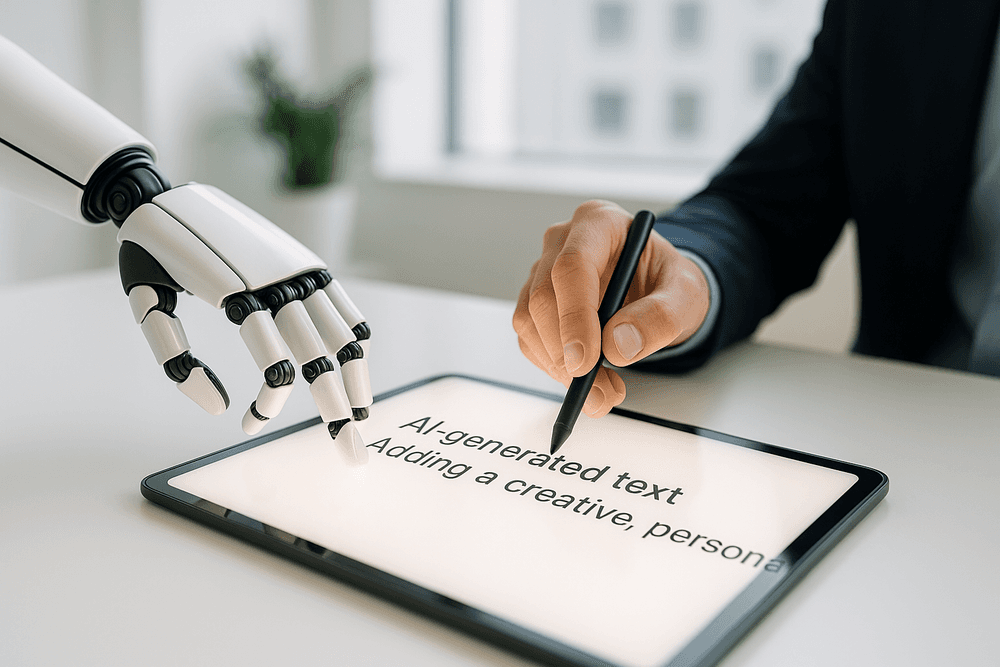
The most critical mistake you can make in ai content generation is treating the first draft as the final product. AI is an incredibly powerful assistant, but it is not a replacement for human creativity, empathy, and strategic insight. The final 10% of the work—the human touch—is what elevates content from good to great.
Always review and edit every piece of AI-generated content. Your editing checklist should include:
- Fact-Checking: AI models can "hallucinate" and present incorrect information confidently. Verify all stats, dates, and factual claims.
- Injecting Personality: Weave in your unique perspective, personal anecdotes, or brand-specific stories. This is what builds a genuine connection with your audience.
- Enhancing Flow and Readability: Break up dense paragraphs, rephrase clunky sentences, and ensure smooth transitions between ideas.
- Strategic SEO: While you can ask the AI to include keywords, a human editor is needed to ensure they are placed naturally and that the content fully satisfies search intent.
- Ensuring Authenticity: Read the content aloud. Does it sound like something a human would say? Does it align perfectly with your brand's voice and values? Adjust until it does.
Best Practices for Ethical and Effective AI Content Generation
Harnessing the power of AI content generation is more than just clicking a button; it’s about wielding a powerful tool responsibly. As AI becomes more integrated into our workflows, adhering to ethical best practices is crucial for maintaining quality, credibility, and audience trust. By integrating human oversight and transparency, you can leverage AI effectively while safeguarding your brand's integrity.
The Human-in-the-Loop: Why Fact-Checking is Non-Negotiable
The single most important principle in ethical ai content generation is keeping a human in the loop. AI models, particularly Large Language Models (LLMs), are designed to predict the next most likely word in a sequence. This makes them incredibly fluent, but it doesn't make them arbiters of truth.
AIs can—and do—"hallucinate," meaning they can confidently state incorrect information, invent sources, misquote experts, or fabricate statistics. For example, an AI might generate a compelling paragraph about a marketing study that sounds legitimate but never actually took place. Without human verification, this misinformation could be published, severely damaging your credibility.
Your role as a content creator is to be the final editor and fact-checker. Treat every piece of AI-generated content as a first draft. Scrutinize all claims, verify every statistic against a primary source, and ensure all names and events are accurate. This critical step isn't a bottleneck; it's a non-negotiable quality control process that protects your reputation and ensures you deliver value, not fiction.
Avoiding Plagiarism and Ensuring Content Originality
A common concern with AI is the risk of plagiarism. While advanced AI tools are built to generate novel text, their training data consists of vast amounts of existing content from the internet. There is a small but real chance they might reproduce sentences or phrases verbatim from their training sources without attribution.
To mitigate this, always run AI-generated content through a reliable plagiarism checker like Copyscape or the tools built into Grammarly Premium. This should be a standard part of your pre-publication checklist.
However, true originality goes beyond simply passing a plagiarism scan. The real value you bring to ai content generation is your unique perspective, brand voice, and expertise. Use the AI's output as a foundation or an outline. Then, infuse it with:
- Your unique insights and analysis.
- Brand-specific examples and case studies.
- A consistent tone and voice that resonates with your audience.
- Proprietary data or personal anecdotes.
By building upon the AI's draft, you transform a generic piece of text into a valuable, unique, and truly original asset.
Disclosing AI-Assisted Content to Your Audience
Transparency is the cornerstone of building and maintaining trust with your audience. In an era where AI-generated content is becoming ubiquitous, being upfront about your use of technology is a sign of confidence and respect for your readers.
Disclosure doesn't need to be a blaring warning. A simple, clear statement is often sufficient. Consider adding a small disclaimer at the beginning or end of your content, such as:
- "This post was created with the assistance of AI technology and has been reviewed, fact-checked, and edited by our editorial team."
- "We use AI tools to help us brainstorm and draft content. Our human editors are responsible for the final accuracy and quality of this article."
This practice not only fosters trust but also future-proofs your content strategy. Search engines like Google value expertise, authority, and trustworthiness (E-E-A-T). Disclosing human oversight demonstrates a commitment to quality and signals that your content isn't just low-effort spam. By being transparent, you position your brand as a forward-thinking, ethical leader in your industry.
Real-World Impact: Use Cases for AI Content Generation
The theoretical power of AI is impressive, but its true value is measured by its real-world impact. Across industries, businesses are moving beyond experimentation and integrating AI content generation directly into their core workflows to achieve tangible results. From boosting organic traffic to driving sales, AI is no longer a futuristic concept but a practical tool for gaining a competitive edge. Here are three powerful use cases that demonstrate how companies are leveraging this technology today.
Scale Your Blog with AI-Assisted SEO Articles
For businesses that rely on content marketing, maintaining a consistent publishing schedule is critical for SEO success, but it's incredibly resource-intensive. This is where AI content generation transforms the entire process. Instead of staring at a blank page, content teams can use AI tools to accelerate ideation and production.
The workflow often starts with using AI to conduct keyword research and generate comprehensive article outlines based on top-ranking competitors. From there, the AI can produce a detailed first draft, complete with headings, key points, and foundational paragraphs. The human writer then steps in to act as an editor and strategist—fact-checking information, refining the language, injecting unique brand voice, and adding personal anecdotes or expert insights that an AI cannot replicate. This hybrid approach allows a small team to scale its output from a few articles a month to a dozen or more, drastically increasing their opportunities to rank on search engines without sacrificing quality.
Generate High-Converting Ad Copy and Social Media Posts
In the fast-paced world of digital advertising and social media, the demand for fresh, engaging copy is relentless. Marketers need a constant stream of variations for A/B testing ad headlines, descriptions, and calls-to-action to optimize campaign performance. AI content generation tools are perfectly suited for this high-volume, iterative task.
A marketer can input a core message, target audience, and desired tone, and an AI platform can instantly generate dozens of creative options. This includes everything from witty Instagram captions and professional LinkedIn updates to persuasive Google Ads headlines and emotional Facebook Ad copy. By automating the brainstorming process, teams can spend less time writing and more time analyzing performance data to identify the copy that truly resonates with their audience and drives conversions.
Automate E-commerce Product Descriptions at Scale
Imagine an e-commerce store with thousands of products. Manually writing unique, compelling, and SEO-optimized descriptions for every single item is a monumental and often prohibitive task. This challenge is where AI content generation truly shines for online retailers. By connecting an AI tool to a product information management (PIM) system or a simple spreadsheet, businesses can automate this entire process.
The AI can take structured data—like product name, features, materials, and dimensions—and instantly transform it into engaging, benefit-driven prose that speaks to the customer. This not only ensures every product page has unique content (a major plus for SEO) but also maintains a consistent brand voice across the entire catalog. The result is an enhanced customer experience, better search visibility, and thousands of hours saved in manual labor.

Conclusion: Integrating AI Content Generation into Your Strategy
We've journeyed through the transformative landscape of AI-powered creativity, from understanding its core mechanics to exploring the market's leading tools. The key takeaway is clear: AI content generation is no longer a futuristic concept but a practical, powerful asset available to creators and marketers today. Integrating it into your strategy is not about replacing human ingenuity but augmenting it, creating a powerful synergy that scales output and sparks new ideas. The question now isn't if you should adopt AI, but how you can strategically leverage it to achieve your goals.
Recap: Selecting the Right AI Tool for Your Needs
As we’ve discussed, the quest for the perfect AI tool begins and ends with your specific needs. There is no one-size-fits-all solution. A solo blogger's ideal text generator will differ vastly from the multi-modal platform required by a full-service marketing agency. Before committing to a tool, revisit your core objectives. Are you looking to:
- Draft long-form content like articles and whitepapers?
- Generate short-form copy for social media and ads?
- Create stunning visuals or AI-generated video?
- Optimize content for search engines with integrated SEO features?
Your answers will guide you to the platform that fits seamlessly into your workflow, aligns with your budget, and ultimately feels like a natural extension of your creative team. The most effective AI content generation tool is the one you’ll actually use consistently.
Start Your AI Content Generation Journey Today
Knowledge without action is merely potential. The most critical step in this entire process is to begin experimenting. The barrier to entry has never been lower, with countless platforms offering free trials and freemium plans. Don't aim for perfection on your first try; aim for practice.
Start small. Task an AI with generating a list of blog post titles. Ask it to rewrite a clunky paragraph. Use an AI image generator to create a featured image for your next article. This hands-on experience is where you will truly learn the art of prompt engineering and discover the unique capabilities of your chosen tool. By taking these initial steps, you begin building the skills to overcome writer's block, accelerate your content pipeline, and unlock a new level of productivity.
The Future of AI in Content Creation
The world of AI content generation is evolving at a breathtaking pace. Today’s innovations are merely the foundation for what’s to come. We are heading toward a future of hyper-personalization, where AI can tailor content to individual users in real time. Multi-modal generation, where a single prompt can yield a blog post, a social media campaign, and a corresponding video, is on the horizon.
Creators who embrace this technology now are not just optimizing their current workflows; they are future-proofing their skills. By becoming proficient with these tools, you position yourself at the forefront of a paradigm shift in digital communication. The future of content creation is a collaborative dance between human strategic vision and the immense processing power of AI. Your journey into this exciting future starts with the first prompt you write.