
August 4, 2025
An Introduction to AI Content Generation
The New Creative Frontier: An Introduction to AI Content Generation
Imagine having a creative partner who can brainstorm ideas, draft articles, and write marketing copy 24/7. This isn't science fiction; it's the reality of AI content generation. This transformative technology is reshaping how we create, communicate, and connect with audiences. But what exactly is it, and how did it become so powerful?
What is AI Content Generation and How Does It Work?
At its core, AI content generation is the use of artificial intelligence, particularly machine learning models, to automatically create new, original content. This can range from written text like blog posts, emails, and social media updates to visuals like images and videos.
The magic behind this technology lies in complex systems known as Large Language Models (LLMs), such as the Generative Pre-trained Transformer (GPT) family. These models are "trained" on colossal datasets—essentially, a significant portion of the text and images available on the internet. By processing this information, the AI learns intricate patterns, grammar, context, styles, and factual knowledge.
When you provide a prompt (a command or a question), the AI doesn't just search for a pre-written answer. Instead, it uses its learned patterns to predict the most logical sequence of words or pixels to fulfill your request. It generates a response word-by-word, creating a unique piece of content tailored to your specific instructions.
The Evolution from Simple Bots to Sophisticated Storytellers
The journey of AI content generation has been a rapid one. Not long ago, "AI writers" were little more than rule-based bots that followed rigid templates, often producing stilted and repetitive text. Think of early chatbots that could only answer a narrow set of questions or "article spinners" that clumsily rephrased existing content.
The revolutionary leap came with the development of advanced neural networks and transformer architecture. This shift marked the transition from simple automation to true generation. AI models evolved from merely rearranging information to understanding context and nuance. Today's sophisticated AI can:
- Adopt specific tones of voice (e.g., professional, witty, empathetic).
- Mimic the writing styles of famous authors or publications.
- Craft compelling narratives, write poetry, and even generate computer code.
- Maintain coherence and context over long-form articles.
This evolution has transformed AI from a clumsy assistant into a capable creative collaborator, capable of producing content that is not only coherent but also engaging and stylistically rich.
Why AI is a Game-Changer for Creators and Marketers
The rise of high-quality AI content generation is more than just a technological curiosity; it's a fundamental game-changer. For creators and marketers, it unlocks unprecedented levels of efficiency and creativity.
For Content Creators, it acts as a powerful catalyst. It can shatter writer's block by generating outlines and first drafts, accelerate research by summarizing complex topics, and offer fresh angles on familiar subjects. This frees creators from the most time-consuming parts of the process, allowing them to focus on strategy, editing, and infusing the final product with their unique human insight and expertise.
For Marketers, the primary benefit is scale and personalization. An AI tool can generate dozens of ad copy variations for A/B testing in minutes, write unique product descriptions for an entire e-commerce catalog, and draft a month's worth of social media posts in a single afternoon. This massive boost in productivity allows marketing teams to execute campaigns faster, reach wider audiences, and deliver highly personalized content—all while reducing operational costs.

Choosing Your Toolkit: The Best AI Content Generation Platforms
Selecting the right AI tool is like choosing a co-worker; you need one that complements your workflow and excels at the tasks you do most. The market for ai content generation is bustling, but the best platform for you depends entirely on your goals, from drafting long-form blog posts to crafting a single, high-converting ad. Let's break down the leading contenders.
The All-Rounders: Jasper vs. Copy.ai
For versatile marketing and content creation, two names consistently dominate the conversation: Jasper and Copy.ai.
- Jasper (formerly Jarvis) positions itself as a premium, enterprise-ready solution. It excels at maintaining a consistent brand voice across all generated assets and is built for creating entire marketing campaigns, not just individual pieces of copy. With a vast library of templates, robust collaboration features, and a focus on high-quality, long-form content, Jasper is a favorite among marketing teams and agencies who need a powerful, centralized platform for their ai content generation efforts.
- Copy.ai offers a more streamlined and accessible experience, making it a fantastic starting point for freelancers, small businesses, and marketers. While it also has powerful features, its strength lies in its intuitive interface and workflow automation. Copy.ai is particularly adept at generating sales and marketing copy, from product descriptions to cold outreach emails. Its Chat feature provides a highly interactive way to brainstorm, refine, and create content with a conversational partner.
SEO-Focused Powerhouses: Surfer SEO & Frase
If your primary goal is to rank on Google, you need more than just content—you need optimized content. These platforms merge ai content generation with deep SEO analysis.
- Surfer SEO is a data-driven tool built to help you dominate the search engine results pages (SERPs). Its core feature is a real-time content editor that provides a "Content Score" based on an analysis of top-ranking competitors. It tells you exactly which keywords to use, how often, and what your content structure should look like. Its AI writer, integrated directly into the editor, helps you build out this optimized content efficiently, ensuring every paragraph serves an SEO purpose.
- Frase focuses on the research and outlining phase of SEO content creation. It rapidly analyzes top search results for a given keyword and generates a detailed content brief based on common headings, topics, and questions people are asking. Its AI writer then helps you flesh out this outline, ensuring your article is comprehensive and directly addresses user intent. Frase is invaluable for creating content that is not just keyword-rich but also genuinely helpful.
Exploring Niche Tools
Sometimes, a specialized tool is better than a jack-of-all-trades. The ai content generation ecosystem includes many niche players designed for specific tasks:
- For Social Media: Tools like LatelyAI analyze long-form content (like a blog or podcast) and automatically generate dozens of distinct social media posts from it, tailored to the style of different platforms.
- For Ad & Email Copy: Platforms like Anyword specialize in performance-driven copy. They not only generate variations of ads or subject lines but also provide a predictive performance score, helping you choose the copy most likely to convert before you even launch your campaign.
Under the Hood: The LLMs Powering the Magic
It's important to understand that most of these platforms are user-friendly interfaces built on top of powerful, foundational Large Language Models (LLMs). These are the "brains" of the operation. You've likely heard of the major players: OpenAI's GPT-4, Google's Gemini, and Anthropic's Claude. AI platforms often leverage these models via APIs, adding their own proprietary data, templates, and workflows to create a unique product. This is why output can differ between tools even if they're powered by the same core technology—the platform's "secret sauce" makes all the difference.
Mastering the Craft: Prompting for Effective AI Content Generation
If the AI model is the engine, your prompt is the steering wheel, accelerator, and GPS all in one. The quality of your output is directly proportional to the quality of your input. Mastering the art of prompting is the single most important skill for leveraging ai content generation effectively. It’s the difference between getting generic, unusable text and creating polished, on-brand content that truly performs.
The Art of the Perfect Prompt: A Step-by-Step Guide
Vague prompts lead to vague content. To get the best results from your AI assistant, you need to provide clear, detailed, and contextual instructions.
- Set the Stage with Context and Role: Begin by telling the AI who it is and what its purpose is. For example, "Act as an expert copywriter specializing in B2B SaaS."
- Define the Task and Format: Clearly state what you want the AI to create. Be specific. Instead of "Write about social media," try "Create a 5-point listicle for a blog post titled '5 Ways to Boost Engagement on Instagram in 2024'."
- Provide Key Information and Constraints: Include essential details like the target audience (e.g., "small business owners with limited marketing experience"), desired word count, and any negative constraints (e.g., "Do not mention our competitors," "Avoid using complex jargon").
Using Tone, Style, and Persona to Guide Your AI Assistant
Content isn't just about information; it's about connection. You can guide the AI to adopt a specific voice that aligns with your brand.
- Tone: Specify the emotional feel of the content. Is it
professional,witty,empathetic,formal,inspirational, orurgent? Including a tone word in your prompt drastically alters the vocabulary and sentence structure. - Style: Instruct the AI on the writing style. You can reference well-known publications ("Write in the style of Harvard Business Review") or describe the style yourself ("Use short, punchy sentences and a conversational style suitable for a blog.").
- Persona: Assigning a persona gives the AI a character to embody, ensuring consistency. A prompt starting with "You are a seasoned financial advisor explaining retirement options to a 30-year-old" will yield vastly different results than one starting with "You are a travel blogger describing your latest adventure."
How to Iterate on Outputs for Continuous Improvement
Your first AI-generated draft is rarely the final version. Think of it as a talented but junior writer's first pass. The real magic of ai content generation lies in the iterative refinement process. Treat it like a conversation.
- Refine and Re-prompt: Is a paragraph too dense? Ask the AI: "Rewrite the above paragraph to be more concise and use simpler language."
- Expand and Elaborate: Need more detail? Prompt it with: "Expand on the second point, providing a real-world example and a supporting statistic."
- Change Perspective: Not happy with the angle? Try: "Rewrite this section from the perspective of a skeptical customer."
Incorporating SEO Keywords Naturally Within Your Prompts
To create content that ranks, SEO keywords must be integrated seamlessly. Instead of simply listing keywords at the end of your prompt, weave them into your instructions. This helps the AI understand their context and use them more naturally.
Poor Prompt: "Write a blog post about AI content tools. Keywords: ai content generation, content creation workflow, marketing strategy."
Excellent Prompt: "Write a 500-word blog post for marketing managers explaining how using ai content generation can streamline their content creation workflow. Show how these tools fit into a larger marketing strategy to improve efficiency and ROI."
By mastering these prompting techniques, you transform from a passive user into an active director, guiding your AI to create precisely the content you need.
From Theory to Reality: Use Cases for AI Content Generation
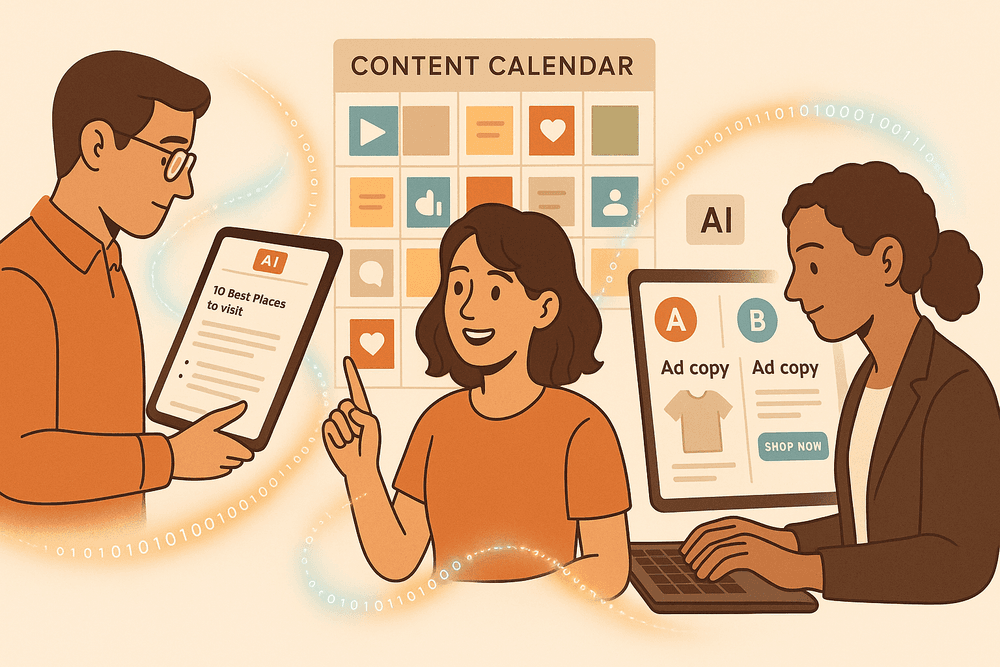
The abstract concept of artificial intelligence creating text becomes truly powerful when you see it in action. Far from a futuristic novelty, AI content generation is a practical tool that marketers, creators, and business owners are using today to solve real-world challenges, enhance productivity, and drive measurable results. The key is moving from "What can it do?" to "What can it do for me?" Let's explore some of the most impactful use cases revolutionizing modern workflows.
Scaling Your Blog with AI-Assisted Article Writing
Maintaining a consistent and authoritative blog is one of the most effective long-term marketing strategies, but it's incredibly resource-intensive. This is where AI-assisted writing shines. Instead of staring at a blank page, you can use AI to kickstart the entire process. It can brainstorm a month's worth of relevant blog topics based on your niche and target keywords, generate detailed outlines complete with H2s and H3s, and even produce a comprehensive first draft.
This doesn't remove the writer from the equation; it elevates them to the role of an editor and strategist. Human experts can then focus their valuable time on fact-checking, infusing the content with unique brand voice, adding personal anecdotes, and ensuring the final piece meets the highest standards of quality and accuracy. This collaborative approach allows a single creator to produce the output of a small team, dramatically scaling content velocity without sacrificing quality.
Automating Social Media Calendars and Post Creation
An "always-on" social media presence demands a relentless stream of fresh, engaging content tailored to each platform. AI content generation tools can act as your tireless social media intern. You can feed an AI a single piece of pillar content, like a new blog post or case study, and instruct it to generate a week's worth of promotional posts. It can create witty tweets, an insightful LinkedIn post, engaging Facebook questions, and image-accompanying Instagram captions—all from the same source material. These tools can also suggest relevant hashtags, identify trending topics to post about, and help you build a complete content calendar from a few simple prompts, freeing you to focus on community engagement and strategy.
Generating High-Converting Ad Copy and Product Descriptions
Persuasive copy is both an art and a science, and AI is an increasingly adept student of both. For e-commerce and performance marketing, AI can be a game-changer. By analyzing vast datasets of successful ads and product listings, AI models can generate high-converting copy in seconds. You can ask for ten different headlines for a Google Ad, five variations of a Facebook ad that use the AIDA (Attention, Interest, Desire, Action) framework, or compelling bullet points for an Amazon product description that highlight key benefits. This enables rapid A/B testing at a scale previously unimaginable, helping you quickly identify the messaging that resonates most with your audience and maximizes your return on ad spend (ROAS).
Crafting Personalized Email Marketing Campaigns at Scale
Generic email blasts are dead. Today's consumers expect personalization. While inserting a [First Name] tag is a start, true personalization goes much deeper, and it's a task perfectly suited for AI. By integrating with your CRM or customer data platform, AI content generation can craft hyper-personalized email campaigns. Imagine an automated email that not only recommends products based on a user's recent browsing history but also references a specific blog category they enjoy and crafts a subject line designed to re-engage them based on their past open rates. This level of granular, one-to-one communication at scale builds stronger customer relationships and significantly boosts engagement, open rates, and conversions.
The Human Element: Best Practices for an AI-Powered Workflow
Artificial intelligence has fundamentally changed the content creation landscape, but it hasn't removed the most critical component: you. Think of AI not as an autonomous author, but as the world's most advanced co-pilot. It can handle the heavy lifting, navigate complex routes, and process data at incredible speeds, but the human creator remains firmly in the pilot's seat, setting the destination and making the critical decisions. An effective ai content generation workflow isn’t about replacing humans; it's about augmenting their capabilities to produce better content, faster.
Why Fact-Checking and Human Editing Are Non-Negotiable
Relying on a raw, unedited AI draft is a recipe for disaster. While impressive, Large Language Models (LLMs) are prone to a phenomenon known as "hallucination"—they can confidently invent facts, statistics, sources, and quotes. They don't know information; they predict the next most likely word in a sequence. This can lead to content that looks plausible but is fundamentally inaccurate.
A human editor is your last line of defense against misinformation. Your role is to:
- Verify Every Claim: Cross-reference all data, statistics, and factual statements with reputable sources.
- Assess Nuance and Context: AI struggles to grasp subtle cultural context, industry-specific jargon, or the emotional undertones of a topic. A human ensures the content is appropriate and resonant.
- Refine Tone and Voice: Your brand has a unique voice. An editor’s job is to sculpt the AI’s often-generic output until it perfectly aligns with your brand’s personality.
Avoiding Common Pitfalls: Plagiarism, Inaccuracy, and Brand Dilution
Without proper human oversight, an ai content generation strategy can quickly backfire. Here are three critical pitfalls to avoid:
- Plagiarism: While most tools are designed to create original text, they learn from a massive dataset of existing internet content. This can lead to "accidental plagiarism," where the generated text is too similar to its training data. Always run AI-assisted content through a reliable plagiarism checker before publishing.
- Inaccuracy: As mentioned, AI's tendency to hallucinate can severely damage your credibility. A single incorrect statistic or misattributed quote can erode audience trust that took years to build.
- Brand Dilution: If all your content is created with minimal human input, it will start to sound generic and robotic—just like your competitors who are using the same tools. Human creativity is what injects unique insights, compelling stories, and a distinct brand personality that makes your content stand out.
Blending AI Efficiency with Human Creativity and Strategy
The true power of AI is unlocked when you combine its speed with human ingenuity. This hybrid model allows you to scale production without sacrificing quality.
- Let AI Handle the Mechanics: Use AI for brainstorming topics, creating detailed outlines, summarizing research, generating first drafts, and repurposing existing content for different platforms.
- Let Humans Drive the Strategy: The human role shifts to higher-level tasks: defining content goals, understanding audience pain points, developing unique angles, providing creative direction, and performing the crucial final edit. This strategic oversight ensures that every piece of content serves a purpose.
Building an Ethical Framework for Your AI Content Strategy
Integrating AI requires a commitment to ethical practices. Your framework should be built on three pillars:
- Transparency: Be upfront about your use of AI where appropriate. While you may not need a disclaimer on every blog post, being transparent builds trust with your audience and prepares you for evolving regulations.
- Accountability: The ultimate responsibility for published content lies with the human publisher, not the machine. You are accountable for its accuracy, originality, and impact. You can't blame the algorithm for a factual error or a plagiarized sentence.
- Data Privacy: Be mindful of the information you feed into AI prompts. Avoid inputting sensitive proprietary data, customer information, or any confidential material into public AI tools.

The Future is Now: Your Next Steps in AI Content Generation
We've journeyed through the what, why, and how of AI content generation. The theoretical has become practical. But understanding a tool and wielding it effectively are two different things. The real transformation begins when you integrate these powerful capabilities into your daily workflow. This isn't about a distant future; it's about taking decisive action today to redefine your content creation process. Let's outline your immediate next steps and look at the exciting horizon ahead.
Your AI Content Generation Playbook: Key Takeaways
To successfully integrate AI, shift your mindset from replacement to collaboration. The most effective strategies don't aim to automate humans out of the loop but to augment their creativity and efficiency. Here’s what to remember as you get started:
- Human Oversight is Non-Negotiable: Always review, edit, and fact-check AI-generated drafts. Your expertise, brand voice, and ethical judgment are irreplaceable. AI is a powerful assistant, but you are the editor-in-chief.
- Start Small, Scale Smart: Don't try to overhaul your entire content strategy overnight. Begin with a single, low-risk task like generating blog post ideas or drafting social media captions. Learn the ropes before applying AI to more critical, customer-facing content.
- Master the Art of the Prompt: The quality of your output is directly tied to the quality of your input. Invest time in learning how to write clear, contextual, and detailed prompts. Think of it as briefing a new team member—the more context you provide, the better the result.
- Focus on Augmentation, Not Automation: Use AI for brainstorming, creating first drafts, summarizing research, and overcoming writer's block. Let it handle the heavy lifting so you can focus on high-level strategy, original insights, and creative polish.
Beyond Text: The Evolving Landscape of AI in Content Creation
While current discussions often center on text, the future of AI content generation is multimodal and deeply integrated. We are on the cusp of a new era where the lines between different content types blur, all powered by more sophisticated AI.
Expect generative models that can create a complete campaign from a single brief—producing a blog post, a corresponding video script, social media visuals, and even a custom audio track. Hyper-personalization will reach new heights, with AI dynamically tailoring web copy and email content to individual user behavior in real time. We'll also see the rise of autonomous AI agents tasked with managing entire content calendars, from ideation and creation to performance analysis and strategic adjustment. The core practice of AI content generation will evolve from a specific task into a foundational element of a truly intelligent marketing engine.
Launch Your Strategy Today: First Steps to Success
Feeling inspired? The best way to harness this potential is to start now. Follow these concrete steps to launch your initial AI content generation strategy and build momentum.
- Define a Clear Objective: What is your primary goal? Do you want to increase content output by 20%, improve your team's efficiency, or simply save time on drafting? A specific goal will guide your efforts and help you measure success.
- Select Your Pilot Project: Choose one well-defined, manageable task. Examples include: generating five blog topic ideas with outlines, drafting a week’s worth of LinkedIn posts, or rewriting a high-performing article for a different audience.
- Choose a Starting Tool: Select a user-friendly AI content generation platform. Many leading tools offer free trials, allowing you to experiment without a significant financial commitment. Focus on one that aligns with your pilot project's needs.
- Establish Simple Guidelines: Create a one-page document outlining your brand's tone of voice, key messaging points, and a mandatory human review process. This ensures consistency and quality control from day one.
- Measure, Learn, and Iterate: After your pilot project, assess the results. Did you meet your objective? What worked well? What didn't? Use these insights to refine your prompts, adjust your workflow, and plan your next, more ambitious project.