
September 11, 2025
Why You Need an AI-Powered Collaboration Platform
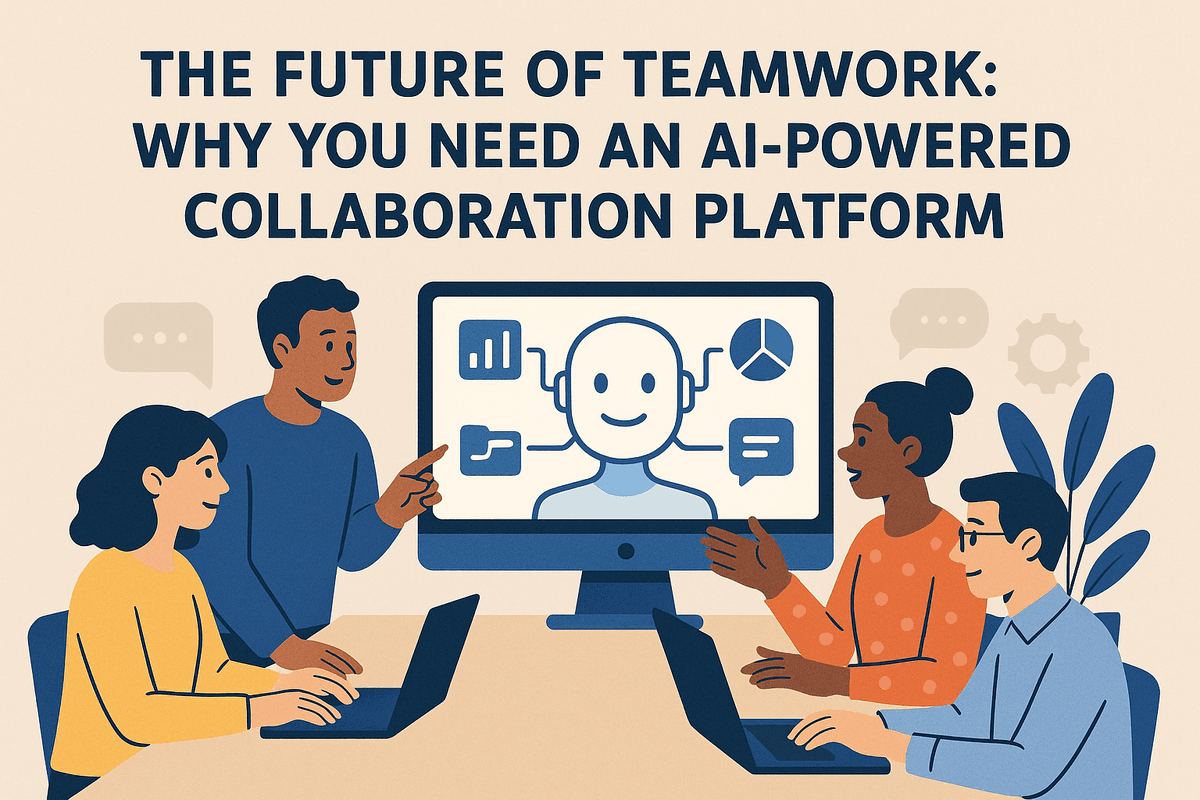
The Future of Teamwork: Why You Need an AI-Powered Collaboration Platform
The digital workplace is overflowing. We juggle endless chat notifications, navigate sprawling project boards, and hunt through countless folders for a single piece of information. While traditional collaboration tools promised to connect us, they often created more digital noise. The solution isn’t another app—it’s a smarter way of working. This is where the next evolution of digital teamwork comes into play: the AI-powered collaboration platform.
So, What Is an AI-Powered Collaboration Platform, Really?
Think beyond a simple chatbot or a grammar checker. An AI-powered collaboration platform is an integrated workspace where artificial intelligence is woven into the very fabric of your team's daily activities. It’s a central hub that doesn’t just store your conversations, tasks, and documents; it actively understands, organizes, and acts on them.
Instead of being a passive repository, this intelligent system works as a proactive partner. It can summarize long discussion threads, automatically generate action items from a meeting transcript, analyze project progress to flag potential risks, and even personalize your workflow by surfacing the most relevant information for your specific role. It’s the difference between having a digital filing cabinet and having a digital chief of staff for your entire team.
Moving Beyond Basic Chat and Project Management
For years, we’ve relied on a fragmented stack of tools. A chat app for communication, a project management tool for tasks, and a cloud drive for files. While useful, these tools operate in silos, forcing you to manually bridge the gaps. You read a decision in a chat, then switch apps to create a task, and then link to a document stored somewhere else.
An AI-powered collaboration platform collapses these silos. By integrating these functions into a single environment, the AI can see the bigger picture. It understands the context connecting a conversation to a task and a task to a final deliverable. This enables a new level of intelligent automation:
- From Conversation to Action: The platform can identify a commitment made in a chat and automatically suggest creating a task assigned to the correct person.
- Intelligent Resource Allocation: It can analyze team workload and suggest who is best suited to take on a new task based on their current capacity and skills.
- Contextual Knowledge: When you search for a project name, it doesn’t just show you files; it pulls up relevant conversations, key decisions, and related tasks in one cohesive view.
How AI Is Supercharging Remote and Hybrid Workflows
In a remote or hybrid setting, maintaining alignment and avoiding burnout is a constant challenge. Time zone differences lead to meeting fatigue, and a lack of spontaneous office chats can create information gaps. An AI-powered collaboration platform is uniquely equipped to solve these modern work challenges.
AI-driven features act as a great equalizer, ensuring everyone has access to the same information, regardless of their location or schedule. It automates the tedious administrative work that consumes our days, like writing meeting notes or chasing status updates. For distributed teams, this means less time spent on coordination and more time spent on meaningful, creative work. It’s how teams can finally move from being simply connected to being truly in sync.

Core Features of a Modern AI-Powered Collaboration Platform
The true potential of an ai powered collaboration platform isn't just about adding a chatbot to a messaging app. It’s about embedding intelligence into the very fabric of teamwork. These platforms are designed to reduce friction, automate tedious work, and provide insights that were previously impossible to obtain. Let's explore the core features that set these next-generation tools apart.
Automated Meeting Summaries and Action Item Generation
Meeting fatigue is real, but the post-meeting administrative work is often just as draining. Modern AI platforms tackle this head-on. Imagine an AI co-pilot that joins your video calls, transcribes the entire conversation in real-time, and then automatically generates a concise, accurate summary.
This technology goes beyond simple transcription. The AI is trained to understand context, identifying key decisions, unresolved questions, and important takeaways. Most impressively, it pinpoints action items discussed during the call, suggests the appropriate owner for each task, and can even populate them directly into your project management board. This eliminates ambiguity, ensures accountability, and gives every team member back valuable time previously spent on manual note-taking and follow-up.
Intelligent Task Management and Workflow Automation
Standard to-do lists are a thing of the past. An ai powered collaboration platform introduces a layer of intelligence to task and project management. Instead of you manually prioritizing tasks, the AI can analyze deadlines, dependencies, and project goals to suggest a daily or weekly focus for each team member.
Furthermore, it excels at workflow automation. The system can learn your team’s repetitive processes and automate them. For example, when a designer marks a task as "Ready for Review," the AI can automatically assign it to the project manager, send a notification in the relevant channel, and update the project timeline. This intelligent routing ensures that work flows smoothly from one stage to the next without manual intervention, preventing bottlenecks and keeping projects moving forward.
Predictive Insights for Project Timelines and Resource Allocation
One of the most transformative features is the AI's ability to provide predictive insights. By analyzing data from past and current projects—including task completion times, team workload, and communication patterns—the platform can forecast project timelines with a much higher degree of accuracy.
This AI-driven foresight helps project managers identify potential risks and delays before they become critical issues. It can flag when a team member is becoming overloaded and suggest reallocating resources to keep the project on track. This shifts project management from a reactive, fire-fighting discipline to a proactive, strategic one, enabling teams to deliver projects on time and within budget consistently.
AI-Driven Search to Instantly Find Files and Conversations
How much time does your team waste searching for a specific document, link, or decision buried in endless chat threads and folders? A leading ai powered collaboration platform solves this with a universal, AI-powered search function.
Using natural language processing (NLP), this search understands what you’re looking for, not just the keywords you type. You can ask questions like, "What was the final decision on the Q3 marketing budget?" or "Find the design mockups from last week's client meeting." The AI will instantly scan across all your integrated tools—chats, documents, project boards, and cloud storage—to deliver the precise information you need in seconds. This creates a single source of truth and makes institutional knowledge instantly accessible to everyone.
Unlocking Peak Performance: Key Benefits for Your Team
In today's fast-paced work environment, the difference between a good team and a great one often comes down to efficiency and intelligence. While traditional collaboration tools have helped, they often fall short of tackling the core issues of information overload and administrative drag. This is where an ai powered collaboration platform becomes a game-changer, moving beyond simple task management to actively enhance your team's potential. By embedding intelligent automation and data analysis into daily workflows, these platforms deliver tangible benefits that unlock new levels of performance and innovation.
Eliminate Administrative Busywork and Reclaim Productive Hours
How much of your team’s week is lost to scheduling meetings, taking notes, creating summaries, and manually assigning follow-up tasks? These small, repetitive duties accumulate, stealing valuable time that could be spent on strategic, high-impact work. An ai powered collaboration platform acts as a hyper-efficient virtual assistant for the entire team. It automates mundane tasks like generating meeting agendas, transcribing discussions in real-time, and creating concise summaries with highlighted action items. By intelligently routing tasks to the right people based on workload and expertise, the platform ensures that administrative friction is minimized, freeing your team to focus on what they do best: solving problems and driving growth.
Enhance Decision-Making with Data-Driven Recommendations
Gut feelings and past experiences are valuable, but in a competitive landscape, data is king. The best decisions are informed decisions. An intelligent collaboration platform doesn't just store your project data; it actively analyzes it to provide predictive insights. Imagine being alerted to a potential project bottleneck before it occurs or receiving recommendations on how to reallocate resources for optimal results. These platforms can analyze communication patterns, track progress against goals, and identify trends that would be invisible to the human eye. This transforms your project management from a reactive process to a proactive, data-driven strategy, empowering leaders to make smarter, faster, and more confident decisions.
Break Down Information Silos and Improve Cross-Functional Visibility
As organizations grow, knowledge often becomes trapped within specific departments or teams, creating information silos that hinder collaboration and lead to redundant work. An ai powered collaboration platform serves as a central nervous system for your organization. Its intelligent search capabilities can instantly surface relevant documents, conversations, and experts from across the entire company, regardless of where the information lives. By automatically linking related projects and discussions, the platform creates a transparent and interconnected work environment. This ensures that everyone, from marketing to engineering, has a clear view of the bigger picture, fostering better alignment and a more cohesive, cross-functional workflow.
Foster Innovation by Automating Repetitive Creative Tasks
Innovation isn't just about one big idea; it's about creating an environment where creative thinking can flourish. Ironically, many creative processes involve repetitive, foundational tasks that can drain energy and stifle momentum. AI collaboration tools can augment the creative process by handling the heavy lifting. This includes generating first drafts of marketing copy, creating outlines for presentations based on a few key points, summarizing extensive market research, or even brainstorming initial concepts. By automating this groundwork, the platform allows your creative talent to bypass the blank page and focus their expertise on strategy, refinement, and true out-of-the-box thinking, turning your team into an innovation engine.
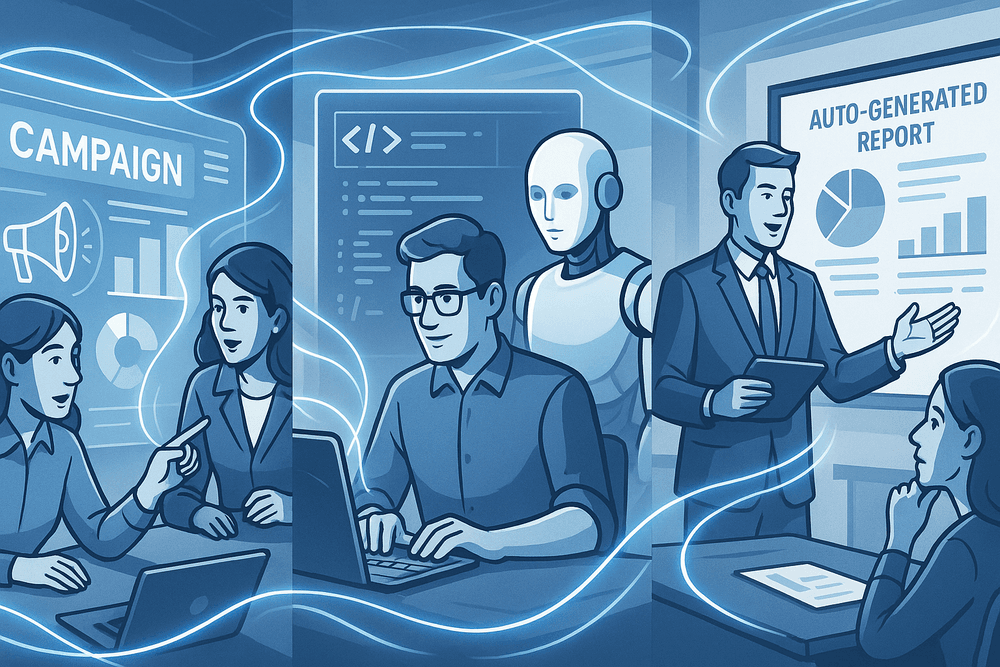
AI in Action: Real-World Use Cases for AI Collaboration
The true value of an ai powered collaboration platform isn't just in its futuristic features, but in its practical application to solve everyday business challenges. Across industries, teams are leveraging these intelligent tools to break down silos, eliminate friction, and achieve goals faster. Let’s explore how different departments are putting AI collaboration into action.
Streamlining Marketing Campaign Execution
Marketing teams operate in a high-stakes environment of tight deadlines, cross-functional dependencies, and constant performance analysis. An ai powered collaboration platform acts as an intelligent command center, simplifying complex campaign workflows from start to finish.
- AI-Assisted Content Creation: Instead of starting from a blank page, marketers can use AI to generate campaign briefs, brainstorm ad copy variations, or create outlines for blog posts and whitepapers directly within their project management space.
- Intelligent Task Automation: The platform can automatically create and assign sub-tasks based on triggers. For example, once a designer marks a graphic as "complete," the AI can instantly assign the next task to the social media manager to draft a post, attaching the final asset automatically.
- Proactive Performance Insights: Rather than manually exporting data from various analytics tools, AI can pull performance metrics directly into the collaboration hub. It can then analyze the data and provide plain-language summaries and optimization suggestions, such as, "The click-through-rate for Campaign B is 15% below average; consider A/B testing the headline."
Accelerating Software Development Sprints
In the fast-paced world of agile development, efficiency and clarity are paramount. AI-powered collaboration tools integrate seamlessly into the development lifecycle, helping teams plan, execute, and ship code with greater precision.
- Smarter Sprint Planning: AI can analyze a team's historical velocity and the complexity of backlog items to predict more accurate sprint timelines. It can flag potential overloads or identify dependencies that might create bottlenecks before the sprint even begins.
- Automated User Stories and Documentation: Teams can feed high-level feature requirements into the AI, which can then generate well-structured user stories, acceptance criteria, and technical sub-tasks. This saves valuable engineering time and ensures consistency in documentation.
- Intelligent Code Review and Bug Triage: By integrating with platforms like GitHub, the AI can help manage the review process by suggesting appropriate reviewers based on code ownership and expertise. It can also assist in triaging new bug reports by analyzing their descriptions, identifying duplicates, and suggesting a priority level.
Managing Complex Client Projects with Automated Reporting
For agencies and client-service businesses, maintaining transparency and communication is as crucial as the work itself. An ai powered collaboration platform transforms client management by automating tedious administrative tasks and fostering clearer communication.
- Automated Status Reports: Forget spending hours every Friday compiling progress updates. The AI can automatically generate comprehensive reports by pulling data on completed tasks, budget utilization, and upcoming milestones. These reports can be customized for client-facing and internal use, providing a real-time, accurate snapshot of project health.
- AI-Generated Meeting Summaries: After a client call, the platform's AI can transcribe the recording, identify key decisions, and create a list of actionable next steps with assigned owners and due dates. This ensures nothing falls through the cracks and keeps everyone perfectly aligned.
- Sentiment Analysis: Advanced platforms can analyze communication within client-facing channels (like shared messages or emails) to gauge sentiment. This provides an early warning system, allowing project managers to proactively address potential concerns before they escalate.
How to Choose the Right AI-Powered Collaboration Platform
The market for AI-powered collaboration platforms is exploding, with new tools emerging constantly. While this innovation is exciting, it can also be overwhelming. The secret isn't finding the "best" platform—it's finding the right one for your team. A tool that seamlessly integrates into your workflow can be a game-changer, while the wrong one creates more friction than it resolves. This guide will walk you through a strategic process for selecting the perfect AI-powered collaboration platform for your unique needs.
Assess Your Team's Specific Needs and Pain Points
Before you even look at a feature list, look inward at your own team's processes. The most effective AI tool will solve a real, existing problem. Start by mapping out your current workflows and identifying the biggest bottlenecks.
Ask yourself and your team:
- Where do communication breakdowns happen? Are important messages getting lost in crowded channels? Do teams struggle to stay aligned on cross-functional projects?
- What repetitive tasks consume the most time? Think about manual data entry, compiling weekly reports, or transcribing meeting notes.
- Are meetings productive? Do you struggle with creating agendas, capturing action items, and ensuring follow-through?
- How do you manage knowledge? Is crucial information scattered across documents, emails, and chat threads, making it hard to find?
Once you identify your primary pain points, you can look for an AI-powered collaboration platform with features that directly address them. For instance, if knowledge management is your biggest hurdle, prioritize a tool with a powerful AI-driven search function. If repetitive tasks are killing productivity, look for robust workflow automation capabilities.
Prioritize Key Integration Capabilities
No platform is an island. A powerful AI tool becomes exponentially more valuable when it connects to the software you already use every day. Forcing your team to abandon their favorite apps for a new, closed-off ecosystem is a recipe for low adoption.
Look for a platform with a rich integration library that connects with your core business systems:
- Communication Hubs: Slack, Microsoft Teams
- Productivity Suites: Google Workspace (Docs, Sheets, Calendar), Microsoft 365
- Project Management: Jira, Asana, Trello, Monday.com
- CRM: Salesforce, HubSpot
- Cloud Storage: Dropbox, Google Drive, OneDrive
Seamless integration ensures data flows freely between systems, reduces time-wasting context switching, and establishes a single source of truth for your projects.
A Quick-Glance Comparison Checklist
As you evaluate different options, use this checklist to compare them consistently:
- Core AI Features: Does it offer AI-powered summaries, workflow automation, predictive task management, and an intelligent assistant?
- Ease of Use: Is the interface intuitive and user-friendly? Can your least tech-savvy team member adopt it easily?
- Integration Strength: Does it natively connect with your must-have tools?
- Customization & Scalability: Can the platform be tailored to your workflow? Will it grow with your team?
- Security & Data Privacy: How is your data used? Does it meet your industry’s compliance standards (e.g., GDPR, SOC 2)?
- Pricing & ROI: Is the pricing model transparent (per user, tiered)? Does the potential productivity gain justify the cost?
Questions to Ask During a Demo or Free Trial
Make the most of your trial period by going in with a list of targeted questions. This is your chance to see if the platform lives up to its marketing promises.
- How does the AI specifically help solve [Your Primary Pain Point]?
- Can you demonstrate how to set up an automation for [Your Specific Repetitive Task]?
- What is the typical onboarding process and learning curve for a team of our size?
- How is our proprietary data protected and used to train your AI models?
- What new AI features are on your product roadmap for the next six months?
Conclusion: Your Next Steps to Smarter Collaboration
We've explored the transformative potential of AI-powered collaboration platforms, moving them from a futuristic concept to a tangible, must-have tool for modern businesses. These intelligent systems are no longer just about storing files or sending messages; they are active partners in enhancing productivity, automating routine tasks, and fostering a more connected and efficient work environment. The question is no longer if you should adopt this technology, but how you can integrate it successfully.
Your Simple Roadmap for Successful Implementation
Embarking on this journey doesn't have to be complex. By following a structured approach, you can ensure a smooth transition and maximize your return on investment.
- Assess Your Core Challenges: Before looking at any software, look inward. Where are your team’s biggest friction points? Is it in managing cross-departmental projects, finding information quickly, or streamlining meeting follow-ups? A clear understanding of your pain points will guide your search for the right ai powered collaboration platform.
- Research and Request Demos: With your needs defined, create a shortlist of platforms. Go beyond feature lists and marketing jargon. Schedule live demos to see how the tool handles your specific use cases. Pay close attention to the user interface, the intelligence of its AI features (like task automation and smart search), and its integration capabilities.
- Launch a Pilot Program: Instead of a company-wide rollout, start with a single, tech-savvy team or a specific project. This creates a controlled environment to gather real-world feedback, identify potential hurdles, and create internal champions who can advocate for the new system.
- Train, Support, and Scale: Use the insights from your pilot program to develop training materials and best practices. As you expand the rollout, focus on demonstrating value. Show teams how the platform saves them time on administrative tasks, provides better project visibility, and helps them focus on more strategic work.
The Future Outlook: What's Next for AI in the Workplace?
The evolution of the ai powered collaboration platform is just beginning. The next wave of innovation will push beyond simple automation and into proactive, predictive assistance. Imagine an AI that not only summarizes your meetings but also predicts potential project roadblocks based on communication patterns and suggests preventative actions. We are moving towards a future where these platforms act as a central nervous system for your organization—a hyper-personalized assistant that understands individual work styles, anticipates needs, and facilitates a truly seamless flow of information and creativity across all your business tools.
Ready to Upgrade Your Teamwork? Get Started Today
The shift to intelligent collaboration is happening now. The tools to automate the mundane, unlock deeper insights, and empower your team to do their best work are more accessible than ever. By taking the first step—assessing your needs and exploring your options—you position your organization not just to keep up, but to lead the way. Don’t wait for the future of work to arrive; start building it today.