
September 5, 2025
What is an AI-Powered Collaboration Platform?
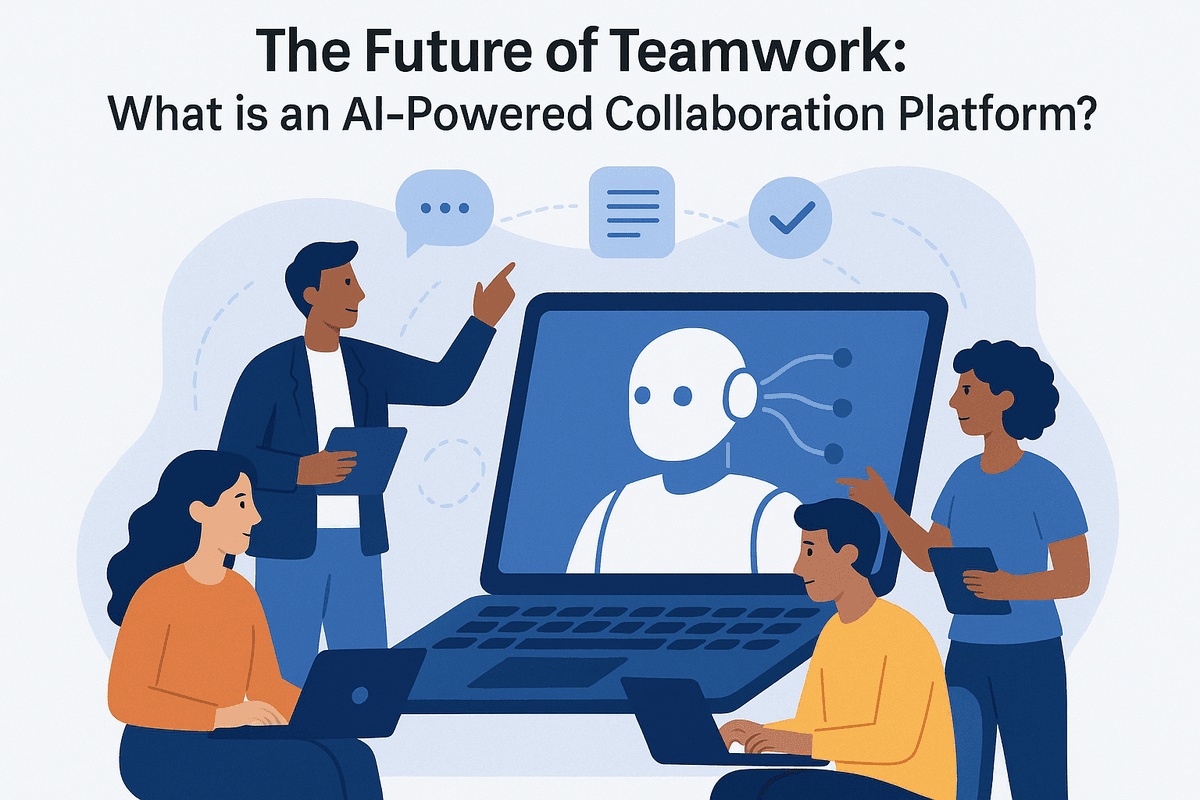
The Future of Teamwork: What is an AI-Powered Collaboration Platform?
The modern workplace is a paradox of connection and fragmentation. We have more tools than ever to communicate, yet information remains siloed, and productivity is often lost to the digital noise of endless notifications and context switching. For years, the solution was to move conversations from email to chat apps and projects to digital boards. But this was merely a change of venue, not a fundamental shift in how we work. The true evolution is here, and it's driven by intelligence. Welcome to the era of the AI-powered collaboration platform.
Beyond the Inbox: Defining the Modern Collaboration Tool
At its core, a modern collaboration platform is a centralized digital workspace designed to unify a team's communication, projects, and knowledge. Think of it as a virtual headquarters where conversations happen in organized channels, tasks are tracked on shared boards, and documents are stored and co-edited in a single, accessible location. This model breaks down the information silos created by relying on a patchwork of disconnected tools like email, spreadsheets, and separate cloud storage.
However, the defining characteristic of a next-generation tool isn't just centralization; it's intelligence. While a standard platform provides the space for work, an AI-powered collaboration platform actively participates in it.
How AI is Revolutionizing Team Synergy and Productivity
Artificial intelligence transforms a passive collaboration tool into a proactive, intelligent partner for your team. It moves beyond simple automation to provide insights, streamline complex workflows, and reduce the cognitive load on every team member. An AI-powered collaboration platform doesn't just hold your data; it understands it.
Here’s how AI is fundamentally changing the game:
- Intelligent Summarization: AI can transcribe entire meetings, automatically identifying key decisions, action items, and follow-up tasks. This frees your team from frantic note-taking and ensures perfect alignment, even for those who couldn't attend.
- Predictive Task Management: By analyzing project data and communication patterns, AI can suggest relevant next steps, recommend the best person for a specific task based on their current workload and skills, and flag potential bottlenecks before they derail your timeline.
- Personalized Workflows: AI assistants can learn individual work habits and help prioritize tasks, manage notifications, and surface the most relevant information for each user, creating a focused and less overwhelming work environment.
- Enhanced Search and Knowledge Discovery: Instead of just searching for keywords, you can ask natural language questions like, "What was our Q3 marketing budget?" and the AI will find the precise information across chats, documents, and project boards.
Key Signs Your Team is Ready for an Upgrade
Is your current toolset holding you back? If you find yourself nodding along to the following points, it's a clear signal that your team is ready to graduate to an AI-powered collaboration platform:
- "Work about work" is draining your time: You spend more hours organizing tasks, chasing updates, and summarizing meetings than you do on strategic, high-impact activities.
- Information is constantly lost: Important decisions get buried in long email chains or endless chat threads, forcing team members to repeatedly ask for information they know exists somewhere.
- Project visibility is cloudy: It’s difficult to get a clear, real-time overview of who is doing what and whether projects are on track without scheduling another status meeting.
- Onboarding is slow and painful: Bringing new members up to speed is a manual, time-consuming process of forwarding old emails and documents.
- Innovation is stalling: Your team is so bogged down in administrative friction and repetitive tasks that they lack the mental space for creativity and proactive problem-solving.

Core Features of a Leading AI-Powered Collaboration Platform
While traditional collaboration tools connect people, a true ai powered collaboration platform actively participates in the work, transforming how teams achieve their goals. These intelligent systems are defined by a set of core features designed to automate the mundane, anticipate needs, and provide instant access to information. By integrating AI at every level, they move beyond simple communication to become a proactive partner in your team's success. Let's explore the standout capabilities that set these platforms apart.
Intelligent Task Automation and Workflow Optimization
Imagine a project manager that never sleeps and handles all the tedious, repetitive tasks with perfect accuracy. That's the power of intelligent automation. A leading ai powered collaboration platform can:
- Automate Task Assignment: The AI analyzes team member skills, current workload, and past performance to suggest or automatically assign new tasks to the best-suited person.
- Streamline Approvals: Instead of manually chasing stakeholders, workflows can be configured to automatically route documents or designs for approval, sending reminders and escalating if necessary.
- Optimize Processes: By learning from past projects, the system can identify bottlenecks and suggest more efficient workflows, helping your team continuously improve its processes without manual intervention.
This frees up your team from administrative overhead, allowing them to focus on high-impact, strategic work that drives real value.
Predictive Analytics for Project Timelines and Resource Allocation
Guesswork is the enemy of successful project management. AI-powered predictive analytics replaces uncertainty with data-driven foresight. The platform analyzes historical data from countless projects to provide remarkably accurate forecasts. Key benefits include:
- Accurate Timeline Projections: By considering task complexity, dependencies, and team member availability, the AI can predict project completion dates with a high degree of confidence, helping you set realistic client expectations.
- Proactive Risk Detection: The system constantly scans for potential delays or budget overruns. It can flag a task that is falling behind or identify a team member who is becoming a bottleneck long before it becomes a critical issue.
- Smarter Resource Allocation: AI can recommend the optimal distribution of team members across projects, ensuring that skills are properly utilized and no one is over or under-capacity.
Automated Meeting Summaries and Action Item Tracking
Meetings are essential, but the administrative follow-up can be a significant drain on productivity. An intelligent platform turns every meeting into a productive, actionable event. AI assistants can join your calls to:
- Generate Instant Summaries: The AI transcribes the entire conversation and then uses natural language processing to create a concise, easy-to-read summary, highlighting key decisions and discussion points.
- Capture and Assign Action Items: It intelligently identifies when a task is assigned during a conversation (e.g., "John will send the report by Friday"). It then automatically creates the task, assigns it to the right person, and adds it to the project plan with the specified deadline. This ensures nothing falls through the cracks and creates a clear chain of accountability.
Natural Language Search for Finding Files and Conversations Instantly
How much time does your team waste searching for information? AI-powered search eliminates this frustration. Instead of relying on exact keywords, you can ask the platform questions in plain English, just as you would ask a colleague. For example, you could search for:
- "Show me the final budget proposal for the Q4 campaign that Sarah approved"
- "What was the final decision on the new logo from last week's marketing sync?"
The AI understands context, relationships, and user intent to instantly find the exact file, message, or decision you're looking for, no matter where it's buried. This conversational search capability transforms your entire digital workspace into a fully accessible and intelligent knowledge base.
Comparing the Top AI-Powered Collaboration Platforms in 2024
The market for AI-enhanced tools is booming, but not all platforms are created equal. The ideal ai powered collaboration platform for a fast-moving creative agency will differ significantly from what a security-conscious enterprise requires. To help you navigate the options, we’ve broken down the top contenders based on the unique needs of different teams, focusing on their standout features and overall value proposition.
For Creative Teams: Platforms with Generative AI for Brainstorming
Creative teams thrive on iteration and inspiration. The best AI tools for them act as a tireless brainstorming partner, helping to break through creative blocks and accelerate the journey from concept to final product.
- Key Features to Look For: Integrated generative AI for text and images, intuitive digital whiteboards, AI-powered mind-mapping, and automated content summarization.
- Leading Platforms:
- Notion AI: Seamlessly integrated into its popular workspace, Notion AI can draft blog posts, brainstorm campaign ideas, create tables from unstructured notes, and even change the tone of existing copy. It excels at turning chaotic brainstorming sessions into organized project plans.
- Miro Assist: Known for its infinite digital whiteboard, Miro now includes AI features that can generate mind maps from a single prompt, cluster sticky notes by theme, and create instant summaries of complex diagrams, making collaborative ideation faster and more structured.
For Technical Teams: Tools with Code-Aware AI Assistants
For developers, engineers, and product teams, efficiency is paramount. The right AI collaboration platform goes beyond simple task management by understanding the technical context of their work, from code to documentation.
- Key Features to Look For: Code generation and debugging assistance, automated documentation creation, intelligent sprint planning, and AI-powered summaries of technical discussions.
- Leading Platforms:
- GitHub Copilot: While primarily a coding assistant, its integration into the developer workflow makes it a powerful collaboration tool. It helps teams maintain code consistency, reduces time spent on boilerplate code, and accelerates peer reviews by providing context-aware suggestions.
- Linear: This modern issue tracker uses AI to streamline workflows by automatically labeling and prioritizing issues, summarizing long comment threads, and helping draft release notes, freeing up developers to focus on coding rather than administrative tasks.
For Enterprise: Solutions Focused on Security and Scalability
Large organizations require an ai powered collaboration platform that not only enhances productivity but also meets stringent security, compliance, and data privacy standards. These platforms are designed to integrate safely with existing enterprise ecosystems.
- Key Features to Look For: Enterprise-grade security protocols (e.g., SOC 2, GDPR compliance), robust administrative controls, advanced data encryption, and the ability to train AI on internal knowledge bases without exposing data.
- Leading Platforms:
- Microsoft 365 Copilot: Embedded across the entire Microsoft suite (Teams, Outlook, Word), Copilot leverages your organization’s internal data in a secure environment. It can summarize meetings you missed in Teams, draft emails based on internal documents, and create presentations, all while adhering to your company's security policies.
- Slack AI: Built into the communication hub many businesses already use, Slack AI provides channel recaps, thread summaries, and an intelligent search that can answer questions based on your company’s entire Slack history, ensuring knowledge is never lost and is easily accessible.
Pricing and ROI: Which Platform Offers the Best Value?
Calculating the value of an AI platform goes beyond the monthly subscription fee. The true return on investment (ROI) is measured in productivity gains. Pricing models typically range from per-user/per-month fees (often between $10-$30 per user) to usage-based credits.
To determine the best value, consider this: if a $20/month AI assistant saves each team member just three hours a month, the ROI is already substantial. Most top platforms offer free trials or freemium tiers. Use these opportunities to identify your team’s most time-consuming bottlenecks and assess whether a specific AI tool can effectively solve them before committing. The best value will always come from the platform that most directly aligns with and streamlines your core workflows.
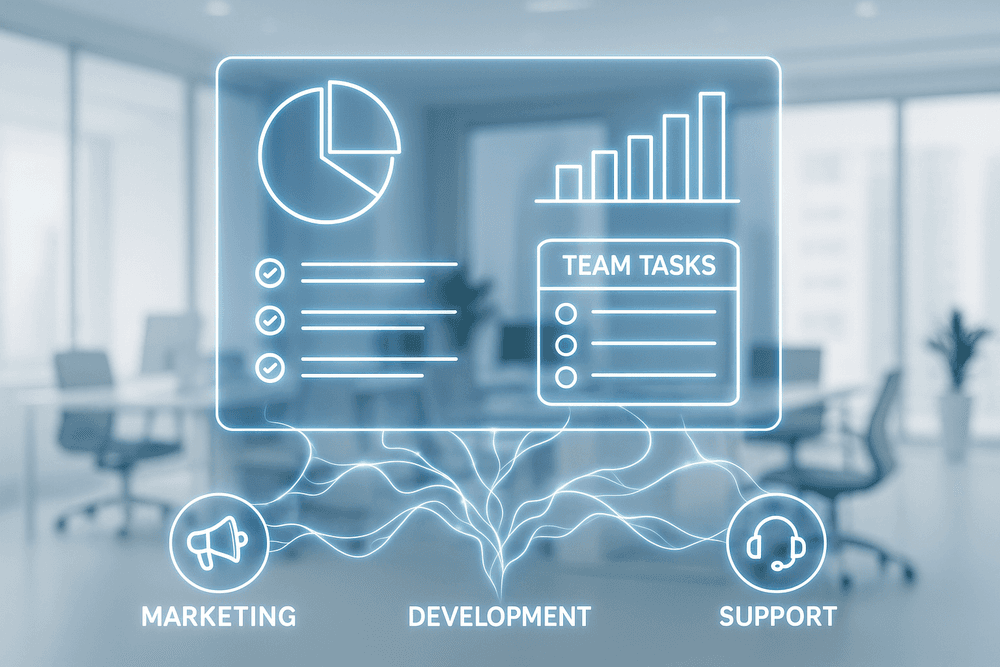
Real-World Impact: Use Cases for an AI-Powered Collaboration Platform
The theoretical promise of artificial intelligence is impressive, but its true value is measured in tangible business outcomes. An ai powered collaboration platform isn't just a futuristic concept; it's a practical tool that is actively transforming how teams work, innovate, and deliver results. From automating tedious tasks to uncovering predictive insights, these platforms are solving real-world challenges across diverse industries. Let’s explore some concrete examples of their impact.
Case Study: How a Marketing Agency Cut Reporting Time by 50%
For marketing agencies, client reporting is a critical but often time-consuming task. A mid-sized digital agency, for example, was spending over 20 hours per week manually compiling performance data from various ad platforms, analytics tools, and social media channels. This process was not only inefficient but also susceptible to human error.
By adopting an ai powered collaboration platform with integrated data connectors, they completely revolutionized their workflow. The platform’s AI engine automatically:
- Aggregated data in real-time from all connected sources into a unified dashboard.
- Identified significant trends, anomalies, and key performance indicators (KPIs) without manual analysis.
- Generated natural-language summaries and draft reports, highlighting crucial insights for client presentations.
The result? The agency reduced its reporting time by half, freeing up strategists to focus on optimizing campaigns and strengthening client relationships. The AI didn't just speed up a task; it elevated the team's strategic capacity.
Boosting Efficiency in Remote and Hybrid Work Environments
In a world of distributed teams, maintaining alignment and combating digital fatigue are paramount. An ai powered collaboration platform acts as the central nervous system for remote and hybrid workforces. AI-driven features like automated meeting transcription and summarization ensure that no one misses critical decisions or action items, even if they can’t attend a live call. Intelligent task management systems analyze team workloads and skill sets to suggest the best person for a new project, preventing burnout and promoting balanced contributions. By filtering out low-priority notifications and summarizing channel activity, the AI helps employees stay focused, making remote collaboration more purposeful and less chaotic.
Streamlining Product Development Cycles with Predictive Insights
Product development teams operate on tight deadlines where a small bottleneck can cause a significant delay. An ai powered collaboration platform can integrate with project management tools to provide a crucial advantage: predictive analytics. By analyzing historical project data, task dependencies, and current progress, the AI can forecast potential roadblocks and flag at-risk timelines before they become critical. It can identify which tasks are most likely to cause delays and suggest resource reallocation to keep the project on track. This shifts the team from a reactive to a proactive model, enabling them to mitigate risks, optimize sprints, and deliver products to market faster and more reliably.
Enhancing Customer Support with AI-Driven Knowledge Bases
Exceptional customer service hinges on speed and accuracy. An ai powered collaboration platform transforms a static internal knowledge base into a dynamic, intelligent resource. The AI constantly learns from new support tickets, internal documentation, and team conversations. When a support agent receives a customer query, the platform instantly surfaces the most relevant troubleshooting steps, policy documents, or even pre-drafted responses. This AI-driven knowledge retrieval system dramatically reduces response times, improves first-contact resolution rates, and ensures every customer receives consistent, high-quality information.
How to Choose the Right AI-Powered Collaboration Platform for Your Business
Selecting the perfect ai powered collaboration platform is more than just picking the one with the most features; it's about finding a solution that fits your team's DNA. The right tool can supercharge productivity, while the wrong one becomes another forgotten login. To make the right choice, focus on a strategic evaluation process that puts your business needs first.
Assess Your Team’s Unique Workflow and Pain Points
Before you even look at a demo, look inward. The most effective starting point is a thorough audit of your team's current processes and challenges. Are your teams drowning in back-to-back meetings that could have been summarized by AI? Is crucial information constantly lost in a sea of chat messages and email threads? Are project managers spending more time chasing status updates than driving progress?
Map out your core workflows from start to finish and pinpoint the exact bottlenecks. A clear understanding of these pain points—like inefficient knowledge sharing, disorganized task management, or poor cross-functional alignment—gives you a powerful checklist. An ai powered collaboration platform should be a direct solution to these problems, offering features like intelligent search, automated meeting summaries, or predictive task scheduling that align with your team’s specific needs.
Prioritize Integrations with Your Existing Tech Stack
No platform is an island. A new tool must seamlessly connect with the applications your team already relies on every day. A lack of integration creates frustrating data silos and forces employees to constantly switch between windows, defeating the purpose of a unified platform.
Make a list of your mission-critical software: your CRM (e.g., Salesforce), project management tools (e.g., Jira, Asana), communication hubs (e.g., Slack, Microsoft Teams), and cloud storage (e.g., Google Drive, Dropbox). The best ai powered collaboration platform will offer deep, native integrations with this stack. This ensures that data flows freely, AI-driven insights are available where you work, and the new tool enhances, rather than disrupts, your established digital ecosystem.
Evaluate Security, Compliance, and Data Privacy Features
Introducing an AI-powered tool into your workflow means entrusting it with your company's sensitive data. Therefore, security and privacy are non-negotiable. Scrutinize each potential vendor’s security credentials and data handling policies with the utmost care.
Look for robust security measures like end-to-end data encryption, granular access controls, and compliance with internationally recognized standards such as SOC 2 or ISO 27001. If your business operates in a regulated industry, confirm that the platform meets specific requirements like GDPR or HIPAA. Furthermore, demand transparency about how your data is used to train their AI models. A trustworthy ai powered collaboration platform will provide clear policies and give you control over your own information.
Start Small: Pilot a Platform Before Full Rollout
Resist the urge to go all-in from day one. A full-scale, company-wide deployment without proper testing is a recipe for low adoption and wasted investment. The smartest approach is to run a controlled pilot program with a single, tech-forward team or a specific, well-defined project.
Set clear goals and metrics for the trial period. Are you aiming to reduce meeting time by 20%? Improve project completion rates? Or increase cross-departmental visibility? Collect quantitative data and, just as importantly, qualitative feedback from your pilot group. Their real-world experiences will reveal the platform’s true strengths and weaknesses, providing invaluable insights to help you make a confident final decision and plan a successful company-wide implementation.

Conclusion: Embracing the Future with an AI-Powered Collaboration Platform
The landscape of teamwork is undergoing a seismic shift. We've moved beyond simple chat and video conferencing tools into an era of intelligent, predictive, and truly integrated work environments. As we've explored, the integration of artificial intelligence into our daily workflows is no longer a futuristic concept—it's the competitive edge that high-performing teams are leveraging today. Adopting an ai powered collaboration platform is not merely about upgrading your software; it's about fundamentally transforming how your team communicates, innovates, and achieves its goals. It's about building a smarter, more agile, and more connected organization from the ground up.
Recap: The Key Benefits of AI-Enhanced Teamwork
An ai powered collaboration platform acts as a central nervous system for your team, learning from your interactions to proactively support your efforts. The benefits are tangible and transformative:
- Amplified Productivity and Efficiency: By automating routine tasks like meeting summaries, action item tracking, and information retrieval, AI frees up your team's valuable time. This allows them to focus on high-impact strategic work, problem-solving, and creative thinking rather than getting bogged down in administrative overhead.
- Data-Driven Decision-Making: AI-powered analytics can uncover hidden patterns in communication, identify potential project risks before they escalate, and provide sentiment analysis on team discussions. This equips leaders with the objective insights needed to make faster, more informed decisions that steer projects toward success.
- Seamless and Streamlined Workflows: These platforms break down information silos by intelligently connecting conversations, documents, and tasks across different departments. With features like automated task assignment and intelligent project timelines, workflows become smoother, more transparent, and less prone to human error.
- Enhanced Creativity and Innovation: AI can serve as a powerful creative partner. From facilitating dynamic brainstorming sessions with generative ideas to helping draft initial content, it provides the spark that can lead to breakthrough innovations and a more dynamic creative process.
Your Next Step: How to Get Started
The most effective way to grasp the potential of an ai powered collaboration platform is to experience it directly. Reading about its capabilities is one thing; seeing it in action with your own team is another.
We encourage you to take the next step by exploring a free trial of one of the leading solutions discussed in this guide. During this trial period, focus on a specific project or a small pilot team. Test the features that align with your biggest challenges—whether it's running more efficient meetings, managing complex projects, or simply improving cross-functional communication. This hands-on approach provides a low-risk opportunity to measure the impact and build a business case for wider adoption.
Preparing Your Team for a Seamless Transition
Introducing any new technology requires thoughtful planning. To ensure a smooth and successful rollout, focus on the human element of change:
- Communicate the 'Why': Clearly articulate the benefits for the team. Frame the platform as a tool that augments their abilities, reduces tedious work, and helps them succeed—not as a tool for micromanagement.
- Provide Robust Training: Offer comprehensive onboarding sessions, create a repository of quick-start guides, and establish a clear channel for questions. The more confident your team feels using the new tool, the faster they will embrace it.
- Start Small and Iterate: Begin with a pilot group of enthusiastic early adopters. Let them become champions for the new platform, sharing their successes and providing valuable feedback. Use their insights to refine your implementation strategy before rolling it out to the entire organization.
By adopting an ai powered collaboration platform, you are investing in a future where your team works smarter, not just harder. You are building a resilient, innovative, and highly productive organization ready to thrive in the years to come.