
November 21, 2025
An Introduction to the AI Grant Proposal Generator
The Future of Fundraising: An Introduction to the AI Grant Proposal Generator
The grant writing landscape is notoriously demanding. Countless hours are spent on meticulous research, painstaking drafting, and rigorous editing, all under the pressure of tight deadlines and fierce competition. For every successful proposal, many more fall short, leaving vital community projects unfunded. But what if you could transform this grueling process, turning the daunting blank page into a powerful, data-driven draft in a fraction of the time? This is the promise of the AI grant proposal generator—a revolutionary tool that is rapidly becoming an indispensable asset for non-profits and researchers alike.
At its core, an AI grant proposal generator is a sophisticated software platform that leverages artificial intelligence, particularly natural language processing (NLP) and machine learning (ML), to streamline and enhance the creation of grant applications. It’s not a simple template filler. Instead, it acts as an intelligent co-writer. You provide the essential details of your project—your mission, objectives, budget, and desired outcomes—and the AI synthesizes this information, cross-references it with vast databases of successful proposals and funder guidelines, and generates well-structured, persuasive, and relevant content for every section of your application.
Why Grant Writers are Turning to AI for a Competitive Edge
The shift towards AI in grant writing isn't just about keeping up with technology; it's about gaining a significant strategic advantage. Funders are inundated with applications, and only the most compelling, clear, and perfectly aligned proposals stand out. Here’s why savvy grant professionals are integrating AI into their workflow:
- Accelerated Speed and Efficiency: AI can reduce the time spent on initial drafting by up to 80%. It automates repetitive tasks like summarizing project details and formatting text according to specific funder requirements, freeing up writers to focus on strategy and program refinement.
- Data-Informed Content: An advanced AI grant proposal generator doesn't just write; it analyzes. It can identify key phrases and themes that resonate with specific foundations, suggesting language that aligns perfectly with a funder’s stated priorities and past funding patterns.
- Enhanced Quality and Consistency: AI helps maintain a consistent tone and voice throughout a lengthy proposal. It can also serve as a first-line editor, flagging grammatical errors, improving clarity, and ensuring every section logically supports the overall narrative.
- Overcoming Writer’s Block: Staring at a blank needs statement or project description can be paralyzing. AI provides a robust, well-organized starting point, instantly breaking through creative barriers and allowing writers to move directly into the refinement and customization phase.
From Blank Page to Winning Proposal: The Core AI Advantage
The fundamental advantage of using an AI grant proposal generator lies in its ability to augment human expertise, not replace it. The technology handles the heavy lifting of content generation and data synthesis, empowering the grant writer to operate at a higher, more strategic level. The grant writer’s deep understanding of the organization's mission and the community's needs remains the heart of the proposal. The AI simply provides a more powerful and efficient vehicle to convey that story.
This synergy transforms the entire process. Instead of getting bogged down in the minutiae of sentence structure, you can focus on strengthening your project's logic model, building stronger relationships with funders, and tailoring the AI-generated draft with unique, compelling anecdotes. The AI builds the strong foundation, and the human expert adds the soul. This powerful combination is what turns a good proposal into an irresistible, fundable case for support, giving your organization the competitive edge it needs to secure critical funding and maximize its impact.
Key Features to Look For in an AI Grant Proposal Generator
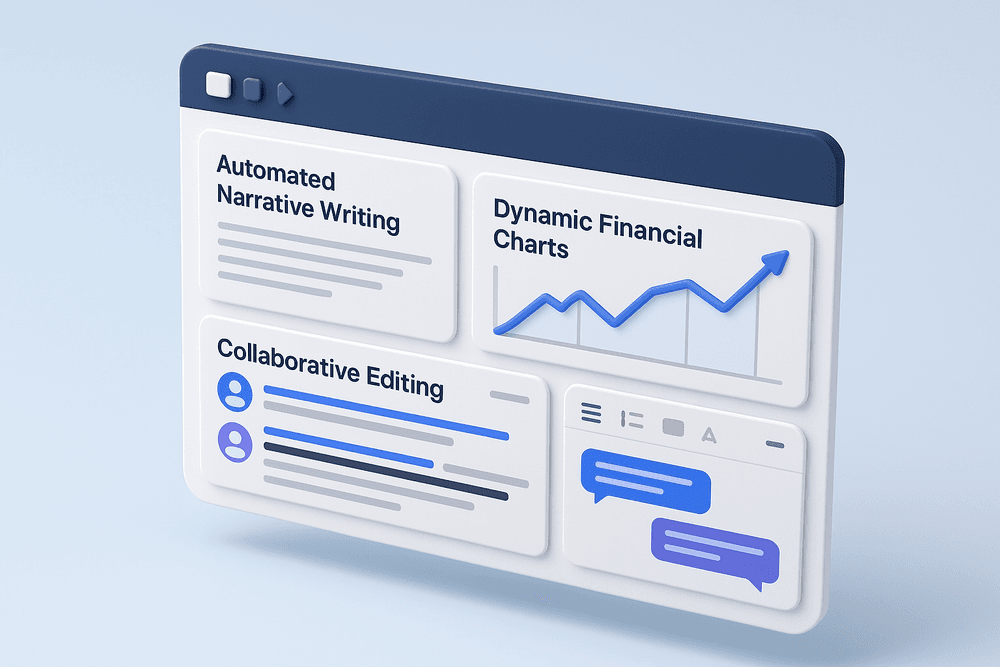
Navigating the world of AI-powered tools can be overwhelming, but choosing the right ai grant proposal generator comes down to its core capabilities. The most effective platforms are more than just advanced spell-checkers; they are comprehensive partners in your funding journey. When evaluating your options, prioritize tools that offer a robust suite of features designed to streamline your workflow, strengthen your narrative, and increase your chances of success. Here are the essential features to look for.
AI-Powered Narrative Crafting and Storytelling
A winning grant proposal tells a compelling story. It must connect with reviewers on an emotional and logical level, clearly articulating a problem and presenting a viable solution. A premier ai grant proposal generator uses sophisticated language models trained on thousands of successful proposals to help you weave this narrative. Look for features that can:
- Generate Persuasive Content: Move beyond basic text generation to create drafts for your executive summary, needs statement, and project description that are both data-driven and emotionally resonant.
- Refine Tone and Voice: Instantly adjust the tone of your writing to match the specific preferences of a foundation, whether it's academic and formal or passionate and community-focused.
- Structure Your Argument: Help organize your thoughts into a logical flow, ensuring each section builds effectively on the last to create a convincing case for funding.
Intelligent Funder Matching and Requirement Analysis
Finding the right funder is half the battle. The best AI tools eliminate the guesswork and countless hours of manual research. This feature acts as a strategic matchmaker, connecting your project with funders whose missions and priorities align perfectly with yours. Key functions include:
- Smart Prospecting: The AI scans a vast database of foundations, government grants, and corporate funders to identify the best potential matches based on your project scope, location, and goals.
- Requirement Deconstruction: An advanced ai grant proposal generator can instantly analyze a funder's complex Request for Proposal (RFP) or guidelines and transform them into an actionable checklist or proposal outline. This ensures you address every single requirement, preventing disqualification due to a simple oversight.
Automated Budgeting and Financial Projection Tools
A clear, accurate, and justifiable budget is critical for building trust with funders. However, creating one can be a tedious and error-prone process. AI-driven financial tools bring precision and efficiency to this crucial task. A powerful platform should offer:
- Template-Based Budget Creation: Generate detailed, compliant budget tables with pre-defined categories for personnel, direct costs, and indirect costs.
- Automated Calculations: Eliminate mathematical errors by letting the AI handle calculations for salaries, fringe benefits, and overhead rates.
- Budget Narrative Generation: Create a clear, concise narrative that explains and justifies each line item, directly linking your expenses to your project activities and outcomes.
Real-Time Collaboration and Feedback Integration
Grant writing is rarely a solo endeavor. It involves input from program managers, finance officers, and other key stakeholders. A modern ai grant proposal generator must function as a central hub for teamwork. Look for built-in collaborative features such as:
- Shared Workspaces: Allow multiple team members to access, edit, and comment on the proposal simultaneously.
- Version Control: Easily track changes and revert to previous versions, ensuring nothing important gets lost in the revision process.
- Smart Feedback Integration: The most advanced systems can analyze comments from your team and suggest concrete edits, helping you incorporate feedback efficiently while maintaining a consistent voice throughout the document.
How to Write a Grant-Winning Application with an AI Grant Proposal Generator
Turning a brilliant idea into a funded project requires a proposal that is clear, compelling, and meticulously crafted. An AI grant proposal generator doesn't replace your passion and expertise; it amplifies it. By blending advanced technology with your strategic vision, you can streamline the writing process and significantly increase your chances of success. Here’s a four-step guide to making it happen.
Step 1: Input Your Core Project Data and Mission Statement
The quality of your grant proposal begins with the quality of your input. Think of the AI as a brilliant but uninformed partner. Your first task is to provide it with the foundational building blocks of your project. This isn't just about copying and pasting; it's about feeding the system clear, concise, and comprehensive information.
Start by uploading or inputting key documents and data points, including:
- Your Mission and Vision Statements: This sets the overarching tone and purpose.
- The Problem Statement: Clearly define the need your project addresses, supported by relevant statistics and research.
- Project Goals and Objectives: Use the SMART (Specific, Measurable, Achievable, Relevant, Time-bound) framework.
- Target Population: Describe who you serve and why.
- Budget Summary: Provide a high-level overview of your financial needs.
The more detailed and well-organized your initial data, the more relevant and powerful the AI’s first draft will be.
Step 2: Generate and Refine the Proposal's Narrative and Structure
Once the AI grant proposal generator has your core information, it gets to work. In minutes, it will produce a structured first draft, complete with all the essential sections: an executive summary, a needs statement, a project description, evaluation methods, and organizational background.
This draft is your powerful starting point, not the finished product. Now is the time for your human expertise to shine. Read through the generated text and ask critical questions:
- Does the narrative flow logically?
- Is the "why" of your project coming through with passion?
- Are there opportunities to insert a powerful anecdote or a specific client story?
Use the AI’s structured output as a scaffold. Your role is to refine the language, strengthen the arguments, and infuse the document with the authentic voice of your organization. This collaborative process ensures the final proposal is both professionally structured and deeply resonant.
Step 3: Leverage AI to Review for Clarity, Tone, and Compliance
Now, shift the AI’s role from writer to editor. A sophisticated AI grant proposal generator can analyze your refined draft for critical elements that grant reviewers look for. You can instruct the tool to:
- Check for Clarity and Conciseness: Ask it to identify jargon, simplify complex sentences, and ensure the entire document is easy to understand.
- Adjust the Tone: Prompt the AI to make the tone more persuasive, urgent, or academic, depending on the specific funder’s preferences.
- Ensure Compliance: This is a game-changer. Upload the funder's guidelines or RFP, and the AI can cross-reference your proposal to flag any missing components, unanswered questions, or formatting errors. This step alone can save you from an immediate disqualification due to a simple oversight.
Step 4: Finalize and Export Your Funder-Ready Document
With the narrative refined and compliance checked, you’re on the home stretch. Perform one last, thorough read-through yourself. The AI is brilliant at catching grammatical errors and structural issues, but your human eye will catch the subtle nuances of your organization's voice. Once you are confident that the proposal perfectly represents your project, use the tool to export it into the required format, whether it’s a polished PDF or an editable Word document. You’ll have a professional, compelling, and compliant proposal ready for submission, completed in a fraction of the time.
Putting AI to the Test: Top AI Grant Proposal Generator Platforms
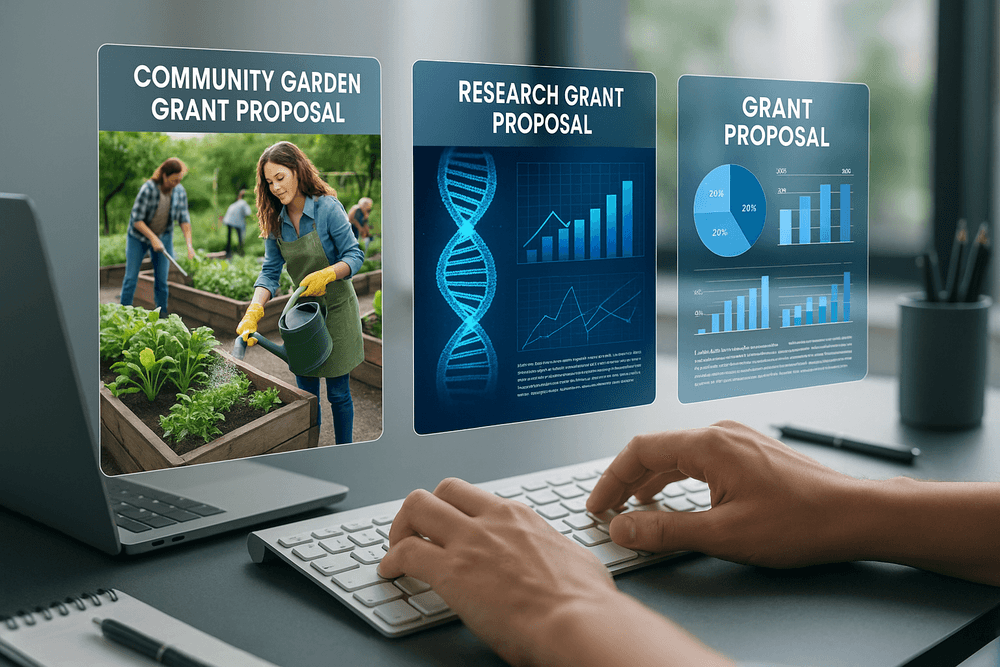
With a growing number of tools on the market, choosing the right ai grant proposal generator can feel overwhelming. The best platform for a small community garden project will differ significantly from the one needed by a major research university. To help you navigate the options, we’ve broken down our top picks based on their ideal user, highlighting the features that make them stand out.
GrantWriterAI: Best for Small Non-Profits and Community Projects
For small non-profits, grassroots organizations, and community-focused initiatives, resources are often tight. GrantWriterAI is designed with this reality in mind, prioritizing simplicity, affordability, and speed. It strips away overly complex features in favor of a streamlined, intuitive workflow that even a volunteer grant writer can master in minutes.
The platform excels at helping you tell your organization's story. Its narrative-building modules guide you through crafting a compelling case for support, transforming your mission and activities into the persuasive language funders want to see.
Key Features:
- Template-Driven Process: Access a rich library of templates tailored for common grants, including those from local foundations and community trusts.
- Budget Builder: A simplified tool helps you create clear and concise project budgets, a common stumbling block for smaller organizations.
- Impact Statement Generator: Helps articulate your project's potential outcomes and community benefits in clear, powerful terms.
- Affordable Subscription Tiers: Pricing is structured to be accessible, ensuring even organizations with the tightest budgets can leverage AI power.
SciFund Pro: The Top Choice for Scientific and Research Grants
Scientific and research proposals demand an exceptional level of precision, technical accuracy, and adherence to strict formatting guidelines from bodies like the NIH and NSF. SciFund Pro is a specialized ai grant proposal generator built specifically for this high-stakes environment. It goes beyond basic text generation to act as a research assistant.
Its core strength lies in its ability to process and structure complex information. The AI is trained on a massive corpus of successful scientific grants, enabling it to refine technical jargon, suggest appropriate methodological language, and ensure your data presentation is logical and compelling. It helps researchers translate brilliant ideas into fundable projects.
Key Features:
- Technical Language Refinement: Analyzes and improves the clarity and accuracy of scientific terminology.
- Literature Review Assistance: Can help summarize existing research and pinpoint knowledge gaps to strengthen your proposal's rationale.
- Funder Guideline Compliance: Cross-references your draft against specific funder requirements (e.g., page limits, section headers, biosketch formatting).
- Data Section Structuring: Provides frameworks for presenting your research design, methodology, and data analysis plan effectively.
Impactor: Ideal for Large-Scale, Enterprise-Level Fundraising
For large institutions like universities, hospital networks, and international NGOs, grant writing is a complex, collaborative, and continuous operation. Impactor is an enterprise-grade platform designed to function as the central nervous system for a sophisticated development department. It’s less of a single tool and more of a comprehensive grant management ecosystem.
Impactor integrates collaboration, project management, and powerful analytics. It allows dozens of stakeholders—from program managers and researchers to finance officers and lead grant writers—to work in a single, secure environment. This platform is built for organizations managing a high volume of complex, high-value grant applications simultaneously.
Key Features:
- Collaborative Workspace: Features real-time editing, version control, and role-based permissions for seamless teamwork.
- CRM and Database Integration: Syncs with systems like Salesforce and Blackbaud to align grant efforts with broader fundraising and donor data.
- Advanced Performance Analytics: Tracks success rates by funder, project type, and writing team, providing data-driven insights to refine future strategies.
- Grant Lifecycle Management: Manages the entire process from prospect research and proposal creation to post-award reporting.
Real-World Success: How Teams Win with an AI Grant Proposal Generator
The true measure of any tool is its impact. Beyond the features and functions, how does an ai grant proposal generator actually help organizations achieve their missions? The answer lies in tangible results: more funding, reclaimed time, and stronger, more compelling proposals. These real-world examples showcase how teams are leveraging AI to turn grant writing from a hurdle into a strategic advantage.
Case Study: Securing 50% More Funding for a Community Arts Program
"ArtReach," a small nonprofit dedicated to providing free arts education in underserved neighborhoods, was struggling to scale. Their passionate, two-person team spent months crafting proposals but often faced rejection from larger foundations, leaving their impact limited. They needed a way to compete without hiring a dedicated grant writer.
By implementing an ai grant proposal generator, ArtReach transformed its approach. The tool helped them:
- Tailor Applications at Scale: Instead of reusing generic language, they quickly customized proposals to perfectly align with each funder’s specific mission and language.
- Craft Data-Driven Narratives: The AI assisted in weaving their program statistics into compelling stories, clearly demonstrating their impact on community engagement and student outcomes.
- Refine and Polish: The generator acted as a co-writer, suggesting stronger verbs, clarifying objectives, and ensuring a professional tone throughout.
The result? In their next funding cycle, ArtReach secured three major grants they had previously been denied, increasing their annual funding by over 50%. This allowed them to hire two new instructors and double the number of students they serve.
Boosting Efficiency: How a Small Research Team Saved 100+ Writing Hours
For a university research lab studying climate change, the grant writing process was a major bottleneck. The principal investigators were brilliant scientists but not professional writers. Each major proposal to national science foundations would consume over 150 hours, pulling them away from their critical research.
Adopting an ai grant proposal generator became a game-changer. The team used the AI to handle the heavy lifting of proposal creation. They uploaded their research data, previous papers, and the specific grant requirements. The AI then generated a structured, well-written first draft, complete with sections for methodology, budget justification, and project timelines. The researchers could then focus their expertise on refining the scientific details rather than starting from a blank page. The lab estimates they now save over 100 hours per proposal, allowing them to submit more applications and spend more time in the lab making discoveries.
Avoiding Critical Errors: How AI Catches Common Rejection Triggers
One of the most frustrating aspects of grant writing is rejection based on a simple, avoidable mistake. A misaligned budget, a missing appendix, or language that doesn't resonate with the funder's stated priorities can lead to an immediate "no." An ai grant proposal generator serves as a crucial safeguard against these common pitfalls.
Think of it as an intelligent proofreader that understands grant requirements. These tools can:
- Check for Alignment: By analyzing the funder’s guidelines, the AI can flag sections of your proposal that deviate from the stated priorities or formatting rules.
- Ensure Cohesion: It reviews the entire document for internal consistency, ensuring the budget narrative matches the figures in the spreadsheet and the objectives align with the proposed activities.
- Identify Weak Language: The AI suggests alternatives for vague or unclear statements, helping you articulate your mission and impact with precision and confidence.
By catching these errors before submission, the AI helps ensure your proposal is judged on its merit, not on a preventable mistake.
Conclusion: Amplify Your Impact with an AI Grant Proposal Generator
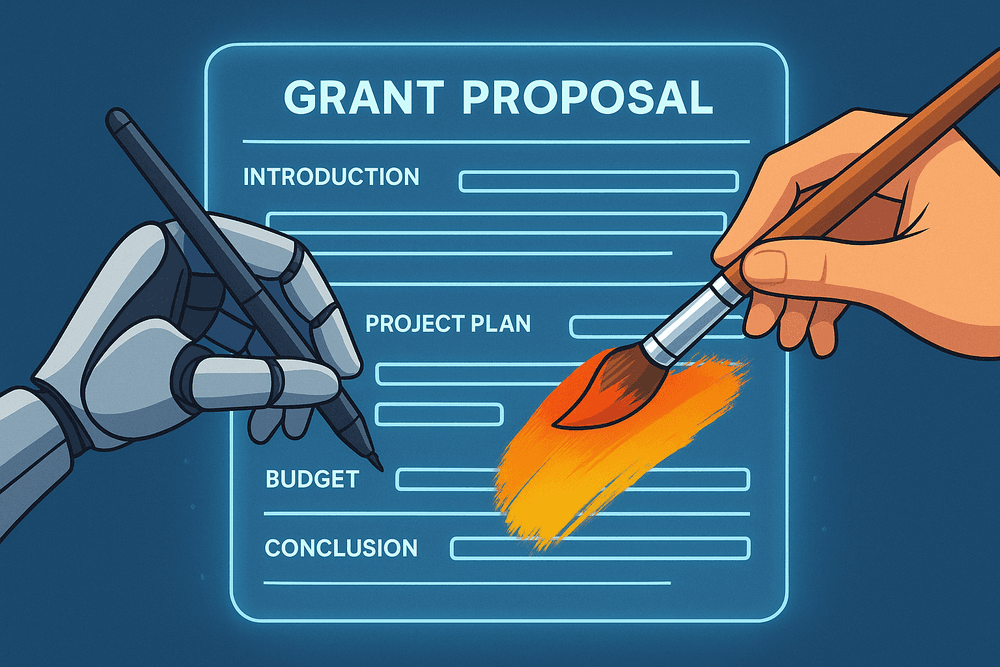
The landscape of fundraising is evolving, and the grant writing process is no exception. We’ve journeyed through the immense potential of AI, exploring how it can transform tedious tasks into strategic opportunities. The key takeaway is clear: an ai grant proposal generator is not a replacement for the passionate, dedicated people behind a mission. Instead, it’s a powerful co-pilot, designed to amplify your expertise, streamline your workflow, and ultimately, help you secure the funding your organization deserves. It’s about working smarter, not harder, to fuel the change you want to see in the world.
Final Checklist: Is an AI Grant Proposal Generator Your Next Strategic Move?
Before you take the leap, it's crucial to determine if this technology aligns with your organization's current needs and goals. Ask yourself and your team these critical questions:
- Are we bottlenecked by bandwidth? Do you find your team constantly struggling to meet deadlines or forgoing grant opportunities simply because you lack the time to write a quality proposal?
- Do we struggle with consistency? Does the tone, style, and data presentation vary significantly from one proposal to the next, depending on the writer? An AI tool can establish a consistent, professional baseline.
- Could our narratives be more compelling? Do you need help transforming raw data and program outcomes into a powerful, persuasive story that resonates with funders?
- Are we spending too much time on foundational drafts? If your experts are bogged down with structuring documents and writing repetitive sections, an ai grant proposal generator can free them to focus on high-level strategy and refinement.
If you answered "yes" to one or more of these questions, integrating an AI tool could be a game-changing decision for your funding strategy.
Your Next Steps to Secure Funding with AI
Ready to move from consideration to action? Here’s a simple roadmap to begin harnessing the power of AI for your grant writing:
- Research and Select: Revisit the key features discussed in this guide. Identify the ai grant proposal generator that best fits your workflow, whether you need robust research capabilities, advanced narrative crafting, or budget-building assistance.
- Start with a Pilot Project: Don't try to overhaul your entire process overnight. Choose a single, upcoming grant and use the AI tool to assist with one specific section, like the needs statement or the project description.
- Learn and Refine: Treat the AI like any new team member. Learn how to communicate with it effectively through clear, detailed prompts. The more context you provide, the better the output will be.
- Integrate and Scale: As you become more comfortable, integrate the tool more deeply into your workflow. Use it to create templates, summarize research, and generate initial drafts for review, scaling its use across your development team.
Combining AI Efficiency with Your Essential Human Passion
Ultimately, the most successful grant proposals are born from a perfect synergy: the efficiency of technology and the irreplaceable passion of the human heart. An ai grant proposal generator excels at organizing information, structuring arguments, and ensuring every data point is perfectly placed. It handles the mechanics of proposal writing with speed and precision.
This leaves you—the visionary, the strategist, the storyteller—with more time and mental energy to focus on what AI cannot replicate: your deep understanding of the community you serve, your genuine connection to the mission, and the authentic passion that inspires funders to invest. Let AI build the framework, so you can fill it with the soul of your organization. This winning combination doesn't just create better proposals; it frees you to do more of the work that truly matters.