October 21, 2025
Rethinking Security Compliance with AI
The Future is Now: Rethinking Security Compliance with AI
In today's hyper-connected digital landscape, the concept of security is in constant flux. Threats evolve, regulations tighten, and the data an organization must protect expands exponentially. Against this backdrop, traditional, manual approaches to security compliance are becoming relics of a simpler time. The future belongs to a smarter, more adaptive strategy: AI-driven security compliance. This isn't just about faster audits; it's about fundamentally transforming how we view and manage our security posture.
What is AI-Driven Security Compliance?
AI-driven security compliance moves beyond static checklists and periodic reviews. It is the application of artificial intelligence and machine learning to continuously monitor, analyze, and manage an organization's adherence to regulatory frameworks like GDPR, HIPAA, and PCI DSS. Instead of simply verifying if a control is in place, AI-powered systems can interpret vast amounts of data from across your network—logs, user activity, system configurations—to provide real-time insights.
This intelligent automation can identify potential compliance gaps before they become critical vulnerabilities, predict emerging risks based on subtle patterns, and even recommend or execute remediation actions automatically. It transforms security compliance from a reactive, point-in-time assessment into a proactive, continuous, and integrated part of your security operations.
Why Manual Compliance Audits Are No Longer Enough
The manual audit process is straining under the weight of modern IT complexity. Cloud environments, IoT devices, and distributed workforces have created a sprawling attack surface that is impossible for human teams to monitor effectively. Manual audits are inherently slow, resource-intensive, and prone to human error. They provide a mere snapshot of your compliance status, which can be outdated the moment the audit is complete.
Furthermore, the sheer volume of data and the ever-growing list of controls make manual verification a Herculean task. A single misconfiguration overlooked in a mountain of logs can lead to a significant breach and devastating non-compliance penalties. In a world of sophisticated, automated threats, relying on a slow, manual defense is like bringing a knife to a gunfight. The speed and scale of today’s digital operations demand a more dynamic approach to security compliance.
The Business Case for Automating Your Security Posture
Adopting an AI-driven approach to security compliance is not just a technical upgrade; it's a strategic business decision with a clear return on investment. The primary benefit is a massive leap in efficiency. By automating routine monitoring and evidence collection, you free up your highly skilled security professionals to focus on strategic threat mitigation rather than tedious paperwork.
This automation leads to significant cost savings by reducing the man-hours required for audit preparation and execution. More importantly, it dramatically improves accuracy and reduces risk. AI provides continuous, 24/7 visibility into your compliance posture, allowing you to identify and remediate issues in real-time, not months later. This proactive stance strengthens your overall security, builds trust with customers and partners, and ensures your organization can scale its operations without outgrowing its ability to stay secure and compliant.

How AI Transforms Traditional Security Compliance Frameworks
Traditional approaches to security compliance are notoriously manual, time-consuming, and reactive. Teams spend countless hours chasing down evidence, preparing for annual audits, and struggling to keep policies up-to-date. This "point-in-time" snapshot often fails to capture the dynamic reality of modern IT environments. Artificial intelligence is rewriting this narrative, transforming security compliance from a periodic burden into a continuous, automated, and proactive discipline. By integrating AI, organizations can achieve a more robust and resilient compliance posture while freeing up valuable resources.
Automating Evidence Collection for NIST, ISO 27001, and SOC 2
One of the biggest drains on resources during an audit cycle is evidence collection. Manually gathering screenshots, configuration files, access logs, and policy documents for frameworks like NIST, ISO 27001, and SOC 2 is a monumental task prone to human error.
AI-driven platforms eliminate this friction. By integrating directly with your cloud providers (AWS, Azure, GCP), SaaS applications, and infrastructure, these tools act as a central evidence repository. They automatically and continuously pull relevant data, map it to specific framework controls, and organize it in an audit-ready format. Instead of spending weeks on manual collection, compliance teams can access a dashboard with up-to-the-minute evidence. This not only accelerates audits but also ensures the evidence is consistent, complete, and accurately reflects the state of your security controls, solidifying your security compliance foundation.
Leveraging AI for Continuous Monitoring and Control Validation
Compliance isn’t a once-a-year event; it’s an ongoing state. Traditional audits only verify compliance at a single moment, leaving dangerous gaps where configurations can drift and vulnerabilities can emerge. AI shifts the paradigm from periodic auditing to continuous assurance.
AI-powered systems constantly monitor your entire technology stack, validating that security controls are operating as intended. These tools can automatically check for things like:
- Are multi-factor authentication (MFA) policies enforced on all critical accounts?
- Is data encryption enabled on all storage volumes?
- Are access permissions aligned with the principle of least privilege?
If a control fails or a configuration deviates from your established baseline, the AI system generates an immediate alert. This allows security teams to remediate issues in real-time, long before they become a finding in an official audit. This proactive approach turns security compliance into a live, dynamic process that genuinely enhances security posture.
AI-Powered Policy Management and Enforcement
Security policies are the bedrock of any compliance program, but they are useless if they exist only on paper. Enforcing these policies across a sprawling, hybrid environment is a significant challenge. AI provides the intelligence and automation needed to bridge the gap between policy and practice.
AI tools can ingest your organization’s security policies and translate them into machine-readable rules that can be monitored and enforced automatically. For example, a policy requiring all new virtual machines to be scanned for vulnerabilities can be implemented as an automated workflow. Furthermore, AI can assist in policy creation by recommending specific controls based on the compliance frameworks you need to adhere to. It can also manage the entire policy lifecycle, from creation and distribution to exception tracking and annual reviews, ensuring your governance framework remains effective and your security compliance efforts are always aligned with documented standards.
Essential Features of AI-Driven Security Compliance Platforms
As organizations integrate artificial intelligence into their GRC (Governance, Risk, and Compliance) strategies, it's crucial to understand that not all platforms are created equal. The true power of AI in this space lies in specific, transformative capabilities. These core features are what separate a basic automation tool from a dynamic, intelligent system that redefines how you achieve and maintain security compliance.
Real-Time Threat Intelligence and Anomaly Detection
Static, rule-based security systems are no longer sufficient. Modern AI-driven platforms operate in a state of constant vigilance, continuously ingesting and analyzing a massive stream of global threat intelligence. But where they truly excel is in learning your organization’s unique digital heartbeat. By establishing a baseline of normal network activity, user behavior, and data flow, the AI can instantly identify anomalies—subtle deviations that could signal a sophisticated attack or an internal compliance breach. This immediate detection is a cornerstone of robust security compliance, enabling organizations to meet the stringent breach notification timelines required by frameworks like GDPR and CCPA, shifting the posture from reactive cleanup to proactive defense.
Automated Audit Trail Generation and Reporting
The days of manually gathering evidence for audits are over. A key feature of an advanced AI platform is its ability to create a comprehensive, immutable audit trail automatically. Every user action, system change, and access request is logged, timestamped, and contextualized without human intervention. This eliminates the risk of incomplete or altered records. Furthermore, the AI can translate this vast log of data into audit-ready reports tailored to specific regulatory standards like PCI DSS, HIPAA, or ISO 27001. With the click of a button, compliance managers can generate the precise evidence auditors need, drastically reducing preparation time, minimizing human error, and ensuring a smoother, more successful audit experience.
Predictive Analytics for Proactive Risk Management
While real-time detection is about identifying current threats, predictive analytics is about preventing future ones. By leveraging machine learning models, these platforms analyze historical incident data, system vulnerabilities, and evolving threat patterns to forecast potential security compliance gaps. The AI can identify toxic combinations of risk—such as a user with excessive permissions accessing a system with a known vulnerability—and flag them before an incident occurs. This foresight allows security teams to move beyond a reactive, checklist-based approach. It enables them to prioritize remediation efforts based on calculated risk, proactively strengthening controls where they are most likely to be tested and maintaining a state of continuous compliance.
Natural Language Processing for Policy Interpretation
Compliance frameworks and internal security policies are often dense, complex documents that are difficult for both machines and humans to interpret. This is where Natural Language Processing (NLP) becomes a game-changer. NLP, a sophisticated branch of AI, can read, understand, and contextualize these documents. It can automatically map intricate regulatory requirements from a new law to your existing internal controls, highlighting gaps that need to be addressed. It can also power intelligent chatbots that allow employees to ask plain-language questions about security policies and receive instant, accurate answers. This capability ensures that your security compliance program is not just a document on a server but a living, understood, and enforceable set of principles across the entire organization.
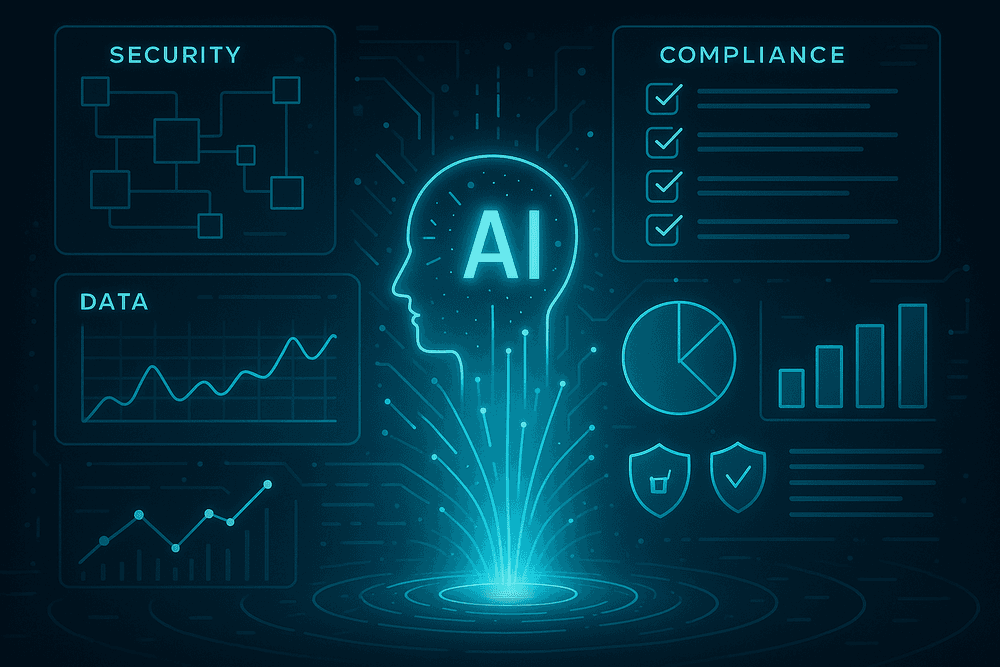
Implementing AI for Better Security Compliance: A Step-by-Step Guide
Transitioning to an AI-powered compliance strategy isn't about flipping a switch; it's a deliberate process of integration, training, and measurement. A thoughtful implementation ensures that AI becomes a powerful ally, not just another complex tool. By following a structured approach, you can unlock the full potential of AI to fortify your security compliance posture.
Integrating AI with Your Existing SIEM and GRC Tools
Your current Security Information and Event Management (SIEM) and Governance, Risk, and Compliance (GRC) platforms are rich sources of data. The first step is not to replace them but to enhance them. Modern AI compliance solutions are designed to integrate seamlessly via APIs, creating a unified ecosystem.
Start by identifying the key data feeds. Connect your AI platform to your SIEM to analyze real-time event logs, threat intelligence, and alerts. This allows the AI to correlate disparate events and identify potential compliance violations that a human analyst might miss. Simultaneously, link it to your GRC tool to give the AI context about your organization’s specific policies, risk registers, and control frameworks (like NIST, ISO 27001, or GDPR). This synergy transforms your existing tools from passive repositories into an active, intelligent defense system for maintaining continuous security compliance.
Training and Fine-Tuning AI Models with Organizational Data
An off-the-shelf AI model understands general threats, but it doesn’t understand your business. The true power of AI is unlocked through customization. This involves training and fine-tuning the models with your unique organizational data. Begin by feeding the AI with historical data, including past audit reports, incident response logs, policy exception records, and vulnerability scan results.
This process teaches the AI what "normal" looks like for your specific environment and what constitutes a deviation from your established security compliance baseline. For instance, by analyzing past audit findings, the AI can learn to proactively identify similar patterns before your next official audit. Fine-tuning ensures the AI’s alerts are highly relevant, significantly reducing false positives and allowing your security team to focus on genuine risks.
Ensuring Transparency and Explainability in AI-Driven Audits
A common concern with AI is the "black box" problem—getting an answer without understanding the reasoning. For compliance and audits, this is a non-starter. Regulators and auditors require clear, defensible evidence. Therefore, prioritize AI solutions that emphasize Explainable AI (XAI).
An explainable AI system doesn't just flag a potential non-compliance issue; it provides a clear audit trail. It should be able to articulate why an activity was flagged, which specific control or policy it violates, and present the correlated evidence it used to reach that conclusion. This transparency is crucial. It builds trust with auditors, simplifies remediation efforts, and ensures that your team can validate the AI’s findings, maintaining human oversight over the entire security compliance process.
Measuring the ROI of Your AI Compliance Investment
To justify the investment in AI, you must measure its impact. The return on investment (ROI) for AI in security compliance extends beyond simple cost savings. Track a combination of quantitative and qualitative metrics to build a comprehensive business case.
Key metrics to monitor include:
- Reduced Audit Preparation Time: Measure the decrease in person-hours required to gather evidence and prepare for internal and external audits.
- Faster Non-Compliance Detection: Track the mean time to detect (MTTD) policy violations or control failures.
- Decreased Fines and Penalties: The most direct financial metric is the reduction in costs associated with compliance breaches.
- Improved Team Productivity: Quantify the time security and compliance teams save by automating repetitive tasks, allowing them to focus on strategic initiatives.
By tracking these KPIs, you can demonstrate how AI is not an expense but a strategic investment that strengthens security, reduces risk, and drives operational efficiency.
Real-World Wins: AI in Security Compliance Use Cases
The theoretical power of AI is impressive, but its true value is measured in practical application. Across heavily regulated industries, organizations are already leveraging artificial intelligence to transform their security compliance from a reactive, manual burden into a proactive, automated strength. These real-world use cases demonstrate how AI is not a future concept but a present-day solution for navigating complex regulatory landscapes.
Streamlining HIPAA and HITRUST in Healthcare
The healthcare industry operates under a microscope of regulatory scrutiny, with frameworks like HIPAA (Health Insurance Portability and Accountability Act) and HITRUST (Health Information Trust Alliance) demanding rigorous protection of Protected Health Information (PHI). The sheer volume of patient data makes manual oversight nearly impossible.
This is where AI delivers a critical advantage. AI-powered platforms continuously monitor electronic health record (EHR) systems and network logs for anomalous activity. For instance, a machine learning model can learn the typical data access patterns of a nurse and instantly flag when their credentials are used to access patient records outside their department or at an unusual hour. This proactive threat detection is a cornerstone of modern HIPAA security compliance. Furthermore, AI tools automate evidence gathering for HITRUST assessments by continuously mapping existing security controls to specific requirements, identifying gaps in real-time and drastically reducing the manual effort required for certification.
Automating PCI DSS Reporting in the Finance Sector
For any organization that processes, stores, or transmits credit card information, the Payment Card Industry Data Security Standard (PCI DSS) is non-negotiable. Proving continuous compliance through quarterly scans and annual Reports on Compliance (ROC) is a resource-intensive cycle.
AI is revolutionizing this process by shifting from point-in-time snapshots to continuous validation. AI-driven security compliance tools integrate with firewalls, servers, and endpoint security systems to automatically collect and analyze the necessary data. Instead of waiting for a scheduled scan, these platforms can immediately detect a misconfiguration—like an open port that violates a PCI DSS rule—and trigger an alert. They can even automate the generation of compliance reports by populating them with real-time, validated evidence, transforming a weeks-long manual task into a streamlined, on-demand process. This not only saves countless hours but also significantly reduces the risk of a breach going undetected between formal assessments.
Maintaining GDPR and CCPA Adherence for Consumer Data
Privacy regulations like the EU’s General Data Protection Regulation (GDPR) and the California Consumer Privacy Act (CCPA) have empowered consumers with rights over their personal data, including the right to access and delete it. Fulfilling these Data Subject Access Requests (DSARs) can be a logistical nightmare, requiring organizations to find every piece of a user’s data across countless systems.
AI-powered data discovery and classification engines are the definitive solution. These tools use Natural Language Processing (NLP) and machine learning to scan structured and unstructured data repositories—from databases to cloud storage and email archives—to automatically identify and tag Personal Identifiable Information (PII). When a DSAR is submitted, the AI can quickly locate all relevant data, automate the compilation process, and even assist in redacting sensitive information. This ensures organizations can respond accurately and within the legally mandated timeframe, avoiding staggering fines and building crucial customer trust.
Conclusion: Your Next Steps in Automated Security Compliance
The journey toward modern, resilient security compliance is no longer paved with manual checklists and frantic, last-minute audits. As we've explored, AI-driven automation has fundamentally transformed the landscape, turning a reactive, often burdensome process into a proactive, continuous, and strategic advantage. Embracing this shift is not just about keeping up with technology; it's about building a more secure and agile organization. The question is no longer if you should automate your security compliance, but how you can start today.
How to Choose the Right AI-Powered Security Compliance Tool
Selecting the right platform is the most critical step in your automation journey. A powerful tool does more than just tick boxes; it becomes an integral part of your security ecosystem. As you evaluate your options, prioritize solutions that offer a holistic approach to security compliance.
Look for these key features:
- Broad Framework Support: Ensure the tool supports the frameworks and regulations relevant to your business, such as SOC 2, ISO 27001, NIST, GDPR, HIPAA, and PCI DSS. The best platforms offer a library of controls that map across multiple frameworks, saving you from redundant work.
- Seamless Integrations: The tool must connect effortlessly with your existing tech stack—cloud providers (AWS, Azure, GCP), development tools (Jira, GitHub), and HR systems (Gusto, Rippling). This is essential for automated evidence collection and continuous monitoring.
- Real-Time Monitoring and Alerting: Static compliance is a thing of the past. Your chosen solution should continuously monitor your environment for misconfigurations and policy deviations, providing real-time alerts so you can remediate issues before they become audit findings.
- Intuitive Dashboards and Reporting: A clear, centralized dashboard is vital for gaining at-a-glance insights into your security compliance posture. Look for customizable reporting features that make it easy to demonstrate compliance to auditors, executives, and other stakeholders.
Key Questions to Ask Potential Vendors
Before you commit to a platform, arm yourself with the right questions to vet potential partners thoroughly. This will help you see beyond the marketing materials and understand how their solution will work in your specific environment.
- How does your platform automate the evidence collection process for audits?
- Can you demonstrate how your AI/ML models reduce false positives and alert fatigue for my security team?
- What is the typical onboarding and implementation process like, and what level of support can we expect?
- How does your tool map controls and policies across multiple security compliance frameworks to avoid duplicate efforts?
- What is your product roadmap for supporting new and emerging regulations and technologies?
- Can you provide case studies or references from companies of a similar size and in a similar industry to ours?
Start Your Journey to a More Secure and Compliant Future
Moving to an AI-driven approach is a strategic imperative for any forward-thinking organization. It allows you to transform security compliance from a costly, time-consuming obligation into a streamlined, automated business function that actively strengthens your security posture. By choosing the right tool and partner, you can free up your team to focus on strategic initiatives, reduce human error, and achieve a state of continuous, audit-ready compliance. The path to a more secure, efficient, and scalable future is clear. Your journey begins with the first step toward intelligent automation.