
November 10, 2025
How AI in Market Research is Changing the Game
The Future is Now: How AI in Market Research is Changing the Game
For decades, market research has been a cornerstone of business strategy, but the tools of the trade—surveys, focus groups, and manual data analysis—have often been slow, expensive, and limited in scope. Today, a seismic shift is underway. The integration of AI in market research is not just an incremental improvement; it’s a complete paradigm shift, transforming how businesses understand their customers, competitors, and the market itself.
So, what exactly is AI-powered market research? It’s the application of artificial intelligence technologies like machine learning (ML), natural language processing (NLP), and predictive analytics to the entire research lifecycle. Instead of manually coding survey responses or spending weeks sifting through spreadsheets, AI algorithms can process, categorize, and analyze massive datasets in a matter of minutes. This technology can scan millions of social media posts, product reviews, news articles, and customer service transcripts to uncover trends, sentiments, and insights that would be impossible for a human team to find.
Moving Beyond the Limitations of Traditional Methods
Traditional market research has always faced inherent challenges. Sample sizes were often too small to be truly representative, human bias could unconsciously skew interpretations, and the time lag between data collection and final reporting meant insights were often outdated by the time they reached decision-makers. The digital age, with its explosion of unstructured data (text, images, video), has only amplified these limitations.
This is where AI in market research steps in to change the game. It breaks down these barriers by:
- Automating at Scale: AI eliminates the manual, time-consuming tasks of data collection and cleansing, freeing up researchers to focus on higher-level strategic analysis.
- Analyzing Unstructured Data: NLP allows machines to understand the context, sentiment, and emotion within human language, turning millions of raw comments and reviews into structured, quantifiable insights.
- Removing Human Bias: By relying on algorithms to identify patterns, AI can provide a more objective view of the data, reducing the risk of researchers finding only what they expect to find.
How AI Provides a Significant Competitive Edge
Adopting AI isn't just about efficiency; it's about gaining a powerful competitive advantage. Businesses leveraging AI in market research can move faster, make smarter decisions, and build a profoundly deeper connection with their customers.
The primary edge comes from three key areas:
- Speed to Insight: In a fast-moving market, speed is everything. AI can deliver real-time insights, allowing companies to react instantly to competitor moves, emerging trends, or shifts in consumer sentiment.
- Depth of Understanding: AI goes beyond the "what" to uncover the "why." Sentiment analysis can reveal not just if customers like a product, but what specific features they love or hate and the emotional intensity behind their opinions.
- Predictive Forecasting: Perhaps the most significant advantage is the shift from reactive analysis to proactive strategy. AI-powered predictive models can forecast future trends, predict customer churn, and identify new market opportunities, allowing businesses to act on what’s next, not just what’s already happened.
Core Applications of AI in Market Research You Need to Know
AI is no longer a futuristic concept; it's a practical toolkit that's actively reshaping how businesses understand their customers. The real power of AI in market research lies in its ability to move beyond simple data collection and into the realm of intelligent, automated, and predictive analysis. By harnessing these capabilities, companies can unlock insights that were previously inaccessible. Let’s explore the core applications that are giving forward-thinking organizations a decisive competitive advantage.
Automating Sentiment Analysis from Customer Feedback
What do your customers really think about your brand, products, and services? Manually sifting through thousands of online reviews, social media comments, and support tickets to find out is a monumental and biased task. AI-powered sentiment analysis automates this process with incredible speed and nuance.
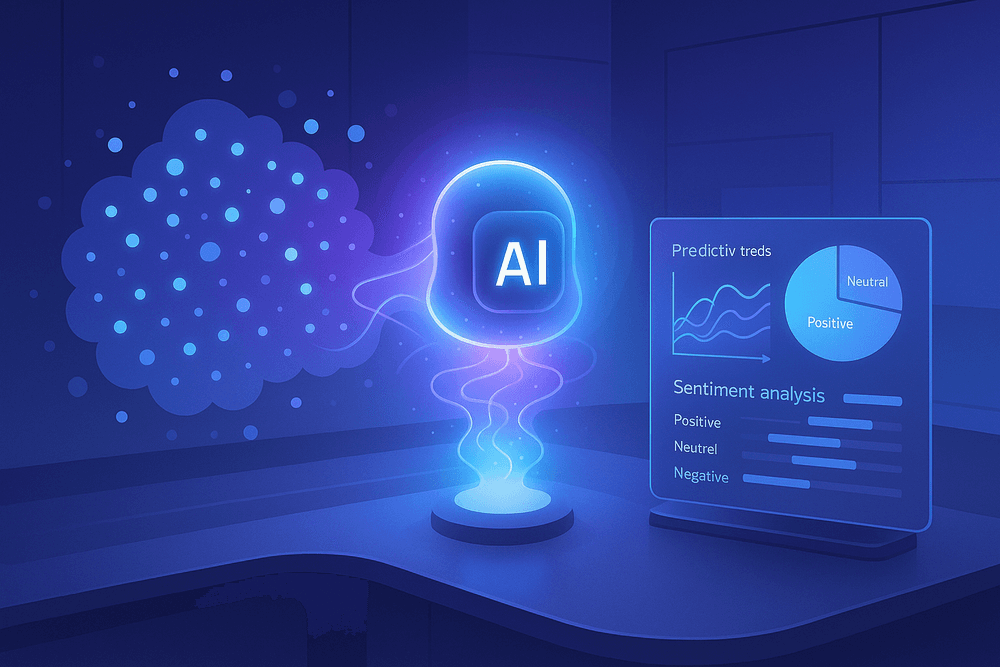
Using Natural Language Processing (NLP), algorithms can analyze vast amounts of unstructured text to identify not just keywords, but the emotion and intent behind them—categorizing feedback as positive, negative, or neutral. This provides a real-time pulse on brand perception and product satisfaction. Instead of waiting weeks for a report, you can instantly see how a new feature is being received or why customer service calls are spiking, allowing for rapid, data-driven responses.
Leveraging Predictive Analytics to Forecast Consumer Trends
The ultimate goal of market research has always been to see what’s around the corner. With predictive analytics, AI in market research makes this a tangible reality. By training machine learning models on extensive historical datasets—including sales figures, web traffic, social media engagement, and even macroeconomic indicators—AI can identify complex patterns to forecast what’s next.
This goes far beyond simple trend lines. It can help you anticipate shifts in consumer behavior, predict demand for new products, and identify emerging market segments before they become mainstream. This proactive intelligence allows businesses to optimize inventory, tailor marketing campaigns, and innovate with confidence, ensuring they stay one step ahead of the competition.
Uncovering Hidden Patterns with Advanced AI Data Analysis
Your data holds valuable secrets that the human eye can easily miss. AI excels at uncovering these hidden patterns and non-obvious correlations within massive datasets. Techniques like cluster analysis can automatically group customers into nuanced segments based on subtle behaviors, not just simple demographics.
For example, an AI might discover a high-value customer segment that buys specific products only during certain times of the year and responds exclusively to a particular type of marketing message. These are the kinds of deep insights that traditional analysis would likely overlook. This capability allows for hyper-targeted strategies and a more profound understanding of the complex drivers behind consumer choices, unlocking new revenue opportunities.
Personalizing Surveys and Feedback Collection at Scale
Traditional surveys are often static and one-size-fits-all, leading to respondent fatigue and incomplete data. AI transforms feedback collection into a dynamic and personalized experience. AI-driven surveys can adapt questions in real-time based on a user's previous answers, digging deeper into relevant topics while skipping irrelevant ones.
This "conversational" approach keeps respondents engaged and yields richer, more contextual data. Furthermore, AI-powered chatbots can be deployed across websites and messaging apps to collect feedback in a natural, interactive way. This application of AI in market research not only boosts completion rates but also makes customers feel that their unique perspective is genuinely valued.
Comparing the Top Tools for AI in Market Research
The explosion of AI in market research has led to a powerful ecosystem of tools designed to extract signal from noise. Choosing the right platform depends entirely on your goals—are you tracking brand perception across the web, analyzing thousands of survey responses, or synthesizing qualitative interview data? Here’s a breakdown of the leading contenders in three critical categories.
For Consumer Intelligence: Brandwatch vs. Talkwalker
When you need to understand the "what" and "why" behind public conversations, social listening and consumer intelligence platforms are your go-to.
- Brandwatch: A giant in the space, Brandwatch leverages its proprietary AI, Iris™, to analyze a colossal dataset of online conversations. Its core strengths lie in sophisticated, multi-language sentiment analysis, advanced image recognition (to find your logo even when your brand isn't tagged), and powerful trend-spotting capabilities. For researchers conducting deep competitive analysis or tracking nuanced brand health metrics over time, Brandwatch provides an incredibly granular and robust toolkit.
- Talkwalker: Talkwalker distinguishes itself with its "conversational intelligence" approach, analyzing text, audio, and visual data to provide a 360-degree view of brand perception. Its AI excels at predictive analytics, helping you spot emerging trends and potential PR crises before they escalate. Users often praise Talkwalker for its comprehensive global data coverage and a highly intuitive interface that makes complex data accessible, making it a powerful choice for international brands seeking actionable, real-time insights.
For AI-Enhanced Survey Analysis: SurveyMonkey vs. Qualtrics AI
Surveys remain a cornerstone of market research, but AI is transforming how we analyze the results, especially open-ended feedback.
- SurveyMonkey: Known for its user-friendliness, SurveyMonkey has integrated smart AI features to democratize data analysis. Its AI-powered "Genius" engine provides real-time feedback on survey design to improve question quality and reduce bias. For analysis, its sentiment analysis and word cloud features automatically process open-text answers, allowing you to quickly identify key themes and emotions from thousands of responses without tedious manual coding. It's a fantastic entry point for teams wanting to leverage AI in market research without a steep learning curve.
- Qualtrics AI: As a comprehensive, enterprise-grade Experience Management (XM) platform, Qualtrics offers a more profound suite of AI tools. Its Text iQ feature uses advanced Natural Language Processing (NLP) to automatically surface topics, sentiment, and effort from any unstructured text source. Qualtrics goes beyond just analysis, using predictive AI to identify at-risk customers or pinpoint key drivers of satisfaction, directly linking insights to business outcomes.
For Qualitative Data Synthesis: Dovetail and Emerging Platforms
Qualitative data from interviews and usability tests is rich but notoriously difficult to analyze at scale. AI is changing the game.
- Dovetail: This platform is a market leader in the research repository space, designed specifically to manage and analyze qualitative data. Dovetail’s AI shines with lightning-fast, accurate transcription of audio and video interviews. More importantly, its AI features can suggest tags and help researchers cluster insights, dramatically accelerating the time it takes to move from raw transcripts to actionable, evidence-based themes. It empowers teams to build a centralized, searchable library of customer knowledge.
- Other Emerging Platforms: This is a rapidly growing area. Tools like Notably, EnjoyHQ, and Condens are also using AI to streamline qualitative workflows. They help researchers tag, organize, and discover patterns across different research studies, creating a "single source of truth" for customer insights that can be easily shared across an organization.

Key Benefits of Implementing AI in Market Research
Adopting artificial intelligence isn't just about embracing new technology; it's about fundamentally upgrading your ability to understand the market and your customers. Integrating AI in market research unlocks a powerful suite of advantages that translate directly into a competitive edge. From unprecedented speed to unbiased analysis, the benefits are transforming how businesses make strategic decisions.
Achieve Faster, More Accurate Insights with Automated Processing
In today's fast-paced market, the speed of insight is critical. Traditional market research can be a lengthy process, involving manual data collection, coding, and analysis that can take weeks or even months. AI-powered platforms crush these timelines. By automating the processing of vast datasets—from millions of social media comments to thousands of survey responses—AI delivers actionable insights in a fraction of the time.
But speed doesn't come at the cost of precision. In fact, AI enhances it. Machine learning algorithms are designed to detect subtle patterns, correlations, and anomalies in data that the human eye would almost certainly miss. This leads to more accurate, reliable conclusions, ensuring your strategies are built on a solid foundation of data, not just educated guesses.
Reduce Human Bias for More Objective Conclusions
Every researcher, no matter how skilled, carries inherent biases that can unconsciously influence data interpretation. Confirmation bias, cultural assumptions, and personal experiences can subtly skew findings, leading to flawed conclusions. A significant advantage of AI in market research is its ability to operate with a level of objectivity that humans cannot.
AI models analyze data based on the algorithms and statistical principles they are built on, free from emotion or preconceived notions. By processing raw data without a subjective filter, AI provides a more impartial view of consumer sentiment and behavior. This objectivity ensures that the strategic decisions you make are truly data-driven, minimizing the risk of costly missteps based on a skewed understanding of the market.
Gain a Deeper, More Nuanced Understanding of Your Audience
AI allows you to move beyond basic demographics and understand the "why" behind consumer actions. Technologies like Natural Language Processing (NLP) are revolutionary for analyzing qualitative data. AI can sift through open-ended survey answers, product reviews, and online conversations to identify not just keywords, but also sentiment, emotion, and intent. This unlocks a rich, nuanced understanding of what your audience truly thinks and feels.
Furthermore, AI-driven predictive analytics can forecast future trends and consumer behaviors based on historical data. This enables businesses to be proactive rather than reactive, anticipating market shifts and customer needs before they even arise. The result is hyper-personalized marketing, more effective product development, and stronger customer relationships.
How AI Drives Cost-Efficiency in Research Budgets
Implementing AI in market research is a strategic investment that delivers significant returns by optimizing your budget. Automation drastically reduces the hours of manual labor required for data collection, cleaning, and analysis, freeing up your team to focus on higher-value strategic tasks. This directly translates to lower operational costs.
Moreover, the speed and accuracy of AI-driven insights reduce the risk of expensive market failures. By gaining a clearer picture of market demand and potential challenges early on, you can avoid launching products or campaigns that are destined to miss the mark. This efficiency means your research budget works harder, delivering a greater ROI and empowering even smaller teams to compete with the analytical power of larger corporations.
Success Stories: Real-World Examples of AI in Market Research
The theoretical benefits of artificial intelligence are compelling, but its true power is revealed in practical application. Across industries, companies are already leveraging AI to solve complex challenges, validate ideas, and unlock unprecedented growth. The real story of AI in market research isn't just about data—it's about the tangible business outcomes it drives.
Let's explore how three different companies transformed their operations with AI.
The CPG Brand: Predicting New Product Success
The Challenge: A leading consumer packaged goods (CPG) company wanted to launch a new line of organic energy bars. With high development costs and a 40% failure rate for new products in their category, they couldn't afford a costly misstep. Traditional methods like focus groups and surveys were time-consuming and often failed to predict real-world purchasing behavior.
The AI Solution: The brand turned to an AI-powered predictive analytics platform. The system ingested and analyzed a massive array of data, including historical sales figures for similar products, social media sentiment around health trends, online reviews of competitor bars, and even macroeconomic data related to wellness spending. The AI model ran thousands of simulations to forecast the market viability of different flavor profiles, price points, and packaging designs.
The Outcome: The AI uncovered a powerful insight that conventional research missed: while consumers talked about "fruity" flavors, their actual purchasing data showed a strong preference for "savory" options like sea salt and dark chocolate. Guided by this, the company launched a product line that directly addressed this latent demand. The launch exceeded sales forecasts by over 30% in its first year, cementing the value of using AI in market research to de-risk innovation.
The E-commerce Giant: AI-Driven Pricing Research
The Challenge: An e-commerce giant managing millions of products struggled with price optimization. Manually tracking competitor prices, supply chain fluctuations, and shifting consumer demand was impossible at scale. Their static pricing models often left them either uncompetitive or sacrificing potential profit margins.
The AI Solution: They implemented a dynamic pricing engine fueled by machine learning. This AI system continuously monitored competitor pricing, on-site user behavior (like which products were viewed but not purchased), inventory levels, and even external events like news about a supplier. The algorithm learned the price elasticity for thousands of individual products, identifying the exact price point that would maximize revenue at any given moment.
The Outcome: The ability to perform real-time, AI-driven pricing research transformed their strategy. The system automatically adjusted prices to stay competitive without initiating a price war, leading to a 9% increase in overall profit margins. This proactive approach to AI in market research allowed them to respond to market dynamics instantly, turning pricing into a powerful competitive advantage.
The SaaS Company: Personalizing Onboarding with AI Feedback Analysis
The Challenge: A B2B SaaS provider was facing a high customer churn rate within the first 60 days. They knew the problem was in their user onboarding process but couldn't pinpoint the exact friction points. Their team was drowning in unstructured feedback from support tickets, surveys, and call transcripts.
The AI Solution: The company adopted an AI platform that used Natural Language Processing (NLP) to analyze all their qualitative feedback. The AI automatically tagged and categorized thousands of comments by topic (e.g., "integration setup," "dashboard confusion," "billing issue") and sentiment. It quickly surfaced a critical trend: users who mentioned the term "API key" with negative sentiment were 50% more likely to churn.
The Outcome: With this highly specific insight, the product team was able to create a targeted, proactive in-app guide that walked new users through the API key setup process. This single change, identified through AI-powered feedback analysis, reduced early-stage churn by 18% and significantly improved user activation metrics.

Your Next Steps: Getting Started with AI in Market Research
The revolution is here, and embracing AI in market research is no longer an option—it’s a necessity for staying competitive. But how do you move from understanding the potential of AI to actually implementing it? This guide will walk you through the practical steps to integrate AI into your strategy, choose the right tools, and prepare for the future.
How to Integrate AI into Your Current Research Strategy
Transitioning to an AI-powered approach doesn't have to be a complete overhaul. A phased, strategic integration is the most effective way to ensure success and team adoption.
- Start with a Pilot Project: Identify a specific, manageable pain point in your current workflow. Is it the hours spent manually coding open-ended survey responses? Or perhaps the challenge of spotting emerging trends in social media conversations? Select an AI tool designed to solve that one problem. Using AI for sentiment analysis on a single customer feedback survey is a perfect starting point.
- Augment, Don't Replace: Frame AI as a powerful assistant for your research team, not a replacement. AI can handle the repetitive, data-heavy tasks, freeing up your human analysts to focus on what they do best: strategic thinking, interpreting nuanced insights, and storytelling with data. This approach boosts efficiency and empowers your team.
- Prioritize Data Quality: AI models are only as good as the data they are trained on. Before you begin, ensure your data is clean, well-organized, and relevant. Invest time in data hygiene to guarantee the insights you generate are accurate and reliable.
- Upskill Your Team: Provide training and resources to help your researchers understand how to use new AI platforms and, more importantly, how to critically evaluate AI-generated outputs. A team that is confident in using AI is one that will unlock its full potential.
Choosing the Right AI Solution for Your Business Goals
With a flood of new tools on the market, selecting the right one can be overwhelming. Focus on your specific business objectives to narrow the field.
- Define Your "Why": What do you need to achieve? Are you looking for faster qualitative data analysis, predictive sales forecasting, automated report generation, or a deeper understanding of customer emotion? Your primary goal will dictate the type of AI solution you need.
- Evaluate Core Features: Look for platforms that specialize in AI in market research. Key features to consider include Natural Language Processing (NLP) for analyzing text and speech, predictive analytics for forecasting trends, and seamless integration with your existing data sources (e.g., CRM, survey tools, social media).
- Consider Usability and Scalability: The best tool is one your team will actually use. Prioritize platforms with intuitive user interfaces and strong customer support. Ensure the solution can scale with your business as your data and research needs grow.
The Future Outlook: What's Next for Market Research?
The integration of AI in market research is just beginning. The horizon is filled with even more transformative possibilities that will redefine the industry. Expect to see a surge in hyper-personalization, with AI enabling insights at the individual consumer level. The focus will shift from descriptive analytics (what happened) to prescriptive analytics (what we should do next). Furthermore, generative AI will play a larger role in everything from drafting survey questionnaires and simulating consumer personas to summarizing complex datasets into clear, actionable business memos, making deep insights more accessible than ever before.