
January 10, 2026
Why Use AI for Knowledge Management?
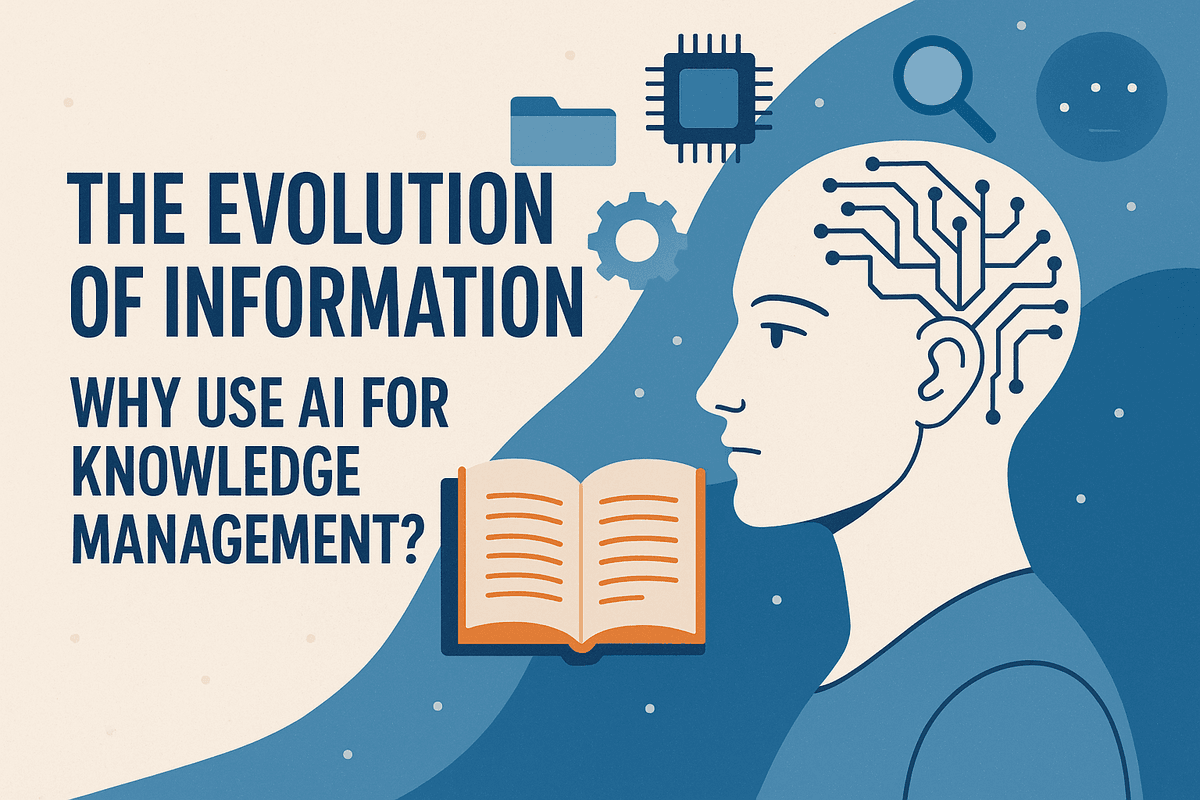
The Evolution of Information: Why Use AI for Knowledge Management?
For decades, organizational knowledge management (KM) operated on a "library" model. Companies built vast, static repositories—intranets, wikis, and shared drives—where information was deposited and often forgotten. These systems relied heavily on manual curation, rigid folder structures, and users knowing exactly which keywords to type into a search bar. However, as the volume of enterprise data explodes, this passive approach has become obsolete. The modern workplace requires a shift from static storage to dynamic intelligence, a transition best navigated by adopting AI for knowledge management.
From Static Wikis to Dynamic Intelligence
The fundamental difference between traditional KM and the new wave of AI-driven solutions is the shift from storage to utility. In the past, a corporate wiki was a destination; employees had to leave their workflow, log into a portal, and dig for answers. If a document was mislabeled or untagged, it was effectively invisible.
Artificial Intelligence transforms this dynamic by turning knowledge bases into active participants in the workflow. Instead of requiring exact keyword matches (e.g., searching "2024 PTO Policy"), AI utilizes semantic search and Natural Language Processing (NLP). This allows the system to understand the intent behind a query like "how do I book time off?" and retrieve the correct policy, regardless of the filename. This evolution moves the organization from managing documents to managing intelligence, ensuring that information finds the user, rather than the user hunting for information.
Solving the Data Silo Crisis
The greatest barrier to productivity in the modern enterprise is the fragmentation of truth. Information is no longer centralized; it is scattered across a sprawling ecosystem of SaaS applications. Critical project details live in Jira, client history sits in Salesforce, decision-making happens in Slack, and documentation resides in Google Drive.
These "data silos" create a disjointed experience where employees spend nearly 20% of their workweek just looking for internal information. Implementing AI for knowledge management solves this crisis by acting as a connective layer above these disparate applications. Advanced AI tools can index and ingest data from multiple sources without moving the files, creating a unified "single source of truth." By analyzing patterns across these silos, AI can link related concepts that a human might miss, bridging the gap between a conversation in a chat app and a formal document in the cloud.
What is an AI-Powered Knowledge Base?
To understand why this shift is necessary, one must define what an AI-powered knowledge base actually is. It is not merely a faster database; it is a self-learning ecosystem designed to enhance information accessibility.
- Semantic Understanding: Unlike legacy systems that match text strings, an AI knowledge base understands context, synonyms, and nuanced language, functioning more like a knowledgeable colleague than a search engine.
- Auto-Tagging and Categorization: AI algorithms can scan content upon upload, automatically generating tags, summaries, and categories. This eliminates the manual drudgery that leads to poorly maintained wikis.
- Generative Answers: Rather than simply providing a list of links (blue links), generative AI can synthesize information from multiple documents to provide a direct, conversational answer to a query.
By leveraging these capabilities, organizations are not just storing data; they are refining it into actionable insights, proving that the move toward AI is the natural evolution of information management.

Core Benefits of Integrating AI for Knowledge Management
In the modern enterprise, information is abundant, but actionable insight is often scarce. Organizations frequently suffer from data silos where valuable expertise is trapped within specific departments or buried inside forgotten folders. This is where integrating AI for knowledge management shifts from being a luxury to a strategic necessity. By embedding artificial intelligence into the heart of information strategy, businesses can transform a static repository of documents into a dynamic, intelligent engine that actively supports the workforce.
Boosting Employee Productivity with Instant Retrieval
The most immediate impact of AI-driven knowledge systems is the reclamation of lost time. Studies suggest that knowledge workers spend a significant portion of their week simply searching for the information required to do their jobs. Traditional systems force users to sift through lists of file names, hoping to find the right document.
AI changes this paradigm by shifting the focus from "search" to "retrieval." deeply integrated AI tools act less like a library index and more like an intelligent concierge. When an employee queries the system, the AI analyzes the request and instantly surfaces the specific paragraph, data point, or procedure needed, rather than just providing a link to a 50-page PDF. This instant access keeps employees in their workflow, reducing context switching and significantly boosting overall productivity.
Enhancing Searchability Through Natural Language Processing (NLP)
The frustration of typing a keyword and getting zero results—simply because you didn't use the exact jargon stored in the system—is a common workplace hurdle. AI for knowledge management overcomes this through Natural Language Processing (NLP).
NLP allows the knowledge base to understand human intent and semantic context. It bridges the gap between how employees speak and how data is stored. For example, a user can ask, "How do I fix the login error for the legacy portal?" and the system will understand the intent, even if the technical documentation is titled "Authentication Protocol Troubleshooting." By enabling conversational search, organizations democratize access to information, ensuring that new hires and non-technical staff can access the same depth of knowledge as veteran experts without needing to know specific taxonomy.
Automating Content Tagging and Maintenance
One of the biggest reasons knowledge management initiatives fail is the manual burden of maintenance. Organizing content, applying metadata, and tagging files is tedious work that humans often neglect, leading to "knowledge rot"—a state where the database becomes cluttered with outdated or untagged information.
AI automates these administrative heavy lifts. Machine learning algorithms can scan content as it is created, automatically generating relevant tags and categorizing documents into the correct taxonomy. Furthermore, AI agents can proactively monitor the health of the knowledge base. They can flag conflicting information, identify duplicate entries, or alert subject matter experts when specific documentation hasn’t been updated in a set period. By removing the manual friction of categorization and maintenance, AI ensures the knowledge base remains a pristine, reliable source of truth with minimal human intervention.
Essential Features in Top AI Knowledge Management Tools
Navigating the landscape of AI for knowledge management requires looking beyond buzzwords to identify functionality that genuinely impacts workflow. Not all platforms are created equal; while legacy systems function as static filing cabinets, modern AI-driven solutions act as active digital assistants. When evaluating software to modernize your organization's information strategy, three specific capabilities stand out as non-negotiable for driving productivity and ensuring widespread adoption.
Generative AI for Instant Answer Summarization
The most immediate value add in modern tools is the shift from "search and retrieval" to "search and synthesis." Traditional knowledge bases return a list of blue links, forcing employees to open multiple documents and hunt for specific details.
Advanced AI for knowledge management leverages Generative AI and Large Language Models (LLMs) to change this dynamic completely. instead of providing a list of documents, the AI scans your entire repository, synthesizes the relevant information, and generates a direct, natural language answer to the user's query.
Furthermore, these tools offer powerful drafting capabilities. For subject matter experts (SMEs), the barrier to documenting knowledge is often the time it takes to write. Generative AI can take bullet points or rough notes and expand them into formatted, professional articles or standard operating procedures (SOPs). This reduces the friction of contribution, ensuring that tacit knowledge is captured before it leaves the organization.
Predictive Analytics to Identify Knowledge Gaps
A common failure point in traditional knowledge management is content decay—information becomes outdated, or specific user questions remain unanswered because no document exists to cover them. Humans often struggle to manually audit thousands of wiki pages, but this is where predictive analytics shines.
Top-tier AI tools monitor search patterns and user behavior to identify "content holes." If multiple employees search for "remote VPN setup for Mac" and bounce without clicking a result—or mark results as unhelpful—the AI flags this as a critical knowledge gap.
Beyond just identifying missing topics, predictive AI facilitates proactive maintenance. It can assign "health scores" to content based on its age and usage frequency, automatically notifying content owners when a document is likely obsolete. This creates a self-healing knowledge ecosystem where the accuracy of the database improves over time, rather than degrading.
Seamless Integrations with the Flow of Work
The most sophisticated AI is useless if it lives in a browser tab that no one opens. The philosophy of "flow of work" integration is central to successful AI for knowledge management strategies. The best tools embed themselves directly into the platforms where employees spend their day, such as Slack, Microsoft Teams, Salesforce, and Zendesk.
This integration works bi-directionally:
- Retrieval: A support agent working in a CRM should see AI-suggested answers popup automatically based on the context of the customer ticket, without ever leaving the window.
- Capture: When an engineer answers a complex question in a Slack channel, the AI should recognize the value of that exchange and prompt the user to turn that conversation into a permanent knowledge base article with a single click.
By eliminating context switching—the mental tax paid every time an employee toggles between apps—these integrations ensure that knowledge management becomes an invisible, frictionless part of the daily routine rather than an administrative chore.
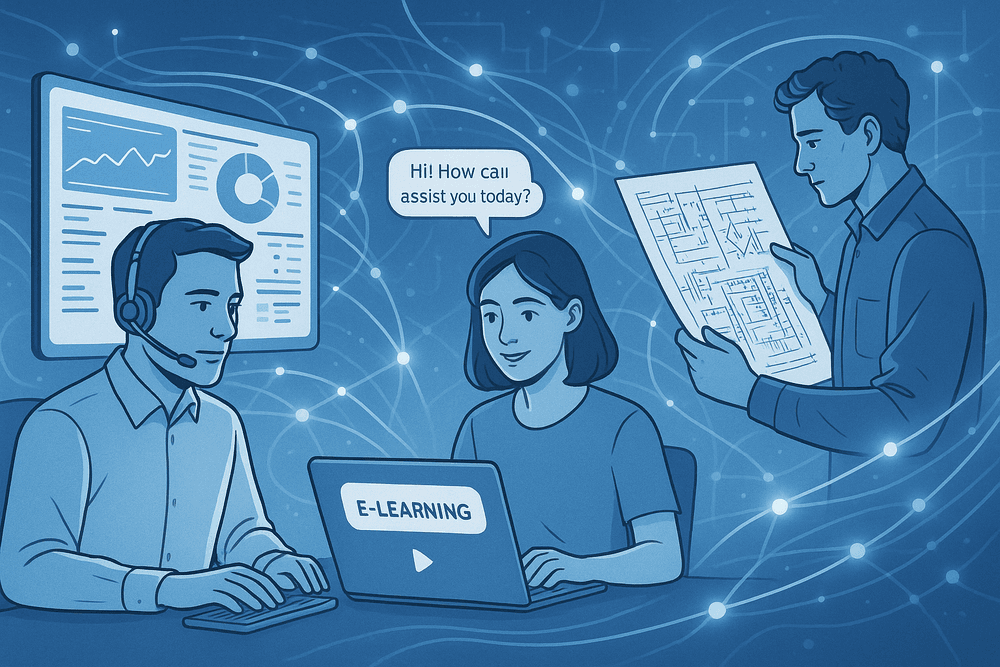
Real-World Use Cases: AI for Knowledge Management in Action
While the theoretical benefits of artificial intelligence are compelling, the true value becomes evident when we observe how organizations are deploying these tools on the ground. Moving beyond simple file storage, AI for knowledge management is actively transforming static repositories into dynamic engines of productivity. By automating information retrieval and synthesis, companies are solving critical bottlenecks across various departments, from the frontline of customer service to the depths of research and development.
Revolutionizing Customer Support with Self-Serve AI Agents
The era of navigating clunky, keyword-based FAQ pages is rapidly fading. Modern customer support teams are leveraging generative AI to create intelligent, self-serve agents that function less like search bars and more like expert consultants.
Unlike traditional chatbots that rely on rigid decision trees, AI-driven knowledge management systems ingest vast amounts of support documentation, product manuals, and historical ticket data. When a customer asks a complex question, the AI understands the intent and context, instantly retrieving and synthesizing the exact answer.
This application of AI for knowledge management delivers two distinct advantages:
- Instant Resolution: Customers receive immediate, accurate answers 24/7 without waiting for a human agent, significantly boosting Customer Satisfaction (CSAT) scores.
- Agent Efficiency: Human support agents are relieved of repetitive Tier-1 queries. When they do step in, the AI provides them with "agent assist" summaries and suggested solutions, reducing average handling time (AHT) and allowing them to focus on high-value, empathetic interactions.
Accelerating Employee Onboarding and Continuous Training
One of the most significant drains on organizational productivity is the "ramp-up" period for new hires. Traditionally, onboarding involved scouring fragmented wikis or interrupting senior colleagues for guidance. AI transforms this process by acting as an always-on "learning buddy."
By integrating AI for knowledge management into internal communication platforms (like Slack or Microsoft Teams), organizations provide new employees with instant access to institutional wisdom. An employee can ask, "What is the protocol for approving a vendor invoice?" or "Summarize our brand voice guidelines," and receive a concise, cited response drawn from the company’s internal knowledge base.
This approach facilitates "just-in-time" learning. Rather than front-loading training that is easily forgotten, employees access knowledge exactly when they need to apply it. This reduces the cognitive load on new hires and accelerates their time-to-productivity, while simultaneously preserving the focus of senior mentors who face fewer interruptions.
Streamlining Technical Documentation for R&D Teams
For Research and Development (R&D) and engineering teams, knowledge silos can be disastrous, leading to duplicated code, repeated mistakes, and wasted innovation cycles. Technical documentation is often dense, unstructured, and spread across version control systems, bug trackers, and cloud drives.
AI-powered knowledge management tools excel at parsing this complex technical data. utilizing semantic search, these tools allow engineers to query the entire R&D knowledge ecosystem naturally. A developer might ask, "Have we tested this battery configuration before?" or "Show me the API documentation for the legacy payment gateway."
The AI scans code comments, commit messages, and technical specs to surface relevant insights. This capability ensures that past lessons are retained and easily accessible, effectively preventing the "reinventing the wheel" syndrome. By streamlining access to technical contexts, R&D teams can maintain velocity and focus on solving new problems rather than searching for old answers.
Best Practices for Implementing AI in Knowledge Management Strategies
Deploying ai for knowledge management is not merely a technical upgrade; it is a fundamental shift in how an organization captures, processes, and distributes intelligence. While the potential for efficiency is immense, the gap between a successful deployment and a failed initiative often lies in execution. To truly transform your organizational productivity, you must navigate the complexities of security, data integrity, and human behavior.
Prioritizing Data Privacy and Security
The most immediate concern when integrating artificial intelligence into your knowledge base is the protection of intellectual property and sensitive information. Unlike standard software, AI models—particularly Large Language Models (LLMs)—consume vast amounts of text to generate answers.
To ensure a secure deployment, organizations must establish strict governance frameworks. This involves utilizing enterprise-grade AI solutions that guarantee your data is not used to train public models. Furthermore, implementation should include:
- Role-Based Access Control (RBAC): The AI should respect existing permission structures. An intern asking the AI about "company strategy" should not receive answers pulled from confidential executive meeting minutes.
- Data Anonymization: Before feeding datasets into an AI system, Personally Identifiable Information (PII) must be masked or removed to comply with regulations like GDPR or CCPA.
- Regular Security Audits: Continuous monitoring of AI interactions is necessary to detect potential prompt injection attacks or data leakage.
Curating High-Quality Data for Training
There is an old axiom in computer science that remains the golden rule of AI: "Garbage in, garbage out." An AI solution is only as intelligent as the data it has access to. If your current knowledge base is filled with outdated documents, conflicting file versions, or unstructured chaos, the AI will confidently provide incorrect answers.
Before "flipping the switch" on an AI tool, you must invest time in data hygiene. This process involves:
- Auditing Legacy Content: Identify and archive obsolete information. If the AI reads a policy document from 2018 that contradicts a policy from 2023, it may hallucinate or provide a hybrid answer that confuses the user.
- Structuring Unstructured Data: While AI is good at reading natural language, it thrives when information is tagged and categorized. standardizing metadata helps the AI understand the context and hierarchy of information.
- Creating a Feedback Loop: Implement a "human-in-the-loop" mechanism where subject matter experts review AI-generated responses for accuracy, helping to fine-tune the model over time.
Change Management: Encouraging Team Adoption
The most sophisticated ai for knowledge management system will fail if employees refuse to use it. Resistance often stems from two sources: fear of replacement and skepticism regarding reliability.
To drive adoption, reframe the narrative. Position AI not as an oracle that knows better than the staff, but as a "co-pilot" that handles the drudgery of searching for files, allowing them to focus on high-value creative work.
Strategies for successful change management include:
- Identify AI Champions: Select enthusiastic early adopters within different departments to demonstrate specific wins—such as how the AI saved them two hours of research time.
- Comprehensive Training: Move beyond technical manuals. Host workshops that show practical use cases, such as how to prompt the AI effectively to retrieve complex project histories.
- Transparent Communication: Be open about the AI's limitations. By managing expectations regarding accuracy, you build trust. When users understand that the tool is an assistant rather than a flawless authority, they are more likely to integrate it into their daily workflows constructively.

Future-Proofing Your Business with AI for Knowledge Management
Adopting ai for knowledge management is no longer a luxury for forward-thinking enterprises; it is a necessity for survival in a data-dense world. However, simply installing a tool is not enough. To truly future-proof your organization, you must anticipate where the technology is heading and prepare your infrastructure to adapt. The landscape is shifting from static repositories to dynamic, self-learning ecosystems that actively assist your workforce.
The Next Frontier: Neural Networks and Neural Search
The most significant shift in the immediate future is the move away from lexical search (matching exact keywords) toward neural search. Powered by advanced neural networks, this technology mimics the human brain’s ability to understand context, synonyms, and intent.
In traditional systems, if an employee searches for "annual leave policy," but the document is titled "time off guidelines," they might get zero results. Neural networks bridge this gap using vector search technology. This allows the system to understand that "leave" and "time off" are semantically related.
Furthermore, we are witnessing the convergence of ai for knowledge management and Generative AI (GenAI). Rather than simply returning a list of links (which forces the user to read through documents to find an answer), the next generation of KM tools utilizes Retrieval-Augmented Generation (RAG). These systems digest proprietary company data and generate a direct, conversational answer to a query, citing sources for verification. This shift transforms your KM platform from a library into an intelligent analyst.
How to Choose the Right AI KM Vendor
With the market flooded with AI startups and legacy providers tacking on "AI features," selecting the right partner is critical. When evaluating solutions for ai for knowledge management, focus on these four pillars:
- Integration Capabilities: Your AI solution shouldn't require you to migrate all your data into a new silo. Look for vendors offering "zero-copy" architecture with robust connectors to your existing tech stack (Slack, SharePoint, Salesforce, Google Drive).
- Security and Governance: An AI that learns from your data must respect your permission structures. Ensure the vendor is SOC2 compliant and offers "permissions-aware" search, ensuring an intern doesn't accidentally access executive payroll data via an AI prompt.
- Explainability: Avoid "black box" AI. The system should always be able to cite the source of its generated answers so employees can verify accuracy.
- Customizability: Every industry has unique jargon. The best tools allow you to fine-tune the model on your specific domain language without requiring a team of data scientists.
Immediate Next Step: Conducting a Knowledge Audit
Before you sign a contract or deploy a new neural network, you must assess the current state of your information. AI accelerates processes, which means if your underlying data is obsolete, you will simply accelerate the spread of misinformation.
Start by conducting a comprehensive knowledge audit today. This involves:
- Mapping Data Silos: Identify where your teams actually store information versus where they should store it.
- Rot Analysis: distinctively separate Redundant, Obsolete, and Trivial (ROT) content from high-value assets.
- Gap Identification: Determine what questions your support and sales teams are asking that currently have no documented answers.
By cleaning your data foundation now, you ensure that when you fully deploy ai for knowledge management, the engine runs on high-octane fuel rather than unrefined crude.