
August 19, 2025
Your First AI Literature Review
The End of Manual Drudgery: Your First AI Literature Review
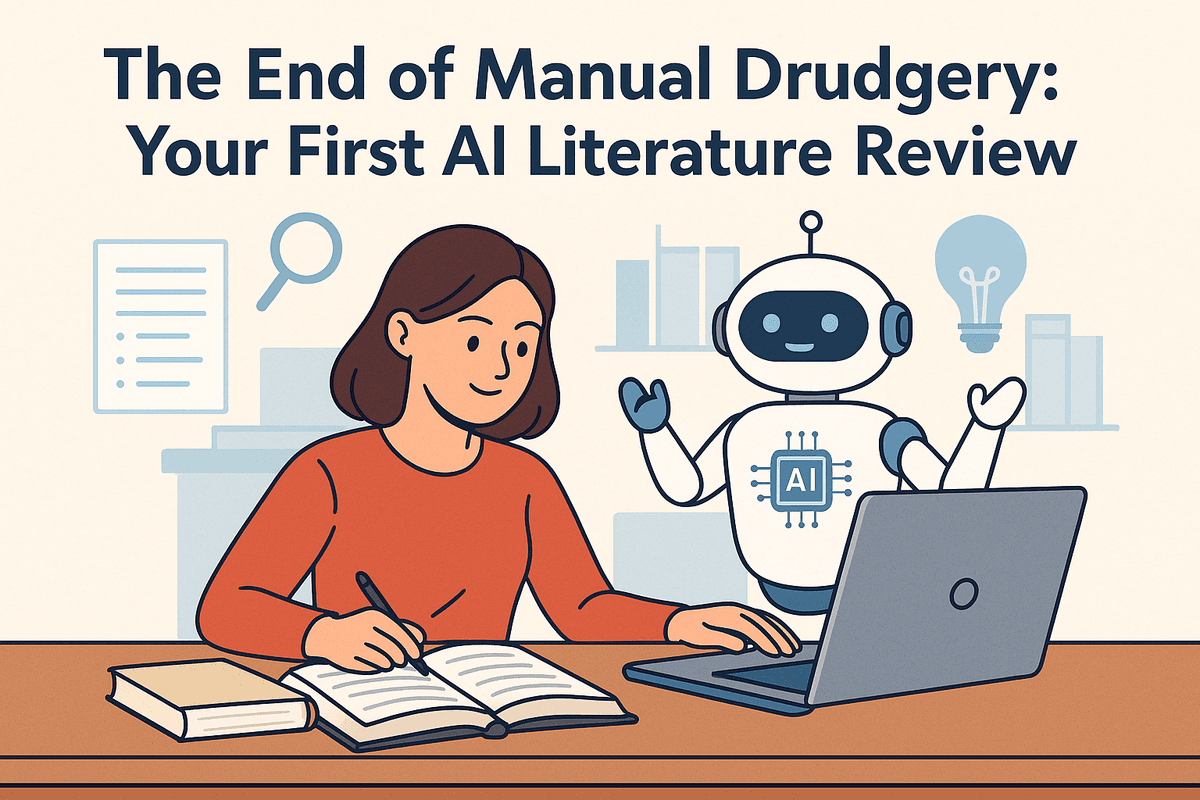
The traditional literature review is a rite of passage for every researcher—a painstaking process of sifting through endless databases, deciphering dense abstracts, and manually mapping connections between studies. It’s a foundational part of academic work, but it’s also a notorious bottleneck. What if you could reclaim hundreds of hours from this process and dedicate them to what truly matters: critical analysis and original insight? This is the promise of the AI literature review, a revolutionary approach that transforms this daunting task from a marathon of manual labor into a focused, strategic sprint.
What is an AI Literature Review, Really?
An AI literature review is not about having a machine write your paper for you. Instead, think of it as a human-machine partnership where you act as the lead researcher and AI serves as your brilliant, tireless research assistant. It involves leveraging specialized AI tools to automate and accelerate the most time-consuming aspects of the literature review process.
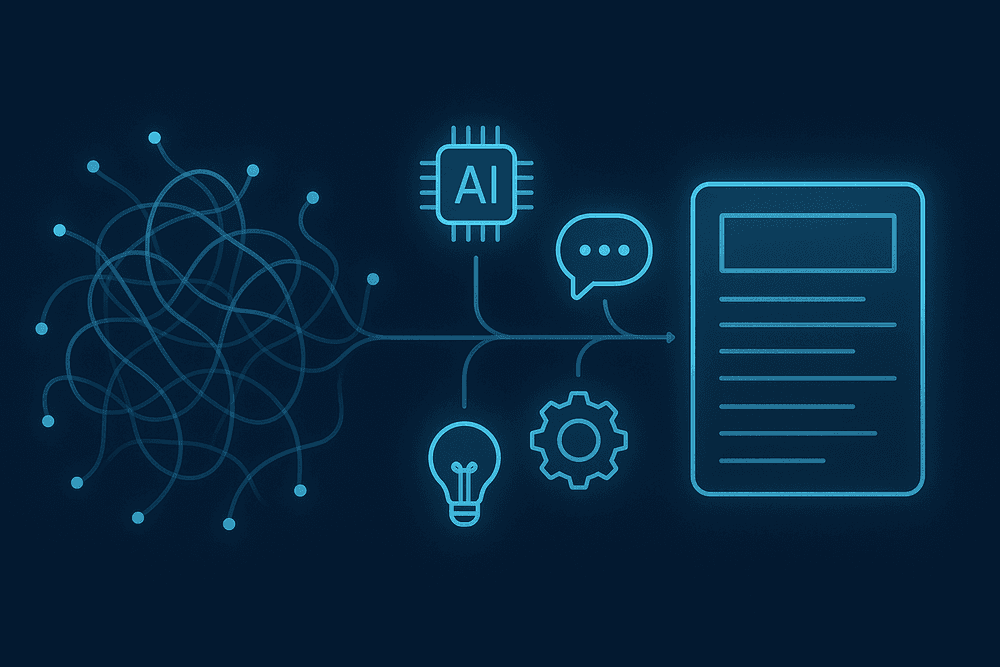
Instead of just searching by keywords, AI can understand concepts, identify semantic relationships between papers, and screen thousands of sources in minutes. The process typically involves:
- AI-Powered Discovery: Finding highly relevant papers you might have missed with traditional search methods.
- Automated Summarization: Generating concise summaries of articles to quickly assess their relevance.
- Thematic Analysis: Grouping papers into clusters based on common themes, methodologies, or findings.
- Knowledge Synthesis: Creating visual maps or outlines that highlight research gaps and intellectual conversations in the field.
Ultimately, an AI literature review empowers you to work with a much larger body of literature more efficiently, ensuring your work is comprehensive and built on a solid foundation.
From Days to Hours: The Core Problems AI Solves for Researchers
The traditional literature review is plagued by inefficiencies that AI is uniquely equipped to solve. By integrating AI into your workflow, you directly address several core challenges that drain a researcher’s time and energy.
- Information Overload: The sheer volume of published research is overwhelming. AI algorithms can analyze vast datasets of academic papers, cutting through the noise to pinpoint the most critical sources relevant to your specific research question.
- The Time Sink of Manual Screening: Reading abstracts one by one to gauge relevance is a slow, repetitive task. AI tools can perform this initial screening in a fraction of the time, presenting you with a highly curated list of papers that demand your full attention.
- Uncovering Hidden Connections: A human researcher can only hold so many concepts in mind at once. AI can identify non-obvious connections, trace citations, and spot emerging trends across disparate fields that would be nearly impossible to detect manually. This accelerates insight and can lead to more innovative research directions.
Setting Expectations: What AI Can and Cannot Do for Your Paper
To successfully conduct an AI literature review, it’s crucial to have realistic expectations. AI is a powerful accelerator, not a replacement for scholarly intellect and critical thinking.
What AI Excels At:
- Breadth and Speed: Rapidly identifying, screening, and categorizing a massive number of sources.
- Summarization: Providing high-level summaries to help you quickly decide which papers to read in depth.
- Pattern Recognition: Highlighting thematic clusters, influential authors, and foundational papers.
- Discovery: Suggesting relevant articles based on the content of a seed paper or your research query.
Where the Researcher Remains Essential (What AI Cannot Do):
- Deep Critical Analysis: AI can summarize what a paper says, but it cannot critique its methodology, evaluate the strength of its argument, or assess its true impact. This is your job.
- Nuanced Synthesis: Weaving disparate findings into a coherent narrative that forms the argument for your own research requires human intellect and creativity.
- Understanding Context: You provide the research question and the "so what." The AI provides the data; you provide the interpretation and meaning.
- Ensuring Academic Integrity: You are ultimately responsible for the final content, ensuring accurate representation of sources and avoiding plagiarism. AI is a tool, not an author.
Choosing Your AI Research Assistant: Tools for a Smart Literature Review
Navigating the vast sea of academic literature can be daunting, but the right AI co-pilot makes all the difference. A truly effective AI literature review isn't about finding one perfect tool, but about building a strategic toolkit. Different platforms excel at different stages of the process, from initial discovery to critical validation and final synthesis. Let's break down the leading contenders and how they fit into your research workflow.
Elicit vs. ResearchRabbit: The Best Tools for Automated Discovery
Your first challenge is finding the right papers. These tools use different philosophies to help you unearth relevant literature beyond simple keyword searches.
- Elicit: Think of Elicit as a research assistant that reads and summarizes papers for you. Instead of just searching keywords, you ask a research question, and Elicit scans its database to provide a summarized answer with supporting papers. Its standout feature is the ability to extract key data—like interventions, populations, and outcomes—from papers and organize it into a structured table. This is invaluable for systematic reviews and quickly comparing study methodologies.
- ResearchRabbit: If Elicit is a methodical analyst, ResearchRabbit is a visual networker. Often called the "Spotify for papers," it excels at helping you discover connected literature. Start with a few key "seed papers," and ResearchRabbit generates interactive graphs showing you related work, earlier influential papers, and newer studies that cite your initial sources. It’s a powerful and intuitive way to perform "snowball" and "citation chasing" searches, ensuring you don't miss crucial connections.
Scite and Consensus: AI for Validating Claims and Finding Evidence
Once you've found your papers, how do you know if they're credible and influential? This is where validation tools shine, adding a layer of critical analysis to your AI literature review.
- Scite: Scite goes beyond simple citation counts. It analyzes the context of citations, classifying them as "supporting," "mentioning," or "contrasting." This allows you to quickly see if a paper's findings have been supported by subsequent research or challenged by the academic community. You can instantly gauge the academic conversation surrounding a paper, which is a game-changer for critical appraisal.
- Consensus: This AI-powered search engine is built to give you direct, evidence-based answers from scientific research. Ask a "yes/no" or "what is the effect of X on Y" question, and Consensus scans millions of papers to find and extract relevant findings, often presenting them with a "consensus meter." It's perfect for quickly checking the scientific agreement on a specific topic and finding direct quotes to support your claims.
Using Generalists like ChatGPT-4 and Claude for Synthesis and Summarization
After discovering and vetting your sources, large language models (LLMs) like ChatGPT-4 and Claude become your synthesis partners. These tools are less for discovery (as they can "hallucinate" sources) and more for processing the information you’ve already gathered.
Feed them the abstracts or full text of selected papers and ask them to identify common themes, compare methodologies, or summarize key arguments. They can help you draft sections of your review, create an annotated bibliography, or rephrase complex technical language. Remember the golden rule: these are powerful assistants, not authors. Always verify their output against the source material and use their summaries to fuel your own critical thinking and unique analysis.
How to Conduct an AI Literature Review: A Step-by-Step Workflow
Transforming the literature review from a daunting marathon into a strategic sprint is now possible. An AI literature review leverages specialized tools to automate the most time-consuming tasks, freeing you to focus on critical analysis and synthesis. This workflow breaks the process down into four manageable, AI-powered steps.
Step 1: Scoping Your Research and Identifying Seed Papers
Before you can build your library, you need a blueprint. A well-defined research question is the foundation of any strong literature review. AI tools can act as your Socratic partner in this crucial first stage. Use conversational AIs like ChatGPT or Perplexity AI to brainstorm keywords, explore sub-topics, and rephrase your initial ideas into a focused, researchable question.
Once your scope is clear, the next task is to find your "seed papers"—the foundational or highly influential articles that anchor your research field. Instead of relying on guesswork, use platforms like Consensus or Scite. These tools analyze vast citation networks to identify seminal works that are frequently cited by other experts, ensuring you start your AI literature review with the most impactful sources.
Step 2: Automating Source Discovery and Citation Chaining
With your seed papers in hand, it’s time to expand your search. Traditional citation chaining—manually combing through bibliographies (backward chaining) and finding papers that cite your source (forward chaining)—is tedious. AI transforms this into a dynamic discovery process.
Tools like ResearchRabbit and Connected Papers automate citation chaining instantly. Simply input your seed papers, and these platforms generate interactive visual maps of the academic landscape. They show you how papers are connected, revealing clusters of related research, key authors, and chronological developments. This automated approach not only saves dozens of hours but also uncovers relevant sources you might have otherwise missed, building a comprehensive foundation for your AI literature review.
Step 3: Generating Thematic Summaries and Identifying Gaps
Finding papers is only half the battle; understanding and synthesizing them is where the real work begins. This is where an AI literature review truly shines. Instead of reading and manually summarizing 50 different abstracts, you can use AI to do the heavy lifting.
Upload your collection of papers to a tool like Elicit.io or SciSpace. These platforms can “read” the documents and extract key information—such as methodology, population, key findings, and limitations—and present it in a structured, easy-to-scan table. This allows you to quickly compare and contrast studies, identify recurring themes, and spot inconsistencies. Most importantly, by getting a bird's-eye view of the existing research, you can more easily pinpoint the critical research gaps that your own work can fill.
Step 4: Creating an Annotated Bibliography in Minutes
An annotated bibliography is a powerful tool for organizing your thoughts, but it’s notoriously time-consuming to create. AI can generate the first draft for you in a fraction of the time. Using an AI writing assistant or a well-crafted prompt in a large language model, you can feed it a paper’s abstract or full text and ask for a concise annotation.
Specify the elements you need: a summary of the research question, the methodology used, the main findings, and its significance to your topic. The AI will produce a structured paragraph for each source. Crucially, this is a draft, not a final product. Your job is to then review, edit, and infuse each annotation with your own critical analysis and voice. This final human touch ensures the accuracy and intellectual rigor required for academic work.
Best Practices for an Academically Rigorous AI Literature Review
Harnessing AI can dramatically accelerate your research, but power must be paired with precision and ethical diligence. An effective AI literature review isn't about replacing the researcher; it's about augmenting their capabilities. Adhering to best practices ensures your work remains rigorous, verifiable, and academically sound.
Crafting Effective Prompts to Uncover Niche Sources
The quality of your AI's output is directly proportional to the quality of your input. Vague prompts yield generic results. To uncover the niche, specific sources that give a literature review its depth, you must be a skilled interrogator.
- Be Hyper-Specific: Move beyond broad topics. Include specific keywords, established theories, key authors in the field, methodological approaches, and date ranges.
- Instead of: "Find articles about AI in education."
- Try: "Identify peer-reviewed studies from 2019-2023 that assess the impact of adaptive learning platforms using machine learning on student outcomes in higher education mathematics courses."
- Iterate and Refine: Treat your interaction with the AI as a conversation. Use the initial results to ask follow-up questions, request comparisons between papers, or drill down into a specific sub-theme that emerges.
Fact-Checking and Verifying AI-Generated Summaries
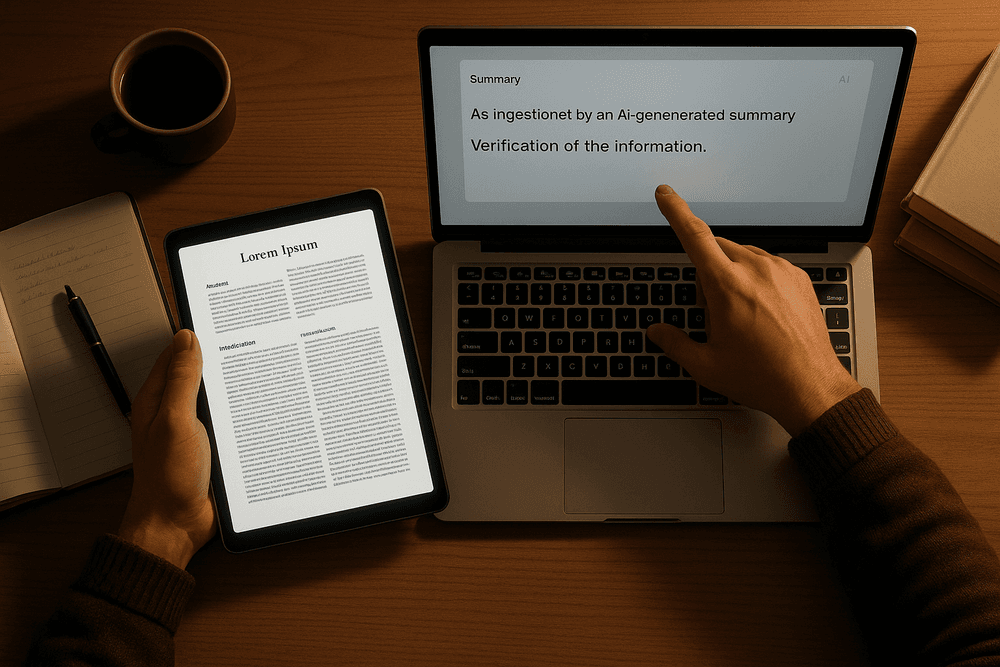
The cardinal rule of using AI in research is: trust but verify. AI models can "hallucinate"—inventing facts, misinterpreting data, or even creating citations for non-existent papers. Never take an AI-generated summary at face value.
- Always Go to the Source: Use the AI-generated summary as a guide, not a substitute. Before you even consider citing a paper, you must read the original full-text article yourself.
- Cross-Reference Key Claims: Verify specific data points, methodological details, and the authors' core conclusions by checking them against the source paper.
- Validate Citations: Ensure every DOI, author, and journal reference provided by the AI is real and accurate. A quick search in Google Scholar or your university's library database can prevent the embarrassing inclusion of a fabricated source.
Avoiding Plagiarism: The Ethics of Using AI in Academic Writing
The line between assistance and academic misconduct is crystal clear. AI is a tool for discovery and first-draft summarization, not for writing.
- Your Voice, Your Analysis: Directly copying and pasting AI-generated text into your manuscript is plagiarism. The purpose of a literature review is to showcase your critical synthesis and analysis of the existing research—a task that requires your unique intellectual contribution.
- Acknowledge and Disclose: Transparency is key. Familiarize yourself with your institution's, and your target journal's, policies on the use of AI. Many now require authors to disclose which AI tools were used in the research process, and for what purpose.
Integrating AI Tools with Zotero, Mendeley, and Other Reference Managers
The true power of an AI literature review is realized when new tools are integrated into your existing workflow. AI platforms are excellent for discovery, while reference managers like Zotero, Mendeley, and EndNote are essential for organization.
Create a seamless workflow: Use an AI research tool to identify a batch of relevant papers. Then, export the citation data (usually as a .bib or .ris file) and import it directly into your reference manager. This instantly populates your library with accurate metadata, saving you hours of manual entry and ensuring your sources are organized and ready for citation from day one. Many AI tools and databases also work with browser connectors (like the Zotero Connector), allowing you to add sources to your library with a single click.
Case Studies: An AI Literature Review in Action
Theory is one thing, but seeing the impact of an AI literature review in practice is another. These tools are not just abstract concepts; they are actively reshaping how researchers approach their work. Let’s explore three distinct scenarios where AI-powered tools provide a decisive advantage, saving time and elevating the quality of academic output.
Use Case 1: Accelerating a PhD Thesis Proposal in Social Sciences
The Challenge: A PhD candidate in sociology, let's call her Maria, is developing her thesis proposal on the impact of remote work on social cohesion in urban communities. She faces a mountain of literature spanning sociology, urban planning, and organizational psychology. Manually sifting through decades of research to identify foundational theories, current debates, and a novel research gap could take months, delaying her progress significantly.
The AI Solution: Maria turns to an AI literature review platform. She inputs her primary research question: "How does the rise of remote work affect community engagement and social capital in major cities?" The AI tool rapidly scans thousands of papers, clustering them thematically. It generates a summary table of key concepts, identifies seminal authors, and outlines the main methodological approaches used in the field. Crucially, it highlights areas with conflicting findings or limited research—specifically, the long-term effects on marginalized communities.
The Outcome: In under two weeks, Maria has a comprehensive map of the intellectual landscape. The AI literature review allowed her to quickly synthesize existing knowledge and pinpoint a compelling research gap. Her thesis proposal is stronger, more focused, and grounded in a thorough understanding of the field, a process that would have traditionally taken an entire semester.
Use Case 2: Ensuring Comprehensive Coverage for a Medical Systematic Review
The Challenge: A medical research team is conducting a systematic review on the efficacy of a new class of drugs for treating autoimmune diseases. The PRISMA protocol for systematic reviews demands an exhaustive, transparent, and reproducible search process. Manually screening the 5,000+ abstracts retrieved from databases like PubMed and Scopus is a monumental task, prone to human error and bias.
The AI Solution: The team uses a specialized AI literature review tool designed for medical research. After importing their search results, they train the AI with a small sample of clearly relevant and irrelevant papers. The AI then uses this knowledge to screen the remaining thousands of abstracts, assigning each a relevance score. It automatically flags duplicates and presents the researchers with a prioritized list for manual review, significantly reducing the initial screening burden.
The Outcome: The AI-assisted screening process cuts the team's workload by over 60%. This allows them to dedicate more time to the critical stages of full-text analysis and data extraction. The process is more rigorous and less susceptible to individual screener fatigue, leading to a higher-quality, more reliable systematic review that meets the highest standards of evidence-based medicine.
Use Case 3: Finding Interdisciplinary Connections for a Grant Application
The Challenge: Dr. Lee, an environmental scientist, is preparing a grant application for a project on sustainable agriculture using soil sensors. To make his proposal innovative and impactful, he needs to connect his core research to adjacent fields like data science, behavioral economics, and public policy, but he isn't an expert in those areas.
The AI Solution: Dr. Lee uses a visual AI literature review tool that creates knowledge graphs. He enters a few key papers from his own field. The AI generates an interactive network, revealing how these papers are cited by and connected to research in other domains. He discovers a cluster of papers linking real-time soil data to farmer decision-making models from behavioral economics—a connection he had not previously considered. The tool also recommends highly-cited review articles in these new areas for a quick "crash course."
The Outcome: The AI literature review uncovers a powerful, interdisciplinary angle for his research. Dr. Lee is now able to frame his project not just as a technological advancement but as a socio-technical solution to promote sustainable farming practices. His grant application is far more compelling, demonstrating a broader vision and a clear pathway to real-world impact.

Conclusion: The Future of Research and Your Next Steps
We've explored the transformative landscape of AI in academic research, demonstrating how these tools are no longer a futuristic concept but a practical reality. The goal is not to replace the researcher but to augment your capabilities, turning the often-grueling literature review process into a more dynamic and insightful phase of discovery. By automating the repetitive and time-consuming tasks, you unlock more time for what is truly irreplaceable: deep, critical thinking and innovative analysis. The future of scholarship lies in this powerful human-AI collaboration.
Key Takeaways: Integrating AI into Your Workflow Today
To make the leap from theory to practice, focus on incremental integration. You don’t need to overhaul your entire process overnight.
- Start with a Focused Task: Begin by using an AI tool for a single, well-defined objective. Ask it to summarize a dense paper, brainstorm alternative search keywords, or rephrase a complex sentence. Small wins build confidence and familiarity.
- Choose Specialized Tools: While general-purpose AI is impressive, platforms designed specifically for researchers (like Elicit, Scite, or ResearchRabbit) offer superior features for source verification, citation tracking, and discovering connected literature.
- Master the Art of the Prompt: The quality of your AI's output is a direct reflection of your input. Be specific in your prompts. Provide context, define the desired format, and clearly state your objective to get the most accurate and relevant results.
- Always Trust but Verify: This is the golden rule. AI tools can "hallucinate" or misinterpret nuance. Treat every AI-generated summary, claim, and synthesis as a first draft that must be rigorously cross-referenced with the original source material.
A Final Checklist for Your Next AI Literature Review
Use this checklist to structure your process and ensure you’re leveraging AI effectively without compromising academic integrity.
- Define Your Foundation: Solidify your research question, scope, and inclusion/exclusion criteria before you begin.
- Select Your AI Toolkit: Choose 2-3 specialized tools for distinct tasks—one for discovery, one for summarization, and one for synthesis or citation management.
- Plant the Seed Papers: Upload 3-5 highly relevant articles to an AI platform to quickly uncover a network of connected research and seminal works.
- Triage with AI Speed: Use an AI assistant to rapidly screen and summarize abstracts, allowing you to efficiently filter a large volume of papers down to the most relevant few.
- Synthesize Initial Themes: Ask the AI to identify recurring themes, methodologies, and potential research gaps across your curated list of articles.
- Critically Evaluate and Fact-Check: Manually review the AI's thematic analysis and summaries against the full-text papers to ensure accuracy, context, and nuance.
The Human in the Loop: Why the Researcher Is Still Essential
Ultimately, the most powerful component in any AI literature review is you. An AI is a formidable data processor, capable of pattern recognition at a scale and speed no human can match. However, it lacks the critical faculties that define true scholarship.
AI cannot formulate a novel research question born from genuine curiosity. It cannot grasp the subtle socio-historical context of a study, apply nuanced ethical judgment, or make the intuitive leaps that lead to breakthrough discoveries. Your role evolves from a manual data collector to a strategic director. You are the pilot, using AI as an advanced navigation system. You set the destination, interpret the data, question the outputs, and steer the project toward a meaningful conclusion. The future of research is a powerful symbiosis: AI handles the scale, and you provide the soul.