
August 27, 2025
An Introduction to AI Trend Forecasting
The Dawn of Predictive Power: An Introduction to AI Trend Forecasting
For centuries, businesses have relied on a mix of historical data, expert intuition, and a healthy dose of guesswork to predict what comes next. From poring over last year's sales figures to assembling panels of industry gurus, the goal has always been the same: to catch the next big wave before it breaks. But in a world overflowing with data and defined by lightning-fast change, these traditional methods are starting to look less like a compass and more like a rearview mirror.
Enter the new oracle of the digital age: AI trend forecasting.
Beyond the Crystal Ball: What is AI Trend Forecasting?
Forget a mystical gaze into the future. AI trend forecasting is a data-driven discipline that uses machine learning (ML), natural language processing (NLP), and advanced analytics to identify and predict emerging patterns in consumer behavior and market dynamics. It’s the science of sifting through a mountain of digital information—from social media chatter and search engine queries to news articles and e-commerce data—to find the "weak signals" that precede a major shift.
Instead of just telling you what was popular last quarter, AI models can detect subtle changes in language, sentiment, and online behavior to forecast what will be popular next. It’s about connecting disparate dots in real-time to build a statistically robust picture of the future.
The Limits of Looking Backwards: Why Traditional Forecasting Falls Short
Traditional forecasting methods, while valuable in stable markets, struggle to keep pace with the modern consumer landscape. Their limitations have become increasingly apparent:
- Too Slow: By the time a company conducts surveys, organizes focus groups, and manually analyzes the data, the trend it was trying to capture may have already peaked or fizzled out.
- Too Narrow: These methods can only process a limited amount of structured data, often missing the rich, unstructured conversations happening across social media, forums, and product reviews where trends are born.
- Too Biased: Human analysis is inherently susceptible to cognitive biases. Forecasters may unconsciously favor data that confirms their existing beliefs, leading to skewed and unreliable predictions.
In essence, traditional methods are reactive. They excel at explaining the past but are ill-equipped to navigate the volatile, unpredictable currents of today’s global marketplace.
The AI Advantage: Gaining a Competitive Edge
This is where AI trend forecasting delivers a transformative competitive advantage. By automating the analysis of vast datasets, AI-powered platforms can offer insights that are not just faster, but deeper and more accurate.
The benefits are clear:
- Speed and Scale: AI analyzes billions of data points in near real-time, spotting nascent trends weeks or even months before they hit the mainstream.
- Objective Insights: By removing human bias from the initial analysis, AI identifies patterns based purely on data, revealing non-obvious correlations that human analysts might overlook.
- Proactive Strategy: Armed with predictive insights, businesses can shift from reacting to the market to anticipating it. This allows for smarter product development, hyper-targeted marketing campaigns, optimized inventory management, and the agility to pivot before competitors even know what’s happening.
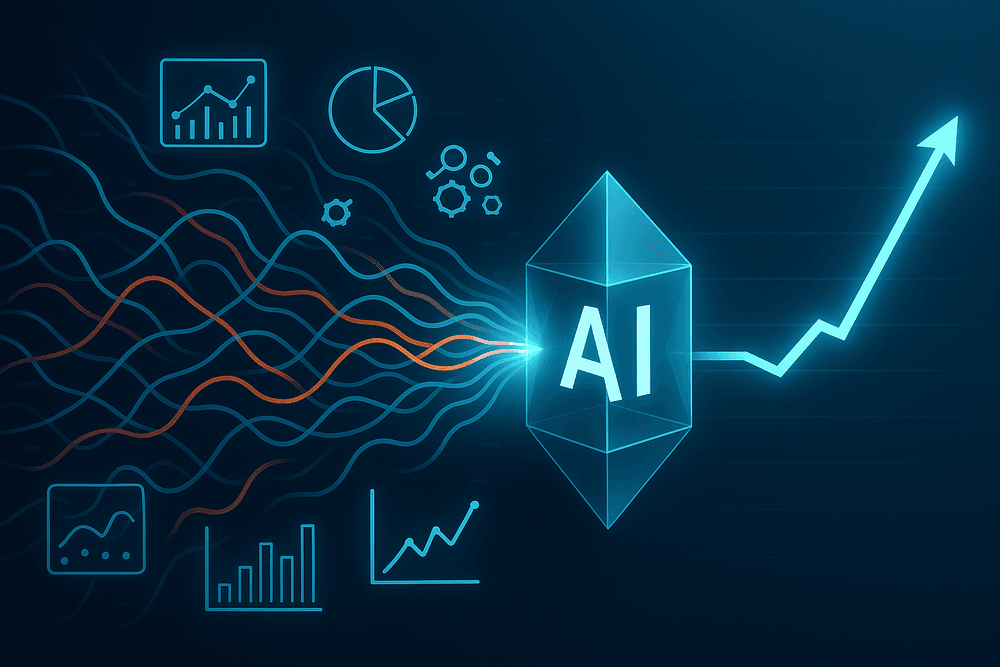
How Does AI Trend Forecasting Actually Work?
At its core, AI trend forecasting isn't a crystal ball; it's a sophisticated system of interconnected technologies working in concert to make sense of the world's data. It moves beyond simple observation by using computational power to identify, interpret, and project patterns with incredible speed and accuracy. This process primarily relies on three powerful pillars: Machine Learning, Natural Language Processing, and Predictive Analytics.
Machine Learning: Finding Patterns in Massive Datasets
The engine driving AI trend forecasting is Machine Learning (ML). Think of ML algorithms as tireless digital detectives sifting through mountains of data—far more than any human team could ever analyze. This data can include everything from historical sales figures and website traffic to global shipping movements and raw material costs.
Instead of being explicitly programmed to look for specific things, these algorithms learn to recognize subtle correlations and hidden patterns on their own. For example, an ML model might analyze retail data and discover that a slight increase in online searches for "vintage leather" in one region, combined with a rise in specific color palettes on design blogs, consistently precedes a spike in sales for rustic-style furniture three months later. This is the power of ML: it uncovers the faint signals of an emerging trend before they become obvious market movements.
Natural Language Processing (NLP): Tapping into Social Media and Consumer Sentiment
While machine learning excels at analyzing structured, numerical data, a vast amount of trend information exists in the unstructured chaos of human language. This is where Natural Language Processing (NLP) comes in. NLP is a branch of AI that gives computers the ability to read, understand, and interpret human language from sources like:
- Social media posts on TikTok, Instagram, and X (formerly Twitter)
- Online product reviews and customer feedback
- Articles from news sites and industry blogs
- Comments on forums and online communities
NLP algorithms perform sentiment analysis to gauge whether the public conversation around a topic is positive, negative, or neutral. They can identify key themes, emerging keywords, and the context in which products or ideas are being discussed. This gives businesses a real-time focus group of millions, revealing the "why" behind consumer behavior. Effective AI trend forecasting uses NLP to hear the first whispers of a new desire, a budding frustration, or a cultural shift straight from the source.
Predictive Analytics: From Historical Data to Future Outcomes
The final piece of the puzzle is predictive analytics. This component takes the patterns identified by Machine Learning and the contextual understanding from NLP and uses them to project future outcomes. It essentially answers the question, "Based on everything we've learned, what's likely to happen next?"
Predictive models use statistical algorithms to forecast the trajectory, velocity, and potential peak of an identified trend. For instance, after ML identifies a pattern and NLP confirms growing positive sentiment around "upcycled fashion," a predictive model can estimate the potential market size for such products over the next 18 months. It can help businesses decide when to invest, how much inventory to prepare, and which specific consumer segments are most likely to adopt the trend. This transforms raw data into a strategic roadmap, allowing companies to act on the future with confidence.
AI Trend Forecasting in Action: Real-World Use Cases
The theoretical power of AI trend forecasting is impressive, but its true value is demonstrated in its real-world applications. Across diverse industries, companies are moving beyond historical data and gut feelings to make data-driven decisions that give them a significant competitive edge. From the runway to the stock market, AI is actively shaping the future by predicting it. Let's explore how this technology is being implemented today.
Uncovering the Next Big Thing in Fashion and E-commerce
The fashion industry, notorious for its fast pace and fickle trends, is a prime beneficiary of AI trend forecasting. Instead of relying solely on runway shows and expert intuition, companies now deploy AI algorithms to scan millions of data points in real time. These systems analyze:
- Social Media: Tracking what influencers are wearing, which hashtags are gaining traction on platforms like TikTok and Instagram, and analyzing user-generated content for emerging aesthetics.
- E-commerce Data: Monitoring search queries, product click-through rates, and shopping cart patterns to see which styles, colors, and silhouettes are capturing consumer interest.
- Cultural Content: Sifting through articles, blogs, and even TV show wardrobes to spot nascent trends before they hit the mainstream.
For example, a fast-fashion retailer can use AI to detect a sudden surge in demand for "Barbiecore pink" or a specific type of oversized blazer, allowing them to rapidly design, manufacture, and market those items weeks ahead of competitors. This not only boosts sales but also significantly reduces the waste associated with producing unpopular clothing lines.
Anticipating Financial Market Shifts and Opportunities
In the high-stakes world of finance, a millisecond of foresight can be worth millions. AI trend forecasting provides this edge by processing vast and complex datasets far beyond human capacity. Financial institutions and hedge funds use sophisticated AI models to:
- Analyze Market Sentiment: Algorithms scan news articles, financial reports, and social media chatter to gauge investor sentiment towards a particular stock, commodity, or market, predicting potential price swings.
- Identify Emergent Themes: By analyzing research papers, patent filings, and corporate earnings calls, AI can identify budding technological or economic trends—such as a breakthrough in battery technology or a shift in consumer spending—that signal new investment opportunities.
- Model Complex Scenarios: AI can simulate how geopolitical events, regulatory changes, or macroeconomic shifts might impact a portfolio, enabling proactive risk management. This moves beyond traditional charting, offering a more holistic and predictive view of market dynamics.
Optimizing Supply Chains with AI-Powered Demand Forecasting
An empty shelf means a lost sale, while an overstocked warehouse means wasted capital. Traditional demand forecasting, often based on last year's sales, is ill-equipped for today's volatile market. AI-powered demand forecasting revolutionizes supply chain management by incorporating a much wider array of predictive variables, including:
- Weather forecasts
- Local events and holidays
- Competitor promotions and pricing
- Social media trends
- Economic indicators
- Real-time search interest
A global CPG company, for instance, can use AI trend forecasting to predict a spike in demand for sunscreen in a specific region experiencing an unseasonal heatwave. The system can then automatically trigger inventory shipments to local distribution centers, ensuring products are on the shelves right when customers need them. This level of granular, predictive accuracy prevents stockouts, minimizes carrying costs, and ultimately creates a more resilient and efficient supply chain.

Top Tools for AI Trend Forecasting in 2024
Once you understand the power of AI in predicting market shifts, the next step is choosing the right toolkit. The market for AI trend forecasting solutions is booming, presenting a crucial decision for businesses: Do you subscribe to an existing platform or build a custom solution from scratch? Navigating this choice requires a clear understanding of the leading tools, the build-vs-buy trade-off, and the essential features that drive success.
Platform Review: Leading SaaS Solutions
Off-the-shelf Software-as-a-Service (SaaS) platforms offer a fast track to sophisticated forecasting. They handle the complex data infrastructure and model maintenance, allowing you to focus on insights. Here’s a look at the landscape:
For Consumer & Market Insights (e.g., Trendalytics, Glimpse)
- Strengths: These platforms excel at analyzing unstructured data from social media, search trends, news, and e-commerce sites to identify emerging consumer behavior. Their user-friendly dashboards are often designed for marketing, brand, and product teams, providing clear visualizations of what's "next" in fashion, food, or media.
- Weaknesses: They may offer less granularity for highly specific industries or internal data sets like supply chain logistics. Customization of the underlying algorithms is typically limited.
For Quantitative & Business Forecasting (e.g., Anaplan, Forecast Pro)
- Strengths: Built for precision, these tools are ideal for demand planning, financial forecasting, and inventory management. They leverage historical sales data and economic indicators to create highly accurate quantitative predictions. Their strength lies in optimizing operations and mitigating financial risk.
- Weaknesses: These platforms require clean, structured data and can have a steeper learning curve. They are less effective at capturing the "why" behind qualitative shifts in consumer sentiment that aren't yet reflected in sales numbers.
Building vs. Buying: When to Develop a Custom AI Forecasting Model
The decision to build a proprietary AI forecasting model is a strategic one, hinging on your resources, data, and objectives.
Choose a "Buy" (SaaS) solution when:
- You need rapid deployment and immediate access to forecasting capabilities.
- Your team lacks specialized data science and machine learning engineering talent.
- Your forecasting needs align with standard industry use cases (e.g., general market trends, seasonal demand).
- You prefer a predictable, subscription-based operational expense (OpEx).
Opt to "Build" a custom model when:
- You possess unique, proprietary data that could provide a significant competitive advantage.
- Your forecasting requirements are highly specific and not met by existing tools.
- Predictive analytics is a core, mission-critical function of your business.
- You have the in-house talent and financial resources to support a long-term capital expenditure (CapEx) project.
Key Features to Look for in an AI Forecasting Tool
Whether you buy or build, certain features are non-negotiable for effective AI trend forecasting.
- Diverse Data Integration: The tool must seamlessly connect to a wide array of sources—from your internal CRM and sales data to external APIs for social media, news, and economic indicators.
- Model Transparency (Explainable AI): A black box is useless. The best tools provide insight into why a prediction was made, showing the key drivers and data points influencing the outcome. This builds trust and enables better decision-making.
- Real-Time Analysis & Alerts: Trends move fast. Your tool should process data in near real-time and provide configurable alerts when key metrics or new patterns emerge, allowing you to act proactively.
- Customization and Scalability: Look for the ability to adjust variables, weight different data sources, and tune the models to your specific business context. The platform should be able to scale as your data volume and complexity grow.
- Intuitive Visualization & Reporting: Powerful insights are only valuable if they can be understood. An effective tool translates complex data into clear, actionable dashboards and reports that can be easily shared across your organization.
Implementing an AI Trend Forecasting Strategy That Delivers Results
Moving from theory to practice is where the true value of AI trend forecasting is unlocked. A powerful algorithm is only one piece of the puzzle; success depends on a strategic framework that connects data, inquiry, and action. Building this framework requires a methodical approach to ensure your predictive models don’t just generate noise, but deliver tangible business results. Here’s how to construct a robust strategy, step by step.
Step 1: Integrate Diverse and High-Quality Data Sources
The foundation of any successful AI trend forecasting initiative is the data it’s fed. The principle of "garbage in, garbage out" has never been more relevant. To gain a holistic and accurate view of the market, you must move beyond a single data stream and create a rich, multi-faceted dataset.
Your data sources should include:
- Internal Data: This is your proprietary goldmine. It includes historical sales figures, customer relationship management (CRM) data, website analytics, and customer service logs. This data reveals how your specific audience has behaved in the past.
- External Data: To understand the "why" behind market shifts, you need to look outward. Integrate real-time external data like social media conversations (from platforms like X, TikTok, and Reddit), search engine query volumes (e.g., Google Trends), news sentiment analysis, competitor pricing data, and macroeconomic indicators.
- Third-Party Data: Enriched datasets from market research firms, industry reports, and consumer panel providers can add another layer of depth, providing context that your internal and public external data might miss.
The goal is to blend these sources to create a comprehensive picture of consumer behavior, cultural shifts, and competitive pressures.
Step 2: Ask the Right Questions to Guide the AI
An AI model is a powerful analytical engine, not a psychic. Its output is a direct reflection of the questions you ask. Vague queries will yield vague, unhelpful results. The key is to frame specific, goal-oriented questions that direct the AI’s focus.
Consider the difference:
- Weak Question: "What will be popular next year?"
- Strong Question: "Which emerging color palettes are gaining traction in online discussions related to home décor among millennials in Western Europe, and how does their sentiment compare to established color trends from the last 24 months?"
Effective questions are specific, measurable, and tied to a business objective. Before querying your model, define your parameters: What demographic are you targeting? What is the geographic scope? What is the relevant timeframe? Aligning your inquiries with product development, marketing, or supply chain goals ensures the insights are immediately relevant.
Step 3: Translate AI Insights into Actionable Strategy
The final, most critical step is converting predictive insights into concrete business actions. An AI forecast that sits in a report is worthless. You need a clear process for operationalizing the intelligence you receive.
For example, if your AI trend forecasting model predicts a 40% surge in consumer interest for sustainable packaging in the beauty industry over the next six months, your actionable strategy could include:
- Product Development: Task the R&D team with sourcing and testing three new biodegradable packaging materials.
- Marketing: Launch a digital campaign highlighting your brand’s existing commitment to sustainability and teasing future eco-friendly innovations.
- Supply Chain: Begin negotiations with suppliers of sustainable materials to secure favorable pricing and capacity ahead of the demand curve.
Finally, create a feedback loop. Track the performance of these strategic decisions and feed the results back into your AI model. This continuous refinement sharpens the accuracy of future forecasts, creating a powerful cycle of prediction, action, and learning.
Avoiding Common Pitfalls in Predictive Modeling
As you implement your strategy, be mindful of common traps:
- Over-reliance on historical data: The past doesn’t always predict the future, especially after disruptive events. Ensure your model is weighted to prioritize emerging, real-time signals.
- Ignoring context: A data spike is just a number without context. Human oversight is essential to understand the "why" behind the trend.
- Confirmation bias: Don’t just use the AI to validate existing beliefs. Foster a culture that uses insights to challenge assumptions and explore new opportunities.

The Future is Predictive: Your Next Steps in AI Trend Forecasting
The competitive landscape is no longer defined by who reacts fastest, but by who anticipates first. The shift from reactive to proactive strategy is the cornerstone of modern business, and it’s powered by artificial intelligence. Embracing AI trend forecasting is not a distant-future luxury; it's a present-day necessity for staying relevant and profitable. The good news is that starting this journey is more accessible than ever. Here’s how you can step into the predictive future.
Emerging Innovations Shaping Tomorrow's Forecasts
The field of predictive AI is evolving at a breakneck pace. Yesterday's science fiction is today's strategic tool. Keep an eye on these game-changing innovations that are redefining what’s possible:
- Generative AI & Synthetic Data: Beyond just analyzing past data, generative models can now create highly realistic, synthetic data sets that represent potential future scenarios. This allows businesses to stress-test strategies against a range of possible market conditions, making forecasts more robust and anti-fragile.
- Explainable AI (XAI): One of the biggest hurdles to AI adoption has been the "black box" problem—getting a prediction without understanding the logic behind it. XAI is changing that. These new systems are designed to provide clear, human-readable explanations for their conclusions, building trust and enabling leaders to make informed decisions with confidence.
- Causal AI: Moving beyond simple correlation, Causal AI aims to understand the true cause-and-effect relationships within your data. This allows you to not only predict a trend but also understand the specific levers you can pull to influence it, turning forecasting from a passive observation into an active strategic instrument.
How to Start Your AI Trend Forecasting Journey Today
Diving into AI trend forecasting doesn't require you to overhaul your entire operation overnight. A methodical, phased approach will deliver the best results.
- Define a Crystal-Clear Objective: Start by asking a specific, high-value question. Instead of a vague goal like "predict future trends," focus on something concrete, such as, "Which emerging consumer concerns in the sustainability space will impact our product line in the next 18 months?" or "What flavor profiles are gaining traction on social media that could inform our Q3 product launch?"
- Assess and Organize Your Data: AI is fueled by data. Take inventory of your existing assets—customer transaction histories, social media engagement, website analytics, and industry reports. Identify gaps and evaluate the quality of your data. Clean, well-structured data is the foundation of any successful forecasting initiative.
- Launch a Pilot Project: Select one well-defined objective and run a small-scale pilot. This allows you to test methodologies, understand the required resources, and demonstrate tangible ROI to key stakeholders. A successful pilot builds crucial momentum for broader implementation.
Choosing the Right Partner for Your Business Needs
Unless you have a dedicated data science team, you'll likely need a technology partner to help you navigate the complexities of AI. Not all partners are created equal. Look for one that provides:
- Deep Industry Expertise: A partner who understands the nuances of your specific market—be it retail, finance, or manufacturing—will deliver far more relevant and actionable insights.
- A Focus on Actionable Insights, Not Just Data: The goal isn't a complex dashboard; it's clear, strategic guidance. Your ideal partner translates raw predictive data into concrete business recommendations.
- Scalability and Integration: Ensure their platform can grow with your business and integrate smoothly with your existing technology stack, from your CRM to your marketing automation tools. A solution that can’t scale is a dead end.