
November 5, 2025
A New Era for SEO
The Dawn of AI Content Optimization: A New Era for SEO
The landscape of search engine optimization is in constant flux. We’ve moved from the era of keyword density to the age of user experience, and now we stand at the precipice of another revolution. This new frontier is powered by artificial intelligence, transforming how we create, refine, and rank digital content. Welcome to the dawn of AI content optimization, a discipline that promises not just better rankings, but more meaningful connections with your audience.
What Exactly Is AI Content Optimization?
At its core, AI content optimization is the strategic use of artificial intelligence to analyze, enhance, and refine content to achieve higher performance in search engine results pages (SERPs) and better engagement with users. It goes far beyond simply generating text with an AI writer. These sophisticated platforms act as powerful analytical engines, processing vast datasets—from competitor content and SERP features to user behavior signals—to provide actionable, data-driven recommendations.
This process involves leveraging AI for a suite of tasks:
- Identifying semantic keyword gaps and topic clusters.
- Structuring content to target featured snippets and People Also Ask boxes.
- Improving readability and clarity for a better user experience.
- Ensuring comprehensive topical coverage based on what’s already ranking.
- Predicting a piece’s potential to rank before you even hit publish.
Think of it as having a team of thousands of tireless SEO analysts working for you, pinpointing exactly what your content needs to succeed.
Moving Beyond Keywords: How AI Understands User Intent
For years, SEO was a game of keywords. While they remain important, modern search engines like Google prioritize understanding the why behind a search query—the user intent. This is where AI excels. Using Natural Language Processing (NLP) and machine learning, AI tools deconstruct search queries to grasp their underlying meaning, context, and purpose.
They don't just see the words; they see the intent—whether a user is looking to learn (informational), buy (transactional), or find a specific site (navigational). An effective AI content optimization platform analyzes the top-ranking pages for a target query and identifies the patterns that satisfy this intent. It uncovers the subtopics, common questions, and related entities that Google’s algorithm expects to see, allowing you to build content that is truly comprehensive and helpful, not just keyword-rich.
The Crucial Role of the Human Editor in an AI-Driven Workflow
The rise of AI often sparks fear of replacement, but in the world of content, it’s about collaboration, not obsolescence. AI is a powerful co-pilot, not the pilot. While an AI can suggest what topics to cover and which keywords to include, it cannot replicate the nuance of a brand’s voice, the empathy of a skilled storyteller, or the critical thinking of an expert fact-checker.
The human editor remains the indispensable final filter. Their role evolves to become more strategic:
- The Strategist: Guiding the AI with the right context and creative direction.
- The Storyteller: Weaving AI-suggested data points into a compelling narrative with unique insights and anecdotes.
- The Fact-Checker: Verifying accuracy and ensuring the information is trustworthy and up-to-date.
- The Brand Guardian: Polishing the text to ensure it aligns perfectly with the company’s tone, style, and values.
The most successful content strategies merge AI's analytical power with human creativity. AI provides the data-driven blueprint; the human editor builds the masterpiece.

Top AI Content Optimization Tools & Platforms Compared
Navigating the world of AI content optimization can feel overwhelming, with dozens of tools claiming to be the ultimate solution. The key is understanding that different platforms are built for different jobs. They generally fall into three categories: comprehensive suites, writing-first assistants, and specialized niche tools. Let's break down the leaders in each category to find the perfect fit for your workflow.
All-in-One Suites: SurferSEO vs. MarketMuse
For teams looking for an end-to-end solution, all-in-one suites provide tools for research, writing, and optimization.
- SurferSEO: Think of Surfer as your on-page SEO personal trainer. Its core strength lies in analyzing top-ranking pages for a target keyword and providing a clear, actionable checklist for your own content. The Content Editor gives you a real-time score based on factors like keyword density, word count, heading structure, and NLP (Natural Language Processing) terms. It's an incredibly tactical tool for writers and SEOs who need to ensure every article is perfectly tuned to compete in the SERPs.
- MarketMuse: Where Surfer is tactical, MarketMuse is strategic. This platform excels at the planning stage, using its proprietary AI to analyze your entire website, identify content gaps, and build topic clusters that establish authority. It helps you answer the question, "What should we write about next to become the expert on this topic?" While it also offers a content editor, its true power is in providing the high-level strategic direction needed for long-term ai content optimization success.
The Verdict: Choose SurferSEO for optimizing individual articles with data-driven precision. Choose MarketMuse for building a comprehensive, authority-building content strategy from the ground up.
AI Writing Assistants: Jasper vs. Copy.ai for SEO
These tools started as AI writers but have evolved to include significant optimization features.
- Jasper (formerly Jarvis): Jasper is a premium writing assistant known for its high-quality output and brand voice features. Its biggest SEO advantage is its deep integration with SurferSEO (available on certain plans). This creates a seamless workflow where you can generate long-form content with Jasper's creative AI and optimize it in real-time using Surfer's data, all within one interface. This powerful combination makes it a top choice for serious content marketers.
- Copy.ai: Copy.ai shines with its user-friendly interface and incredible speed, offering a vast library of templates for everything from ad copy to blog intros. While it has recently added long-form document editors, its core strength remains in quickly generating ideas and shorter pieces of content. Its SEO capabilities are less robust than Jasper's, making it better for initial drafting and creative brainstorming than for in-depth ai content optimization.
The Verdict: Jasper is the superior choice for creating and optimizing long-form SEO content at scale. Copy.ai is ideal for rapid-fire copywriting, brainstorming, and overcoming writer's block.
Niche Tools: Using Frase.io for Question-Based Optimization
Some tools carve out a specific niche and do it exceptionally well.
- Frase.io: Frase is laser-focused on user intent. Its primary function is to analyze search results and automatically generate detailed content briefs based on the questions people are asking online. It pulls data from sources like People Also Ask, Quora, and Reddit to identify the exact queries your audience has. By building your content around answering these questions, you create articles that are inherently valuable and optimized for modern, intent-based search. This question-centric approach is a crucial pillar of any sophisticated ai content optimization strategy.
The Verdict: If your goal is to create the most comprehensive, user-focused content that directly answers your audience's questions, Frase.io is an indispensable tool.
Core Features Powering Successful AI Content Optimization
The magic of AI content optimization isn't a single, abstract concept; it's a suite of specific, data-driven features working in harmony. These tools transform content creation from a guessing game into a strategic science, empowering creators to build content that ranks higher, engages readers, and drives results. By integrating these core features, you can streamline your entire workflow, from initial ideation to final publication and beyond.
Automated Content Brief and Outline Generation
Before a single word is written, the foundation for success is laid. Manually analyzing competitor articles, identifying common themes, and compiling keywords can take hours. AI automates this entire process in minutes. By analyzing the top-ranking pages for your target keyword, AI platforms generate comprehensive content briefs that serve as a data-backed blueprint. These briefs typically include:
- Target Word Count: Based on the average length of top-performing content.
- Key Topics and Entities: A list of essential sub-topics and semantic keywords to cover for topical depth.
- Competitor Outlines: A breakdown of the heading structures used by the top results.
- Questions to Answer: A compilation of "People Also Ask" queries and other relevant user questions.
This feature ensures your writer starts with a clear, SEO-informed roadmap, dramatically increasing the chances of creating content that meets search intent from the outset.
Real-time Content Grading and Performance Scoring
Imagine having an SEO expert looking over your shoulder as you write, offering instant feedback. That’s the power of real-time content grading. As you type in an AI-powered editor, the system continuously analyzes your work against the data-driven brief it created. It provides a dynamic content score—often on a scale of 1 to 100—that reflects how well you’re meeting optimization targets. This score is influenced by factors like keyword density, inclusion of semantic terms, heading structure, and readability. This immediate feedback loop allows you to make crucial adjustments on the fly, ensuring the final draft is fully optimized before it ever gets published.
Leveraging AI for Internal Linking and Topic Clustering
Topical authority is a critical ranking factor, and a strong internal linking structure is how you demonstrate it to search engines. Manually identifying relevant linking opportunities across a large website is a monumental task. This is where AI excels. Advanced AI content optimization tools crawl your entire site, using natural language processing (NLP) to understand the context of every page. They then suggest highly relevant internal links, strengthening the connections between your articles and distributing link equity effectively. This capability is instrumental in building powerful topic clusters—groups of interlinked content around a central pillar page—that establish your site as an authority on a given subject.
AI-Powered Readability and Tone-of-Voice Analysis
Content must satisfy search engines and, more importantly, human readers. AI goes beyond keywords to analyze the user experience of your writing. It assesses readability using established metrics like the Flesch-Kincaid grade level, highlighting complex sentences, excessive passive voice, and dense paragraphs. This ensures your message is clear, accessible, and engaging for your target audience. Furthermore, sophisticated AI can analyze your tone of voice, comparing your draft against a pre-defined brand style. It flags words and phrasing that might be too formal, too casual, or off-brand, helping you maintain a consistent and authentic voice across all your digital assets.
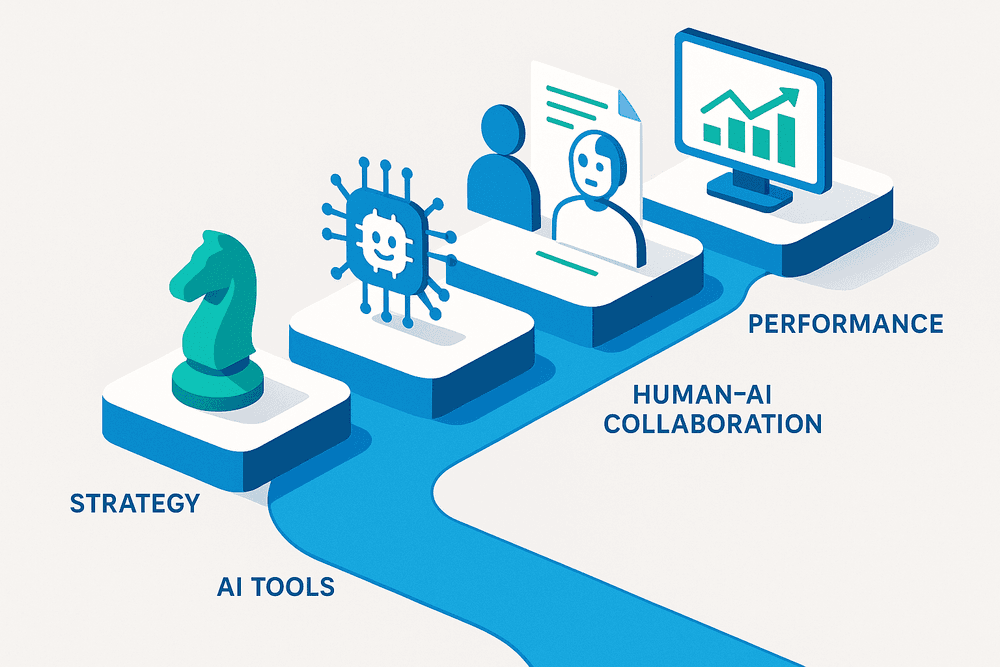
A Step-by-Step Guide to AI Content Optimization
Ready to move from theory to practice? Effective AI content optimization isn't about pushing a button and hoping for the best; it’s a strategic process that blends machine efficiency with human insight. This four-step framework will guide you through creating high-performing content that resonates with your audience and ranks on search engines.
Step 1: Define Your Goals and Target Audience
Before you write a single prompt, you must set your destination. Artificial intelligence is a powerful vehicle, but it needs a map. Start by defining what success looks like for this specific piece of content. Are you trying to:
- Increase organic traffic by ranking for a specific keyword?
- Improve user engagement and time on page?
- Drive conversions and generate leads?
- Establish topical authority in your niche?
Next, get crystal clear on your target audience. Create a detailed persona, outlining their pain points, questions, and search intent. Understanding who you're talking to allows you to provide the AI with the right context, ensuring the generated content speaks their language and solves their problems. This foundational step ensures your entire AI content optimization strategy is aligned with tangible business outcomes.
Step 2: Choose the Right AI Tools for Your Workflow
The AI landscape is crowded, with tools for every imaginable task. The key is to select a tech stack that complements your existing workflow, rather than complicating it. Broadly, AI content tools fall into a few categories:
- All-in-One SEO Platforms: Tools like SurferSEO and MarketMuse analyze top-ranking content and provide data-driven briefs. They use AI to suggest keywords, optimal word count, and structural elements before you even start writing.
- Generative AI Assistants: Models like ChatGPT, Jasper, and Copy.ai excel at brainstorming, outlining, and drafting content based on your prompts. They are your creative partners for generating the initial raw material.
- Specialized Optimization Tools: Applications like Grammarly (for readability and tone), Hemingway Editor (for clarity), and NeuronWriter (for NLP-driven term suggestions) help you refine and polish your draft.
Choose tools that align with the goals you set in Step 1. A balanced approach often involves using a generative AI for drafting and an all-in-one platform for SEO-focused refinement.
Step 3: Generate, Refine, and Fact-Check Your Content
This is where the magic happens. Your process should follow a clear "human-in-the-loop" model to ensure quality and authenticity.
- Generate: Start by feeding your generative AI a detailed prompt. Include your target audience, primary and secondary keywords, desired tone of voice, and a rough outline. The more context you provide, the better the initial draft will be.
- Refine: This is the core of AI content optimization. Use your chosen SEO tools to analyze the draft. Weave in suggested keywords naturally, adjust heading structures, and enhance readability scores. Most importantly, edit the text to inject your brand’s unique perspective, add personal anecdotes, and ensure the tone is authentic. AI provides the skeleton; you provide the soul.
- Fact-Check: This step is non-negotiable. AI models can "hallucinate" and present incorrect information as fact. Meticulously verify all statistics, claims, and data points from reputable sources. Your credibility is on the line, and human oversight is the only way to protect it.
Step 4: Measure Performance and Iterate for Better Results
Your work isn’t done when you hit "publish." True optimization is a continuous feedback loop. Once your content is live, track its performance against the goals you defined in Step 1. Monitor key metrics like:
- Keyword rankings
- Organic traffic
- Click-through rate (CTR)
- Time on page and bounce rate
- Conversion rates
Use this data to inform your future strategy. If a piece of content is underperforming, use AI tools to re-optimize it by analyzing current top competitors or identifying new keyword opportunities. Each piece of content becomes a data point, helping you refine your prompts and processes for even better results next time. This iterative cycle transforms your content creation from a one-off task into a dynamic growth engine.
Real-World Wins: AI Content Optimization Case Studies
Theory and potential are exciting, but tangible results are what truly matter. The strategic application of AI content optimization isn't just a futuristic concept; it's delivering measurable ROI for businesses today. Let's move beyond the abstract and explore concrete examples of how companies are leveraging AI to transform their content performance and achieve remarkable growth.
Case Study 1: How a B2B SaaS Company Boosted Organic Traffic by 150%
The Challenge: A promising B2B SaaS company had a blog filled with insightful articles written by subject matter experts. Despite the quality, their content was underperforming, buried on page three or four of search results for critical keywords. Their manual SEO process was slow, inconsistent, and couldn't keep pace with competitors, resulting in stagnant organic traffic and a low volume of inbound leads.
The Solution: The marketing team adopted an AI content optimization platform to overhaul their strategy. They started by using AI to analyze the top-ranking articles for their target keywords, instantly identifying the semantic terms, subtopics, and questions their content was missing. This data was used to create AI-powered content briefs, providing their writers with a clear roadmap for creating comprehensive, SEO-driven articles. Before publishing, every draft was run through the AI tool for real-time scoring on readability, keyword density, and overall optimization.
The Result: Within six months of implementing this AI-driven workflow, the company’s organic traffic increased by a staggering 150%. They secured first-page rankings for several high-intent keywords, and the number of marketing qualified leads (MQLs) generated from their blog tripled.
Case Study 2: E-commerce Success: Optimizing Thousands of Product Descriptions at Scale
The Challenge: A large online retailer with over 20,000 SKUs faced an impossible task. Their product descriptions were generic, often duplicated from manufacturer specs, and completely unoptimized for search engines. This led to poor organic visibility and lackluster conversion rates. The sheer volume of products made a manual rewrite project financially and logistically unfeasible.
The Solution: The company turned to AI content optimization to tackle the problem at scale. They integrated a generative AI tool trained on their brand voice and product data. This system was able to programmatically rewrite thousands of product descriptions, transforming them from bland lists of features into unique, persuasive, and SEO-friendly copy. The AI seamlessly integrated target keywords, added benefit-oriented language, and structured the text with bullet points for enhanced scannability.
The Result: The impact was immediate and significant. The retailer saw a 40% increase in organic traffic to optimized product pages. More importantly, conversion rates for these products climbed by 22%, directly boosting the bottom line while saving thousands of hours of manual work.
Case Study 3: From Blog to Resource Hub: A Publisher's Content Transformation
The Challenge: A well-established digital publisher in the finance niche had a vast archive of high-quality articles. However, the content existed in silos. There was no clear structure or internal linking strategy, which hurt their topical authority. Users would find one article and leave, and search engines struggled to recognize the depth of the site's expertise.
The Solution: The editorial team used an AI content optimization tool to perform a comprehensive content audit. The AI mapped out their entire content library, identified thematic gaps, and recommended a topic cluster strategy. It suggested which articles should serve as "pillar pages" and which should be supporting "cluster content." Crucially, the AI also generated a prioritized list of internal linking opportunities to weave their disconnected blog posts into a cohesive and authoritative resource hub.
The Result: By restructuring their content based on AI insights, the publisher established strong topical authority in key areas. This led to higher rankings for entire categories of keywords, not just individual articles. User engagement soared, with time-on-page and pages-per-session metrics doubling as visitors began to explore the interconnected resource hub.

The Future is Now: Your Next Steps in AI Content Optimization
The conversation around artificial intelligence has shifted from "what if" to "what now." For content creators and marketers, this isn't a distant future—it's the current landscape. Embracing AI content optimization is no longer a competitive edge; it's a fundamental requirement for staying relevant, visible, and effective in a crowded digital space. The key is to move from theory to action. This section provides a clear, actionable roadmap to integrate AI into your content strategy, starting the moment you finish reading.
Key Takeaways for Your AI-Powered Content Strategy
Before diving into tools and tactics, it's crucial to adopt the right mindset. Successful AI content optimization is built on a strategic foundation. Keep these core principles in mind:
- AI as an Augmentation, Not a Replacement: The most effective strategies use AI to empower human creativity, not replace it. Use AI tools to handle heavy lifting like data analysis, competitor research, and first drafts. This frees up your team to focus on high-value tasks: strategy, unique insights, brand voice, and storytelling.
- Data-Driven Decisions are Paramount: AI thrives on data. Let performance metrics be your guide. Use AI-powered analytics to understand what content resonates with your audience, which keywords drive traffic, and where users drop off. Use these insights to continuously refine your approach.
- Prioritize a Human-in-the-Loop Workflow: Never "set it and forget it." Always have a human editor review, refine, and fact-check AI-generated or -optimized content. This critical step ensures quality, accuracy, and alignment with your brand's unique perspective. A human touch is what separates great content from generic noise.
How to Start Your AI Content Optimization Journey Today
Getting started doesn't require a complete overhaul of your operations. You can begin making a tangible impact by following these four manageable steps:
- Define Clear, Measurable Goals: What do you want to achieve? Don't just say "better content." Get specific. Are you aiming to improve search rankings for a key topic cluster? Increase user time-on-page by 15%? Or accelerate your content production workflow by 25%? Your goals will determine which tools and processes you need.
- Audit Your Current Workflow: Identify the biggest friction points in your content lifecycle. Do you spend too much time on keyword research? Is your editing process slow and inconsistent? Pinpoint these bottlenecks to find the most impactful areas where AI content optimization can provide immediate value.
- Research and Pilot One Tool: The market is flooded with AI tools. Instead of getting overwhelmed, focus on solving one problem identified in your audit. Choose a highly-rated tool for on-page SEO, a grammar and readability assistant, or a content analytics platform, and run a small pilot project on a few pieces of content.
- Measure, Learn, and Iterate: Track the performance of your pilot content against your baseline metrics. Did the optimized blog posts see an uptick in traffic? Did the AI-assisted copy generate more engagement? Use these initial learnings to refine your process before scaling up across your entire strategy.
Get Our Free Checklist for Evaluating AI Content Tools
Choosing the right software is often the biggest hurdle. How do you know which platform truly fits your needs and which is just hype? To help you cut through the noise, we've created a comprehensive checklist for evaluating AI content tools.
This free, downloadable resource guides you through a strategic evaluation process, ensuring you select a tool that aligns with your goals, workflow, and budget. It will help you ask the right questions about:
- Core Functionality and Use Case Alignment
- Integration with Your Existing Tech Stack
- Ease of Use and Team Learning Curve
- Data Accuracy and Customization Options
- Scalability and Transparent Pricing
Stop the endless "free trials" and start making an informed decision. Download our checklist to build your perfect AI content optimization toolkit with confidence.
[Download Your Free AI Content Tool Evaluation Checklist Now]