
September 25, 2025
An Introduction to AI Knowledge Management
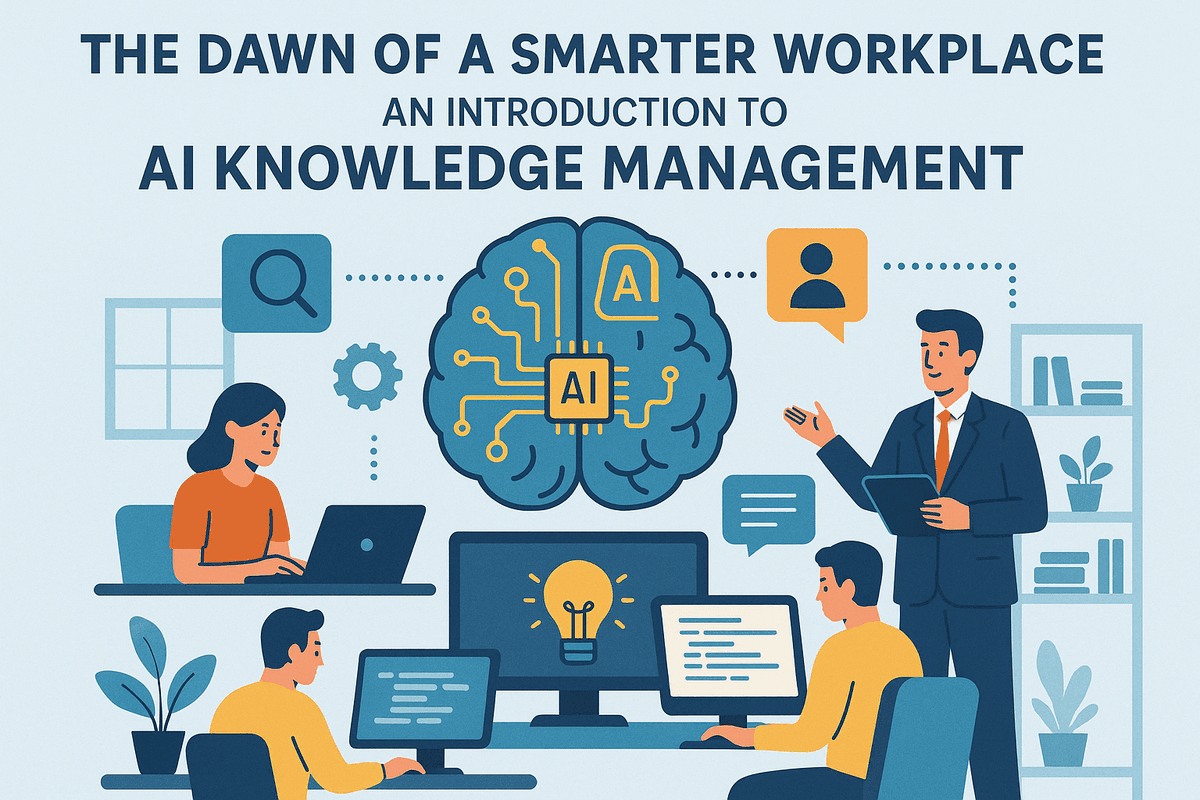
The Dawn of a Smarter Workplace: An Introduction to AI Knowledge Management
Ever spent twenty minutes searching for a document you know exists, only to give up and ask a colleague? You’re not alone. In today’s digital workplace, we are drowning in data but starved for wisdom. Information is scattered across Slack, Teams, email, Google Drive, and countless other applications, creating a chaotic digital landscape. This is where AI knowledge management steps in, not just as a new tool, but as a fundamental shift in how organizations operate.
What is AI Knowledge Management, Really?
At its core, AI knowledge management is the use of artificial intelligence technologies to supercharge the way a company captures, organizes, shares, and utilizes its collective information. Think of it as giving your organization a centralized, intelligent brain.
Unlike a simple search bar, an AI-powered system doesn't just look for keywords. It uses technologies like Natural Language Processing (NLP) and machine learning to understand context, intent, and the relationships between different pieces of information. It can answer a question like, "What was our Q3 marketing ROI for the European campaign?" by pulling data from a presentation, a spreadsheet, and a series of emails, then synthesizing a coherent answer. It’s a proactive, learning system that gets smarter with every interaction, transforming your scattered data into an accessible, reliable source of truth.
Moving Beyond Traditional, Static Knowledge Bases
For years, companies have relied on traditional knowledge bases—think wikis, intranets, or shared drives. While well-intentioned, these systems often become digital graveyards. They are:
- Static: Content becomes outdated almost as soon as it's published, requiring constant manual updates.
- Siloed: Information is trapped within specific platforms, invisible to other parts of the organization.
- Difficult to Navigate: They rely on rigid folder structures and precise keyword searches. If you don’t know the exact name of the file, you might never find it.
AI knowledge management breaks down these limitations. Instead of you having to find the information, the information finds you. It automates the tagging and categorization of new documents, archives obsolete information, and can even suggest relevant content to an employee based on the project they are working on or the questions they are asking in a chat.
How AI Transforms Data Chaos into Organizational Wisdom
The true power of AI knowledge management lies in its ability to convert the digital noise of the modern workplace into a clear signal. It connects the dots that no human could possibly see on their own.
An AI system can analyze a support ticket, instantly surface five relevant help articles for the agent, and simultaneously identify the in-house product expert on that specific issue. It can scan all project management data to proactively flag potential risks or resource conflicts. By integrating with all your communication and storage platforms, the AI builds a comprehensive "knowledge graph" of your entire organization. This living, breathing map of your company's intelligence doesn't just answer questions—it anticipates needs, identifies expertise, and unlocks the collective wisdom that was previously buried under an avalanche of data. This is how data chaos is finally transformed into true organizational wisdom.

Core Benefits of Implementing AI Knowledge Management
Adopting an AI knowledge management system is more than just a technological upgrade; it's a strategic move to unlock your organization's collective intelligence. By infusing AI into how you capture, share, and utilize information, you can transform operational efficiency and drive innovation. This shift moves your business from a state of searching for data to one where insights are actively delivered, creating a foundation for smarter, faster growth. The core benefits ripple across every department, fundamentally changing how your teams work for the better.
Boost Productivity with Instant, Context-Aware Answers
How much time do your employees lose each week searching for information? The answer is often staggering. Traditional search bars in shared drives or intranets are notoriously inefficient, returning a laundry list of documents that employees must sift through manually. AI knowledge management eradicates this time-wasting bottleneck.
By leveraging Natural Language Processing (NLP), these intelligent systems understand the intent and context behind a query, not just the keywords. An employee can ask, "What was our Q3 revenue in the EMEA region last year?" and receive a direct, accurate answer, complete with source links, instead of a dozen irrelevant reports. This capability to surface precise information from a sea of data—whether it's in Slack, Confluence, or an internal wiki—empowers employees to resolve issues independently, accelerate project timelines, and focus on high-value, strategic work.
Enhance Decision-Making with Predictive Insights
In today's fast-paced market, reactive decision-making is a recipe for falling behind. The true power of an AI knowledge management platform lies in its ability to go beyond simply organizing past information. By analyzing vast datasets, including historical performance, customer feedback, and market trends, AI can identify patterns and generate predictive insights that humans might miss.
This transforms your knowledge base from a passive repository into a proactive strategic asset. Imagine your system alerting you to a potential dip in customer satisfaction based on support ticket analysis or forecasting a potential supply chain disruption by connecting disparate data points. Leaders can access data-driven recommendations, test hypotheses with predictive models, and make confident, forward-looking decisions that mitigate risk and seize opportunities before competitors do.
Break Down Information Silos and Foster Seamless Collaboration
Information silos are the silent killers of collaboration and innovation. When valuable knowledge is trapped within specific departments, platforms, or even individual inboxes, the organization as a whole suffers. An AI knowledge management solution acts as a powerful central nervous system, connecting disparate systems and creating a single source of truth.
It intelligently indexes information from all your critical tools—CRM, project management software, communication apps, and document repositories—making it universally discoverable. A sales team member can instantly access technical specifications created by the engineering team, or a marketing specialist can pull insights from customer support conversations. This cross-functional access ensures everyone is working with the most current and complete information, fostering a culture of transparency, reducing redundant work, and enabling true, seamless collaboration across the entire organization.
Automate Content Tagging and Retrieval at Scale
A knowledge base is only as good as its organization. In traditional systems, maintaining a well-organized repository relies on manual, often inconsistent, content tagging. As an organization's data grows, this becomes an impossible task. AI automates this critical process with unparalleled accuracy and speed.
AI algorithms can analyze the content of documents, videos, and conversations, automatically identifying key topics, themes, and entities to apply relevant tags and metadata. This ensures that every piece of information is properly categorized and indexed the moment it's created. The result is a highly organized, self-maintaining knowledge base where information retrieval is fast and incredibly precise. This automated governance is the backbone of a scalable AI knowledge management strategy, guaranteeing that your system remains effective and valuable as your company's collective knowledge expands.
Comparing the Top AI Knowledge Management Platforms of 2024
Navigating the market for an AI knowledge management solution can be daunting. The landscape is diverse, with platforms designed for every scale and specialization. From sprawling enterprises to agile teams, the right tool depends entirely on your unique needs. Here, we break down the main categories of platforms and the critical features you must evaluate to make an informed decision.
Enterprise Solutions: Scalability and Deep Integration
Enterprise-grade AI knowledge management platforms are built for complexity and scale. They are designed to serve as a central nervous system for organizations with vast, siloed data repositories. Their primary strength lies in connecting disparate systems—from Salesforce and SAP to SharePoint and custom databases—into a single, searchable intelligence layer.
Key Features & Integrations:
- Advanced Semantic Search: Goes beyond keywords to understand the context and intent behind a user's query, delivering highly relevant results from documents, chat logs, and databases.
- Robust Security & Governance: Offers granular permission controls, data encryption, and compliance with standards like GDPR, HIPAA, and SOC 2, ensuring sensitive information remains protected.
- Customizable AI Models: Many allow for fine-tuning AI models on your company-specific data and jargon, improving accuracy and relevance.
- Deep API & Connector Libraries: Extensive pre-built integrations with major enterprise software, along with powerful APIs for custom connections.
Self-Service Platforms: Empowering Teams with User-Friendly UI
For small to mid-sized businesses or individual departments, self-service platforms offer a powerful yet accessible entry point into AI knowledge management. Their hallmark is an intuitive, user-friendly interface that requires minimal technical setup. These tools prioritize speed-to-value, enabling teams to organize and access their collective knowledge almost immediately.
Key Features & Integrations:
- Plug-and-Play Integrations: Seamless connections with popular collaboration tools like Slack, Microsoft Teams, Google Drive, and Notion.
- Automated Content Curation: AI-powered features automatically tag, organize, and suggest new content for the knowledge base.
- Natural Language Q&A: Users can ask questions in plain English and receive direct, AI-generated answers with citations from source documents.
- Collaborative Interface: Often designed like modern wikis, making it easy for any team member to contribute and update information.
Niche Tools: Specialized AI for Specific Industries
Some challenges require a specialist. Niche AI knowledge management tools are pre-trained on industry-specific datasets and terminology, giving them a significant advantage in specialized fields. For example, a legal tech platform will understand legal citations and precedents, while a healthcare tool will be versed in medical terminology and clinical trial data. These platforms offer unparalleled accuracy for their target domain.
Critical Features to Evaluate Before You Buy
As you compare solutions, focus on these core functionalities to find the best fit:
- Search & Discovery: How effectively can the tool find information? Test its ability to handle complex, conversational queries.
- Connectivity: Does it integrate with the critical applications your team uses every day? A lack of integration creates new silos.
- AI Capabilities: Look beyond search. Does it offer generative AI for content summarization, draft creation, or trend analysis?
- User Experience (UX): Is the platform intuitive for all users, not just the tech-savvy? High adoption rates depend on a clean, simple interface.
- Analytics & Insights: Can the system show you what knowledge people are searching for, identify content gaps, and track knowledge utilization?

AI Knowledge Management in Action: Real-World Use Cases
The true value of any technology is revealed not in theory, but in its practical application. AI knowledge management is moving beyond the conceptual stage and delivering tangible, transformative results for businesses across every sector. By integrating intelligent systems into core processes, organizations are unlocking new levels of efficiency, innovation, and customer satisfaction. Let’s explore three powerful, real-world use cases where AI is fundamentally changing the way we manage and leverage information.
Revolutionizing Customer Support with AI-Powered Answers
For customer-facing teams, the pressure is constant: resolve issues quickly, accurately, and with a human touch. However, traditional knowledge bases are often cumbersome, leading to long search times for agents and frustrating experiences for customers. This is where AI knowledge management creates a paradigm shift.
Imagine a customer support agent handling a complex technical query. Instead of manually searching through endless articles, an AI assistant integrated into their console instantly surfaces the precise solution, complete with step-by-step instructions and links to relevant documentation. Simultaneously, AI-powered chatbots on the company website handle high volumes of routine questions—like "Where is my order?" or "How do I reset my password?"—providing instant, 24/7 support. This dual approach achieves several key outcomes:
- Drastically reduced response times and higher first-contact resolution rates.
- Improved Customer Satisfaction (CSAT) by providing immediate and consistent answers.
- Empowered human agents who are freed from repetitive tasks to focus on high-value, complex problem-solving.
Accelerating R&D with Intelligent Document Analysis
Research and Development departments are built on information, but they often drown in it. Teams must analyze mountains of unstructured data, from dense scientific papers and patent filings to market analysis reports and internal experimental data. Manually extracting insights is a slow, labor-intensive process where critical connections can easily be missed.
An AI knowledge management platform equipped with Natural Language Processing (NLP) and semantic search capabilities can ingest and comprehend this vast repository of documents. Researchers can ask complex, conversational questions like, "Summarize recent studies on lithium-ion battery degradation that mention cobalt alternatives." The AI doesn't just find keywords; it understands context and relationships, delivering synthesized summaries, identifying trends, and highlighting conflicting data points—all with sources cited. This intelligent document analysis leads to:
- Accelerated innovation cycles by cutting down research time from weeks to minutes.
- Prevention of redundant work by quickly identifying previously completed internal research.
- Discovery of novel insights by uncovering hidden patterns across disparate datasets.
Streamlining Employee Onboarding and Internal Training
A new employee’s first few weeks are critical, yet they are often marked by information overload and confusion. Navigating company wikis, HR portals, and shared drives to find answers to basic questions is inefficient and can leave new hires feeling unsupported.
Implementing an internal AI knowledge management system provides a single, intelligent source of truth. New and existing employees can ask an AI-powered "copilot" direct questions like, "What is the process for requesting new software?" or "Where can I find the brand logo files?" and receive immediate, contextually relevant answers drawn from official documentation. The system can also personalize the onboarding journey, proactively suggesting relevant training modules, connecting new hires with departmental experts, and tracking their learning progress. This modern approach to internal knowledge sharing results in:
- A faster, more consistent onboarding experience that boosts productivity from day one.
- Increased employee self-sufficiency and a reduction in repetitive questions directed at HR and senior team members.
- A scalable training model that supports continuous learning and keeps the entire workforce aligned with the latest processes and information.
Your Blueprint for Success: Implementing an AI Knowledge Management Strategy
Transitioning to an intelligent information ecosystem isn't about flipping a switch; it's about executing a deliberate, strategic plan. A successful AI knowledge management implementation empowers your team, streamlines operations, and delivers a clear return on investment. Follow this four-step blueprint to build a system that transforms how your organization leverages its collective wisdom.
Step 1: Audit Your Current Information Ecosystem
Before you can build the future, you must understand the present. The first step is a thorough audit of your existing knowledge landscape. This involves mapping out exactly where your company's information lives. Is it fragmented across shared drives, buried in email inboxes, locked in siloed applications like Salesforce and Jira, or fleeting in Slack channels?
Conduct interviews with different departments to identify their primary pain points. Ask critical questions:
- What information is most difficult for your team to find?
- How much time is spent each week searching for documents or answers?
- Where do knowledge gaps and redundancies exist?
This audit provides a clear picture of your information architecture's strengths and weaknesses. It creates the foundational understanding needed to select and implement an AI knowledge management solution that solves real, identified problems rather than just adding another layer of technology.
Step 2: Integrate AI Tools with Existing Workflows
The most powerful tools are the ones people actually use. The key to successful adoption is to weave your AI knowledge management system directly into the daily workflows your team already knows. Disrupting established habits creates friction and resistance. Instead, choose a platform that offers robust integrations with your core business applications—be it Microsoft Teams, Slack, your CRM, or your project management software.
The goal is to bring knowledge to your employees, not force them to go hunting for it. An integrated system can surface relevant sales battle cards directly within a Salesforce record, provide instant technical answers within a developer's IDE, or suggest relevant policy documents right inside a support agent’s ticketing system. Start with a pilot program in a single department to test these integrations, gather feedback, and demonstrate value before a company-wide rollout.
Step 3: Train Your Team and Encourage Adoption
Technology alone is not a solution. Your people are the most critical component of your knowledge management strategy. A comprehensive training program is essential, but it should focus on the "why" as much as the "how." Show employees how the new AI knowledge management platform will reduce tedious searching, eliminate repetitive questions, and empower them to make smarter, faster decisions.
Identify and empower "AI Champions" within different teams. These enthusiastic early adopters can provide peer support, share success stories, and foster a culture of knowledge sharing. Establish a clear feedback loop to address user concerns and continuously refine the system based on their experiences. Consistent communication and showcasing early wins are crucial for building momentum and driving long-term adoption.
Step 4: Measure Impact and Calculate ROI
To justify the investment and secure ongoing support, you must demonstrate tangible results. Before you launch, establish clear key performance indicators (KPIs) to track the impact of your AI knowledge management initiative.
Measure a mix of quantitative and qualitative metrics:
- Efficiency Gains: Track the reduction in time employees spend searching for information.
- Operational Improvements: Monitor decreases in customer support ticket resolution times or faster employee onboarding.
- Business Outcomes: Correlate system usage with improved sales win rates or faster product development cycles.
- Employee Satisfaction: Use surveys to gauge how easily teams can access the knowledge they need to excel.
By tying these metrics to business objectives, you can calculate a clear Return on Investment (ROI), proving that a smart AI knowledge management strategy isn't a cost—it's a powerful driver of productivity and growth.

Conclusion: The Future of Work is Powered by AI Knowledge Management
We've journeyed through the transformative landscape of AI-driven information, and one truth is undeniable: the era of passive, static knowledge bases is over. In today's hyper-competitive digital economy, the ability to instantly access, understand, and act upon collective institutional knowledge isn't just an advantage—it's a fundamental requirement for survival and growth. The sheer volume of data created daily is overwhelming, but with the right strategy, it becomes your most valuable asset. This is the core promise of AI knowledge management: to turn information chaos into intelligent, actionable clarity.
Your Competitive Edge in the Information Age
For too long, valuable insights have remained locked away in forgotten documents, disparate applications, and the minds of individual employees. AI knowledge management acts as the master key, unlocking this trapped potential and converting it into a powerful competitive engine.
Organizations that embrace this technology will outpace their rivals by:
- Accelerating Decision-Making: Empowering leaders and teams with instant access to comprehensive, data-backed answers, eliminating guesswork and delays.
- Fostering Unprecedented Innovation: Revealing hidden connections between ideas, projects, and customer feedback that human analysis alone would miss, sparking new product ideas and process improvements.
- Boosting Employee Productivity: Slashing the time employees waste searching for information—a major drain on resources and morale—allowing them to focus on high-value, strategic work.
- Delivering Superior Customer Experiences: Equipping support and success teams with the ability to resolve complex issues instantly and accurately, building loyalty and trust.
In short, implementing a robust AI knowledge management system is no longer a forward-thinking "nice-to-have." It is a strategic imperative for any organization looking to thrive in the future of work.
How to Get Started on Your AI Transformation Journey
Embarking on this journey may seem daunting, but it can be a structured and manageable process. You don't need to overhaul everything overnight. Instead, focus on a strategic, phased approach.
- Assess Your Pain Points: Begin by identifying the most significant knowledge gaps and information bottlenecks in your organization. Is your customer support team struggling with resolution times? Is your sales team spending too much time looking for collateral? Pinpoint a specific, high-impact area to start.
- Define Clear Objectives: What does success look like? Set measurable goals, such as "reduce new hire onboarding time by 40%" or "decrease internal support ticket volume by 25%." Clear objectives will guide your implementation and demonstrate ROI.
- Launch a Pilot Program: Start small with a dedicated pilot team. Choose a user-friendly AI knowledge management platform and focus on solving the specific pain point you identified. Gather feedback, measure results against your objectives, and build a success story to champion wider adoption.
- Cultivate a Culture of Knowledge Sharing: Technology is the enabler, but culture is the driver. Encourage employees to trust, use, and contribute to the system. Lead by example and celebrate the wins that come from democratized, intelligent information access.
See AI Knowledge Management in Action
Reading about the potential of AI is one thing; seeing it transform your own content into an intelligent, on-demand expert is another. The best way to understand the profound impact this technology can have on your team's productivity and your company's bottom line is to witness it firsthand.
Stop letting your organization's collective brainpower go to waste. Take the first, most important step on your AI transformation journey.
[Book a personalized demo today to see how AI knowledge management can unlock your team's full potential.]