
September 11, 2025
Taming Information Overload with AI Document Summarization
Introduction: Taming Information Overload with AI Document Summarization
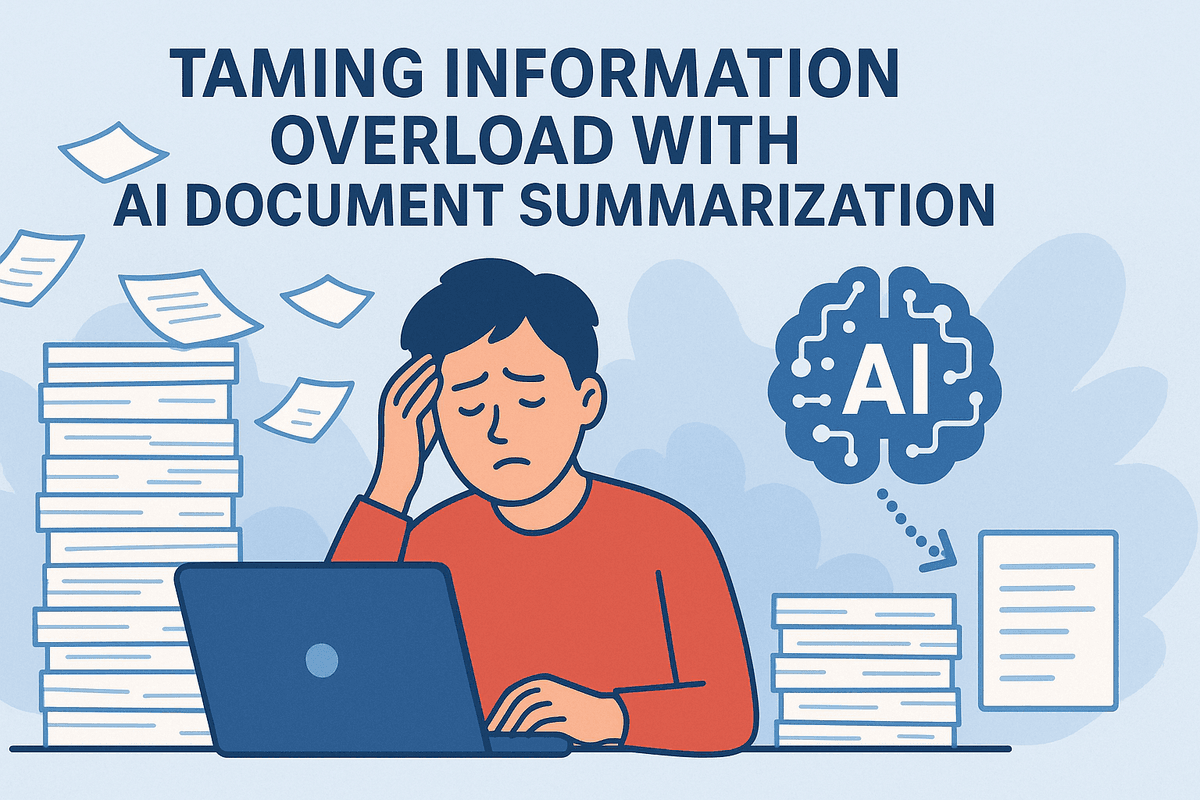
In today's digital world, we're drowning in a sea of information. From lengthy business reports and complex academic papers to endless email threads and market analyses, the sheer volume of text we face daily is overwhelming. This constant deluge, known as information overload, isn't just a minor inconvenience—it's a major roadblock to productivity, leading to decision fatigue, missed insights, and valuable time lost. But what if you could have a brilliant assistant who could read any document in seconds and hand you the key takeaways on a silver platter? That's precisely the power of AI document summarization.
What is AI Document Summarization?
At its core, AI document summarization is the application of artificial intelligence, specifically Natural Language Processing (NLP) and machine learning models, to automatically condense a long piece of text into a shorter, coherent, and accurate summary. It goes far beyond simply copying and pasting the first few sentences. A sophisticated AI summarizer reads and understands the context, identifies the most critical arguments, data points, and conclusions, and presents them in a digestible format. It’s a technology designed to extract the signal from the noise, empowering you to grasp the essence of any document in a fraction of the time it would take to read it in full.
How Does AI Transform Long Documents into Short Summaries?
The magic behind an AI summary isn't really magic—it's advanced computational linguistics. The process works through two primary methods, each with its own strengths:
- Extractive Summarization: This approach works like a highly intelligent highlighter. The AI scans the document, scores individual sentences based on their relevance and importance (using factors like keyword frequency and position), and then extracts the highest-scoring sentences to form a summary. It’s a reliable method for getting a direct, fact-based overview pulled straight from the source.
- Abstractive Summarization: This is where AI truly shines. Emulating human comprehension, an abstractive model first understands the concepts and ideas within the entire document. It then generates a brand new summary in its own words, paraphrasing and synthesizing the information to create a natural, fluent, and often more concise overview. This advanced form of AI document summarization is transforming how we process complex information.
By leveraging these techniques, AI tools can tackle everything from a 50-page legal contract to a dense scientific study, providing you with the critical information needed to make informed decisions quickly. This technology is no longer a futuristic concept; it's a practical and essential tool for anyone looking to reclaim their time and conquer information overload for good.

The Best AI Document Summarization Tools on the Market
Navigating the crowded market of AI document summarization tools can be overwhelming. With dozens of options promising to save you time, how do you choose the right one? The best tool for a multinational corporation handling legal contracts will differ from the one a graduate student uses for literature reviews. This guide breaks down the top platforms, analyzes the free vs. paid debate, and highlights the essential features to look for.
Comparing Top Platforms for Business and Academic Use
The ideal summarization tool depends heavily on your specific needs. Here’s a look at leading platforms tailored for different environments:
- For Business & Enterprise: Tools like Microsoft Copilot and SummarizeBot are built for the corporate world. They prioritize security, integration, and handling large volumes of documents. Key strengths include summarizing meeting transcripts from Teams, analyzing reports within enterprise software, and offering robust APIs to plug summarization capabilities directly into company workflows. They often handle various file formats (DOCX, PDF, PPTX) and focus on extracting actionable insights for teams.
- For Academic Research: Researchers and students need tools that understand the structure of academic papers. Scholarcy and QuillBot excel in this area. They can parse complex PDFs, identify the abstract, methodology, and conclusion, and even generate a bibliography in various citation styles. These platforms are designed to create a structured "summary card" that highlights key findings, participants, and limitations, making literature reviews significantly faster.
- For General & Casual Use: For everyday tasks like summarizing news articles or long emails, accessible tools like SMMRY or the summarization features within ChatGPT are excellent. They are typically web-based, easy to use, and provide quick, coherent summaries from pasted text or a URL. While they may lack advanced features, their simplicity and speed make them perfect for quick information digestion.
Free vs. Paid Summarization Tools: A Cost-Benefit Analysis
Deciding whether to invest in a paid service is a critical step. Each option has distinct advantages and disadvantages.
- Free Tools: The primary benefit is obvious: no cost. They are perfect for occasional, non-sensitive tasks. If you need to quickly grasp the gist of a blog post or a short report, a free tool is often sufficient. However, the trade-offs include restrictive character or word limits, intrusive advertisements, lower accuracy on highly technical documents, and potential data privacy risks, as your text may be used for model training.
- Paid Tools: A subscription-based AI document summarization tool offers a significant upgrade. You gain access to higher accuracy, advanced customization (e.g., adjustable summary length, tone selection), and broader file type support. For businesses, the most crucial benefits are enhanced security protocols, dedicated customer support, and API access for seamless integration. The return on investment comes from increased productivity, better data security, and more reliable outputs for critical decision-making.
Key Features to Look for in a Summarization Tool
When evaluating any tool, keep an eye out for these essential features to ensure it meets your requirements:
- Accuracy and Coherence: The most critical feature. A good summary is not only factually correct but also flows logically and is easy to understand.
- Supported Input Formats: Check if the tool can handle your primary document types, whether it's plain text, web page URLs, PDFs, or Microsoft Office files.
- Customization Options: The ability to control the output is key. Look for features that let you define the summary length (e.g., by percentage or word count) or choose between an extractive (key sentences) or abstractive (newly generated paragraph) summary.
- Integration and Accessibility: A browser extension, mobile app, or API can make the tool much more useful by fitting it directly into your existing workflow.
- Security and Privacy: Especially for business use, ensure the provider has a clear privacy policy and robust security measures to protect your sensitive information.
Core Techniques in AI Document Summarization Explained
When you use an AI to summarize a document, it's not just a single magic trick. Behind the scenes, the AI employs one of two core techniques to condense the information. Understanding the difference between these methods is crucial for choosing the right tool and getting the results you need. The entire field of AI document summarization is built upon these foundational approaches: extractive and abstractive summarization.
Extractive Summarization: The Intelligent Highlighter
Think of extractive summarization as a highly intelligent highlighter pen. This technique works by scanning the entire source document, analyzing its structure, and identifying the most critical sentences. It then "extracts" these exact sentences and stitches them together to form a summary.
How it works: The AI assigns a score to each sentence based on various factors, such as:
- Keyword Frequency: Sentences containing important or frequently used words are ranked higher.
- Position: Sentences at the beginning or end of paragraphs are often considered more significant.
- Sentence Cohesion: How well a sentence relates to its surrounding sentences.
The sentences with the highest scores are selected and presented, in order, as the final summary.
Pros:
- High Factual Accuracy: Since it uses sentences directly from the source text, the risk of misinterpretation or introducing factual errors (hallucinations) is extremely low.
- Speed: It's a computationally less intensive process, making it very fast.
Cons:
- Lacks Flow: The resulting summary can sometimes feel disjointed or choppy because it's a collection of verbatim sentences that weren't originally written to follow one another.
- Contextual Gaps: It may miss nuances or overarching ideas that aren't explicitly contained within a single high-ranking sentence.
Abstractive Summarization: The Creative Paraphraser
Abstractive summarization is a much more sophisticated and human-like approach. Instead of just picking sentences, this method uses advanced deep learning models to read and genuinely comprehend the meaning of the entire document. It then generates a brand-new summary in its own words, just as a person would.
How it works: This technique leverages complex neural networks (like those used in models such as GPT) to parse semantics, context, and relationships within the text. It identifies the core concepts and then articulates them concisely and coherently. This is the cutting edge of AI document summarization.
Pros:
- Highly Readable: The summaries are fluent, coherent, and easy to read, as they are written from scratch.
- Concise and Comprehensive: It can capture the overall gist and synthesize ideas from multiple parts of the document into a single, elegant sentence.
Cons:
- Risk of Inaccuracy: Because the AI is generating new text, there's a small but real chance it could misinterpret the source material and create a summary with factual errors.
- Computationally Demanding: This advanced process requires significantly more processing power than its extractive counterpart.
Which Technique Is Right for Your Needs?
The best method depends entirely on your goal. There’s no single "better" technique; there's only the right tool for the job.
- Choose Extractive Summarization when: You need to guarantee factual integrity above all else. This is ideal for legal document analysis, scientific paper review, or any task where quoting the original text is vital for accuracy.
- Choose Abstractive Summarization when: Readability and conciseness are your top priorities. Use it for creating executive summaries, summarizing news articles or blog posts, or quickly understanding the core message of a business report without getting bogged down in the original phrasing.
Many modern AI document summarization platforms cleverly blend both techniques or allow you to choose which one to use, giving you the perfect balance of speed, accuracy, and readability for any task.
Practical Use Cases: How to Apply AI Document Summarization Today
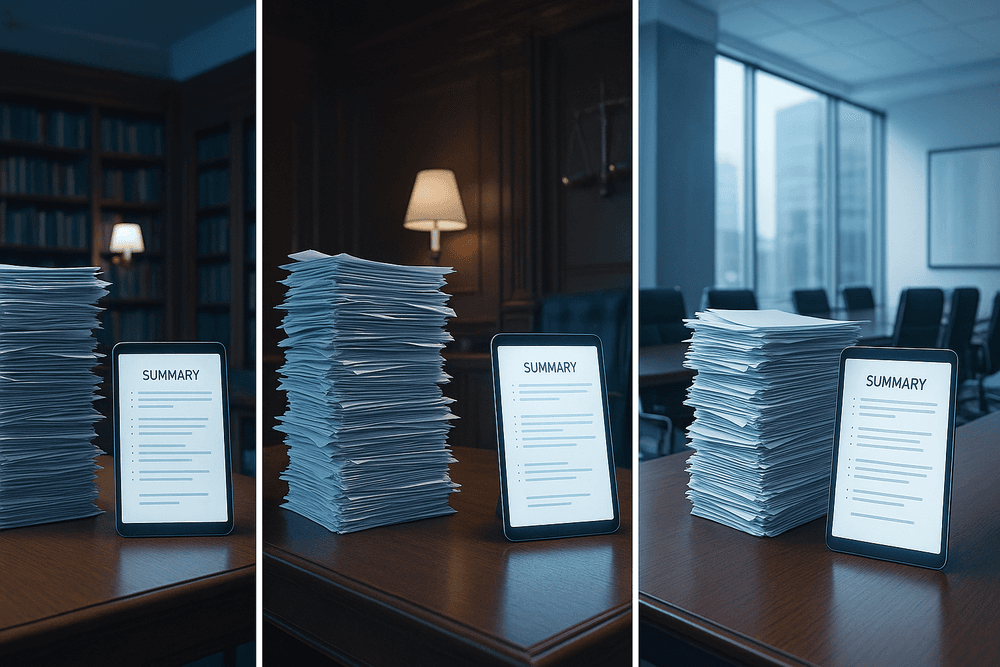
The theory behind AI-powered text analysis is impressive, but its true value lies in its real-world application. Moving beyond abstract concepts, AI document summarization is already revolutionizing workflows across various industries by tackling the universal challenge of information overload. Here’s how you can leverage this technology to gain a competitive edge, save time, and make more informed decisions right now.
Accelerating Academic Research and Literature Reviews
For students, academics, and researchers, the literature review is a foundational—and often overwhelming—part of any project. Sifting through dozens or even hundreds of journal articles, dissertations, and scientific papers can consume weeks of valuable time. This is where AI document summarization becomes an indispensable research assistant.
Instead of manually reading every abstract and introduction to gauge relevance, researchers can use AI to generate concise summaries of entire papers in seconds. This allows for a rapid triage of sources, quickly identifying the most pertinent studies to focus on. An AI summarizer can distill the core methodology, key findings, and conclusions from dense academic text, helping you build a comprehensive understanding of the existing literature at an unprecedented speed. This accelerates the research lifecycle, freeing up more time for critical analysis, experimentation, and writing.
Streamlining Legal Document Analysis
The legal profession is built on a mountain of text. Contracts, depositions, court filings, and case law precedents are notoriously dense, lengthy, and filled with critical details where a single missed clause can change an outcome. AI document summarization is bringing powerful efficiency to this high-stakes environment.
Legal teams can deploy AI tools to instantly summarize complex contracts, highlighting key obligations, dates, and potential liabilities. During the e-discovery phase of litigation, AI can process thousands of documents, summarizing their content to help lawyers quickly identify relevant evidence. This not only saves an extraordinary number of billable hours but also minimizes the risk of human error and oversight. By automating the initial review process, lawyers and paralegals can dedicate their expertise to strategic thinking and case-building rather than getting bogged down in manual document sifting.
Enhancing Business Intelligence and Report Consolidation
In the corporate world, timely decisions depend on accurate information. Yet, executives and analysts are constantly inundated with market research reports, financial statements, competitor analyses, and internal memos. Synthesizing these disparate sources into a coherent picture is a major challenge.
Leveraging AI document summarization transforms this process. An AI tool can ingest multiple reports and generate a consolidated executive summary, pulling out the most critical data points, market trends, and actionable insights. A sales director can get a daily summary of all regional sales reports, while a CEO can receive a condensed brief on the latest industry-wide developments. This enhances business intelligence by providing leaders with a clear, concise overview of the landscape, enabling faster, more data-driven decision-making without the need to read every single page.
Best Practices for Effective AI Document Summarization
Unlocking the full potential of AI document summarization isn’t just about choosing the right tool; it’s about how you use it. Adopting a few key practices can transform this technology from a neat trick into an indispensable productivity engine. By preparing your documents correctly, verifying the output, and seamlessly integrating the process into your routine, you can ensure you get consistently accurate and valuable results.
Preparing Your Documents for the Best Results
The old adage "garbage in, garbage out" holds true for AI. The quality of your input directly impacts the quality of the summary you receive. To set the AI up for success, follow these simple preparation steps.
- Ensure Clean Formatting: Before uploading or pasting your text, remove distracting elements like complex headers, footers, page numbers, and irrelevant sidebars. Stick to standard fonts and clear paragraph breaks. Unstructured or poorly scanned text can confuse the AI, leading to jumbled and inaccurate summaries.
- Leverage Document Structure: A logically structured document with clear headings (H1, H2, H3), bullet points, and numbered lists gives the AI crucial signposts. This helps it understand the hierarchy of information and better identify the most important topics to include in the final summary.
- Define Your Goal: Before you click "summarize," know what you need. Are you looking for a high-level overview, a list of key action items, or a summary of a specific section? Some advanced tools allow you to provide prompts or questions to guide the AI document summarization process toward your specific goal, yielding much more relevant output.
How to Verify the Accuracy of an AI-Generated Summary
While AI is incredibly powerful, it's not infallible. Always treat AI-generated summaries as a first draft that requires a quick human review, especially when dealing with critical information for decision-making. Here’s a simple framework for verification:
- Spot-Check Key Facts: Quickly identify the most critical pieces of information in the summary—names, dates, statistics, or key findings. Use the search function (Ctrl+F or Cmd+F) in the original document to confirm these details are correct and presented in the right context.
- Check for Critical Omissions: A good summary should reflect the core message. Read the introduction and conclusion of the source document and compare them to the summary. Did the AI capture the main thesis and the final conclusions without leaving out essential takeaways?
- Assess Tone and Nuance: A summary might get the facts right but completely miss the tone. For example, a cautious, speculative report summarized as a definitive statement can be dangerously misleading. Read the summary and ask yourself if it accurately reflects the author's original intent and sentiment.
Integrating AI Summarization into Your Daily Workflow
To truly boost productivity, make AI document summarization a seamless part of your daily habits, not just an occasional task. Here’s how you can weave it into your professional life.
- For Meeting Preparation: Instead of spending an hour reading a 30-page pre-read, use an AI summarizer to get the core arguments and data points in minutes. You’ll walk into the meeting informed and ready to contribute meaningfully.
- To Tame Your Inbox: Use AI to summarize long email chains and attached reports. This helps you quickly grasp the context and required actions without getting bogged down in conversational back-and-forth.
- As a Research Assistant: When gathering information, use summarization to quickly vet dozens of articles, academic papers, or reports. This allows you to rapidly identify the most relevant sources for a deep dive, dramatically accelerating your research process.
- Leverage Integrations: Opt for tools with browser extensions or app integrations (e.g., for Slack or Microsoft Teams). This brings summarization capabilities directly into your existing workflow, allowing you to summarize a webpage or a shared file with a single click.

Conclusion: The Future of Productivity with AI Document Summarization
We’ve journeyed through the transformative landscape of AI document summarization, moving from theory to practical application. It’s clear that we are no longer drowning in a sea of endless text; we now have a powerful lifeboat. The challenge of information overload—the constant barrage of reports, articles, emails, and research papers—is finally meeting its match. But this is more than just a technological novelty; it’s a fundamental shift in how we work, learn, and make decisions. The future isn't about reading more; it's about understanding more, in a fraction of the time.
The Productivity Leap: A Quick Recap
Let's circle back to the core benefits that make this technology so revolutionary for your productivity. At its heart, AI document summarization gifts you the one resource you can never get back: time. Instead of spending hours meticulously reading dense material, you can grasp the essential arguments, key data points, and critical conclusions in minutes. This acceleration leads to:
- Enhanced Comprehension: By stripping away the noise, summaries allow you to focus on the signal. You absorb the core message more effectively, leading to better retention and deeper understanding.
- Accelerated Research: Students, analysts, and professionals can sift through vast libraries of information, quickly identifying the most relevant sources without getting bogged down in extraneous detail.
- Informed Decision-Making: When you have the critical facts at your fingertips, you can make smarter, more confident decisions. AI-powered summaries provide the high-level briefing you need to act decisively.
Your First Step: Choosing the Right Summarization Tool
The market is filled with excellent tools, but the "best" one is the one that seamlessly integrates into your workflow. As you prepare to take the plunge, consider your primary needs. Are you a researcher who needs to process complex academic papers and requires summaries that preserve citations and technical nuance? Or are you a business leader who needs to quickly digest market trend reports and internal memos?
Reflect on the types of documents you handle most frequently. Look for a tool that specializes in those formats, whether they are PDFs, web pages, or legal contracts. Many of the top platforms offer free trials or freemium versions. Our advice? Start there. Experiment with a few different options. Upload a document you know well and compare the AI-generated summary to your own understanding. This hands-on experience is the surest way to discover the power of AI document summarization and find the perfect partner for your productivity goals.
Beyond Summaries: Embracing AI for Smarter, Faster Decisions
Ultimately, adopting AI document summarization is about more than just clearing your reading list. It’s about cultivating a new mindset—one where technology acts as an intelligent collaborator, augmenting your own abilities. By outsourcing the cognitive heavy lifting of information processing, you free up your mental bandwidth for the tasks that truly matter: critical thinking, strategic planning, and creative innovation.
This technology empowers you to stay ahead of the curve, to connect disparate ideas, and to see the bigger picture with unprecedented clarity. The age of being buried in data is over. The era of intelligent, data-driven insight has arrived. Embrace it, and unlock a new level of professional effectiveness.