
June 16, 2026
What Is the Soft Summer Color Palette?

Soft Summer in one sentence
The soft summer color palette is a cool, muted, low-contrast palette built around gentle, desaturated colors that feel calm, refined, and understated rather than bright, warm, or high-impact.
For agencies, that matters because “pretty colors” are not enough. A seasonal palette gives your team a strategic shorthand: what the brand should feel like, what it should avoid, and how far designers, writers, and production teams can push the visual system before it starts to feel off-brand.
Core traits: cool, muted, and low-contrast
Soft Summer sits in a narrow emotional lane. Its strength is subtlety. The palette works when the overall impression feels softened, slightly cool, and harmonious.
The three traits to protect are:
- Cool: Colors lean blue-based rather than golden, orange, or earthy. Even when the palette includes pinks, taupes, or greens, they should feel misty or cooled down.
- Muted: Nothing should look neon, candy-bright, tropical, or overly saturated. Soft Summer colors often feel dusted, greyed, or softened.
- Low-contrast: The palette is not built for stark black-and-white drama. It works best when colors sit close together in intensity, creating a quieter, more blended visual impression.
This is where many brand systems drift. A designer may choose a “soft” blue that is actually too bright, or add a charcoal that creates more contrast than the palette can support. The result is not wrong in isolation, but it breaks the seasonal logic. For small agencies managing multiple clients, those small shifts add up fast across decks, social assets, landing pages, and campaign extensions.
When Soft Summer is the right brand signal
Soft Summer is a strong fit when a client needs to communicate calm authority, sensitivity, polish, and trust without feeling corporate or cold. It can work especially well for brands that want to appear thoughtful, editorial, wellness-adjacent, premium-but-approachable, or emotionally intelligent.
Use this direction when the brand should feel:
- Quietly sophisticated rather than flashy
- Supportive rather than aggressive
- Modern but not stark
- Feminine or gentle without becoming overly sweet
- Premium without relying on heavy contrast or luxury clichés
It is less suitable when the client needs to signal speed, disruption, bold entertainment, extreme urgency, or high-energy conversion. In those cases, the softness can become a liability because the palette may feel too restrained.
For agency teams, the value of naming the palette early is alignment. “Soft Summer” gives strategists, designers, and account leads a shared filter for creative decisions. If a concept starts feeling too warm, too sharp, or too saturated, the team has a clear reason to pull it back—not because of personal taste, but because the brand signal has changed.
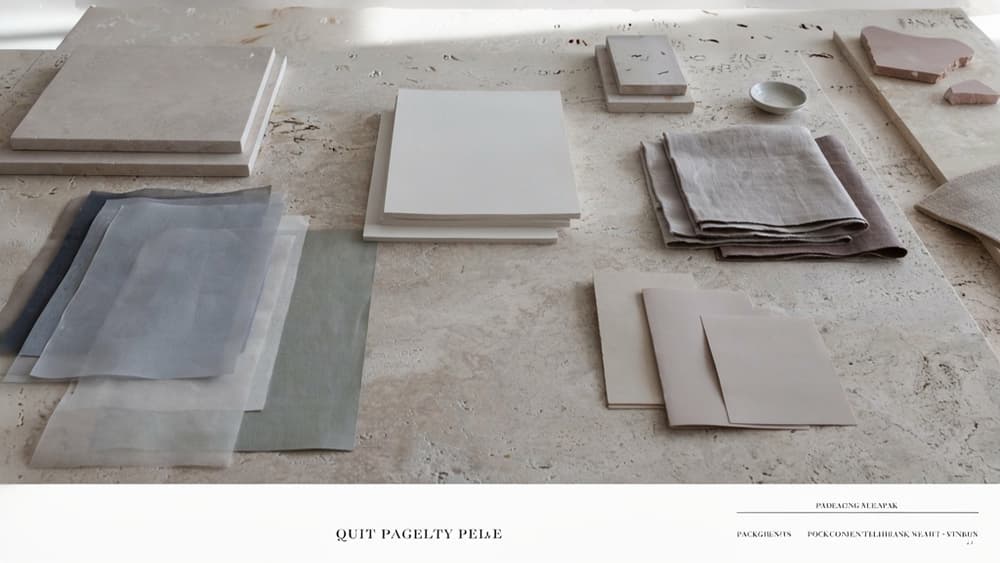
Soft Summer Hex Codes and Color Families
Once the strategy calls for softness, the practical work is choosing colors that stay restrained across every client touchpoint—not just in a moodboard.
Core neutrals for foundations and backgrounds
Soft Summer neutrals should feel cool, misty, and slightly greyed-out. For agency systems, these are the colors that usually do the heaviest lifting: website backgrounds, pitch decks, social templates, packaging flats, UI cards, and typography support.
Role | Color direction | Example hex |
|---|---|---|
Warm-cool off-white | Soft page backgrounds, negative space | `#F2F0EE` |
Mist grey | UI panels, cards, light dividers | `#D8DADF` |
Dove grey | Secondary backgrounds, muted borders | `#B8BBC2` |
Mushroom taupe | Editorial blocks, grounded neutrals | `#A9A19A` |
Slate grey | Body copy, icons, subdued contrast | `#626A73` |
Soft charcoal | Headlines where black feels too harsh | `#3F4650` |
The mistake to avoid: using pure white, jet black, or warm beige as defaults. They can make the rest of the palette look dusty by accident rather than intentionally refined.
Muted blues, mauves, greens, and pinks
The strongest Soft Summer palettes usually come from color families that already have a cooled-down, desaturated quality. Think watercolor, fog, faded textiles, and overcast natural light—not candy, neon, or jewel tones.
Family | Best use | Example hexes |
|---|---|---|
Muted blues | Trust, calm, service brands, SaaS-adjacent creative work | `#8FA3B8`, `#6F879C`, `#AAB8C6` |
Dusty mauves | Beauty, wellness, lifestyle, boutique hospitality | `#B99AAA`, `#A98598`, `#C8B0BB` |
Greyed greens | Sustainability, interiors, slow fashion, editorial brands | `#9BAE9F`, `#7F9788`, `#B8C3B5` |
Soft pinks | Human warmth, community, personal brands, gentle CTAs | `#D7B7BE`, `#CFA6B0`, `#E3C9CE` |
For a client-facing palette, keep the range tight. Five to eight usable colors are easier to govern than twenty “almost right” options that encourage designers, freelancers, and AI tools to improvise.
How to assign palette roles without color drift
A soft summer color palette becomes much easier to scale when each color has a job. Without role assignment, teams tend to brighten accents, warm up neutrals, or introduce higher contrast colors because individual assets feel “too quiet” in isolation.
A simple agency-ready structure:
- Foundation: off-white, mist grey, dove grey
- Text and structure: slate grey or soft charcoal instead of black
- Primary brand color: one muted blue, mauve, or green
- Secondary support: one adjacent muted shade for depth
- Accent: a restrained pink, mauve, or blue used sparingly
- Borders and dividers: low-contrast greys, not saturated color tints
For example, a wellness client might use `#F2F0EE` as the site background, `#626A73` for body copy, `#9BAE9F` as the primary brand color, `#C8B0BB` as a secondary tone, and `#CFA6B0` for small calls to action.
Document the “no” colors too: pure black, bright coral, royal blue, saturated teal, golden yellow, and stark white. Those exclusions help preserve consistency when the palette moves from brand guidelines into production.
Best Soft Summer Color Combinations for Design
Once the palette roles are set, the next decision is how colors sit together. For agencies, this is where a Soft Summer system either feels refined and repeatable — or slowly drifts into muddy, overly gray, or unexpectedly bright territory.
Monochrome and tonal pairings
Monochrome is the safest route when a client needs calm, editorial, or premium softness without much visual noise. Instead of pairing multiple color families, build around one hue and shift the value: lighter tints for space, mid-tones for structure, and deeper muted shades for emphasis.
A strong tonal set might move from:
- Mist blue background
- Soft slate panels
- Smoky blue-gray typography
- Deeper denim-gray accents
The key is contrast without harshness. Avoid jumping from very pale to near-black; Soft Summer works better when the steps feel close and controlled. For agency systems, this is useful because tonal palettes are harder for designers, freelancers, or client teams to misuse. There are fewer “wrong” combinations, and the overall mood stays intact across layouts.
Use tonal pairings when the design needs to feel:
- Quiet and sophisticated
- Minimal but not sterile
- Premium without high contrast
- Consistent across many asset variations
Analogous combinations for gentle depth
Analogous pairings use neighboring hues, which gives the palette more range while still feeling cohesive. In a soft summer color palette, that might mean blue into blue-green, mauve into muted rose, or lavender into cool taupe.
The goal is not contrast first. It is movement. Analogous combinations help a layout feel layered without introducing a loud focal point.
Good examples include:
Combination | Best effect |
|---|---|
Mist blue + muted teal + soft gray | Calm, clean, lightly coastal |
Dusty mauve + cool rose + mushroom taupe | Romantic, editorial, understated |
Lavender gray + slate blue + cool ivory | Polished, serene, premium |
Sage gray + blue-gray + soft charcoal | Natural, grounded, modern |
For agency teams, analogous combinations are especially useful when a client wants more personality than neutrals alone can provide, but still needs the brand to feel mature and restrained. They also make it easier to create campaign variations without inventing a new palette every time.
Accent pairings that stay muted, not loud
Soft Summer accents should create focus, not disruption. This is where many palettes go off-brand: someone adds a bright coral, electric blue, or saturated emerald because the layout “needs a pop.” The result may be eye-catching, but it breaks the seasonal logic.
Better accent choices stay cool, softened, and slightly grayed. Think berry instead of red, smoky plum instead of purple, muted teal instead of turquoise, and rose taupe instead of pink.
A practical rule: if the accent looks clean, hot, or neon against the rest of the palette, it is probably too strong. If it feels slightly weathered or diffused, it is more likely to work.
Use accents sparingly:
- One muted accent per composition
- Keep large areas tonal or neutral
- Use deeper accents for buttons, labels, or small emphasis moments
- Avoid pairing two competing accents in the same layout
The strongest Soft Summer combinations feel intentional because nothing shouts. The palette can still guide attention — it just does it with restraint.
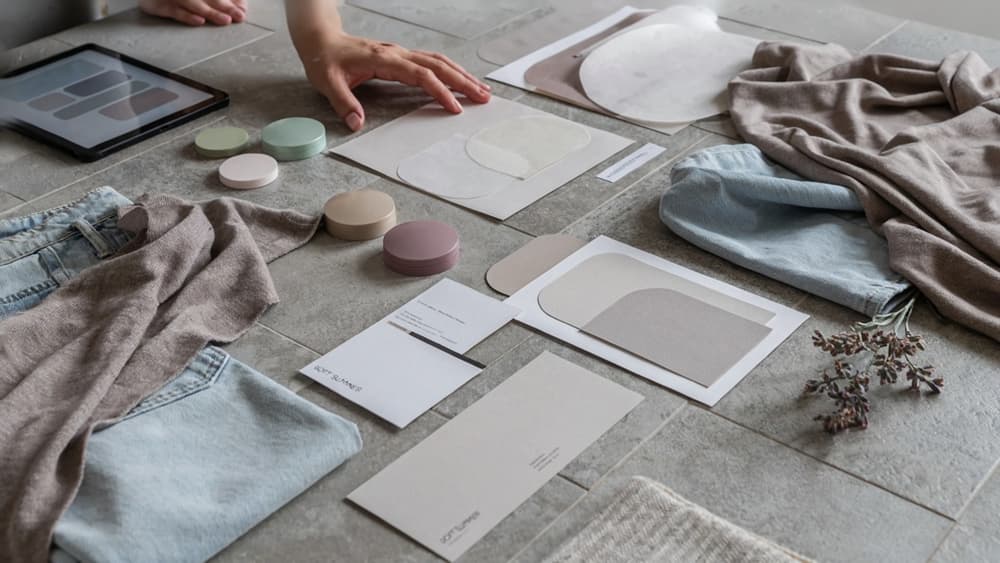
Practical Uses: Branding, Digital Design, and Fashion Direction
Once the palette roles and combinations are set, the real value is in how consistently your team can apply them across every client touchpoint.
Brand identity and client visual systems
For brand identity work, Soft Summer is strongest when the client needs to feel refined, calm, editorial, wellness-oriented, premium, or quietly trustworthy. It works especially well for beauty brands, therapists, boutique hospitality, lifestyle products, personal brands, slow fashion labels, and consultants who want sophistication without stark minimalism.
In a client visual system, use the palette to define more than “approved colors.” Specify how the brand should feel in use:
- Backgrounds should stay soft and breathable, not high-contrast or clinical.
- Logo lockups can sit on muted neutrals or tonal color fields rather than pure white.
- Supporting graphics should use subtle layering, translucent shapes, or tonal blocks instead of bold color hits.
- Icons and illustrations should avoid saturated outlines that make the system feel imported from another brand.
For small agencies, this matters because brand systems often break during production. A strategist approves one direction, a designer extends it, a freelancer builds the deck, and a social contractor creates assets two months later. The soft summer color palette gives the team a shared constraint: gentle contrast, cool undertones, and no sudden jumps in saturation.
Web, social, and campaign assets
In digital design, Soft Summer palettes are useful when the interface should feel polished but not sterile. For websites, they work well across hero sections, editorial landing pages, service pages, product storytelling, and lead-gen experiences where the client wants a softer conversion path.
A few practical applications:
- Use tonal panels to separate sections instead of hard divider lines.
- Pair muted color blocks with generous white space for a premium editorial feel.
- Reserve the clearest accent color for buttons, links, or small navigational cues.
- Keep campaign templates consistent by assigning specific colors to recurring content types, such as testimonials, offers, tips, or founder notes.
For social, the risk is sameness. A muted palette can become flat if every post uses the same background and type treatment. Build variation through layout, scale, cropping, texture, and image treatment rather than introducing off-palette colors. Carousels can alternate tonal backgrounds; quote posts can use deeper muted shades; promotional graphics can rely on contrast in typography and spacing instead of louder accents.
Campaign assets should also account for channel compression. Colors that look elegant in a brand board can lose definition in small mobile placements. Test key templates at feed size, story size, and ad preview size before handing them over.
Fashion, styling, and photography direction
Soft Summer also gives agencies a useful bridge between brand design and visual production. If you’re directing a shoot, moodboard, or creator brief, the palette can guide wardrobe, props, makeup, location, and post-production.
For fashion and styling, think brushed knits, washed denim, soft tailoring, matte finishes, and cool-toned accessories. Avoid styling choices that introduce visual noise: neon nails, warm orange makeup, high-gloss red props, or overly black wardrobe pieces that overpower the palette.
For photography direction, Soft Summer works best with diffused light, lower contrast editing, cool-neutral shadows, and restrained saturation. Backgrounds might include misty blue-gray walls, stone, weathered wood, muted florals, cloudy skies, or soft studio backdrops. The goal is not to make every image monochromatic, but to make the full set feel like it belongs to the same brand world.
That consistency is what clients remember: not just a pretty palette, but a recognizable visual atmosphere across identity, digital, and campaign production.
How Agencies Can Keep Soft Summer AI Outputs On-Brand
Once the palette is defined, the real agency challenge is consistency: making sure every AI-assisted concept, caption, landing page, moodboard, and client presentation follows the same rules without your team re-prompting from scratch.
Ingest the palette once as brand memory
For small agencies, the risk isn’t that AI can’t produce enough ideas. It’s that each tool, freelancer, and account lead interprets the palette slightly differently.
A better workflow is to store the client’s Soft Summer system as reusable brand memory: approved colors, palette roles, usage rules, contrast boundaries, visual references, sample language, and “do not use” guidance. That way, the team doesn’t have to paste the same brand notes into every prompt or hope a designer remembers which accent shade was approved three weeks ago.
For example, instead of prompting:
“Make this feel soft, cool, muted, and elegant.”
Your AI workspace should already know:
“This client uses a soft summer color palette. Keep color choices cool, muted, low-contrast, and restrained. Avoid saturated warm tones, harsh black-white contrast, neon accents, or overly bright gradients.”
That single source of truth matters when multiple people are creating assets for the same client across social, email, web, ads, and presentation decks.
Turn Soft Summer rules into reusable AI instructions
Brand memory becomes much more useful when it is converted into clear operating instructions for AI.
Agencies should define rules such as:
- Use approved palette roles before inventing new colors.
- Keep backgrounds soft and low-contrast unless a stronger CTA treatment is explicitly approved.
- Suggest accent colors only within the client’s muted range.
- Flag any proposed visual direction that feels too bright, warm, saturated, or high-contrast.
- When generating image prompts, describe lighting, wardrobe, props, and environment in a way that supports the palette.
- When writing creative direction, reinforce the intended mood without drifting into unrelated aesthetics.
This is especially valuable for recurring deliverables. A campaign brief, Instagram carousel, homepage concept, and email header can all pull from the same instructions while still leaving room for creative variation.
For agency owners, this reduces the “AI tool sprawl” problem. Your team isn’t managing five different prompt documents, three color-reference links, and a Slack thread full of corrections. The brand rules travel with the work.
Review AI output for palette consistency at scale
Even with strong instructions, agencies still need a fast review layer. The goal is not to slow production down; it’s to catch visual drift before it reaches the client.
A practical review workflow should check:
- Are the generated colors still within the approved palette?
- Did an accent become too saturated?
- Has contrast increased beyond the intended feel?
- Are image prompts introducing warm lighting, bold wardrobe, or vivid props that clash with the system?
- Do layout suggestions respect the palette roles already assigned?
This is where a platform like Aethera can help small creative and digital agencies scale AI output without adding more review burden. By ingesting the client’s brand once and applying those rules across generated work, teams can move faster while keeping every asset aligned to the approved visual system.
The payoff is simple: fewer internal revisions, fewer client comments like “this doesn’t feel like us,” and more confidence using AI across production without sacrificing brand consistency.