September 27, 2025
Reclaim Your Calendar with Meeting Summarization AI
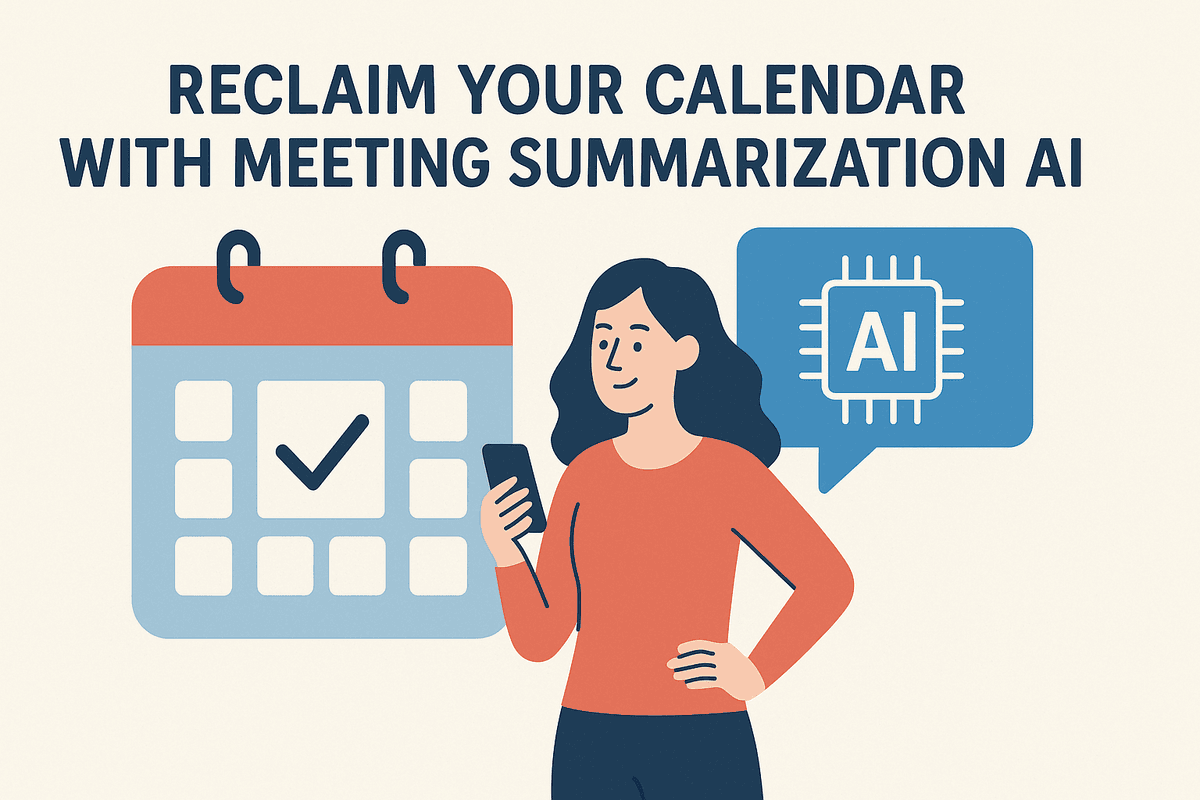
Introduction: Reclaim Your Calendar with Meeting Summarization AI
Does your calendar look like a game of Tetris, with back-to-back meetings stacked so tightly there’s no room to breathe, let alone work? You’re not alone. In today’s fast-paced professional world, meetings are essential for collaboration, but they often become black holes for productivity. You jump from one call to the next, struggling to recall key decisions, track who-owes-what, and distill hours of conversation into a handful of actionable steps. The time spent manually transcribing notes, chasing down action items, and briefing absent colleagues is time stolen from deep, focused work.
The True Cost of Inefficient Meetings
The drain on productivity is more than just a feeling; it’s a measurable cost. Inefficient meetings lead to misaligned teams, missed deadlines, and a frustrating cycle of follow-up conversations to clarify what was decided just days before. Key insights get lost in the shuffle, brilliant ideas are forgotten, and accountability becomes a moving target.
When team members are forced to split their attention between actively participating and frantically typing notes, the quality of both suffers. The result is a mountain of messy, incomplete notes and a team that’s present in the meeting but not truly engaged. This friction doesn’t just slow down projects—it stifles innovation and drains employee morale. It’s time to stop paying this hidden tax on your team’s potential.
What is Meeting Summarization AI and How Does It Work?
Enter meeting summarization AI—a transformative technology designed to give you back your time and focus. This isn't just a simple speech-to-text tool that generates a raw, unedited transcript. True meeting summarization AI is an intelligent system that understands the context and content of your conversations.
Here’s a simplified look at how it works:
- Capture & Transcribe: The AI connects to your virtual meeting platform (like Zoom, Google Meet, or Microsoft Teams) or processes an audio/video recording. Using advanced speech recognition, it creates a highly accurate, speaker-labeled transcript.
- Analyze & Understand: This is where the magic happens. Leveraging Natural Language Processing (NLP) and powerful large language models, the AI analyzes the entire conversation. It identifies key topics, questions, decisions, and sentiment.
- Synthesize & Summarize: Instead of just spitting back the transcript, the AI synthesizes the critical information. It intelligently generates a concise, structured summary highlighting the most important takeaways, decisions made, and unresolved issues. It automatically flags and assigns action items to specific individuals, complete with deadlines.
From Manual Notes to Automated Insights: The Core Benefits
Adopting a meeting summarization AI platform moves your team from a reactive, manual process to a proactive, automated workflow. The core benefits are immediate and impactful. You can finally reclaim your calendar and your focus, knowing that a perfect, searchable record of every conversation is being created for you.
Team members can fully engage in discussions, contributing their best ideas without the burden of note-taking. Anyone who missed the meeting can get up to speed in minutes, not hours. Action items are no longer lost in a notebook; they are clearly defined, assigned, and ready to be tracked. This technology transforms meetings from a necessary evil into a valuable, well-documented asset that drives accountability, enhances collaboration, and accelerates your entire team’s productivity.

The Best Meeting Summarization AI Tools for Every Team
Choosing the right meeting summarization AI isn't a one-size-fits-all decision. The ideal tool depends entirely on your team's size, budget, security requirements, and existing tech stack. A nimble startup has vastly different needs than a large, compliance-driven enterprise. Let's break down the landscape to find the perfect fit for you.
For Startups: Cost-Effective & Agile AI Summarizers
Startups thrive on speed and efficiency, and their tools need to reflect that. The focus is on affordability, ease of use, and quick implementation without locking into expensive, long-term contracts.
Key features for startups include:
- Generous Free or Low-Cost Tiers: The ability to test the platform thoroughly with a small team before committing financially is crucial.
- Simple Integration: Seamless connections with essential startup tools like Slack, Google Workspace, and Trello are non-negotiable.
- User-Friendly Interface: The tool should be intuitive, requiring minimal onboarding so the team can get value from day one.
- Scalable Pricing: Look for per-user plans that allow you to scale your subscription as your team grows.
For Enterprises: Security, Integration, and Scalability
For large organizations, the decision-making process is more complex. Security, compliance, and the ability to integrate deeply into established workflows take center stage. An enterprise-grade meeting summarization AI must be robust and reliable.
Key features for enterprises include:
- Enterprise-Grade Security: Compliance with standards like SOC 2 Type II and GDPR is a baseline requirement. Features like data residency options, single sign-on (SSO), and advanced access controls are critical.
- Advanced Integrations: Beyond basic tools, enterprises need deep integration with CRMs (Salesforce, HubSpot), project management suites (Jira, Asana), and internal communication platforms.
- Scalability and Admin Controls: The platform must support thousands of users with centralized billing, user management, and team-wide analytics to track adoption and ROI.
- Customization: The ability to create custom vocabularies to accurately transcribe industry-specific jargon and company acronyms is a powerful feature.
Comparing Key Players: Fireflies.ai vs. Otter.ai vs. Sembly AI
While many tools exist, these three have emerged as leaders in the space, each with a distinct focus.
Fireflies.ai
Fireflies.ai excels at conversation intelligence, making it a favorite among sales and customer-facing teams. Its greatest strength lies in its deep and extensive integrations, especially with CRMs. It can automatically log meeting notes, create contacts, and update deals in platforms like Salesforce.
- Best for: Sales teams and organizations that want to extract rich, analytical insights and data from their client conversations.
Otter.ai
Otter.ai is renowned for its highly accurate real-time transcription and clean, user-friendly interface. Its "OtterPilot" automatically joins, records, and summarizes meetings, making it incredibly simple to use. Its generous free tier has also made it a popular choice for individuals, students, and small teams just getting started with meeting summarization AI.
- Best for: Individuals and teams needing fast, reliable transcriptions and straightforward summaries with minimal setup.
Sembly AI
Sembly AI positions itself as a smart meeting assistant, with a strong emphasis on creating structured, actionable outputs. It shines in its ability to identify and organize action items, key topics, and decisions into a clean, digestible format. Its "Glance View" provides a quick, visual summary of the meeting's content, which is perfect for project managers.
- Best for: Project-focused teams that need detailed, well-organized meeting notes and seamless integration with task management workflows.
Core Features of a Powerful Meeting Summarization AI
Not all AI tools are created equal. When you're looking for a solution to streamline your meetings, the right features can mean the difference between a minor convenience and a major productivity revolution. A truly powerful meeting summarization AI goes beyond simple transcription to become an indispensable part of your team's workflow. Here are the core features you should demand.
Automated Action Item Detection and Assignment
Ever leave a meeting with a vague sense of what needs to happen next, but no clear list of who is responsible for what? This is where a top-tier AI shines. It actively listens for and identifies key tasks, commitments, and decisions made during the conversation.
Using natural language processing (NLP), the AI recognizes trigger phrases like "I'll take care of that," "The next step is to," or "Sarah will follow up on the report." It then automatically captures these points, formats them as a clean list of action items, and, by using speaker identification, can even assign them to the correct team member. This process eliminates ambiguity, ensures nothing falls through the cracks, and transforms verbal commitments into tracked, accountable tasks without any manual effort.
Multi-Language Transcription and Translation
In today's global workplace, teams are more diverse than ever. A meeting might include participants speaking English, Spanish, and German. A sophisticated meeting summarization AI can handle this complexity with ease. The best platforms offer real-time transcription for multiple languages, accurately capturing the entire conversation as it happens.
But it doesn’t stop there. The core benefit is its ability to provide a translated summary and transcript in a single, unified language (e.g., English). This feature breaks down communication barriers, promotes inclusivity, and ensures that every stakeholder, regardless of their native language, has access to the same clear and accurate information. It democratizes participation and understanding across your entire organization.
Integration with Your Favorite Tools
An AI summary is most powerful when it lives where your team works. A standalone tool that requires you to constantly copy and paste information creates more friction than it removes. That's why seamless integration is a non-negotiable feature.
Look for a meeting summarization AI that connects directly with your existing project management and communication ecosystem. Imagine action items from your strategy session automatically appearing as new tasks in Asana or Jira, or a concise summary being instantly posted to the relevant Slack channel. This seamless flow from conversation to action closes the loop, ensures immediate follow-through, and embeds meeting outcomes directly into your daily workflows.
Speaker Identification and Topic Tracking
Reading a raw, undifferentiated wall of text is almost as time-consuming as re-watching the meeting recording. This is where speaker identification (also known as diarization) becomes crucial. The AI accurately attributes every spoken word to the correct participant, creating a clear, easy-to-follow dialogue. You instantly know who said what, providing crucial context for decisions and ideas.
Coupled with this is intelligent topic tracking. The AI analyzes the conversational flow and automatically segments the transcript and summary into key themes or agenda items discussed. This allows you to jump directly to the section on "Q4 Budget Planning" or "Marketing Campaign Review" without scrubbing through the entire file. It makes your meeting records searchable, scannable, and infinitely more useful.

How to Maximize Your Productivity with Meeting Summarization AI
Adopting a new tool is just the first step; unlocking its full potential is where the real productivity gains happen. A meeting summarization ai is more than a simple recorder—it's a dynamic assistant that, with the right setup and workflow, can transform how your team communicates and collaborates. Here’s how to fine-tune your AI for maximum impact.
Setting Up Your AI for Optimal Accuracy
The quality of your summary starts with the quality of your input. To ensure your AI assistant captures every nuance, focus on these foundational steps:
- Audio Clarity is King: Ensure participants use quality microphones and speak clearly. The AI is only as good as the audio it receives. Encourage the use of headsets in noisy environments and ensure your virtual meeting platform’s audio settings are optimized.
- Integrate with Your Calendar: Connect your meeting summarization ai tool to your team’s calendars (e.g., Google Calendar, Outlook). This allows the AI to automatically join scheduled calls, identify participants, and properly label the meeting context, saving you manual effort.
- Configure Speaker Identification: Spend a few minutes training the AI to recognize the voices of regular team members. Most tools offer a simple voice enrollment process. This ensures that action items and key points are correctly attributed to the right person, eliminating confusion later.
Creating Custom Vocabularies for Industry Jargon
Every company has its own language filled with unique acronyms, project names, and technical terms. An out-of-the-box AI might stumble over "Project Aquila" or misinterpret "S-Q-L" as "sequel." To improve transcription accuracy and the relevance of your summaries, you must teach your AI your specific dialect.
Most advanced platforms allow you to build a custom vocabulary. Take the time to add:
- Names of key clients, partners, and internal stakeholders.
- Internal project codenames and product names.
- Industry-specific acronyms and terminology.
This small investment of time pays huge dividends, dramatically increasing the reliability of your summaries and making the AI feel like a true extension of your team.
Best Practices for Sharing AI-Generated Summaries
A great summary is useless if it isn't shared effectively. Establish a clear, consistent process for distributing the AI-generated outputs to keep everyone aligned.
- Review and Refine: While AI is incredibly accurate, a quick human review (30-60 seconds) is always a good idea, especially when you first start. Check for any misinterpretations of key decisions or action items before sharing widely.
- Automate Distribution: Set up rules to automatically post summaries to a dedicated Slack or Microsoft Teams channel. You can also integrate it with project management tools like Asana or Jira to automatically create tasks from action items mentioned in the meeting.
- Establish a Single Source of Truth: Store all meeting notes and summaries in a centralized, searchable location like Confluence, Notion, or a shared drive. This creates a valuable knowledge base that team members can reference anytime.
Training Your Team to Trust the AI Assistant
The biggest barrier to adoption is often human skepticism. To get your team on board, you need to build trust and demonstrate value.
- Start with a Pilot Group: Roll out the meeting summarization ai with a small, tech-friendly team first. Use their success stories and positive feedback as testimonials to encourage wider adoption.
- Focus on the "Why": Don't just show them how to use the tool; explain why it benefits them directly. Frame it as a way to help them focus completely on the conversation instead of taking notes, and how it saves them time by eliminating post-meeting administrative work.
- Be Transparent: Explain how the AI works in simple terms and address any privacy concerns upfront. Position the tool as an assistant designed to augment their abilities, not replace them. When your team sees the AI as a reliable partner, they’ll embrace it as an essential part of their workflow.
Real-World Use Cases: How Teams Use Meeting Summarization AI
Theory is one thing, but the true power of meeting summarization AI shines when you see it in action. Across an organization, different teams face unique communication challenges, and an AI assistant that captures and distills conversations becomes more than a productivity hack—it becomes a strategic asset. Let's explore how various departments are leveraging this technology to drive concrete results and gain a competitive edge.
Sales Teams: Capturing Client Needs and Follow-Ups
In a high-stakes sales call, a representative’s focus should be on building rapport and understanding the client, not on furiously typing notes. Critical details about pain points, budget constraints, or key decision-makers can easily be missed in the moment. A meeting summarization AI tool acts as a perfect digital memory. It transcribes the entire conversation, uses natural language processing to identify crucial client statements, and automatically generates a list of action items.
Imagine a summary that instantly highlights "Client needs integration with Salesforce" and creates a task to "Send pricing for Enterprise tier by EOD." This empowers sales reps to craft highly personalized, accurate follow-ups that demonstrate they truly listened. The result is a shorter sales cycle, stronger client relationships, and a clear, data-rich record in your CRM.
Project Management: Tracking Decisions and Deliverables
For project managers, clarity is currency. A single misremembered decision or forgotten task can derail a timeline and blow a budget. Project status meetings are dense with updates, scope changes, and critical agreements that must be tracked meticulously. A meeting summarization AI creates an undeniable source of truth. It generates a clean, searchable record of every meeting, pinpointing key decisions, assigned deliverables, and deadlines. The summary clearly states who is responsible for what and by when, eliminating ambiguity and "I thought you were doing that" moments. This ensures complete alignment, holds everyone accountable, and provides a clear audit trail for stakeholders, preventing scope creep and keeping projects firmly on track.
Marketing Teams: Brainstorming and Campaign Recaps
Creativity thrives in free-flowing, energetic environments, but those are precisely the meetings where brilliant ideas get lost. During a marketing brainstorm, one person’s off-the-cuff remark could be the seed of the next big campaign. Meeting summarization AI captures every idea without stifling the creative flow. It can then group related concepts and themes, presenting a structured overview of the session's best output. For post-campaign debriefs, it provides a concise recap of performance metrics, strategic takeaways, and lessons learned, making it easy to share insights with the wider organization. This allows marketers to focus on what they do best: innovating and strategizing.
HR & Recruitment: Unbiased Interview Notes and Candidate Analysis
Conducting effective and fair interviews is a monumental challenge. Interviewers must ask insightful questions, listen actively, and take unbiased notes simultaneously. Unconscious bias can easily influence handwritten summaries. A meeting summarization AI tool provides a verbatim transcript and an objective summary of the candidate’s responses, shifting the focus from the interviewer's interpretation to the candidate's actual words. This ensures every candidate is evaluated on the same criteria, creating a more equitable hiring process. Furthermore, it provides a compliant, detailed record, making it simple for the hiring committee to review and compare candidates based on concrete evidence, leading to better, data-driven hiring decisions.
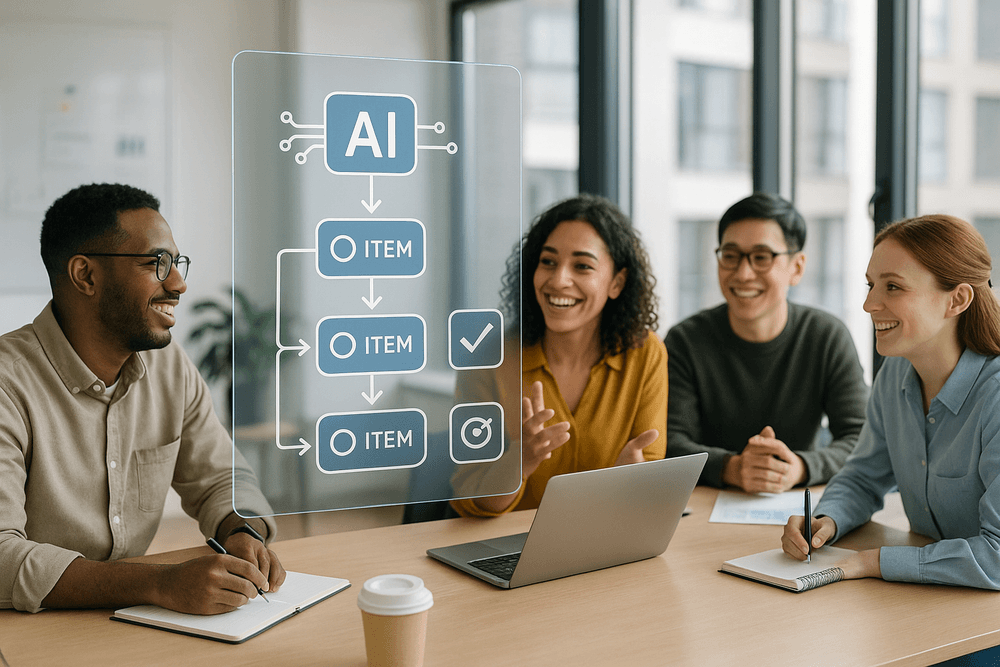
The Future of Meetings: Your Next Steps with AI
You’ve seen the potential. You understand how AI can transform unfocused discussions into actionable outcomes. Now, it's time to bridge the gap between theory and practice. Integrating a meeting summarization AI into your daily operations is the single most impactful step you can take to reclaim lost hours and supercharge your team's productivity. Here’s how to get started and solidify this technology as a cornerstone of your workflow.
Choosing the Right Meeting Summarization AI for Your Workflow
Not all AI tools are created equal. The best platform for your team depends on your unique needs and existing processes. As you evaluate your options, consider these critical factors:
- Integration Capabilities: The most powerful meeting summarization AI is one that feels invisible. Look for a tool that seamlessly integrates with your current calendar (Google Calendar, Outlook), video conferencing software (Zoom, Google Meet, Microsoft Teams), and project management apps (Asana, Jira, Slack). The goal is to automate the flow of information, not create another silo.
- Accuracy and Customization: A great summary is both accurate and relevant. Assess the tool’s transcription accuracy and its ability to intelligently identify key decisions, action items, and deadlines. Can you customize summary templates or define specific keywords to track? A flexible tool adapts to you, not the other way around.
- Security and Privacy: You discuss sensitive information in meetings. Ensure any AI provider you consider has robust, enterprise-grade security protocols, clear data privacy policies, and is compliant with standards like GDPR and SOC 2. Your company's data must remain your own.
Start Your Free Trial: Putting AI to the Test
Reading about benefits is one thing; experiencing them is another. Nearly every reputable meeting summarization AI provider offers a free trial, and you should take full advantage of it. This is your opportunity to conduct a real-world pilot test.
- Select a Pilot Team: Choose a small, forward-thinking team or a specific project to test the tool for one to two weeks.
- Run a Variety of Meetings: Use the AI in different scenarios—a brainstorming session, a daily stand-up, a client-facing project update, and a formal decision-making meeting.
- Evaluate the Output: Don’t just glance at the summaries. Assess them critically. Did the AI accurately capture nuances? Were the assigned action items correct? Did it save you significant time on post-meeting admin work?
- Gather Feedback: Ask your pilot team about their experience. Was the tool easy to use? Did it help them stay more engaged during the meeting, knowing the notes were being taken care of?
Conclusion: Why Meeting Summarization AI is Non-Negotiable for Modern Teams
The era of manual note-taking, forgotten action items, and endless "meeting about the meeting" follow-ups is over. In today’s fast-paced environment, the competitive edge belongs to teams that are agile, aligned, and action-oriented.
Adopting a meeting summarization AI is no longer a forward-thinking luxury; it is a fundamental requirement for operational excellence. It creates an automatic, searchable archive of every decision, turns conversations into measurable tasks, and frees up your team’s most valuable resource—their cognitive energy—to focus on solving problems and driving innovation. Embracing this technology isn't just about improving meetings; it's about building a smarter, more efficient, and more accountable organization from the ground up.