
September 16, 2025
Overcoming Information Overload with AI Research Paper
Introduction: Overcoming Information Overload with AI Research Paper Summarization
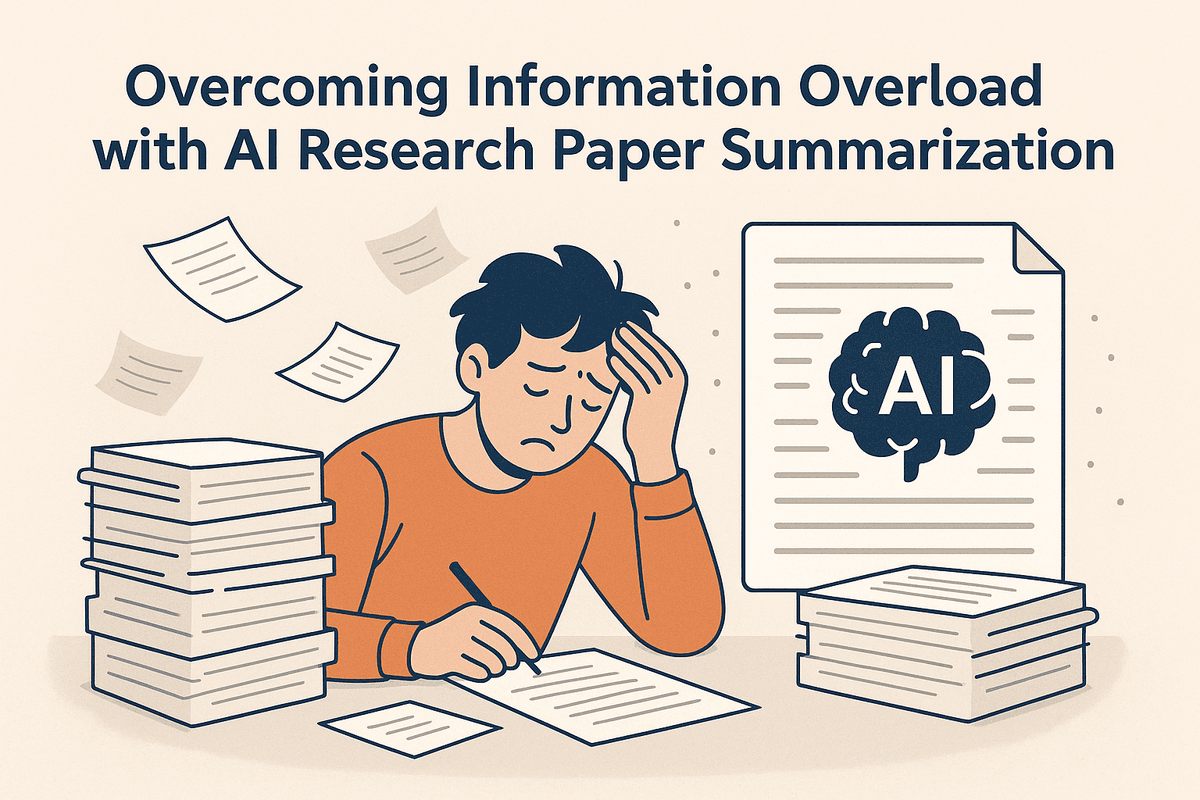
In the world of academia, progress is built on the foundation of existing knowledge. Yet, that foundation is expanding at an exponential rate. Every day, thousands of new studies are published, creating a "digital deluge" that can feel impossible to navigate. For students and seasoned researchers alike, the task of staying current, conducting a thorough literature review, and finding the most relevant papers is no longer just challenging—it's a significant bottleneck to discovery and learning. How can you find the signal in the noise without spending countless weeks simply sifting through abstracts? The answer lies in a transformative technology: AI research paper summarization.
The Challenge of the Modern Literature Review
The traditional literature review process is a rite of passage, but it is also notoriously time-consuming and inefficient. It involves manually searching databases, scanning dozens (or hundreds) of titles and abstracts, and painstakingly reading dense, jargon-filled articles to determine their relevance. This process is fraught with friction. You might spend hours on a single paper only to discover its methodology isn't applicable, or its conclusions are only tangentially related to your work. In the high-pressure "publish or perish" environment, this inefficiency isn't just frustrating; it's a direct impediment to research output and innovation. The sheer volume of information makes it easy to miss critical studies or fail to spot emerging trends, putting your own research at a disadvantage from the start.
What is AI-Powered Research Paper Summarization?
AI-powered research paper summarization is more than just a simple text-shortening tool. It leverages sophisticated artificial intelligence, specifically advanced Natural Language Processing (NLP) models, to read, comprehend, and distill the core components of a complex academic document. Unlike a pre-written abstract, which provides a general overview, an AI summarizer can create dynamic, targeted summaries tailored to your needs.
These tools are trained on vast datasets of scientific literature, enabling them to identify and extract the most crucial elements of a paper:
- The core research question or hypothesis
- The methodology and experimental design
- The key findings and results
- The main conclusions and implications
Essentially, an AI summarizer acts as a brilliant, incredibly fast research assistant. It performs the initial heavy lifting of comprehension, presenting you with a concise, structured brief that allows you to assess a paper's relevance in minutes, not hours.
A New Era for Academics and Students
The integration of AI tools is fundamentally changing the game for academic research. For students, this technology demystifies complex subjects and lowers the barrier to entry for engaging with scholarly literature. Instead of feeling overwhelmed, they can quickly grasp the main arguments of foundational papers, accelerating their learning and improving the quality of their coursework.
For academics and professional researchers, the benefits are revolutionary. AI-powered research paper summarization dramatically accelerates the literature review process, freeing up valuable time and cognitive energy for higher-level tasks like critical analysis, synthesis, and hypothesis generation. Researchers can stay on the cutting edge of their field, identify gaps in existing literature more effectively, and build stronger, more informed arguments for their own studies. This isn't about replacing human intellect; it's about augmenting it, allowing scholars to focus on what they do best: pushing the boundaries of knowledge.

The Best AI Tools for Automated Research Paper Summarization
Navigating the sea of AI tools can be as challenging as the literature review itself. With dozens of platforms claiming to offer the best research paper summarization, how do you choose the one that truly enhances your academic workflow? The right tool doesn't just shorten text; it becomes a trusted research assistant. To find it, you need to evaluate platforms based on a clear set of criteria tailored to the rigors of academic work.
Key Criteria for Evaluating AI Summarizers
Not all AI summarizers are created equal. When your goal is academic precision, look for tools that excel in these three areas:
Accuracy
This is non-negotiable. An effective tool must accurately capture the core argument, methodology, key findings, and conclusions of a paper. It should distinguish between the author's main points and supporting details, preserving the original context and nuance without misinterpretation.
Citation Tracking
Academic integrity is paramount. A superior summarizer will not only condense information but also link its summary points directly back to the source text. This feature, often called "traceability," allows you to quickly verify claims and dive deeper into specific sections, ensuring your work remains grounded in the original evidence.
Integrations
Efficiency is about more than just reading speed. The best tools integrate seamlessly into your existing workflow. Look for compatibility with reference managers like Zotero, Mendeley, or EndNote, as well as browser extensions and the ability to export notes, to create a frictionless research process.
In-Depth Analysis Tools vs. Quick Summary Generators
AI summarization tools generally fall into two categories. For a rapid assessment of a paper's relevance, quick summary generators are perfect. They provide a high-level overview, much like an enhanced abstract, helping you decide if a paper is worth a full read.
For a comprehensive literature review, you need an in-depth analysis tool. These platforms go beyond basic summarization. They can extract methodologies, identify participants, highlight limitations, and even create a comparative matrix of multiple papers. This level of detailed analysis is crucial for building a strong theoretical framework and identifying research gaps.
Comparing the Top 3 Platforms for Academic Work
While new tools emerge constantly, a few have established themselves as leaders for serious academic use.
- Scholarcy: Best for deep, contextual analysis. Scholarcy acts like a digital research assistant, breaking down papers into structured, easy-to-digest sections. It creates a "Robo-Highlight" summary, extracts figures and tables, and compiles a background reading list from the paper’s citations. It’s ideal for researchers who need to deconstruct complex papers methodically.
- SciSpace (formerly Typeset.io): Best for interactive understanding. SciSpace allows you to upload a paper and ask its AI assistant, Copilot, direct questions about the content. You can ask it to explain complex math, clarify the methodology, or summarize a specific section in simple terms. This conversational approach makes it excellent for tackling dense, jargon-heavy material.
- TLDR This: Best for rapid, on-the-fly summaries. As its name suggests, TLDR This excels at providing concise, to-the-point summaries instantly. While it lacks the deep analytical features of its competitors, its browser extension and clean interface make it the perfect tool for quickly screening dozens of articles to build an initial reading list.
Free vs. Paid Summarization Tools: What Do You Really Need?
So, should you open your wallet? The answer depends on the depth and frequency of your research.
- Free tools are excellent for undergraduates, casual researchers, or anyone needing a quick gist of an article. They provide basic summarization but often come with limitations on the number of uploads, feature sets, and may display ads.
- Paid tools are an essential investment for graduate students, PhD candidates, and professional academics. The subscription fee unlocks advanced features like unlimited processing, robust citation tracking, deeper analysis, and crucial workflow integrations. For anyone conducting a serious literature review, the time saved and accuracy gained provides a clear return on investment, making professional research paper summarization a cornerstone of modern academic success.
Core Features to Demand from Your Summarization Tool
Not all AI tools are created equal, especially when academic integrity is on the line. A flashy interface means little if the underlying technology can't support the rigorous demands of research. When evaluating options for research paper summarization, look for a specific set of core features that separate a helpful assistant from a potential liability. These capabilities will ensure you get accurate, verifiable, and seamlessly integrated results.
Extractive vs. Abstractive Summarization: A Critical Choice for Researchers
Understanding how an AI generates its summary is the first step. The two primary methods are extractive and abstractive, and the best tools often offer both.
- Extractive Summarization: This method identifies and pulls the most important sentences directly from the source text, presenting them verbatim. Think of it as a highly sophisticated copy-and-paste. Its greatest strength is accuracy; because it doesn't create new text, the risk of misrepresenting the author's findings is virtually zero. However, the resulting summary can sometimes feel disjointed or lack a natural flow.
- Abstractive Summarization: This more advanced method reads and understands the source material, then generates a new, unique summary in its own words, much like a human would. The result is typically more coherent, concise, and easier to read. The significant drawback is the risk of "AI hallucination," where the model may introduce inaccuracies or information not present in the original paper.
For academic research, a tool that provides a clickable, source-linked abstractive summary is the gold standard. It gives you a readable overview while allowing you to instantly verify every claim against the original text, giving you the best of both worlds.
Automated Keyword and Key Takeaway Extraction
An effective research paper summarization tool should do more than just condense paragraphs. Look for features that automatically identify and list the paper’s core components. This often includes:
- Keywords: A list of the most frequently used and important terms, helping you quickly grasp the paper's central themes and terminology.
- Key Takeaways: A bulleted list of the main findings, conclusions, or arguments. This provides a high-level snapshot, allowing you to decide in seconds whether the paper is relevant to your work.
These features transform the tool from a simple summarizer into a powerful analytical partner, dramatically accelerating your ability to triage dozens of papers.
Seamless Workflow: Integration with Zotero, Mendeley, and More
Your AI tool should fit into your existing workflow, not disrupt it. A non-negotiable feature for any serious student or academic is direct integration with popular reference management software like Zotero, Mendeley, or EndNote. The ideal process is seamless: you upload a PDF to the AI tool, and after it generates the summary and extracts keywords, you can export the paper's metadata, the summary, and your own notes directly to your reference library with a single click. This eliminates tedious manual data entry and ensures your research library is always organized and enriched with valuable context.
The Accuracy Check: Fighting AI Hallucinations
The single most critical feature for academic use is verifiability. An AI hallucination—where the model confidently states something that is not supported by the source text—can be disastrous for your research. The best summarization platforms combat this by making their outputs fully transparent and traceable.
Demand a tool where every sentence or claim in the generated summary is hyperlinked directly back to the precise location in the original document. This allows you to perform an instant fact-check, confirming that the AI’s interpretation is accurate. Treat the AI as an expert research assistant, not an infallible author. A tool that provides these source links empowers you to remain in control, leveraging AI's speed without sacrificing academic rigor.
A Step-by-Step Guide to Effective Research Paper Summarization
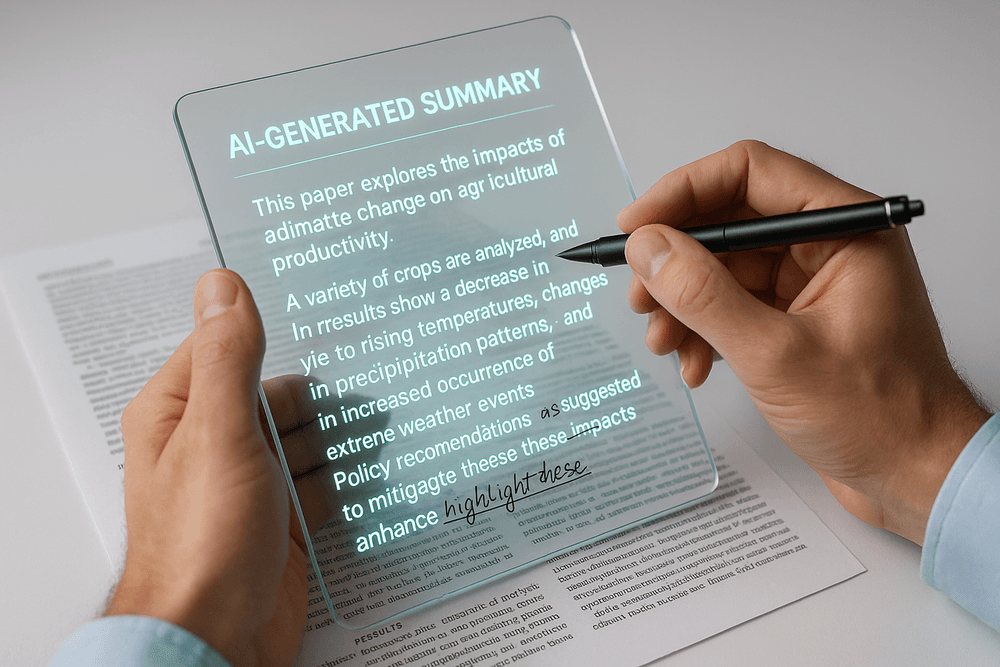
Harnessing AI to accelerate your academic work is more than just a copy-and-paste job. To achieve truly effective research paper summarization, you need a strategic approach. Following a clear process ensures you get accurate, relevant, and genuinely useful results that enhance your understanding and speed up your literature review. Think of the AI as a brilliant but junior research assistant—it needs clear direction and careful oversight. Here’s how to manage the process from start to finish.
Step 1: Define Your Objective Before You Begin
Before you even upload a document, ask yourself a critical question: What do I need from this summary? Your goal will fundamentally change how you interact with the AI and evaluate its output. A vague request yields a vague summary. Get specific with your objective.
Are you:
- Screening for Relevance? You just need to know the paper's core argument and conclusion to decide if it’s worth a full read for your literature review.
- Extracting Methodology? You’re focused specifically on the methods, tools, or experimental setup used by the authors.
- Identifying Key Findings? You need a bulleted list of the primary results and data-backed conclusions.
- Understanding a Complex Theory? You need the AI to simplify a dense theoretical framework into more accessible language.
Defining your objective allows you to write a more targeted prompt, such as, "Summarize the methodology and key statistical findings of this research paper," instead of a generic "Summarize this."
Step 2: Prepare Your Source Material for the Best Results
The principle of "garbage in, garbage out" is especially true for AI. A poorly formatted or incomplete source document will lead to a flawed summary. To set your AI tool up for success, ensure your source material is clean and well-structured. If you’re copying text from a PDF, remove awkward line breaks, page numbers, and headers or footers. For the most accurate high-level research paper summarization, consider feeding the AI specific sections like the Abstract, Introduction, and Conclusion first. This gives the tool the most crucial information without getting bogged down in the granular details of the main body, helping it generate a more coherent initial overview.
Step 3: Use AI Outputs as a Draft, Not a Final Product
This is the most important rule in academic AI use. An AI-generated summary is a fantastic first draft, not a finished piece of work. It’s a starting point designed to save you time, not to do your thinking for you. Directly copying an AI summary into your notes or writing is not only a serious act of academic dishonesty but also a risky intellectual shortcut. AI models can misunderstand nuance, miss critical context, or even "hallucinate" information that isn't in the source text. Always treat the output as raw material that requires your expert analysis and refinement.
Step 4: Critically Evaluate and Refine the AI Summary
Once the AI has produced a draft, your real work begins. This is where you apply your critical thinking skills to transform a machine-generated text into a reliable academic resource. Use this checklist to guide your refinement process:
- Check for Accuracy: Read the summary alongside the original paper. Does the AI accurately represent the authors' hypothesis, methods, and findings? Correct any misinterpretations immediately.
- Identify Critical Omissions: What did the AI leave out? Often, AI summarizers miss the paper’s stated limitations, suggestions for future research, or the finer nuances of the discussion section. Add these crucial details back in.
- Verify Key Data Points: If the summary includes specific numbers, statistics, or quotes, triple-check them against the source. AI can sometimes transpose numbers or take quotes out of context.
- Rewrite in Your Own Voice: The final step is to rewrite the summary in your own words. This process solidifies your understanding, integrates the new knowledge into your existing framework, and ensures the final text is entirely your own.
Real-World Use Cases: How Research Paper Summarization Accelerates Discovery
The theoretical benefits of AI in academia are clear, but how does it perform in the real world? The impact is most profound when we look at the specific, tangible ways research paper summarization is transforming workflows across different professions. From the solitary grind of doctoral research to the high-stakes environment of corporate R&D, these tools are not just saving time—they are fundamentally changing how knowledge is discovered, synthesized, and shared. Here are four key examples of this technology in action.
From Months to Weeks: Revolutionizing the PhD Literature Review
The PhD literature review is a monumental task, often taking months of painstaking work. Researchers must sift through hundreds, if not thousands, of papers, many of which ultimately prove irrelevant to their specific inquiry. This is where AI-powered research paper summarization becomes a game-changer. Instead of manually reading every abstract and introduction, a PhD candidate can generate concise summaries of dozens of papers in minutes. This allows for rapid triage—quickly identifying seminal works, spotting thematic connections between studies, and discarding unrelated articles. The process of mapping a field's intellectual landscape is dramatically accelerated, transforming a months-long ordeal into a focused, weeks-long project. This not only saves invaluable time but also reduces cognitive load and burnout, allowing researchers to dedicate their energy to critical analysis rather than manual sorting.
Gaining a Competitive Edge: Corporate R&D and Market Intelligence
In the fast-paced world of corporate innovation, staying ahead of the curve is paramount. Research and Development (R&D) teams must constantly monitor competitor activities, new patents, and emerging scientific trends. Wading through dense technical papers is a significant bottleneck that can slow innovation to a crawl. AI tools for research paper summarization provide a powerful solution for competitive intelligence. Analysts can quickly process a high volume of publications from competing firms or academic labs, extracting key methodologies, results, and potential applications. This enables them to identify technological threats and opportunities, inform strategic decisions, and avoid duplicating research efforts that have already been explored, giving their company a distinct analytical edge.
Bridging the Gap: Making Science Accessible for Journalists and Policymakers
Complex science often remains locked away in jargon-filled journals, inaccessible to the very people who need to communicate it or act upon it. Science journalists and policymakers face the difficult challenge of translating intricate findings for a general audience or for legislative action. Effective research paper summarization acts as a crucial bridge in this process. An AI-generated summary can distill a paper’s core hypothesis, methodology, and conclusions into clear, accessible language. This gives a journalist a solid foundation for an article or a policymaker a quick, reliable brief on the latest evidence regarding climate change, public health, or technology. While not a substitute for expert consultation, it democratizes access to knowledge, enabling faster, more informed communication and decision-making.
Annotated Bibliographies in Record Time
Creating an annotated bibliography is a foundational—and often tedious—part of academic writing. Each entry requires a concise summary and evaluation of a source, a manual process that consumes hours. AI summarization tools can automate the most time-consuming part of this task. By processing a research paper, the AI can generate a draft annotation that includes the study's purpose, methods, key findings, and conclusion. The researcher can then quickly edit this baseline summary, adding their own critical perspective and analysis of the work's relevance. This transforms the creation of an annotated bibliography from a laborious chore into a streamlined, efficient process, freeing up significant time for higher-level academic work.

Conclusion: Integrating AI Summarization into Your Academic Workflow
The academic landscape is undergoing a profound transformation, and at the heart of this change is the power of artificial intelligence. We've explored how AI is no longer a futuristic concept but a tangible, powerful ally in navigating the ever-expanding sea of scholarly literature. By leveraging sophisticated tools for research paper summarization, you can reclaim countless hours, demystify complex topics, and accelerate your literature review from a daunting task to an efficient, insightful process. The era of manually sifting through dense articles is giving way to a smarter, more focused approach to knowledge acquisition.
Choosing the Right AI Tool for Your Research
Embarking on your AI-assisted journey begins with selecting the right co-pilot. Not all summarization tools are created equal, and the best choice depends entirely on your unique needs. Consider these factors before committing to a platform:
- Project Scope: Are you conducting a broad, preliminary scan to identify key themes, or a deep, systematic review requiring meticulous detail? Some tools excel at providing quick, high-level overviews, while others offer in-depth, structured summaries and data extraction.
- Key Features: Do you simply need a concise abstract, or would your workflow benefit from features like question-answering capabilities, highlighting of key findings and limitations, or integration with reference managers like Zotero and Mendeley?
- Source Compatibility: Ensure the tool can handle your primary document formats, whether they are PDFs stored locally, articles behind a paywall (via a browser extension), or direct links from academic databases.
Ultimately, the goal is to find a research paper summarization service that seamlessly integrates into your existing workflow, acting as a natural extension of your research process. Remember, these tools are designed to augment your critical thinking, not replace it. Always use the AI-generated summary as a map to navigate the original paper, verifying key claims and interpretations yourself.
The Evolving Landscape: What's Next for AI in Academia?
What we see today is just the beginning. The future of AI in academic research extends far beyond summarization. We are on the cusp of a new generation of tools capable of intelligent synthesis—analyzing dozens or even hundreds of papers simultaneously to identify prevailing trends, uncover critical research gaps, and even suggest novel hypotheses for you to explore. Imagine an AI assistant that can not only summarize a body of work but also help you draft a literature review by mapping the intellectual conversation between different authors and studies. This evolution will further empower researchers to move from information retrieval to true knowledge creation at an unprecedented speed.
Your Next Step: Begin Your AI-Powered Journey Today
Reading about the potential of AI is one thing; experiencing it is another. The most effective way to understand its impact is to integrate it into your work today. We recommend starting with a user-friendly and powerful tool like [Tool Name], which provides an excellent balance of robust features and an intuitive interface.
Take the leap. Sign up for a free trial, upload a challenging research paper that’s been sitting on your to-read list, and witness firsthand how quickly you can grasp its core arguments. By embracing AI for research paper summarization, you are not just adopting a new technology; you are investing in a more efficient, insightful, and forward-thinking academic future.