
November 1, 2025
An Introduction to Semantic Search AI
Beyond Keywords: An Introduction to Semantic Search AI
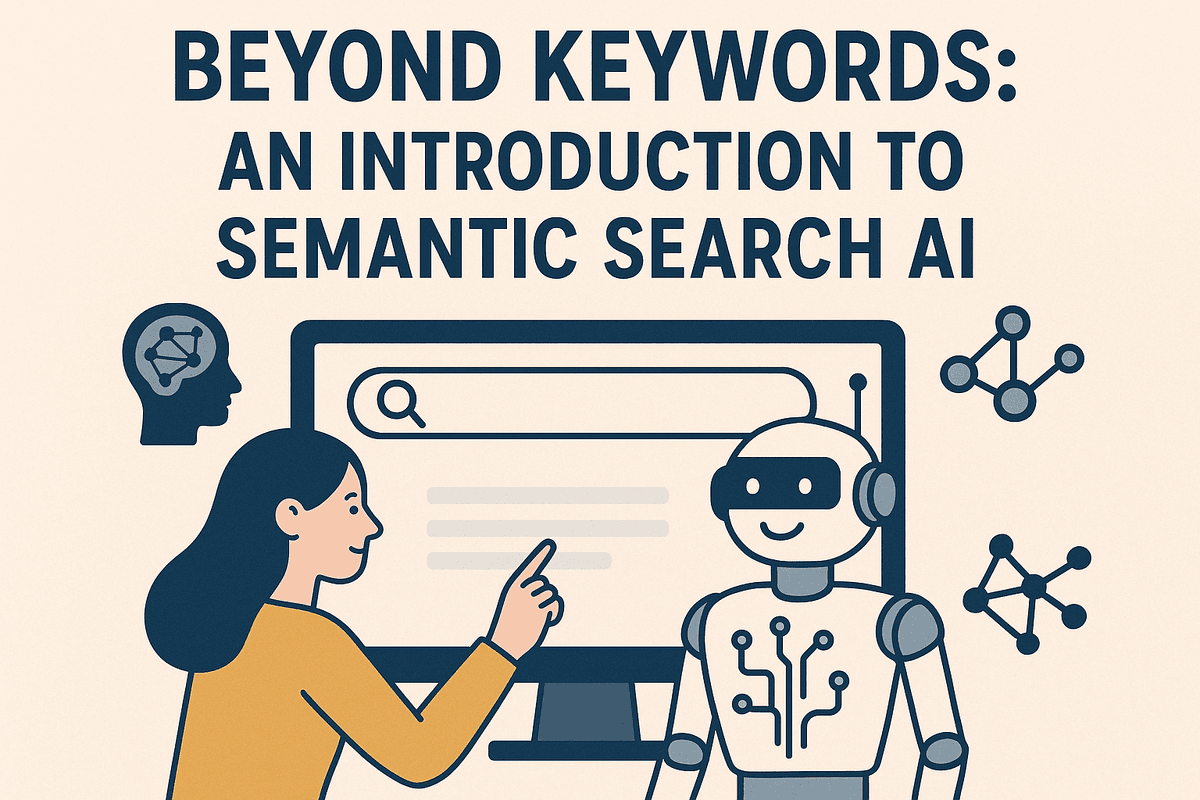
Remember the early days of the internet? Finding information often felt like a game of keyword roulette. You’d type a query, cross your fingers, and hope the search engine would spit back something relevant. If your terms didn’t exactly match the text on a page, you were often out of luck. We’ve come a long way since then, largely thanks to a transformative technology: semantic search AI.
So, what is it? At its core, semantic search is a search methodology that aims to understand the meaning and intent behind a user's query, not just the individual keywords. It goes beyond the literal words on the screen to grasp the contextual relationships between them. It’s the difference between a search engine seeing a string of characters and understanding a genuine question. This matters more than ever in our data-saturated world. We no longer just search for simple facts; we ask complex questions, look for nuanced solutions, and expect our technology to understand us as a human would.
From Keyword Matching to True Intent Understanding
To truly appreciate the power of semantic search, it helps to contrast it with its predecessor, lexical (or keyword) search.
- Lexical Search: This traditional method is essentially a word-matching game. It scans documents for the exact keywords you entered. If you search for "best remote work laptop," it will look for pages containing those specific words. It’s effective but rigid. It doesn't understand synonyms (e.g., "notebook" for "laptop"), context (is "remote" about a TV control or a location?), or the underlying goal of your search (you want to buy a laptop with good battery life and a webcam).
- Semantic Search: This is where the magic of AI comes in. A semantic search AI system doesn't just match words; it deciphers your intent. Using advanced Natural Language Processing (NLP) and machine learning models, it understands that "best remote work laptop" is a query from someone likely looking for a lightweight, portable computer with strong connectivity and long battery life. It can infer that "work from home computer" and "telecommuting notebook" are related concepts and deliver relevant results for all of them, even if the exact keywords aren't present.
The AI Revolution in How We Find Information
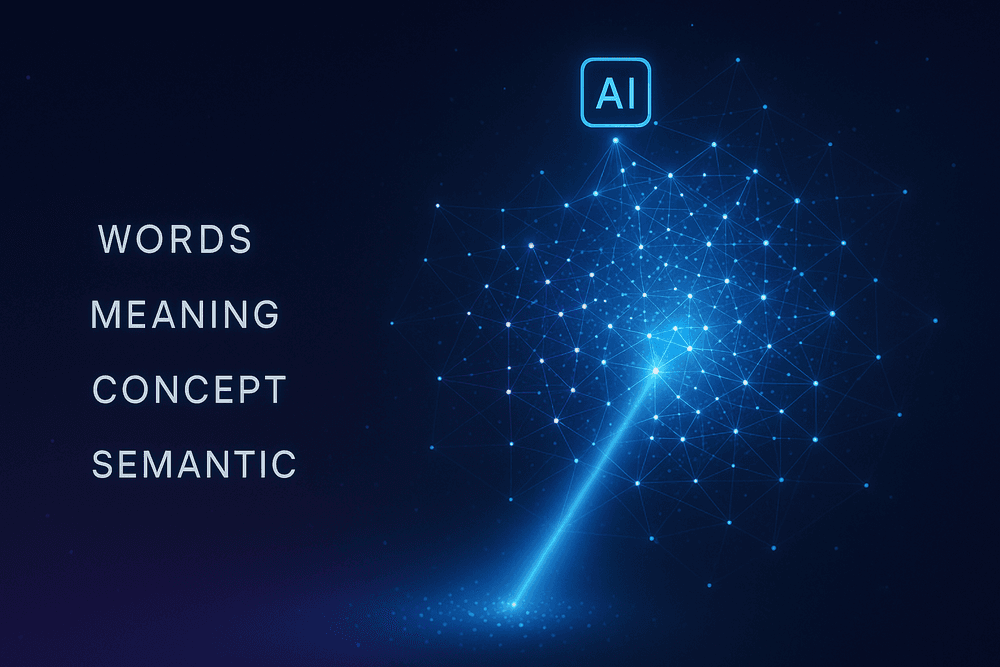
This shift from keyword-matching to intent-understanding is a full-blown revolution, powered by artificial intelligence. Modern semantic search AI engines use techniques like vector embeddings, which convert words and phrases into numerical representations (vectors). In this mathematical space, concepts with similar meanings are located close to one another. This allows the AI to grasp nuances, analogies, and relationships in a way that was previously impossible for a machine.
The impact is profound and extends far beyond your favorite web browser. For businesses, AI-powered semantic search is transforming internal knowledge bases, allowing employees to find complex company policies by asking natural questions. In e-commerce, it helps customers discover products based on descriptive needs ("warm waterproof boots for hiking") rather than just product names. For researchers, it can sift through millions of documents to find conceptually related papers, not just those sharing a specific term. We are moving from a world of "searching" to a world of "discovering," where technology doesn't just fetch data—it provides answers and surfaces insights. This is the new frontier of information retrieval, and semantic search AI is leading the charge.
How Does Semantic Search AI Decipher Your Intent?
Ever wonder how a search engine knows you’re looking for a dessert recipe when you type “best apple crumble” and not information about Apple Inc.’s stock performance? This isn't magic; it’s the result of a sophisticated process where a semantic search AI translates the nuance of human language into a format a machine can understand and act upon. Let’s break down the core components that make this possible.
Inside the Brain: Natural Language Processing (NLP) and Text Embeddings
The journey from your query to a relevant result begins with Natural Language Processing (NLP), a field of AI that gives machines the ability to read, understand, and interpret human language. NLP is the first step, allowing the system to break down your sentence structure, identify key entities, and understand grammatical relationships.
But understanding grammar isn’t enough. To grasp meaning, the AI performs a crucial translation process called text embedding. It converts words, phrases, and even entire documents into a complex numerical representation known as a vector. Think of this as plotting concepts on a vast, multi-dimensional map. On this map:
- The vector for "king" would be located very close to "queen."
- The vector for "puppy" would be near "dog" and "kitten."
- The vector for "How do I fix a leaky faucet?" would be close to a DIY plumbing guide, even if the guide never uses that exact phrase.
These vectors capture the semantic essence—the context, relationships, and underlying intent—of the text.
The Role of Vector Databases in Finding Similar Concepts
Once your entire library of documents, articles, or product descriptions has been converted into a collection of these numerical vectors, they are stored in a specialized system called a vector database. A traditional database is great for finding exact matches, like a specific customer ID. A vector database, however, is built for one primary purpose: lightning-fast similarity search.
When you submit a query, the semantic search AI first converts your query into a vector using the same embedding model. It then sends this query vector to the database, asking, "Find me the vectors that are the closest neighbors to this one on the map." The database rapidly compares your query vector to millions or even billions of others, returning the documents whose vectors are most mathematically similar. This is how it uncovers conceptually related results, moving far beyond simple keyword matching.
Key AI Models That Power Modern Search
The quality of the text embeddings—and therefore the entire search experience—depends on the power of the underlying AI models. The modern revolution in semantic search is largely thanks to a groundbreaking architecture:
- Transformers: This model architecture, introduced in 2017, was a paradigm shift. Unlike older models that processed text word-by-word, Transformers can process entire sequences at once, weighing the importance of every word in relation to all other words. This allows them to capture long-range dependencies and complex context.
- BERT (Bidirectional Encoder Representations from Transformers): Developed by Google, BERT is a famous Transformer-based model that takes contextual understanding to the next level. Its key innovation is being "bidirectional"—it reads the entire sentence at once, looking at words to both the left and right to understand their meaning. This is how a semantic search AI can easily distinguish between "a river bank" (geography) and "a savings bank" (finance), providing you with the precision you expect from modern search.
Core Benefits of Implementing an AI-Powered Semantic Search
Transitioning from traditional keyword-based search to a more intelligent system is not just a technical upgrade; it's a strategic move that fundamentally transforms how users and organizations interact with information. An AI-powered semantic search goes beyond literal string matching to deliver a suite of powerful benefits that drive efficiency, user satisfaction, and data-driven insights. By understanding context, intent, and relationships, a semantic search AI unlocks value that was previously hidden within your data.
Achieve Hyper-Relevant Results, Not Just Matches
The primary weakness of keyword search is its rigidity. It finds documents containing the exact words you typed, often missing the mark entirely if users phrase their query differently. Semantic search, on the other hand, operates on the level of meaning.
Imagine a user searching your e-commerce site for a "durable coat for cold, wet weather." A keyword search might fail if your product listings are titled "waterproof winter parka." A semantic search AI, however, understands the concepts. It recognizes that "durable coat" is conceptually similar to "parka," and "cold, wet weather" implies attributes like "waterproof" and "winter." It deciphers the user's intent—to stay warm and dry—and returns the most relevant products, regardless of the specific terminology used. This ability to connect concepts, synonyms, and context results in a search experience that feels intuitive and consistently delivers hyper-relevant results that truly answer the user's need.
Enhance User Experience and Reduce Bounce Rates
A frustrating search experience is a direct path to a lost customer. When users encounter a "no results found" page or have to rephrase their query multiple times, their confidence erodes, and they are likely to leave. This is where implementing a semantic search AI has a direct and measurable impact on key business metrics.
By providing accurate results on the first try, you eliminate friction in the user journey. This immediate success fosters trust and engagement, encouraging users to spend more time on your platform. Bounce rates plummet because users find what they are looking for quickly and efficiently. The search bar transforms from a simple utility into a helpful, conversational guide. This enhanced experience not only improves user satisfaction but also directly correlates with higher conversion rates and stronger customer loyalty, as users come to rely on your platform as a resource that truly understands them.
Unlock Hidden Insights from Your Unstructured Data
Beyond user-facing applications, one of the most powerful benefits of semantic search is its ability to unlock the value hidden within your organization's unstructured data. An estimated 80% of enterprise data is unstructured—residing in documents, emails, customer support tickets, chat logs, and internal reports. Traditional tools struggle to make sense of this massive trove of information.
A semantic search AI can index and understand the meaning within these documents at scale. This turns your internal knowledge base into a dynamic, queryable asset. For example, a product manager could search for "customer frustrations with the latest feature update" and instantly pull relevant insights from thousands of support tickets, even if each ticket uses different phrasing. An R&D team could find all internal research related to a specific chemical compound, regardless of how it was named in past reports. This capability transforms search from a simple retrieval tool into a powerful engine for business intelligence, trend analysis, and strategic decision-making.
Semantic Search AI in Action: Real-World Use Cases
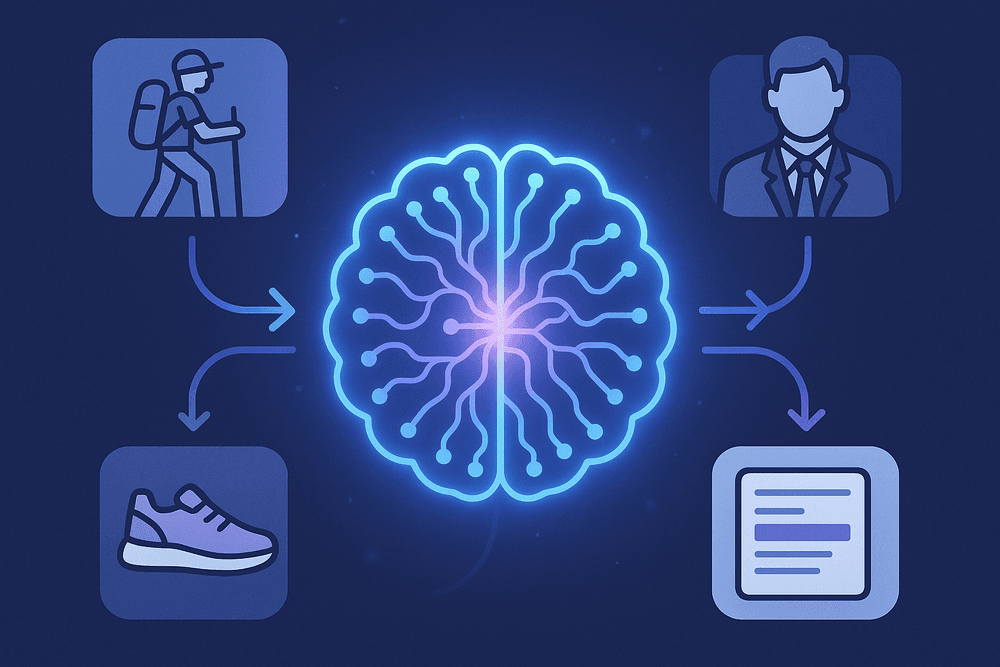
The theoretical power of understanding intent is impressive, but where does the rubber meet the road? Semantic search AI is not a future-facing concept; it's a transformative technology actively reshaping industries today. By moving beyond simple keyword matching, it creates more intuitive, efficient, and intelligent digital experiences. Let's explore three key sectors where its impact is most profound.
E-commerce: Powering Smarter Product Discovery
Imagine a shopper typing "lightweight jacket for a windy spring hike" into an e-commerce search bar. A traditional keyword-based search might return products that contain those exact words, potentially missing a perfect "windbreaker" or "softshell" that doesn't use the term "hike" in its description.
This is where semantic search AI changes the game. It deciphers the user’s intent—the need for a breathable, wind-resistant, non-bulky outer layer suitable for outdoor activity in mild, breezy weather. The AI analyzes product titles, descriptions, specifications, and even user reviews to understand the contextual attributes of each item.
The result: The system can intelligently recommend a Gore-Tex shell, a packable anorak, or a fleece-lined windbreaker, even if they aren't tagged with the user's exact search terms. This contextual understanding leads to:
- Higher Conversion Rates: Shoppers find what they actually want, not just what they typed.
- Improved User Experience: A frustrating search becomes a seamless discovery process, reducing bounce rates.
- Increased Average Order Value: The AI can surface relevant accessories, like hiking socks or a hydration pack, based on the context of the initial search.
Customer Support: Instantly Finding Answers in Knowledge Bases
For customer support, speed and accuracy are everything. Yet, traditional help centers often fail when users describe their problems in natural, conversational language. A customer might ask, "My last payment didn't go through, what happened?" while the relevant help article is titled "How to Resolve a Transaction Failure."
A semantic search AI-powered knowledge base bridges this linguistic gap. It understands that "payment didn't go through" and "transaction failure" refer to the same concept. It can parse the user's question, identify the core issue, and instantly retrieve the most relevant articles, FAQ entries, or community forum posts.
This capability empowers both customers and support agents:
- Self-Service Empowerment: Customers get accurate answers immediately, deflecting support tickets and increasing satisfaction.
- Agent Efficiency: When a query does reach an agent, they can use the same semantic search tool to find precise solutions within internal documentation in seconds, dramatically reducing resolution times.
Enterprise Search: Navigating Complex Internal Documents
Companies today sit on a mountain of unstructured data: contracts, research reports, project plans, HR policies, and marketing presentations stored across countless drives and platforms. Finding specific information is often a monumental task, crippling productivity. An employee might need to find "the clause about intellectual property rights in the 2022 partnership agreement with InnovateCorp."
A keyword search for "intellectual property" would yield hundreds of irrelevant results. Semantic search AI, however, understands the entire query's context. It searches for concepts related to IP, law, partnerships, and a specific company within a defined timeframe. It can pinpoint the exact paragraph within the correct 50-page PDF, surfacing knowledge that would otherwise remain buried. This turns a company’s internal data from a disorganized archive into a strategic, accessible asset, accelerating decision-making and fostering innovation.
Best Practices for Implementing Semantic Search AI
Deploying a powerful semantic search AI system goes beyond simply choosing a technology; it requires a strategic, multi-faceted approach. To transform your data discovery capabilities and deliver truly relevant results, you must focus on the foundational pillars of model selection, data preparation, and continuous improvement. Following these best practices will ensure your implementation is not only successful but also scalable and adaptable for the future.
Choosing the Right AI Models and Infrastructure
The engine of your semantic search AI is its language model and the infrastructure that supports it. Making the right choices here is critical for performance, scalability, and cost-effectiveness.
- Select the Appropriate Embedding Model: Not all AI models are created equal. Your choice depends entirely on your specific use case. For general-purpose document similarity, models like Sentence-BERT (SBERT) are efficient and effective. For more complex question-answering or generative tasks, you might consider larger models from families like GPT or T5. Evaluate models based on their language support, domain specialization, and the balance between performance and computational cost. You can choose from open-source options via platforms like Hugging Face or leverage powerful proprietary models through APIs from providers like OpenAI, Cohere, or Google.
- Implement a Vector Database: At the core of any modern semantic search system is a vector database. Traditional databases are not designed to efficiently query high-dimensional vector embeddings. Specialized vector databases like Pinecone, Weaviate, or Milvus are purpose-built to perform lightning-fast similarity searches across millions or even billions of vectors. This infrastructure is essential for providing the real-time results users expect.
Preparing and Preprocessing Your Data for Success
The old adage "garbage in, garbage out" has never been more true than with AI. The quality and structure of your data directly dictate the accuracy and relevance of your semantic search AI.
- Clean and Standardize Your Corpus: Before feeding data to your model, it must be thoroughly cleaned. This involves removing irrelevant content like HTML tags, boilerplate text, and special characters. Standardize formats, correct typos, and handle duplicate entries to create a clean, consistent dataset.
- Develop a Smart Chunking Strategy: AI models have a limited context window. You cannot simply feed them entire multi-page documents. The solution is "chunking"—breaking down large documents into smaller, semantically coherent pieces (e.g., paragraphs or sections). A well-designed chunking strategy ensures that the resulting embeddings capture a specific, focused concept, dramatically improving the precision of search results. Overlapping chunks can also help preserve context that might otherwise be lost at the edges of a chunk.
Evaluating and Fine-Tuning Search Performance Over Time
Launching your semantic search AI is the beginning, not the end. Continuous evaluation and refinement are what separate a good search system from a great one.
- Establish Relevant Evaluation Metrics: Move beyond simple keyword matching metrics. To truly understand performance, use information retrieval metrics like Mean Reciprocal Rank (MRR), which measures the rank of the first correct answer, and Normalized Discounted Cumulative Gain (nDCG), which evaluates the overall quality of the ranked list. Complement these quantitative metrics with qualitative user feedback.
- Fine-Tune Models for Domain Specificity: A pre-trained model has general language understanding but lacks knowledge of your specific industry jargon or internal terminology. Fine-tuning involves further training the base model on your own curated dataset. This process helps the model learn the unique nuances of your domain, leading to a significant boost in relevance and accuracy for specialized queries.
- Create a Human Feedback Loop: The most effective way to improve your system is to learn from your users. Implement mechanisms to capture user interactions, such as clicks, upvotes/downvotes, or explicit feedback. This data is invaluable for identifying weaknesses, creating better evaluation sets, and continuously retraining your models to adapt to user needs.

The Future is Contextual: Your Next Steps with Semantic Search AI
We’ve journeyed beyond the rigid limitations of keyword-based queries and into a world where meaning, intent, and context reign supreme. As we've seen, the fundamental shift is clear: context is the new keyword. Traditional search methods merely match words; a powerful semantic search AI understands concepts. It doesn't just find documents containing "cloud migration cost," it comprehends the user's need to understand budgeting, potential ROI, and pricing models for moving infrastructure. This leap from lexical matching to contextual understanding is what unlocks the true value hidden within your enterprise data, transforming it from a static repository into a dynamic, intelligent resource.
Embracing this future doesn't have to be an overwhelming endeavor. You can begin harnessing the power of semantic search by starting with a focused, high-impact project.
How to Get Started with Your First Semantic Search Project
Embarking on your AI journey is a matter of taking strategic, incremental steps. By focusing on a single, well-defined use case, you can demonstrate value quickly and build momentum for broader adoption.
1. Define Your High-Value Use Case
Where does your organization feel the most pain from inefficient information retrieval? Start there. Excellent first projects often include:
- Internal Knowledge Base: Empower your employees to find answers in HR policies, technical documentation, and project archives instantly, reducing support tickets and boosting productivity.
- Customer Support Bot: Go beyond simple FAQ bots. Implement a semantic search AI to understand nuanced customer questions and provide accurate solutions from your help center articles.
- E-commerce Product Discovery: Help customers find what they mean, not just what they type. A search for "warm jacket for hiking" should surface insulated, waterproof outerwear, even if those exact keywords aren't in the product title.
2. Consolidate and Prepare Your Data
Your search engine is only as good as the data it can access. Identify the primary data sources for your chosen use case (e.g., Confluence, SharePoint, Zendesk). The initial step involves cleaning and structuring this information. The core of semantic search AI technology will then convert this text into numerical representations called vector embeddings, capturing the contextual meaning for the model to understand.
3. Choose Your Model and Infrastructure
You'll need to select a language model to create the embeddings and a vector database to store and query them. While open-source options provide flexibility, a fully-managed platform can significantly accelerate your timeline and reduce technical overhead, allowing you to focus on the application rather than the infrastructure.
4. Implement, Test, and Iterate
Deploy a pilot version to a small group of users. Gather feedback on the quality and relevance of the search results. This iterative process is crucial for fine-tuning the model and ensuring the semantic search AI continuously improves and adapts to your users' needs.
Explore Our AI Solutions to Revolutionize Your Data Discovery
Building a sophisticated semantic search AI from the ground up requires deep expertise in machine learning, data engineering, and infrastructure management. That's where we come in.
Our end-to-end platform is designed to eliminate the complexity and accelerate your path to intelligent data discovery. We provide the cutting-edge models, scalable vector infrastructure, and intuitive tools you need to build and deploy powerful semantic search applications in a fraction of the time. Stop just searching your data—start understanding it.
Ready to transform your organization's relationship with information? Explore our solutions or schedule a personalized demo to see how our semantic search AI can unlock the contextual intelligence within your data today.