
November 16, 2025
An Introduction to AI-Powered Language Translation
The Revolution in Communication: An Introduction to AI-Powered Language Translation
For centuries, language has been both a bridge and a barrier. It connects cultures while simultaneously creating divides that hinder global collaboration and understanding. Today, we stand at the precipice of a new era where these barriers are crumbling, thanks to the remarkable advancements in AI-powered language translation. This technology is no longer a distant sci-fi dream; it's a practical, powerful tool reshaping how we interact, do business, and share knowledge across the globe.
What is AI-Powered Language Translation?
At its core, AI-powered language translation is the use of artificial intelligence, specifically machine learning and deep learning models, to automatically convert text or speech from one language to another. Unlike older translation software that relied on rigid, dictionary-based rules, AI systems learn from vast amounts of multilingual data.
Think of it this way: instead of simply swapping words, the AI learns the intricate patterns, context, grammar, and nuances that define a language. It analyzes entire sentences and paragraphs to understand the intended meaning before generating a translation. This sophisticated approach allows it to capture idioms, tone, and cultural subtleties with a level of accuracy that was previously unimaginable, creating translations that are not just understandable, but fluid and natural.
From Sci-Fi to Reality: The Evolution of Translation Technology
The idea of an instant translator, like the Universal Translator from Star Trek, has captivated our imagination for decades. The journey to make it a reality has been a long and fascinating one.
The earliest attempts in the mid-20th century used Rule-Based Machine Translation (RBMT). These systems were painstakingly built with massive sets of grammatical rules and bilingual dictionaries. The results were often literal, clunky, and prone to comical errors, as they couldn't grasp context.
The next major leap was Statistical Machine Translation (SMT), which emerged in the late 1980s and dominated for years. SMT models analyzed huge volumes of human-translated texts and used statistical probability to determine the most likely translation for a given phrase. This was a significant improvement, but the translations could still feel disjointed and lacked genuine fluency.
Why Neural Machine Translation is a Game-Changer
The true revolution arrived with Neural Machine Translation (NMT), the engine behind virtually every modern AI-powered language translation tool. NMT utilizes complex neural networks, inspired by the human brain, to process language. Instead of breaking sentences into small chunks, NMT models consider the entire sentence as a single input.
This holistic approach is what makes NMT a game-changer. It allows the AI to:
- Understand Context: It recognizes the relationship between all words in a sentence, leading to far more accurate and relevant translations.
- Produce Fluent Output: NMT-generated text flows naturally and reads like it was written by a human, not a machine.
- Learn and Improve: These models are in a constant state of learning. Every new piece of data helps refine their algorithms, making them progressively smarter and more accurate.
- Handle Nuance: NMT is significantly better at interpreting idioms, slang, and subtle turns of phrase that would baffle older systems.
Thanks to NMT, high-quality, instantaneous translation is no longer science fiction. It’s a powerful, accessible technology that is actively breaking down communication barriers for everyone.
Comparing the Titans: The Best AI-Powered Language Translation Tools Today
The world of ai powered language translation is no longer a futuristic dream—it's a competitive landscape dominated by powerful, intelligent platforms. While many options exist, three titans consistently rise to the top, each offering a unique blend of features, accuracy, and integration. But which one is the right fit for your needs? Let's break down the leaders.
DeepL: The Gold Standard for Nuance and Accuracy
Often hailed by linguists and professional translators, DeepL has earned a reputation for producing astonishingly natural and nuanced translations. Its advanced neural networks excel at understanding the subtle context, idiomatic expressions, and stylistic tone of the source text, resulting in translations that often read as if they were written by a native speaker.
Key Strengths:
- Superior Contextual Understanding: DeepL is exceptional at grasping the full meaning of a sentence, avoiding the literal, word-for-word translations that plague lesser tools.
- Formal/Informal Tone Control: A standout feature for many languages, allowing users to select the appropriate level of formality for their audience.
- Glossary Feature: Users can define how specific terms should be translated, ensuring consistency across documents—a crucial feature for technical or branded content.
Best for: Professionals, academics, writers, and anyone who prioritizes linguistic quality and precision over the sheer number of supported languages.
Google Translate: The Versatile and Accessible Powerhouse
As the most recognized name in translation, Google Translate is the undisputed champion of accessibility and language breadth. Supporting over 130 languages, it’s the go-to tool for quick, on-the-fly translations in almost any situation. Its integration across the entire Google ecosystem—from Chrome browsers to Android devices—makes it effortlessly convenient.
Key Strengths:
- Unmatched Language Support: No other platform comes close to the number of languages Google supports, making it invaluable for travelers and users dealing with less common dialects.
- Multi-Modal Functionality: Google Translate isn't just for text. It offers real-time conversation mode, voice translation, and powerful image translation through Google Lens, allowing you to translate signs and menus with your camera.
- Constant Improvement: Backed by Google's massive data sets, its AI model is continuously learning and improving its accuracy for major language pairs.
Best for: Everyday users, travelers, students, and anyone needing a fast, free, and versatile tool for a wide range of languages and situations.
Microsoft Translator: Best for Business and Enterprise Integration
Microsoft Translator carves out its niche by focusing on business and enterprise solutions. Its greatest strength lies in its seamless integration with the Microsoft Office suite (Word, PowerPoint, Outlook, etc.), allowing professionals to translate documents and communications without ever leaving their workflow.
Key Strengths:
- Deep Microsoft Office Integration: The ability to translate entire documents, presentations, or emails directly within the app is a game-changer for productivity.
- Powerful Business Solutions: Offers robust API and customization options through Azure Cognitive Services, enabling businesses to build custom ai powered language translation solutions.
- Live Conversation Feature: An excellent tool for multilingual meetings, allowing multiple people to join a conversation from their own devices and see real-time translated text in their chosen language.
Best for: Businesses, corporate users, and professionals heavily invested in the Microsoft ecosystem.
A Side-by-Side Feature Breakdown: Which Tool is Right for You?
Choosing the best ai powered language translation service ultimately depends on your primary use case. Here’s a quick summary to help you decide:
- For Uncompromising Quality and Nuance: DeepL. If your work demands the highest level of accuracy and a natural-sounding translation, DeepL is the clear winner.
- For Maximum Reach and Everyday Convenience: Google Translate. When you need a quick translation for an email, a website, or a sign in a foreign country, its speed and massive language library are unbeatable.
- For Professional Workflows and Business Collaboration: Microsoft Translator. If you live in Microsoft Office and need translation tools for business meetings and documents, its deep integration is invaluable.
Unlocking Key Features of Modern AI-Powered Language Translation
The evolution of AI-powered language translation has moved far beyond simple word-for-word exchanges. Today’s sophisticated platforms offer a suite of powerful features designed to handle complex, real-world communication challenges. These tools are no longer just for translating a sentence; they are integrated solutions for breaking down language barriers in every aspect of business and personal interaction. Let's explore the key features that define the cutting edge of this technology.
Translate Entire Documents While Preserving Formatting
One of the most significant time-savers offered by modern translation tools is the ability to process entire documents without destroying the original layout. Gone are the days of painstakingly copying and pasting text, only to spend hours reformatting tables, images, and headlines. Advanced AI-powered language translation services can ingest files like PDFs, Word documents, and PowerPoint presentations, and return a fully translated version that mirrors the original design. This capability is a game-changer for businesses creating multilingual reports, marketing materials, and technical manuals, ensuring professional-grade results with minimal manual effort. The AI intelligently recognizes text blocks, captions, and structural elements, delivering a seamless and efficient workflow.
Master Real-Time Conversation and Voice Translation
Imagine having a personal interpreter in your pocket, ready for any conversation. This is the reality of real-time voice translation. By leveraging sophisticated speech recognition and neural machine translation, these tools can listen to spoken language and provide an instant audio or text translation. This feature is invaluable for international travelers asking for directions, professionals conducting multilingual business meetings, and customer service teams assisting a global clientele. The best AI-powered language translation apps can even facilitate a two-way conversation, allowing for a natural, flowing dialogue between people who do not share a common language, effectively dissolving verbal barriers on the spot.
Leverage API Integration for Your Apps and Workflows
For developers and businesses looking to scale their global reach, API (Application Programming Interface) integration is a critical feature. An API allows you to embed the power of AI-powered language translation directly into your own websites, software, and applications. This means you can automatically translate user-generated content like reviews and comments, create a multilingual e-commerce experience for your customers, or build real-time translation into your internal communication platforms like Slack or Microsoft Teams. By integrating translation capabilities directly into your digital ecosystem, you can automate workflows, enhance user experience, and serve a global audience seamlessly without ever requiring them to leave your platform.
Create Custom Glossaries for Industry-Specific Terminology
Generic translation models are remarkably powerful, but they can sometimes stumble on niche terminology, branded names, or industry-specific jargon. This is where custom glossaries come in. This advanced feature allows users to create a personalized dictionary, defining exactly how specific terms should be translated. For industries like law, medicine, or engineering, this ensures that technical terms are translated with perfect accuracy. For businesses, it guarantees that brand names and slogans are kept consistent across all languages. By fine-tuning the AI with your unique vocabulary, you can elevate the quality of your translations from "good" to "flawless," maintaining precision and brand integrity.
Real-World Applications: Who Benefits from AI-Powered Language Translation?
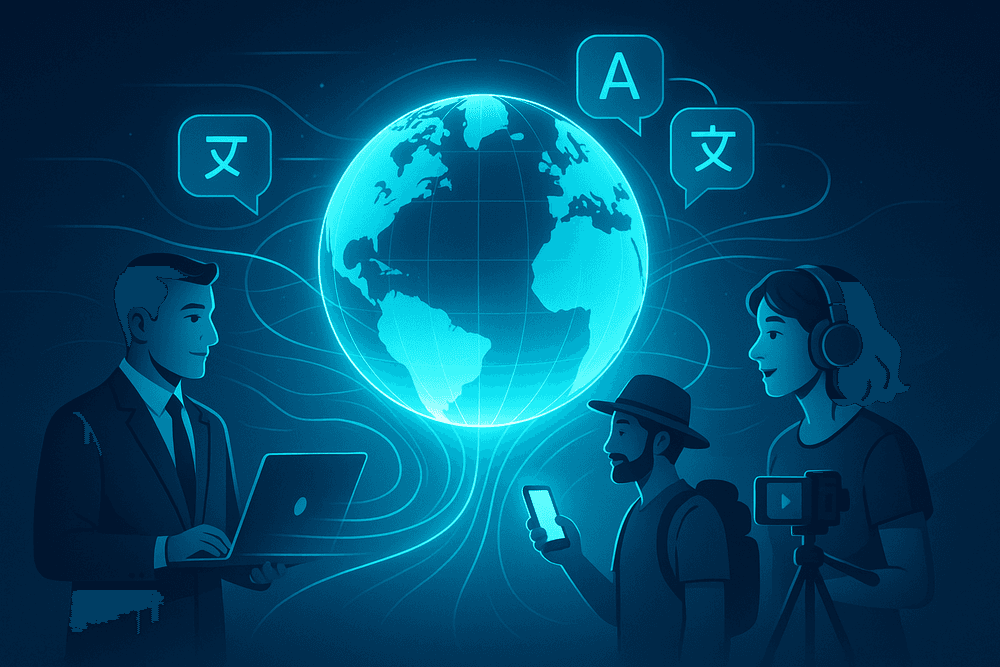
The theoretical power of instant, accurate translation is impressive, but its true value is revealed in its practical, everyday applications. Across industries and personal pursuits, ai powered language translation is not just a novelty; it's a transformative tool that creates opportunity, fosters connection, and drives growth. From multinational corporations to the solo traveler, the benefits are tangible, reshaping how we communicate on a global scale.
How Global Businesses Scale Marketing with AI Translation
For businesses aiming for a global footprint, language is often the final frontier. Traditionally, localizing marketing materials, websites, and customer support was a costly and time-consuming process, creating a significant barrier to entry in new markets.
AI-powered language translation has shattered this barrier. Companies can now:
- Localize Content Instantly: Translate product descriptions, blog posts, social media updates, and email campaigns into dozens of languages simultaneously. This agility allows businesses to launch global campaigns at an unprecedented speed.
- Provide Multilingual Customer Support: Integrate AI translation into chatbots and helpdesk software to offer real-time support to customers in their native language, dramatically improving customer satisfaction and loyalty.
- Conduct Market Research: Quickly analyze foreign-language customer feedback, social media trends, and competitor websites to gain crucial market insights without a team of human translators.
This technology allows a small e-commerce shop to compete with established giants by offering a localized shopping experience, turning a worldwide audience into a reachable customer base.
Empowering Travelers to Break Down Language Barriers
For the modern traveler, a smartphone has become an indispensable guide, and AI translation apps are its most powerful feature. What was once a source of anxiety—navigating a foreign city, ordering from a menu, or asking for help—is now a seamless experience.
Travelers use AI translation to:
- Hold Real-Time Conversations: Speak into their phone and have their words translated aloud, enabling fluid, two-way conversations with locals.
- Read Signs and Menus: Use their phone's camera to instantly translate text on street signs, menus, and museum placards, providing context and independence.
- Navigate with Confidence: Understand directions from public transport announcements or friendly strangers, making exploration less stressful and more enriching.
This application of ai powered language translation does more than just solve logistical problems; it fosters genuine human connection and cultural immersion.
Helping Content Creators Reach a Worldwide Audience
The creator economy thrives on reach. For YouTubers, bloggers, podcasters, and online educators, a global audience means greater impact and revenue. AI translation makes this possible without an enormous budget. Creators can now use AI tools to:
- Generate Multilingual Subtitles: Automatically add accurate subtitles to videos in multiple languages, making their content accessible to viewers worldwide and improving SEO on platforms like YouTube.
- Translate Written Content: Convert blog posts, articles, and newsletters into different languages with a single click, capturing new readers in previously untapped regions.
This allows a niche expert to become a global authority, expanding their influence far beyond their native language.
Enabling Developers to Build Multilingual Software Seamlessly
Software localization has always been a complex development hurdle. Managing different language files ("string resources") and coordinating translation efforts can slow down release cycles significantly. AI-powered translation APIs (Application Programming Interfaces) from services like Google Cloud Translate or DeepL are a game-changer for developers. They can:
- Integrate Translation Directly: Build multilingual features right into their applications, allowing user interfaces and user-generated content to be translated on the fly.
- Automate Localization Workflows: Streamline the process of updating text across multiple languages, ensuring consistency and reducing manual effort.
This enables even solo developers and small startups to launch globally-ready apps from day one, creating a more inclusive and accessible digital world for everyone.
Best Practices for Achieving Flawless AI-Powered Language Translation
Harnessing the full potential of AI-powered language translation goes beyond simply copying and pasting text. To achieve results that are not just understandable but accurate, fluent, and culturally appropriate, you need a strategic approach. These best practices will help you transform raw machine output into polished, professional-grade content.
The Critical Role of Context in Translation Accuracy
Context is the single most important factor for an AI translator. Without it, the AI is essentially guessing. A word like "lead" could mean a metal, a verb for guiding, or a part of a pencil. An AI model can only choose the correct translation if it understands the surrounding text, the subject matter, and the overall intent.
To provide sufficient context and improve accuracy:
- Translate in Chunks: Instead of translating isolated words or sentences, input entire paragraphs or documents. This allows the AI to analyze relationships between sentences and make more informed choices.
- Specify the Domain: If your translation tool allows, specify the field or industry (e.g., legal, medical, tech). This helps the model prioritize relevant terminology and avoid generic, out-of-place phrasing.
- Provide Glossaries: For consistent branding and terminology, use tools that allow you to upload a glossary of key terms. This ensures your company name, product features, and specific jargon are translated correctly every time.
Mastering the Art of Pre-Editing and Post-Editing (PE)
The "human-in-the-loop" model is the gold standard for professional ai powered language translation. This involves two key stages: preparing the text for the AI (pre-editing) and refining its output (post-editing).
- Pre-editing: This is the process of simplifying and clarifying the source text before running it through the AI. The principle is simple: clear input leads to clear output. Remove ambiguities, break down long, complex sentences, spell out acronyms, and replace idiomatic expressions with more literal language.
- Post-editing (PE): This is where a human linguist reviews and corrects the machine-translated text. They don't translate from scratch; instead, they refine the AI's draft, checking for grammatical errors, stylistic inconsistencies, and tonal inaccuracies. This hybrid approach combines the immense speed of AI with the irreplaceable nuance of a human expert.
Knowing When to Use AI vs. When to Hire a Human Expert
The choice between pure AI and a human professional isn't about which is better—it's about choosing the right tool for the specific task.
- Use AI for:
- Gisting: Quickly understanding the general meaning of a foreign text, like a customer review or an internal email.
- Low-Impact Content: Internal communications or initial drafts where perfect polish isn't required.
- High-Volume Tasks: Translating large amounts of user-generated content or technical documentation for internal use.
- Hire a Human Expert for:
- High-Stakes Content: Legal contracts, medical documents, and financial reports where every word matters.
- Creative & Marketing Copy: Slogans, ad campaigns, and website content where brand voice, emotion, and cultural resonance are paramount.
- User-Facing Interfaces: Software, apps, and help guides where clarity and user experience are critical.
How to Avoid Common Pitfalls and Cultural Missteps
A translation can be grammatically perfect but culturally disastrous. The biggest pitfall of relying solely on ai powered language translation is its inability to grasp deep cultural context. Be mindful of:
- Idioms and Slang: Expressions like "it's raining cats and dogs" will be translated literally, creating a nonsensical and unprofessional result.
- Tone and Formality: Different cultures have different expectations for formality in business communication. An AI might not capture the appropriate level of respect (e.g., using formal vs. informal "you").
- Cultural Symbols: Colors, numbers, and images carry powerful connotations that vary globally. For example, the color white is associated with weddings in the West but with funerals in some parts of Asia. A human review is essential to ensure your message is received as intended and avoids causing unintentional offense.

Conclusion: Your Next Steps in a Multilingual World
We've journeyed through the intricate and powerful world of AI-powered language translation, from the neural networks that drive it to the practical tools that are reshaping our interactions. The key takeaway is clear: language barriers are no longer the insurmountable obstacles they once were. For businesses, creators, and individuals, these technologies offer an unprecedented opportunity to connect, understand, and grow on a global scale. Now, the question isn't if you should leverage these tools, but how.
Choosing the Right AI Translation Tool for Your Goals
As we've explored, there is no one-size-fits-all solution. The "best" tool is the one that aligns perfectly with your specific objectives. To find your match, start by asking the right questions:
- What is your primary use case? Are you a student needing quick comprehension of academic papers, a traveler requiring real-time conversation support, or a developer integrating multilingual functionality into an app?
- What level of accuracy and nuance is required? Translating an informal email to a colleague has different stakes than localizing a legal contract or a high-impact marketing campaign.
- What is your budget and scale? Free tools are excellent for casual use, but businesses handling large volumes of content will benefit from the advanced features, security, and collaborative workflows of paid enterprise solutions.
- Do you need customization? If you work in a specialized field with unique jargon or need to maintain a consistent brand voice, look for tools that offer custom glossaries and style guides.
By evaluating your needs against these criteria, you can move from a general appreciation for AI translation to a strategic selection that delivers tangible results.
The Future Outlook for AI Language Technologies
The progress we've seen in recent years is just the beginning. The field of ai powered language translation is advancing at an exponential rate, and the future promises even more seamless and integrated experiences. We are heading towards a reality where technology doesn't just translate words, but preserves intent, emotion, and cultural context with stunning accuracy.
Expect to see advancements in real-time voice dubbing that matches a speaker's vocal tone and lip movements, augmented reality applications that translate signs and menus instantly through your phone's camera, and AI that can flawlessly adapt complex creative content like poetry and puns. The ultimate goal is to make translation invisible—a background process that facilitates genuine human connection without the friction of language differences.
Start Your Global Communication Journey Today
The tools to bridge linguistic divides are at your fingertips. The time for hesitation is over. Don't wait for a future that's already arriving; take the first step today.
Start small. Use a browser extension to read a news article from another country. Translate a customer review to better understand your international audience. For businesses, launch a pilot project by translating your most popular blog post or a key landing page. The insights you gain will be invaluable.
By embracing the power of ai powered language translation, you're not just adopting a new technology; you're unlocking a world of new relationships, fresh perspectives, and limitless opportunities. Your global journey starts now.