
August 7, 2025
Why the Best AI for Idea Generation is Your New Creative
From Blank Page to Breakthrough: Why the Best AI for Idea Generation is Your New Creative Partner
We’ve all been there: staring at a blank screen, a fresh whiteboard, or an empty notebook, waiting for a spark of inspiration that never seems to arrive. This creative gridlock, often called "writer's block" or an "idea drought," can stall projects, stifle innovation, and drain motivation. But what if you had a partner who never runs out of ideas, has access to a world of information, and is available 24/7 to help you brainstorm? Welcome to the world of AI-powered idea generation.
What is an AI Idea Generator and How Does it Work?
At its core, an AI idea generator is a sophisticated tool built on Large Language Models (LLMs). Think of it as a super-powered search engine for concepts. These models are trained on immense datasets—trillions of words from books, articles, scientific papers, and websites. By analyzing this data, the AI learns the intricate patterns, contexts, and relationships between words and ideas.
When you give it a prompt—a simple question, a core topic, a marketing challenge, or a few keywords—the AI doesn't just pull random words from its database. Instead, it synthesizes its vast knowledge to generate new, relevant, and often surprisingly insightful concepts. The best AI for idea generation acts as a catalyst, transforming your initial spark into a full-fledged fire of creative possibilities. It's not magic; it's the computational power to connect dots on a scale that the human brain simply can't match.
The Evolution of Brainstorming: From Sticky Notes to Smart Algorithms
Traditional brainstorming has served us well. We’ve all huddled around a whiteboard, armed with markers and sticky notes, trying to build momentum as a team. While these methods foster collaboration, they have inherent limitations. They can be slow, susceptible to "groupthink" where dominant voices overshadow quieter ones, and are ultimately limited by the collective knowledge in the room.
AI-powered idea generation represents the next leap forward. It doesn't replace human creativity; it supercharges it. Consider the advantages:
- Unparalleled Speed: Generate hundreds of unique ideas in the time it takes to brew a cup of coffee.
- Infinite Scope: Tap into a knowledge base that spans virtually every industry, culture, and historical period.
- Bias Reduction: An AI doesn't have personal biases or office politics. It provides objective output, allowing the best ideas to rise to the top, regardless of their source.
- Diverse Perspectives: Ask the AI to brainstorm from the perspective of a specific customer persona, a historical figure, or a technical expert to unlock angles you’d never consider.
Your New Creative Partner: Who Can Benefit?
The beauty of these tools is their versatility. The best AI for idea generation isn't just for a niche group of tech enthusiasts; it's a powerful ally for anyone who relies on fresh ideas.
- Entrepreneurs and Marketers: Need a killer product name, a viral campaign slogan, or a list of blog topics that will dominate SEO? An AI can be your in-house marketing strategist.
- Writers and Content Creators: Stuck for a plot twist, a video title, or a fresh angle for your next article? Defeat writer's block for good and keep your content pipeline full.
- Product Managers and Developers: Brainstorming new app features, user-centric solutions, or innovative ways to improve existing products becomes faster and more comprehensive.
- Students and Researchers: Discover unique essay topics, formulate research questions, and explore different academic arguments to deepen your understanding and stand out.
Ultimately, anyone facing a creative challenge can turn to an AI idea generator to move from a blank page to a genuine breakthrough. It's your new creative partner, ready to help you innovate at the speed of thought.
The Contenders: A Deep Dive into the Best AI for Idea Generation Tools
The search for the perfect creative spark has a new ally: artificial intelligence. But with a rapidly growing market, finding the best AI for idea generation means looking beyond a single solution and matching the tool to the task. Let's break down the leading contenders and see which one aligns with your unique workflow.
The All-Rounder: ChatGPT for Creative Brainstorming
For sheer versatility and accessibility, it’s hard to beat OpenAI’s ChatGPT. Think of it as a universal brainstorming partner that’s available 24/7. Its power lies in its conversational, text-based interface. You can treat it like a creative consultant, asking it to:
- Generate ten catchy business names for an eco-friendly coffee shop.
- Outline five different blog post angles on the topic of digital minimalism.
- Role-play as a target customer to help you understand their pain points.
- Use the SCAMPER method (Substitute, Combine, Adapt, Modify, etc.) on an existing product to innovate.
Its strength is its flexibility—a blank canvas for any query. However, this is also its weakness. The quality of your ideas depends heavily on the quality of your prompts, and it lacks the built-in visual structure that other specialized tools offer.
The Visual Strategists: Dedicated Mind-Mapping AI Tools
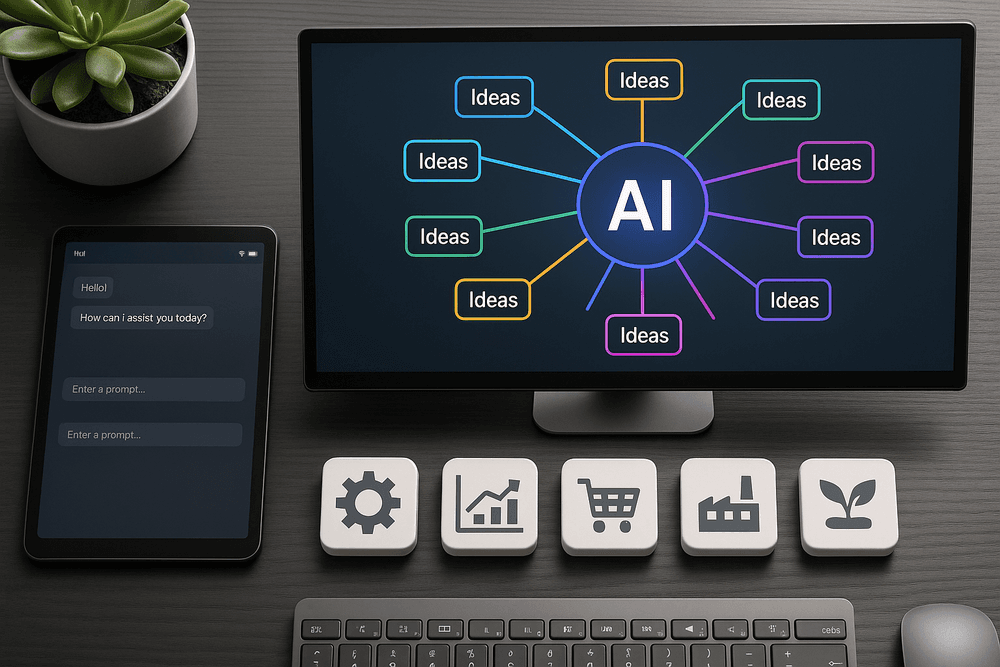
If you think in pictures, charts, and connections, then AI-powered mind-mapping tools like Miro AI, Whimsical, and Xmind AI are your secret weapon. These platforms are designed to turn a single seed of an idea into a sprawling, organized web of concepts. Instead of just a list of text, you get a visual representation of your brainstorm.
Here’s how they elevate idea generation:
- Automated Expansion: Start with a central theme like "Q3 Marketing Campaign," and the AI will automatically generate branching nodes for target audiences, channels, messaging, and potential themes.
- Content Summarization: Paste a block of research text, and the AI can summarize it into key points on your mind map.
- Team Collaboration: These tools are built for collaboration, allowing teams to brainstorm simultaneously on a shared digital canvas, making them arguably the best AI for idea generation in a group setting.
The Specialists: Niche Platforms for Specific Industries
Sometimes, a generalist isn't enough. Niche AI platforms are trained on specific data sets to deliver highly relevant ideas for a particular field. They trade broad capabilities for deep, industry-specific expertise.
- For Marketers & Copywriters: Tools like Jasper and Copy.ai come with pre-built templates for generating ad copy, social media captions, email subject lines, and brand voice ideas.
- For Authors & Screenwriters: Platforms like Sudowrite are designed to help with creative writing, offering plot suggestions, character descriptions, and even alternative prose for a sentence you're stuck on.
- For Entrepreneurs: Some tools focus specifically on business ideation, helping you generate startup ideas, conduct SWOT analyses, and draft value propositions.
Feature-by-Feature: Which AI Fits Your Workflow?
Choosing the right tool comes down to your personal or team process.
- If you need a fast, flexible, text-based partner for solo brainstorming, ChatGPT is an unbeatable starting point.
- If your process is visual, strategic, and often collaborative, a dedicated AI mind-mapping tool will provide the structure and clarity you need.
- If you operate in a specific industry and need high-quality, relevant ideas quickly, a niche platform will deliver the most refined and actionable results.
Unlocking Creativity: Essential Features of Top AI Idea Generators
Not all AI idea generators are created equal. While many can spit out a list of keywords, the truly powerful tools function as dynamic creative partners. When searching for the best AI for idea generation, it’s crucial to look beyond the surface and evaluate the core features that transform a simple query into a groundbreaking concept. These are the non-negotiables that separate the contenders from the pretenders.
Prompt Flexibility and Context Understanding
The quality of an AI's output is directly tied to its ability to understand your input. Top-tier platforms excel at this. Instead of just reacting to a single keyword, they grasp nuance, tone, and complex instructions.
- Conversational Memory: Can the AI remember the last five ideas it gave you and build upon them? The best tools maintain context throughout a session, allowing you to refine and iterate without starting from scratch each time.
- Nuanced Prompts: A superior AI lets you add layers of constraints. For example, instead of just "business ideas," you can prompt: "Generate five eco-friendly subscription box ideas for urban gardeners with a startup budget under $10,000, presented in a playful and witty tone." This level of control is a hallmark of a sophisticated generator.
Brainstorming Templates and Frameworks
Creativity often thrives within structure. The leading AI tools come equipped with proven brainstorming methodologies, guiding your thinking process along established creative pathways. This prevents you from staring at a blank page and provides a launchpad for innovation. Look for built-in frameworks such as:
- SCAMPER: Guides you to innovate on an existing idea by asking you to Substitute, Combine, Adapt, Modify, Put to another use, Eliminate, or Reverse its components.
- SWOT Analysis (Strengths, Weaknesses, Opportunities, Threats): Perfect for entrepreneurs, this helps the AI generate ideas by analyzing a concept from a strategic business perspective.
- Six Thinking Hats: The AI can adopt different "personas" (e.g., the optimist, the critic, the creative) to explore an idea from multiple, unbiased viewpoints.
Collaboration Features for Team-Based Ideation
Great ideas are rarely born in a vacuum. The best AI for idea generation for teams incorporates features that make brainstorming a shared, interactive experience. This transforms the tool from a personal assistant into a central hub for group creativity. Essential collaboration features include:
- Shared Workspaces: A central, cloud-based canvas or board where multiple team members can add prompts, view AI-generated ideas in real-time, and organize concepts.
- Commenting and Annotation: The ability for team members to leave feedback, vote on their favorite ideas, and tag colleagues directly within the platform.
- Version Control: Track changes and revert to previous brainstorming sessions, ensuring no good idea gets lost in the creative shuffle.
Integrations with Creative and Productivity Tools
An idea is only as good as its execution. A standalone idea generator creates friction, forcing you to constantly copy and paste information into other applications. Top-tier platforms eliminate this bottleneck by integrating seamlessly with the tools you already use. Look for native connections to:
- Project Management: Trello, Asana, Jira
- Whiteboarding & Design: Miro, Figma
- Communication: Slack, Microsoft Teams
- Note-Taking & Documents: Notion, Google Workspace, Evernote
These integrations allow you to instantly convert a promising concept into a task, a design mock-up, or a project brief, bridging the critical gap between imagination and action.

How to Master Using AI for Idea Generation: Best Practices
Unlocking the full potential of an AI ideation partner isn’t just about choosing the right software; it’s about mastering the art of collaboration. The quality of your output is directly tied to the quality of your input and your process. To move from generic suggestions to game-changing concepts, adopt these best practices.
Crafting Effective Prompts: The Art of the Ask
The principle of "Garbage In, Garbage Out" is paramount in AI. Vague prompts yield vague ideas. To get brilliant results, you need to provide the AI with rich, specific instructions. Think of yourself as an art director guiding a creative genius.
- Provide Rich Context: Don't just say, "Give me ideas for a new app." Instead, try: "Brainstorm five app ideas for busy parents of toddlers. The apps should solve a daily logistical challenge, like meal planning or coordinating schedules, and be designed for one-handed use."
- Assign a Persona: Frame the AI’s perspective to get more targeted ideas. For example: "Act as a marketing expert for luxury travel brands. What are three unconventional marketing campaign ideas for launching a new eco-lodge in Costa Rica?"
- Introduce Creative Constraints: Limitations can spark incredible creativity. Try adding a constraint to your prompt: "Generate 10 names for a new brand of vegan cookies. Each name must be two words and evoke a sense of playful indulgence."
Using Iterative Feedback to Refine and Polish
Your first set of AI-generated ideas is rarely the final product. It’s the starting point of a conversation. The most effective approach is iterative, where you continuously refine and build upon the initial output. Finding the best AI for idea generation often means finding the one that excels at this back-and-forth dialogue.
Treat the AI as a brainstorming partner. If you get a list of 10 ideas, don't just pick one.
- Dig Deeper: "I like idea #4. Can you elaborate on it? What would be three key features?"
- Combine and Synthesize: "Take the core concept from idea #2 and combine it with the target audience from idea #5. What does that look like?"
- Change the Angle: "Now, re-evaluate all these ideas from the perspective of a risk-averse investor. What are the main objections they would have for each?"
Combining AI Output with Human Intuition
The ultimate goal isn’t to let AI think for you; it's to use AI to help you think better. The most powerful results come from a hybrid approach that blends computational power with human instinct, experience, and emotional intelligence.
Think of it this way: AI is excellent at divergent thinking—generating a vast quantity of possibilities and connecting seemingly unrelated dots. Your role is to apply convergent thinking—using your intuition and strategic judgment to identify the ideas with the most potential, cultural relevance, and alignment with your goals. The best AI for idea generation is one that augments your intuition, not replaces it. Use AI to fill the blank page, then use your expertise to write the story.
Avoiding Common Pitfalls in AI Brainstorming
- Accepting the First Output: The initial results are a rough draft. Always push for a second, third, or fourth round of refinements.
- Outsourcing Critical Thinking: Never blindly trust an AI's suggestion. Always ask: "Does this align with our brand? Is there a real market need for this? What are the potential flaws?"
- Ignoring Inherent Bias: AI models are trained on vast amounts of internet data and can reflect existing societal biases. Be critical of the output and consciously push for more inclusive or original perspectives if the ideas feel stereotypical or derivative.
Real-World Wins: Use Cases for AI-Powered Idea Generation
Theory is one thing, but the true value of any technology is in its real-world application. AI for idea generation isn't just a novelty; it’s a powerful engine driving tangible results across various professional fields. From sparking a new venture to refining a billion-dollar product, AI is becoming the silent partner in innovation. Let's explore how professionals are using these tools to achieve real-world wins.
For Entrepreneurs: Discovering the Next Big Thing
The journey of every startup begins with a single idea. But in a crowded market, finding a concept that is both unique and viable can be paralyzing. Entrepreneurs are now using AI to cut through the noise and identify untapped market niches.
By feeding an AI tool data on their passions, market trends, and existing consumer pain points, founders can generate a list of potential business ventures they might never have considered. For example, an entrepreneur interested in sustainable technology and urban living could ask an AI to brainstorm business ideas at that intersection. The AI might suggest a "smart composting service for apartment buildings" or a "rental platform for electric power tools," complete with initial market analysis and target customer profiles. This process transforms a vague interest into a concrete, research-backed concept, demonstrating why finding the best AI for idea generation is a critical first step for new founders.
For Content Creators: Brainstorming Viral Topics and Angles
For YouTubers, bloggers, and social media managers, the content treadmill never stops. The pressure to consistently produce fresh, engaging material that captures audience attention is immense. AI has become an indispensable brainstorming partner in this high-stakes creative process.
Creators use AI to analyze current trends, search queries, and even the comment sections of their own content to unearth what their audience truly wants to see. A food blogger experiencing writer's block could prompt an AI with "Generate 10 unexpected recipe ideas using pantry staples" or "Suggest 5 video angles for a '30-minute meals' series that haven't been done before." The AI can deliver unique angles like "The Procrastinator's Pantry: Gourmet Meals from Canned Goods" or "One-Pan Wonders That Create Zero Dishes," instantly overcoming creative blocks and providing a springboard for content that resonates.
For Marketing Teams: Developing Innovative Campaign Concepts
In the battle for consumer attention, generic marketing campaigns fall flat. Modern marketing teams are leveraging AI to brainstorm innovative concepts that break through the clutter and create memorable brand experiences.
Instead of a traditional whiteboard session, teams can use AI as a boundless source of inspiration. By providing the AI with a creative brief—including target audience, brand voice, product details, and campaign goals—they can generate a vast array of slogans, ad copy, social media challenges, and even visual mood boards. A marketing team launching a new line of athletic wear could use AI to generate concepts for a TikTok campaign, receiving suggestions for a #FitnessUnfiltered user-generated content challenge or a partnership with micro-influencers in niche sports, complete with sample scripts and visual direction.
For Product Managers: Generating and Prioritizing a Feature Roadmap
Building a successful product isn't about adding more features; it's about adding the right features. Product managers are tasked with navigating a sea of user feedback, competitor analysis, and internal requests to build a roadmap that drives growth and user satisfaction. This is where using the best AI for idea generation can provide a powerful analytical edge.
By feeding thousands of user reviews, support tickets, and forum posts into an AI model, a product manager can quickly synthesize qualitative data into actionable insights. They can ask the AI to "Identify the top 3 user frustrations with our current interface" or "Generate 5 new feature ideas based on competitor weaknesses." The AI might pinpoint a confusing checkout process and suggest solutions like a one-click payment option or a guest checkout flow, helping the PM build a data-driven case for prioritizing features that will have the greatest impact on user retention and delight.

Conclusion: Choosing the Best AI for Your Idea Generation Needs
We’ve journeyed through the dynamic landscape of artificial intelligence, exploring a new class of digital partners designed to augment our creativity and strategic thinking. By now, it should be clear that the search for the single best AI for idea generation doesn't end with one definitive answer. Instead, it leads to a more personal and powerful conclusion: the best tool is the one that seamlessly aligns with your specific goals, workflow, and creative style. It's not about finding a magic button for ideas, but about discovering the right co-pilot for your unique intellectual adventures.
Final Recommendations: Matching the Right AI to Your Goals
Your perfect AI match depends entirely on the nature of your work. The key is to move beyond generic features and focus on the outputs you need to achieve.
- For Creatives, Writers, and Artists: Your primary need is divergent thinking and conceptual exploration. Look for Large Language Models (LLMs) with high "creativity" or "temperature" settings, like GPT-4 or Claude 3 Opus, which excel at crafting unexpected narratives, poetic connections, and abstract concepts. For visual thinkers, multimodal tools like Midjourney or DALL-E 3 are essential for translating abstract thoughts into concrete imagery, sparking entirely new creative directions.
- For Entrepreneurs and Strategists: You require a blend of creativity and structured analysis. The best AI for idea generation in this context can process market data, generate business model canvases, perform SWOT analyses, and outline strategic roadmaps. Look for AIs that can handle large documents and data sets, helping you identify gaps in the market, user pain points, and innovative value propositions with a logical foundation.
- For Teams and Enterprises: Collaboration is paramount. Your ideal AI is likely embedded within a digital workspace like Miro or Mural. These tools don't just generate ideas; they facilitate group brainstorming, organize thoughts visually, and ensure every team member can contribute in real-time. Prioritize platforms with robust security, integration capabilities, and features that structure collective ideation into actionable outcomes.
The Future of AI in Creative and Strategic Thinking
What we see today is merely the dawn of AI-powered ideation. The future promises a deeper, more intuitive partnership. We are moving beyond simple prompt-and-response interactions toward AI that acts as a true Socratic sparring partner—one that can challenge our assumptions, identify our cognitive biases, and push us beyond our intellectual comfort zones.
The future best AI for idea generation will be multi-modal, capable of blending text, images, sound, and data to build holistic concepts. Imagine an AI that not only suggests a business idea but also generates a prototype logo, an initial marketing jingle, and a predictive market analysis report simultaneously. These AI companions will learn our personal creative patterns and strategic preferences, becoming proactive agents that offer inspiration before we even know we need it.
Start Your AI-Powered Brainstorming Journey Today
The most profound insights in this guide won't come from reading, but from doing. The theoretical knowledge of what an AI can do pales in comparison to the experience of what it will do when paired with your unique mind.
Don't wait for the "perfect" tool to emerge. Choose one platform from this guide that resonates with you—whether it’s a free-to-start LLM or a trial of a specialized brainstorming tool—and commit to using it for a small, real-world project this week. Feed it a problem you're stuck on. Ask it a question you think is impossible to answer.
This hands-on experimentation is the final and most critical step. It’s how you’ll develop the intuition and prompting skills to transform these tools from novelties into indispensable partners in innovation. Your next breakthrough idea is waiting. The journey to discovering the best AI for idea generation for you begins with a single prompt. Go start the conversation.