
January 12, 2026
Introduction to Explainable AI Tools and the Black Box
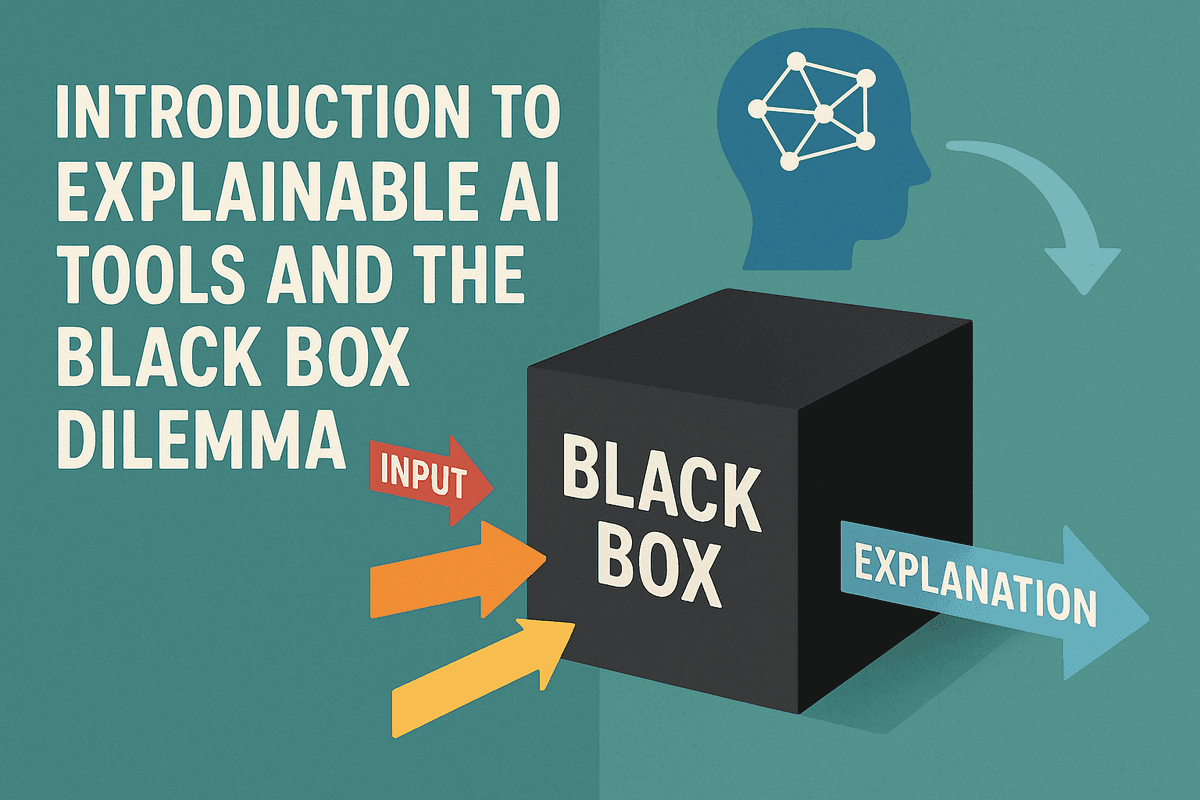
Introduction to Explainable AI Tools and the Black Box Dilemma
Artificial Intelligence has rapidly graduated from experimental labs to real-world applications, driving critical decisions in healthcare, finance, and criminal justice. However, as these models become more sophisticated, they also become more opaque. This phenomenon is known as the "Black Box Dilemma." In a black box model, data goes in and a prediction comes out, but the internal logic used to arrive at that conclusion remains hidden—even to the developers who built it.
This lack of transparency poses a significant risk. If a bank’s algorithm denies a loan or a medical AI misses a diagnosis, stakeholders need to know why. This is where explainable AI tools become indispensable. These tools are designed to crack open the black box, offering insights into how machine learning models process data and make decisions. By implementing XAI (Explainable AI), organizations can transform obscure algorithms into transparent systems that foster human trust.
Bridging the Gap Between Accuracy and Interpretability
For years, data scientists have faced a difficult trade-off: accuracy versus interpretability. Simple models, like linear regression or decision trees, are highly interpretable but often lack the nuance required to handle complex, unstructured data. Conversely, state-of-the-art Deep Learning models and neural networks offer incredible accuracy but operate through millions of abstract parameters that are impossible for humans to parse manually.
Explainable AI tools serve as the bridge across this divide. They allow developers to utilize high-performance, complex models without sacrificing the ability to understand them. Through techniques such as feature importance scoring and counterfactual analysis, these tools help visualize which variables weighed most heavily in a specific decision.
For example, in a predictive maintenance model for manufacturing, XAI can reveal that a specific vibration frequency—rather than temperature—was the deciding factor in predicting a machine failure. This layer of interpretability ensures that high-accuracy models are not just "right" by accident, but are reasoning based on sound, logical patterns that human experts can validate.
The Regulatory Imperative: GDPR and the EU AI Act
Beyond the technical benefits, XAI has shifted from a "nice-to-have" feature to a legal necessity. As AI permeates society, governments are enforcing strict regulations to protect citizens from algorithmic bias and unfair automated decisions.
The General Data Protection Regulation (GDPR) in Europe set the precedent by introducing the "right to explanation." This grants individuals the legal right to demand a meaningful explanation of the logic involved in automated decisions that significantly affect them. Without robust explainable AI tools, complying with this mandate is nearly impossible for companies deploying complex machine learning models.
Furthermore, the introduction of the EU AI Act has raised the stakes. This legislation categorizes AI systems based on risk. "High-risk" applications—such as those used in recruitment, credit scoring, or law enforcement—are subject to rigorous transparency obligations. Non-compliance can result in massive fines and reputational damage. Consequently, integrating XAI frameworks is no longer just about debugging code; it is a critical component of corporate governance and regulatory adherence in the modern digital economy.

Top Open-Source Explainable AI Tools for Developers
As machine learning models grow in complexity—from simple decision trees to deep neural networks—the "black box" problem becomes a significant barrier to adoption. Developers and data scientists can no longer rely solely on accuracy metrics; they must understand why a model behaves the way it does. Fortunately, the open-source community has developed powerful explainable AI tools designed to bridge the gap between complex algorithms and human interpretability.
Selecting the right library is crucial for ensuring transparency and maintaining regulatory compliance. Below, we explore the most essential open-source frameworks that serve as the backbone of modern XAI strategies.
SHAP: The Gold Standard for Feature Consistency
SHAP (Shapley Additive Explanations) is widely regarded as the premier framework among explainable AI tools due to its rigorous mathematical foundation. Based on cooperative game theory, SHAP assigns each feature an importance value for a particular prediction. Imagine a model as a team of players (features) working together to achieve a score (prediction); SHAP fairly distributes the "payout" among players based on their contribution.
What makes SHAP distinct is its consistency. Unlike some methods that might offer varying explanations for the same data points, SHAP provides a unified measure of feature importance. It excels in two key areas:
- Global Interpretability: It helps developers understand the model as a whole (e.g., "Which features are the most dominant across the entire dataset?").
- Local Interpretability: It explains individual predictions (e.g., "Why was this specific loan application rejected?").
While SHAP can be computationally expensive on massive datasets, its TreeExplainer is highly optimized for tree-based models like XGBoost and LightGBM, making it a staple in enterprise data science workflows.
LIME: Simplifying Complex Predictions
While SHAP focuses on theoretical consistency, LIME (Local Interpretable Model-agnostic Explanations) prioritizes speed and local approximation. LIME operates on a simple premise: even if a model is non-linear and incredibly complex globally, it can be approximated by a simpler linear model in the immediate vicinity of a specific data point.
LIME works by perturbing the input data—changing small details of the input—and observing how the predictions change. By doing this, it learns a local interpretable model around the prediction of interest.
- Model Agnostic: LIME treats the underlying model as a black box, meaning it works with any classifier or regressor, whether it is text, image, or tabular data.
- User-Centric: It produces intuitive visualizations that highlight exactly which parts of an input (like specific words in a text or super-pixels in an image) contributed to a classification.
For developers needing quick, "what-if" analysis to explain individual outliers to non-technical stakeholders, LIME remains one of the most accessible explainable AI tools available.
ELI5 and OmniXAI: Debugging and Visualization
Beyond the heavyweights of SHAP and LIME, developers need lightweight utilities for rapid debugging and comprehensive dashboards for reporting.
ELI5 (Explain Like I’m 5) is designed for simplicity. It allows developers to debug machine learning classifiers and inspect model parameters seamlessly. It is particularly effective for white-box models (like linear regressors) but also supports permutation importance for black-box estimators. If you need to visualize weights in a text classifier or check feature contribution quickly within a Jupyter Notebook, ELI5 is the go-to library.
OmniXAI takes a holistic approach. Recognizing that no single explanation method fits every scenario, OmniXAI acts as a unified library that integrates various explainable AI tools—including SHAP, LIME, and others—into a single interface. It provides a comprehensive visualization dashboard that allows users to switch between different explanation methods, perform "what-if" analysis, and compare feature importance charts side-by-side. For teams looking to build a full-stack interpretability capabilities suite without managing disparate dependencies, OmniXAI offers a robust, all-in-one solution.
Leading Enterprise Explainable AI Tools for Business Scale
As organizations move from pilot programs to full-scale deployment, the need for robust infrastructure becomes critical. While individual libraries are useful for research, scaling transparency requires enterprise-grade explainable AI tools capable of handling complex pipelines, regulatory scrutiny, and high-volume predictions.
For businesses aiming to bridge the gap between black-box algorithms and stakeholder trust, relying on a unified platform is often more effective than piecing together disparate scripts. The following tools represent the current gold standard for enterprise environments, offering distinct approaches to model interpretability, feature attribution, and continuous observability.
IBM AI Explainability 360 (AIX360)
IBM has long been a pioneer in ethical AI, and their AI Explainability 360 (AIX360) is arguably the most comprehensive open-source toolkit available for the enterprise. Unlike tools that rely on a single method, AIX360 supports a diverse taxonomy of explainability algorithms tailored to different stakeholders—from data scientists debugging a model to loan officers explaining a denial to a customer.
AIX360 distinguishes itself by covering the entire modeling lifecycle. It offers algorithms for:
- Data explanation: Understanding the characteristics of the training dataset before modeling begins.
- Local explanation: interpreting individual predictions using techniques like LIME and SHAP.
- Global explanation: Providing a holistic view of overall model logic.
This versatility makes it one of the premier explainable AI tools for heavily regulated industries like finance and healthcare, where different "consumers" of explanations require different levels of depth and technicality.
Google Cloud Explainable AI
For organizations already entrenched in the Google ecosystem, Google Cloud Explainable AI offers a seamless integration into Vertex AI. This toolset focuses heavily on "feature attributions," providing a clear score for how much each factor in the data contributed to a specific prediction.
Google’s approach is designed for production speed and visual clarity. A standout component is the What-If Tool, an interactive visual interface that allows developers to test performance in hypothetical situations. Users can manipulate data points without writing code to see how changes affect model output. This creates a feedback loop that helps teams identify bias and model over-reliance on specific features. By integrating directly into the cloud infrastructure, Google ensures that transparency doesn't come at the cost of latency.
Fiddler AI and TruEra: The Era of Observability
While IBM and Google focus heavily on development and deployment, platforms like Fiddler AI and TruEra address the critical post-deployment phase through Model Performance Management (MPM) and observability.
Fiddler AI serves as a centralized control center for Model Operations (ModelOps). It goes beyond static explanations by monitoring models in real-time. Fiddler detects "drift"—when production data diverges from training data—and provides root-cause analysis. If a model’s accuracy degrades, Fiddler uses Shapley values to pinpoint exactly why, ensuring that explainable AI tools are used not just for compliance, but for maintaining system health.
Similarly, TruEra focuses on the quality and stability of ML applications. It provides deep diagnostics to debug model failures and ensuring that explanations remain consistent over time. Both platforms represent a shift toward "continuous explainability," where transparency is an always-on monitoring process rather than a one-time audit check.

Strategic Best Practices for Implementing Explainable AI Tools
Integrating explainable AI tools into your machine learning pipeline is rarely a "plug-and-play" operation. To derive true value—moving beyond simple metrics to genuine model understanding—organizations must adopt a strategic approach. It is not enough to simply generate a chart; data scientists and business leaders must know which interpretation method applies to the specific problem at hand, how to leverage these insights for ethical compliance, and how to manage the computational costs associated with transparency.
Selecting the Right Interpretation Method: Global vs. Local
One of the first decisions a team must make is determining the scope of the explanation required. Not all stakeholders need the same information, and explainable AI tools generally offer two distinct modes of interpretation:
- Global Interpretation: This provides a holistic view of how the model works across the entire dataset. It answers questions like, "What are the top three features driving predictions overall?" For example, a global view might reveal that "Annual Income" is the strongest predictor for a credit scoring model. This is essential for high-level stakeholders, auditors, and regulators verifying general model logic.
- Local Interpretation: This zooms in on a single data point. It answers, "Why was this specific customer denied a loan?" Tools like LIME (Local Interpretable Model-agnostic Explanations) are critical here. This level of granularity is vital for customer support representatives who need to explain decisions to end-users or for engineers debugging specific edge cases where the model failed.
The best practice is to implement a hybrid dashboard that allows users to toggle between global feature importance and instance-level drill-downs, ensuring the explanation matches the user's intent.
Using XAI Tools to Detect and Mitigate Algorithmic Bias
Perhaps the most critical application of explainable AI tools is the detection of bias. Models trained on historical data often inherit historical prejudices. Without interpretability, a neural network might learn to use proxy variables—such as using a zip code as a proxy for race—to make discriminatory decisions.
By visualizing feature attribution, teams can audit their models for fairness before deployment. If an XAI tool reveals that a model relies heavily on a protected attribute (like gender or age) or a suspicious proxy variable to make decisions, developers can intervene. This might involve:
- Retraining the model with balanced datasets.
- Applying fairness constraints during training.
- Removing the problematic feature entirely.
Using these tools proactively transforms compliance from a reactive scramble into a continuous quality assurance process, fostering trust with users and regulators alike.
Balancing Computational Overhead with Depth of Explanation
Transparency comes at a cost. High-fidelity explanation methods, particularly those based on Shapley values (like KernelSHAP), are computationally expensive. Calculating the contribution of every feature for every prediction in real-time can drastically increase latency, potentially rendering a real-time application unusable.
To balance computational overhead with the depth of explanation, consider the following strategies:
- Asynchronous Explanations: For high-volume transactional systems (like fraud detection), decouple the prediction from the explanation. Run the inference in milliseconds, but compute the heavy XAI visualizations in a background process to be reviewed later by analysts.
- Surrogate Models: Use a simpler, interpretable model (like a decision tree) to approximate the behavior of a complex "black box" model for the sake of explanation, accepting a slight trade-off in fidelity for a massive gain in speed.
- On-Demand Sampling: Rather than explaining every prediction, configure your explainable AI tools to trigger only when a prediction falls below a certain confidence threshold or constitutes an outlier.
By carefully managing these trade-offs, organizations can maintain high-performance production environments without sacrificing the transparency required for modern AI governance.
Real-World Use Cases Using Explainable AI Tools
As artificial intelligence moves from research labs into the core infrastructure of global industries, the "black box" problem has transitioned from a theoretical inconvenience to a critical operational risk. It is no longer sufficient for a model to simply yield high accuracy; organizations must understand the rationale behind those predictions. This is where explainable AI tools bridge the gap between complex algorithms and human understanding.
By implementing these tools, enterprises can transform opaque neural networks into transparent decision-support systems. Below, we explore how three high-stakes industries are leveraging XAI to ensure compliance, build trust, and streamline operations.
FinTech: Automating Credit Scoring with Transparent Justification
In the financial sector, the ability to explain a decision is not just a feature—it is often a legal requirement. Regulations such as the GDPR in Europe and the Equal Credit Opportunity Act (ECOA) in the United States grant consumers the "right to explanation" regarding automated decisions that significantly affect them.
When legacy AI models deny a loan application, they often fail to provide a specific reason. By integrating explainable AI tools like SHAP (SHapley Additive exPlanations) into credit scoring pipelines, FinTech companies can decompose the model’s output. Instead of a generic rejection, the system can pinpoint exactly which variables tipped the scale—such as a high debt-to-income ratio or a lack of recent credit history.
This transparency serves two vital purposes:
- Regulatory Compliance: It proves to auditors that the model is not discriminating based on protected attributes like race or gender (fairness auditing).
- Customer Experience: It empowers the customer with actionable insights on how to improve their creditworthiness, turning a negative interaction into a constructive one.
Healthcare: Enhancing Clinician Trust in Diagnostic AI Models
The stakes for AI transparency are highest in healthcare, where a false positive or false negative can impact human life. Deep learning models used for analyzing medical imaging (such as MRIs or X-rays) are notoriously difficult to interpret. A model might correctly identify a tumor, but without knowing where the model is looking, a radiologist cannot trust the diagnosis.
Hospitals and MedTech developers are utilizing explainable AI tools that generate saliency maps and heatmaps. These visualizations overlay the original medical image, highlighting the specific pixels or regions the AI used to make its prediction. If a model predicts pneumonia, the XAI tool highlights the specific area of the lung exhibiting opacity.
This "human-in-the-loop" approach ensures that AI acts as a reliable second opinion rather than an unaccountable decision-maker. It allows clinicians to validate that the AI is detecting relevant biological markers rather than reacting to artifacts, such as image compression noise or hospital-specific watermarks, thereby drastically reducing liability risks.
Fraud Detection: Uncovering the 'Why' Behind Flagged Transactions
Financial institutions process billions of transactions daily, relying on machine learning to flag fraudulent activity in milliseconds. However, fraud analysts are often overwhelmed by false positives. When a model flags a transaction without context, the analyst must conduct a time-consuming manual investigation to verify the threat.
Explainable AI tools accelerate this workflow by providing the narrative behind the flag. Instead of simply labeling a transaction as "High Risk," XAI frameworks can utilize counterfactual explanations or local feature importance to clarify the anomaly.
For example, the tool might indicate: "This transaction was flagged because the purchase amount is 500% higher than the user's average, and the IP location has shifted across continents in under two hours." By exposing the underlying logic, fraud teams can distinguish between a customer on vacation and a stolen credit card instantly. This granular visibility reduces the time spent on manual review, lowers the rate of false declines, and enhances the overall security posture of the banking ecosystem.

Conclusion: Building Trust with the Right Explainable AI Tools
As we navigate the increasingly complex landscape of machine learning, one specific truth has emerged: the era of the accepted "black box" is ending. Throughout this guide, we have explored a diverse range of explainable AI tools, from model-agnostic libraries like LIME and SHAP to enterprise-grade platforms designed for continuous monitoring. However, the ultimate success of your AI initiatives doesn't rest solely on the predictive power of your algorithms, but on your ability to interpret, justify, and trust their outputs.
Matching Capabilities to Your Project Context
Selecting the right toolset is not a one-size-fits-all endeavor. The effectiveness of your transparency strategy depends entirely on aligning tool capabilities with your specific project requirements and stakeholder needs.
- For Data Scientists and Engineers: The focus should remain on granular, technical interpretability. Tools that offer feature importance scores and local explanations are critical for debugging models, identifying overfitting, and optimizing performance before deployment.
- For Regulated Industries (Finance, Healthcare): The priority shifts toward global interpretability and auditability. In these sectors, explainable AI tools serve as a compliance shield, ensuring that decisions—such as loan approvals or medical diagnoses—can be justified to auditors and adhere to strict regulations like the GDPR or the EU AI Act.
- For Business Stakeholders and End-Users: The technical "how" matters less than the functional "why." Visualization dashboards and counterfactual explanations (e.g., "If income were $500 higher, the loan would be approved") are essential for building user confidence and driving adoption.
The Future of Responsible AI and Governance
Looking ahead, the integration of XAI is transitioning from a "nice-to-have" feature to the backbone of Model Governance. As organizations rapidly adopt Generative AI and Large Language Models (LLMs), the risk of hallucinations and bias increases. In this environment, responsible AI is no longer just an ethical concept; it is a vital operational standard.
Future-proofing your AI strategy means embedding interpretability into the entire MLOps lifecycle, not just adding it as an afterthought. We are moving toward a standard where a model is considered incomplete until it includes a robust explanation layer. This shift ensures that as models evolve and retrain on new data, their decision-making logic remains transparent, preventing "model drift" from becoming an unseen liability.
Call to Action: Start Auditing Your Black Box Models
The cost of opacity is too high to ignore. Whether you are a startup disrupting a market or an enterprise scaling operations, trust is your most valuable currency. Do not let your algorithms operate in the dark.
Take the first step toward total model transparency today. Begin by auditing your existing deployments using the explainable AI tools discussed in this guide. Identify which models are making high-stakes decisions without clear justification and integrate an interpretability framework immediately. By shedding light on the inner workings of your AI, you do more than just comply with regulations—you build a resilient, trustworthy system that users can rely on for years to come.