
June 17, 2026
What the Best Example Pitch Decks Actually Teach Agencies

For agencies, the value of studying pitch decks is not finding a prettier template. It’s learning what investors need to believe before they’ll keep reading, take a meeting, or recommend the opportunity to someone else.
What makes a pitch deck example worth copying?
A pitch deck example is only useful if it shows the thinking behind the slides, not just the surface treatment. The strongest examples tend to have three qualities agencies can learn from.
First, they make the company’s case quickly. You should be able to understand who the business serves, what has changed in the market, why the team can win, and what the investor opportunity is without decoding jargon or waiting until slide 12.
Second, they match the company’s stage. A pre-seed deck should not be judged by the same standards as a Series B deck. Early decks usually need sharper insight, founder-market fit, and believable early signals. Later decks need stronger evidence: revenue quality, retention, go-to-market efficiency, and category position.
Third, they make tradeoffs visible. Great decks do not try to say everything. They choose the few points that make the investment feel inevitable and leave secondary details for diligence. That discipline is especially useful for agencies, because client teams often want every feature, milestone, quote, and chart included.
When reviewing example pitch decks, ask:
- What belief is this slide trying to create?
- What did the company choose not to include?
- Is the proof strong enough for the claim?
- Does each slide make the next one feel necessary?
- Would this still work if the branding were removed?
If the answer to the last question is yes, the deck has strategic value beyond design inspiration.
How to read examples without creating generic decks
The biggest risk in using pitch deck examples is copying the visible format while missing the underlying decision. That is how agencies end up with decks that look polished but feel interchangeable.
Instead of copying slide titles or layouts, translate each example into intent. A “market” slide might be doing several different jobs: proving urgency, showing scale, reframing a category, or explaining why now is the right time. Those are different strategic moves, even if the slide label is the same.
A practical way to review examples is to separate them into three layers:
Layer | What to study | What not to copy blindly |
|---|---|---|
Strategic intent | The belief each slide is meant to create | The exact slide order |
Evidence | The type of proof used to support claims | Another company’s metrics or benchmarks |
Expression | Tone, pacing, visual restraint, confidence level | The aesthetic style or wording |
This helps agencies build decks that feel tailored to the client instead of assembled from familiar startup tropes. A fintech infrastructure company, a consumer app, and a B2B SaaS platform may all need investor confidence, but the path to that confidence will differ.
The agency’s job is to turn reference material into a sharper client-specific argument.
The investor-readiness checklist for agencies
Before a deck leaves your agency, it should pass a simple investor-readiness check. This is less about perfection and more about whether the deck can survive a fast, skeptical read.
Use this checklist before presenting internally or sending to the client:
- The company’s one-line description is clear within the first few slides.
- The deck explains why the opportunity matters now, not just why the product exists.
- Claims are supported by specific evidence, not broad adjectives.
- Metrics are defined clearly and consistently.
- The market case feels relevant to the actual business model.
- The competitive view shows differentiation without pretending competitors do not exist.
- The business model is easy to understand.
- The team slide explains why this team is credible for this problem.
- The ask is specific enough to show intent and discipline.
- Every slide has a job; no slide exists only because “decks usually have one.”
For small agencies, this checklist also protects margin. It reduces subjective revision loops, gives clients a clear standard for feedback, and helps your team deliver sharper decks without reinventing the evaluation process every time.

Proven Pitch Deck Structures to Borrow From Real Examples
Once you know which decks are worth studying, the next step is turning their structure into something your agency can reuse without forcing every client into the same story.
The core investor deck slide flow
Most strong example pitch decks follow a recognizable spine. The labels change, but the job of each slide stays fairly consistent:
- Title — who the company is, what it does, and the category it wants to own.
- Problem — the specific pain, inefficiency, or market shift creating urgency.
- Solution — the product, platform, or service model solving that pain.
- Market — the size, growth, and timing of the opportunity.
- Product — how the offer works in practice, usually through a simple walkthrough.
- Business model — how the company makes money.
- Traction — proof that customers, users, revenue, partnerships, or demand already exist.
- Go-to-market — how the company acquires and retains customers.
- Competition — the current alternatives and why this company can win.
- Team — why this group is credible enough to execute.
- Financials — key revenue, margin, growth, or forecast assumptions.
- Ask — the raise amount, use of funds, and milestone plan.
For agencies, this flow is useful because it gives strategists, writers, and designers a shared operating system. Instead of debating “what should come next?” on every client deck, your team can focus on whether each slide is doing its job.
Optional slides by stage, sector, and sales motion
Not every client needs every slide. A seed-stage SaaS company, a services-enabled marketplace, and a consumer brand preparing for growth funding all need different supporting evidence.
Client context | Slides to consider adding | Why it matters |
|---|---|---|
Pre-seed or concept-stage | Vision, founder insight, prototype, roadmap | Investors need conviction before there is much traction. |
Seed-stage with early revenue | Customer proof, pipeline, early retention, use cases | The deck must show signs of repeatable demand. |
Series A or growth-stage | Cohort data, unit economics, expansion strategy, hiring plan | The structure shifts from “can this work?” to “can this scale?” |
B2B SaaS | Sales cycle, buyer persona, integrations, retention metrics | Investors want to understand adoption, stickiness, and revenue quality. |
Marketplace | Supply/demand dynamics, liquidity, take rate, network effects | The deck needs to prove both sides can grow together. |
Consumer brand | Community, distribution, repeat purchase, category positioning | Momentum and defensibility often come from audience and channels. |
Enterprise sales motion | Procurement path, implementation model, case studies, pipeline quality | Long sales cycles need extra confidence signals. |
The key is restraint. Optional slides should answer investor objections, not inflate the deck.
How agencies can turn slide structures into repeatable deck systems
A useful pitch deck system is more than a slide template. It gives your team decision rules.
Start by creating a master deck architecture with the core flow, then tag each slide as one of three types: required, conditional, or supporting. Required slides appear in almost every investor deck. Conditional slides depend on stage, sector, or sales motion. Supporting slides move to the appendix unless they strengthen the main narrative.
Then build intake questions around the structure. For example:
- What proof exists today: revenue, users, pilots, LOIs, waitlist, retention, or partnerships?
- What is the primary sales motion: self-serve, founder-led, sales-led, channel, or marketplace?
- Which investor objection is most likely: market size, defensibility, acquisition cost, team, or timing?
This turns deck creation from a blank-page exercise into a repeatable agency workflow. Strategists can map the structure, writers can draft against slide jobs, and client teams can provide the right evidence faster. The result is a pitch deck process that scales across accounts without producing decks that all sound the same.
Storytelling Patterns That Make Pitch Deck Examples Persuasive
Once the slide order is in place, the difference between a “complete” deck and a fundable one is narrative pressure: each slide should make the next question feel inevitable.
The problem-to-opportunity narrative arc
Strong example pitch decks rarely frame the problem as a vague inconvenience. They show a specific market tension: something is changing, the old way is breaking, and the timing creates room for a new company to win.
For agency teams, this is where client decks often get too soft. “Teams waste time managing workflows” is forgettable. “Mid-market finance teams close books across eight disconnected systems, adding 12 days of manual reconciliation every quarter” gives investors a sharper reason to care.
A persuasive arc usually moves like this:
- The current behavior: What customers do today, even if it is painful.
- The breaking point: Why that behavior no longer works.
- The consequence: What the pain costs in money, time, risk, churn, or missed growth.
- The opening: Why now is the moment a new solution can capture demand.
That last point matters. The opportunity should feel earned by the problem, not pasted on after it. If the deck jumps from “this is annoying” to “the market is worth $20B,” investors feel the gap.
How great decks build credibility before the ask
The most persuasive decks do not wait until the final slides to prove the company deserves capital. They build belief in layers.
For agencies creating decks for founders, this means every claim should reduce investor doubt. If the problem is painful, show evidence. If the market is attractive, show why this team has a wedge. If the product is early, show why customers are already leaning in.
Credibility can come from:
- Customer language that proves the pain is real
- Early usage data that shows behavior, not just interest
- Founder insight that explains why the team sees what others missed
- Distribution advantages, partnerships, or community access
- Clear focus on a narrow initial market before expanding
The key is sequencing proof before ambition. A big vision lands better after the investor believes the company has earned the right to pursue it.
For example, “We’re building the operating system for independent clinics” is stronger after the deck shows that 47 clinics joined a waitlist from one specialist community, three clinics piloted the workflow, and administrators are already replacing spreadsheets with the product.
Turning traction into an investor story
Traction is not just a numbers slide. It is the evidence that the story is already happening.
Weak decks list metrics without interpretation: revenue, users, pipeline, retention. Strong decks connect those metrics to momentum. They answer: what is improving, why does it matter, and what does it suggest about the next stage?
Instead of presenting “$18K MRR, 22% month-over-month growth,” shape the narrative: “Revenue has grown 22% month over month since narrowing the ICP to boutique law firms, with expansion revenue now coming from multi-seat teams.” That tells investors the company is learning, focusing, and becoming more efficient.
Agencies can make traction more persuasive by framing metrics around investor questions:
Investor question | Traction story to tell |
|---|---|
Do customers want this badly? | Activation, repeat usage, paid conversions, waitlist quality |
Can this become efficient to sell? | Shorter sales cycles, stronger close rates, clearer ICP |
Will customers stay or expand? | Retention, seat growth, usage depth, expansion revenue |
Is the market responding now? | Inbound demand, channel pull, category timing, competitive shifts |
The best investor narratives make traction feel like a preview of scale, not a backward-looking status report.
Design Lessons From Example Pitch Decks That Look Investor-Ready
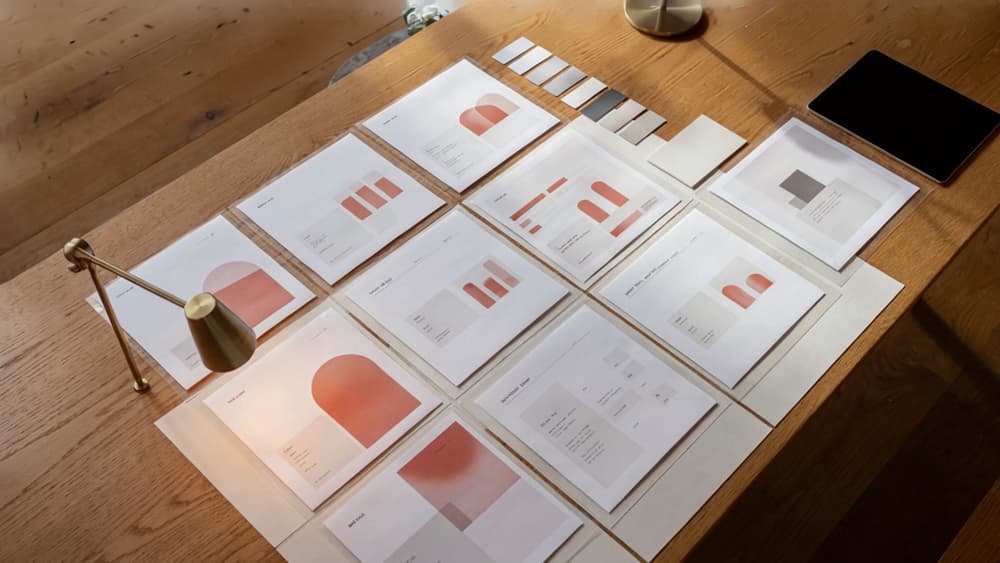
Once the structure and story are working, design has one job: make the investor’s next thought obvious. The strongest example pitch decks don’t feel “designed” in a decorative sense. They feel easy to process under pressure.
Visual hierarchy that makes slides scannable
Investors skim before they study. That means each slide needs a clear reading order: headline first, proof second, supporting detail last.
For agency teams, this is where many decks get over-designed. A founder gives you six points, three metrics, a product screenshot, and a quote. The instinct is to make it all fit. The better move is to decide what the investor must understand in three seconds.
A few practical hierarchy rules:
- Write headlines as conclusions, not labels. “Revenue grew 3.4x after launching self-serve” is stronger than “Traction.”
- Keep one dominant element per slide: one chart, one screenshot, one quote, one diagram.
- Use size and spacing before color. If everything needs a highlight color, the layout is doing too little work.
- Push secondary context into captions, footnotes, or speaker notes instead of competing with the main point.
For agencies producing decks across multiple clients, this becomes a reusable design system: headline style, proof block, supporting note, CTA or takeaway. The client brand can change, but the hierarchy should stay disciplined.
Data visualization choices investors can understand fast
Investor decks are not dashboards. The goal is not to show every available data point; it is to make one business signal unmistakable.
Choose charts based on the point the slide needs to prove:
Investor takeaway | Best visual choice | Avoid |
|---|---|---|
Growth over time | Simple line or bar chart | Multi-series charts with unclear labels |
Market composition | Stacked bar or segmented block | 3D pie charts or tiny slices |
Unit economics improvement | Before/after comparison | Dense tables with every input |
Funnel conversion | Step-down funnel or annotated flow | Raw spreadsheet screenshots |
Competitive position | 2x2 or feature matrix | Overloaded grids with vague checkmarks |
Label the insight directly on the chart. Instead of making investors decode a revenue graph, add a short annotation: “Enterprise accounts begin compounding in Q3.” That small copy decision turns data into evidence.
For agency delivery, this also protects client credibility. A beautiful but confusing chart makes the founder look unprepared. A plain chart with a sharp takeaway feels boardroom-ready.
Brand cues that make the deck feel distinctive
Investor-ready does not mean stripped of personality. It means the brand supports the argument instead of distracting from it.
The best pitch decks use brand cues selectively: typography, color, icon style, image treatment, and tone of visual language. They avoid turning every slide into a campaign concept.
For a fintech client, that might mean restrained color, precise diagrams, and confident whitespace. For a consumer wellness startup, it might mean warmer photography, softer shapes, and more human proof points. For a B2B SaaS company, it may be product UI, clean grids, and customer logos doing most of the visual work.
The agency opportunity is to define a “deck expression” of the brand: less expansive than a full brand system, but more ownable than a template. That usually includes:
- A tight slide color palette with one emphasis color
- Consistent headline and metric treatments
- A defined approach to screenshots, charts, and diagrams
- A repeatable layout language for proof-heavy slides
Distinctive decks are not louder. They are more coherent. Every slide should feel like it came from the same company, even when the content shifts from market size to traction to product.
How Agencies Can Create On-Brand Pitch Decks Faster With AI
Once the structure, story, and design direction are clear, the bottleneck is usually production: turning strategy into a polished deck without letting every writer, designer, and AI tool interpret the client’s brand differently.
Ingest the client brand once before drafting
Before generating slides, give AI the same source of truth your team would use in a kickoff: brand guidelines, website copy, previous decks, messaging docs, product positioning, customer proof points, tone-of-voice notes, and any investor narrative already approved.
For agencies, the goal is not “AI writes a deck.” It is “AI understands this client well enough that every draft starts closer to usable.”
That matters when you’re juggling multiple clients with different voices. A climate tech founder should not sound like a DTC beauty brand. A seed-stage SaaS deck should not inherit the language from last week’s healthcare pitch. If your team is prompting from scratch each time, brand drift is almost guaranteed.
A better workflow is to create a reusable client brand layer first. In Aethera, for example, an agency can ingest the client’s brand once, then generate deck copy, slide headlines, speaker notes, and alternate versions from that same approved context. That keeps AI output aligned before the first draft ever hits the design team.
Use AI to generate first drafts without brand drift
AI is most useful when it speeds up the messy middle: turning raw inputs into clear slide-level language.
Instead of asking for “a pitch deck based on these example pitch decks,” agencies can prompt around specific production tasks:
- Rewrite the problem slide in the client’s voice for a seed investor audience.
- Create three versions of the traction slide headline: confident, understated, and bold.
- Turn founder notes into concise slide copy with no jargon.
- Adapt this market slide for a 10-slide version and a 15-slide version.
- Generate speaker notes that match the approved narrative arc.
This gives your team options without forcing them to start from a blank page. It also lets senior strategists spend less time wordsmithing first passes and more time sharpening the investor argument.
The key is keeping brand context attached to every generation. If one tool writes headlines, another summarizes research, and a third rewrites the ask slide, the deck can quickly feel stitched together. A centralized AI workspace helps agencies avoid that tool sprawl by keeping client context, prompts, and outputs in one place.
Build a QA workflow for investor-ready delivery
AI can compress production time, but agencies still need a final QA layer before the deck goes to a founder, board, or investor meeting.
A practical review workflow should check three things:
- Brand fit: Does the language sound like the client, not the agency or the AI?
- Narrative consistency: Do the headlines, proof points, and ask reinforce the same investor story?
- Delivery readiness: Are slide titles tight, claims supported, metrics consistent, and notes useful for the presenter?
This is where agencies can turn AI from a one-off drafting tool into a scalable delivery system. Save approved prompts. Reuse winning slide treatments. Keep client-specific language rules accessible. Create repeatable QA checklists for every pitch deck engagement.
That way, your team can move faster without producing decks that feel templated — and every client gets a deck that looks, reads, and sells like it was built specifically for them.