
January 15, 2026
Why We Need AI in Identity and Access Management
The Evolution of Security: Why We Need AI in Identity and Access Management
For decades, the standard for digital security was the perimeter model—often described as the "castle and moat" strategy. Everything inside the network was trusted; everything outside was not. However, the rise of cloud computing, remote workforces, and mobile devices has drained the moat. Today, identity is the new perimeter. As the complexity of digital ecosystems expands, legacy systems relying on static rules are crumbling under the pressure, necessitating the integration of AI in identity and access management (IAM).
Moving Beyond Static Passwords to Intelligent Authentication
The traditional reliance on static passwords and basic Multi-Factor Authentication (MFA) creates a paradox: it is often too rigid for legitimate users yet too porous for sophisticated attackers. A static rule typically asks, "Do you have the correct credentials?" If the answer is yes, access is granted, regardless of context.
Intelligent authentication changes the question to, "Is this behavior consistent with the user's history?" AI-driven systems move beyond binary access controls to evaluate risk in real-time. By analyzing contextual signals—such as geolocation, device health, keystroke dynamics, and login time—the system can make granular decisions. If a user logs in from their usual device in London, access is frictionless. If the same credentials are used five minutes later from an unknown device in a different continent, the AI immediately challenges the request or blocks it entirely.
Defining the Role of Machine Learning in Modern IAM
Machine learning (ML) is the engine that powers this shift from reactive to proactive security. In a modern IAM architecture, ML algorithms continuously ingest vast amounts of log data to establish a baseline of "normal" behavior for every user and entity within the organization.
Once this baseline is established, the system can detect subtle deviations that human analysts might miss. This includes:
- Behavioral Anomalies: Identifying when a user accesses sensitive files they rarely touch or downloads unusually large volumes of data.
- Peer Group Analysis: Comparing a user's access requests against those of their peers to determine if a specific permission is actually necessary for their role.
- Threat Intelligence: Correlating internal login attempts with known external threat patterns to predict attacks before they succeed.
This continuous learning capability allows security policies to adapt dynamically, tightening controls when risk is high and relaxing them to improve productivity when risk is low.
The Rising Cost of Breaches: Why Manual Provisioning Fails
Perhaps the most critical driver for adopting AI in identity strategies is the sheer unsustainability of manual provisioning. As organizations grow, the volume of access requests becomes unmanageable for IT helpdesks. This leads to "rubber-stamping," where administrators approve access without proper vetting simply to clear the queue.
The result is "permission creep"—an accumulation of unnecessary access rights that users retain as they move between roles or leave the company. This expands the attack surface significantly. If a credential is compromised, the blast radius is far larger than necessary. Manual certification campaigns, where managers review user access annually, are notoriously ineffective and error-prone.
With the average cost of a data breach reaching millions of dollars, relying on human speed and accuracy for provisioning is a financial liability. AI eliminates the bottleneck by automating low-risk provisioning and de-provisioning, ensuring the principle of least privilege is enforced without slowing down the business.
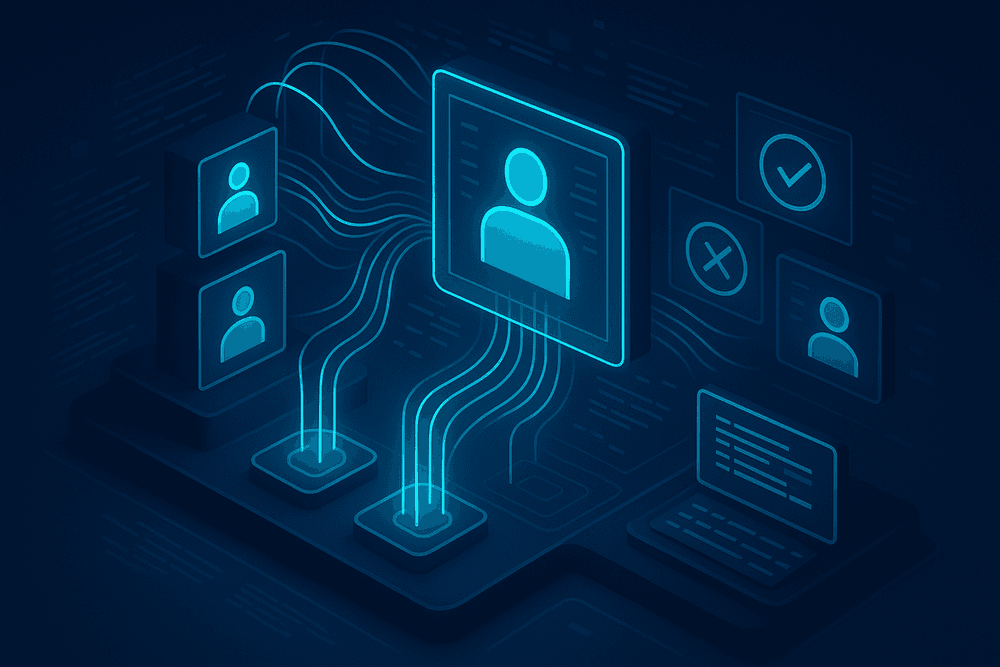
How AI in Identity and Access Management Transforms Operations
Traditional Identity and Access Management (IAM) has long been burdened by static rules, manual ticket processing, and the constant friction between security requirements and user convenience. As organizations scale, the sheer volume of identities—human and machine—renders manual governance impossible. This is where the integration of AI in identity and access management fundamentally shifts the operational landscape, moving from reactive administration to proactive, intelligent governance.
Intelligent Automation of Access Workflows
One of the most immediate operational transformations driven by AI is the modernization of access requests and approval chains. In legacy environments, approval workflows often suffer from "rubber-stamping," where managers approve access requests simply to clear their queues, without understanding the risk implications.
AI eliminates this fatigue by introducing context-aware decision-making. Instead of relying solely on static organizational charts, AI algorithms analyze the request against historical data, peer group analysis, and current risk scores.
- Low-Risk Automation: If a marketing manager requests access to a standard analytics tool that 95% of their peer group already uses, the AI can auto-approve the request, bypassing the helpdesk entirely.
- High-Risk Escalation: Conversely, if that same user requests access to the financial database—a marked deviation from their role’s baseline—the system flags the anomaly and enforces a step-up approval process or multi-factor authentication (MFA) check.
This level of automation significantly reduces the operational overhead for IT teams while ensuring that high-risk requests receive the scrutiny they deserve.
Streamlining User Provisioning and Onboarding
The "Joiner, Mover, Leaver" (JML) cycle is notoriously difficult to manage manually. New employees often wait days for the right permissions to be efficient (the "Joiner" phase), while employees changing departments accumulate unnecessary privileges (the "Mover" phase), leading to dangerous access creep.
AI-driven identity solutions utilize recommender systems—similar to how streaming services suggest content—to predict the necessary access rights for a user based on their role, department, and team behavior. When a new employee is onboarded, the system automatically provisions "birthright" access, ensuring they are productive on Day One without manual intervention.
Furthermore, as employees move laterally within the company, AI in identity and access management dynamically adjusts permissions. It identifies which access rights should be revoked because they are no longer relevant to the user’s new role, effectively mitigating the risk of over-provisioning and ensuring the principle of least privilege is maintained without constant administrative oversight.
Detecting Behavioral Anomalies Before Breaches Occur
Perhaps the most critical operational shift is the transition from static defense to continuous behavioral monitoring. Traditional IAM systems act as gatekeepers: once the gate is opened (via a password or MFA), the user is trusted. AI changes this by continuously verifying the user's identity through User and Entity Behavior Analytics (UEBA).
Machine learning models establish a baseline of "normal" behavior for every identity in the ecosystem. This includes typical login times, geolocation, device usage, and data access patterns. When a compromised credential is used to access the network, the behavior rarely matches the legitimate user's baseline.
For example, if a user who typically accesses email from London during business hours suddenly attempts to download a large volume of sensitive data from a server in a different time zone, the AI detects this behavioral anomaly instantly. Rather than waiting for a human analyst to review logs, the system can trigger automated responses—such as suspending the session or demanding immediate re-authentication—stopping potential breaches in real-time.
Key Benefits of Integrating AI in Identity and Access Management
As organizations scale, the complexity of managing digital identities grows exponentially. Traditional, manual methods of governance are no longer sufficient to handle the sheer volume of users, devices, and applications in a modern enterprise. This is where the strategic value of integrating ai in identity and access management becomes undeniable. By shifting from static rules to dynamic intelligence, businesses can unlock significant improvements in operational efficiency and security posture.
Enhancing Productivity by Reducing IT Helpdesk Friction
One of the most immediate impacts of AI-driven IAM is the dramatic reduction in IT helpdesk friction. In legacy environments, the helpdesk is often inundated with repetitive, low-value tasks—primarily password resets and access requests. These manual workflows create bottlenecks where employees wait hours or days for approvals, stifling productivity.
AI alleviates this burden through intelligent automation. Instead of waiting for a human administrator to review a standard access request, AI algorithms analyze the user’s role, department, and peer group behavior. If a marketing manager requests access to a tool that 95% of their peers already use, the AI can automatically approve the request or flag it as low-risk, granting near-instant access. Furthermore, AI-powered virtual assistants can autonomously handle password resets and account unlocks, resolving issues in seconds rather than hours. This allows IT teams to pivot their focus toward strategic initiatives while ensuring employees remain productive without interruption.
Achieving True Zero Trust Through Continuous Adaptive Authentication
The Zero Trust framework is built on the principle of "never trust, always verify." However, traditional IAM often fails to uphold this standard effectively because it relies on one-time verification at the point of login. Once a user is in, they are trusted implicitly until they log out.
AI transforms this approach by enabling continuous adaptive authentication. Rather than taking a snapshot of identity at the front door, AI algorithms monitor the session continuously. They analyze risk signals in real-time, such as:
- Geolocational anomalies: Is the user logging in from an impossible location relative to their last activity?
- Device health: Is the request coming from an unmanaged or infected device?
- Behavioral biometrics: Does the typing speed, mouse movement, or app usage pattern match the user's historical baseline?
If the risk score elevates during a session, the system can dynamically enforce step-up authentication—demanding a biometric scan or MFA token—without kicking the user out. This ensures that security is maintained continuously without destroying the user experience.
Reducing False Positives in Threat Detection
A major challenge for Security Operations Centers (SOC) is alert fatigue. Traditional rule-based systems are notorious for generating high volumes of false positives. For example, a legitimate user logging in while traveling might trigger a rigid "impossible travel" alert, leading to an account lockout and a panicked call to security.
AI and machine learning excel at distinguishing between actual threats and benign anomalies. By learning the unique behavioral patterns of every user over time, the system understands context. It recognizes that a specific executive travels frequently or that a developer often accesses servers at 2 AM. Consequently, AI filters out the noise of false alarms, ensuring that security teams are only alerted to genuine, high-fidelity threats. This precision not only strengthens security but also prevents the operational paralysis caused by investigating non-existent incidents.

Real-World Use Cases for AI in Identity and Access Management
While understanding the architecture of intelligent security is crucial, seeing ai in identity and access management applied to real-world scenarios demonstrates its true transformative power. Organizations across various sectors are moving beyond static, rule-based permissions to dynamic, machine-learning-driven ecosystems. This shift is not just about convenience; it is a critical response to increasingly sophisticated cyber threats.
Here is how artificial intelligence is currently rewriting the playbook for identity security in three critical industries.
Preventing Insider Threats in Financial Institutions
For banks and fintech companies, the most dangerous threat often comes from within. Legitimate users—employees, contractors, or partners—already possess valid credentials, making traditional perimeter defenses ineffective against them. If an employee decides to act maliciously, or if their credentials are compromised by an external attacker, static IAM policies usually fail to detect the breach until it is too late.
AI-driven systems solve this by establishing a baseline of "normal" behavior for every identity within the network. In a practical scenario, consider a loan officer who typically accesses customer data between 9:00 AM and 5:00 PM from a corporate office in New York. If that same user’s credentials are suddenly used to download a bulk database of credit card numbers at 3:00 AM from an IP address in a different country, AI algorithms immediately flag the anomaly.
Unlike manual audits, which happen retrospectively, AI can trigger an immediate automated response—such as revoking access or forcing a step-up Multi-Factor Authentication (MFA) challenge—effectively stopping data exfiltration in real-time.
Securing Remote Access for Distributed Healthcare Teams
The modern healthcare environment is highly decentralized. Physicians, nurses, and specialists require instant access to sensitive Electronic Health Records (EHR) from hospital workstations, tablets during rounds, and personal devices while on call. Balancing strict HIPAA compliance with the need for immediate data access is a significant challenge.
AI enhances identity security here through context-aware authentication. Instead of relying solely on a password, the system evaluates the context of the access request. It analyzes variables such as:
- Device Trust: Is this a managed device or an unknown personal phone?
- Location Geofencing: Is the request coming from within the hospital network?
- Time of Access: Is the physician currently scheduled for a shift?
By processing these signals, AI enables a "frictionless" experience for low-risk requests, allowing medical staff to access life-saving data without repeated login prompts. Conversely, if the context appears risky, the system automatically tightens security protocols, ensuring patient data remains protected without impeding care.
Optimizing Consumer Identity and Access Management (CIAM) at Scale
Managing internal staff is complex, but managing millions of consumer identities requires a different tier of scalability. Retailers and streaming platforms face a constant barrage of bot attacks, credential stuffing, and Account Takeover (ATO) attempts.
Implementing ai in identity and access management allows consumer-facing platforms to differentiate between a legitimate human user and a malicious bot script. AI models analyze navigation patterns, mouse movements, and typing speeds to detect non-human behavior.
Furthermore, AI optimizes the user experience (UX) by eliminating unnecessary friction. If a customer logs in from a known device and familiar location, the AI suppresses MFA prompts, smoothing the path to purchase. This balance maximizes security without sacrificing conversion rates, proving that robust identity protection can act as a business enabler rather than a bottleneck.
Best Practices for Implementing AI-Driven IAM Solutions
Deploying AI in identity and access management is not merely a software upgrade; it is a fundamental shift in how an organization handles trust and verification. While the promise of automated provisioning and anomaly detection is enticing, the success of these initiatives depends heavily on the strategic groundwork laid before deployment. To truly revolutionize your security posture without disrupting business operations, organizations must adhere to a set of implementation best practices.
Audit Your Infrastructure for AI Readiness
The most sophisticated machine learning algorithms are rendered useless if they are fed poor-quality data. Before integrating AI tools, IT leaders must conduct a comprehensive audit of their current identity infrastructure. AI thrives on context, and if your identity data is siloed across disparate legacy systems, the AI will lack the visibility required to make accurate decisions.
To ensure AI readiness, focus on the following:
- Data Hygiene: Cleanse your existing identity directories. Remove dormant accounts, correct mislabeled user attributes, and resolve duplicate identities. "Garbage in, garbage out" applies strictly here; if the baseline data is flawed, the AI will learn incorrect patterns.
- Integration Capabilities: Assess whether your current applications and resources support API-based integrations. AI-driven IAM solutions need real-time feedback loops from endpoints, cloud platforms, and on-premise servers to detect behavioral anomalies effectively.
- Identify Blind Spots: Map out where your visibility ends. If there are shadow IT applications or off-network devices that the IAM system cannot see, the AI model will generate false negatives regarding potential threats.
Balancing Strict Security with Seamless User Experience
One of the primary value propositions of using AI in identity and access management is the ability to move away from binary, static security rules that frustrate users. However, tuning the sensitivity of these models requires a delicate balance. If the AI is too aggressive, it results in high false-positive rates, locking out legitimate employees and overwhelming the helpdesk. If it is too lenient, subtle attacks may slip through.
The best practice here is to implement Risk-Based Adaptive Authentication. Instead of challenging every user with Multi-Factor Authentication (MFA) at every login, allow the AI to analyze the context. If a user logs in from a known device, at a standard time, and from a usual location, the access should be frictionless. Security friction should only be introduced when the risk score escalates—such as a login attempt from a new continent or an unusual data download volume. This approach maintains high security standards while significantly enhancing the user experience.
Addressing Privacy and Data Governance
As organizations hand over decision-making powers to algorithms, questions of privacy and governance become paramount. AI models ingest vast amounts of behavioral data—typing speed, login times, location history, and resource usage. Handling this data requires strict adherence to privacy regulations like GDPR, CCPA, and internal governance policies.
- Explainability (XAI): Avoid the "black box" problem. You must be able to explain why the AI flagged a specific user or denied an access request. Ensure your solution offers audit logs that detail the factors contributing to a risk score.
- Bias Mitigation: Monitor your models to ensure they do not develop biases against specific user groups based on legitimate but distinct working patterns.
- Data Sovereignty: clearly define how behavioral data is stored and encrypted. Ensure that the AI training data is anonymized where possible to protect employee privacy while still enabling the system to learn and adapt.
By focusing on clean data, adaptive user experiences, and transparent governance, organizations can harness the full power of AI-driven identity security to protect their digital assets.

Future-Proofing Your Strategy with AI in Identity and Access Management
The cybersecurity landscape is not static; it is an arms race. As organizations adopt sophisticated tools to protect their perimeters, threat actors are simultaneously leveraging machine learning to breach them. Consequently, the integration of AI in identity and access management is no longer just a modernization tactic—it is a critical survival mechanism. To future-proof your security posture, you must look beyond current capabilities and anticipate an ecosystem where defensive AI combats offensive AI.
Predicting the Next Generation of Identity Attacks
The era of simple credential stuffing is being superseded by "adversarial AI." Attackers are now using generative models to craft hyper-realistic phishing emails that bypass standard filters, create synthetic identities, and even deploy deepfake voice and video to circumvent biometric verification.
Traditional, static IAM policies cannot withstand this onslaught. Future-proofing requires an IAM strategy anchored in predictive analytics. Instead of waiting for a breach to occur, modern AI-driven systems analyze vast datasets to identify pre-attack indicators. By monitoring subtle shifts in user behavior, device health, and network context, these systems can predict and neutralize an account takeover attempt before the adversary successfully authenticates. This shift from reactive rule-enforcement to proactive threat anticipation is the defining characteristic of next-generation identity security.
Selecting the Right Vendor for Long-Term Goals
Implementing AI in identity and access management is a long-term partnership, not a one-time software purchase. When evaluating vendors, organizations must look beyond flashy dashboards and focus on the underlying architecture of the AI models.
To ensure your investment remains viable over the next decade, prioritize the following criteria:
- Continuous Learning Capabilities: The solution must demonstrate the ability to learn from new data without requiring constant manual tuning. If the AI model is static, it will eventually be outpaced by evolving attack vectors.
- Explainable AI (XAI): Avoid "black box" solutions. Your security team needs to understand why the AI flagged a specific user or denied an access request. Explainability is crucial for compliance auditing and refining security policies.
- Integration and Scalability: The vendor should offer an API-first architecture that integrates seamlessly with your existing HR systems, cloud infrastructure, and legacy applications. As your organization grows, the AI must scale its processing power to handle increased authentication requests without latency.
Taking the Next Step Toward Autonomous Identity Security
The ultimate goal of future-proofing is to move from automated tasks to autonomous security. While automation handles repetitive actions based on triggers, autonomous security implies a system that can make decisions and self-correct without human intervention.
To begin this transition, organizations should start by auditing their current maturity level. Identify high-friction areas—such as manual access reviews or helpdesk password resets—and deploy AI solutions there first. Once trust in the system is established, gradually expand the AI's authority to handle real-time session termination and just-in-time (JIT) provisioning.
By methodically adopting these advanced capabilities, businesses do more than just lock digital doors; they build a resilient, self-defending infrastructure. This evolution allows security teams to step back from administrative fatigue and focus on high-level strategy, confident that their IAM framework is robust enough to handle the threats of tomorrow.