August 12, 2025
An Introduction to Meeting Summarization AI
End Meeting Overload: An Introduction to Meeting Summarization AI
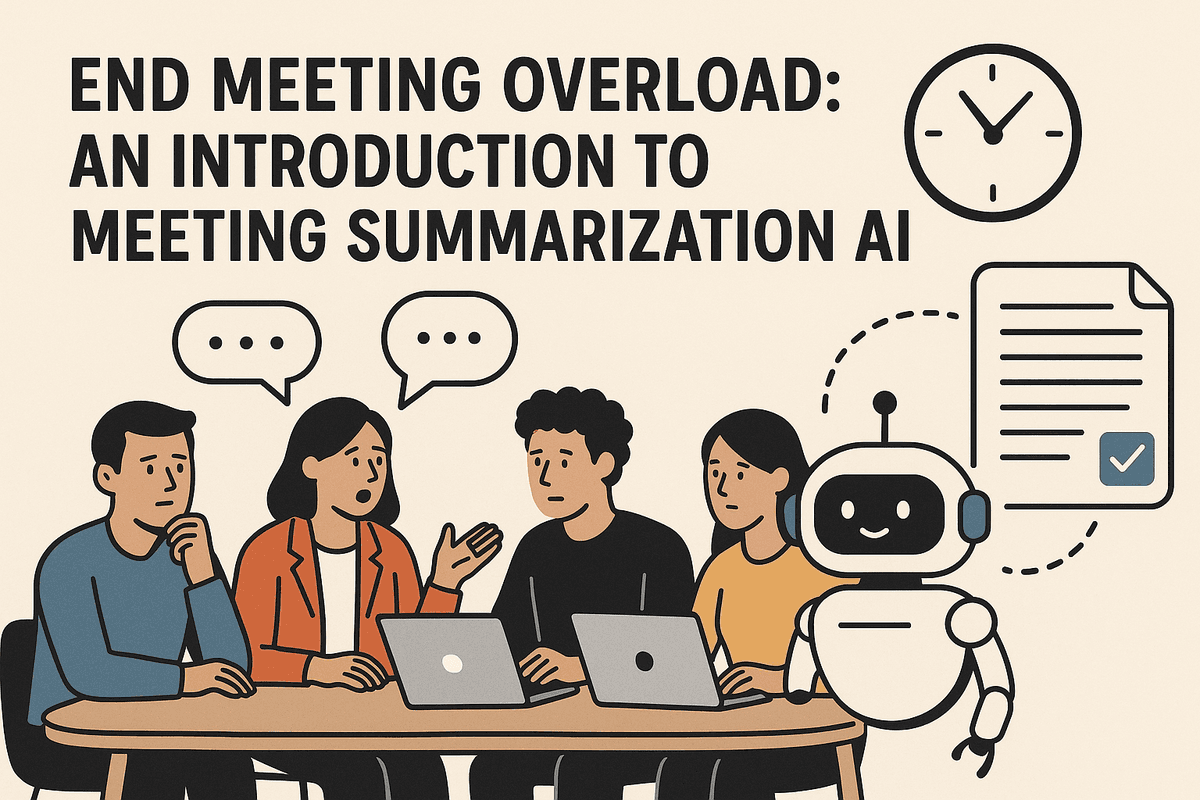
Does your calendar look like a game of Tetris, with meeting blocks stacked one after another? You jump from a strategy session to a project check-in, trying to contribute meaningfully while simultaneously scribbling down notes. By the end of the day, you’re left with a mountain of cryptic notes and a vague sense of what was decided. This is meeting overload, and it’s crushing productivity. The traditional methods of capturing meeting outcomes are broken, but a powerful new solution is here: meeting summarization AI.
This technology is designed to lift the administrative burden from your shoulders, allowing you and your team to focus on what truly matters: the conversation. Let's explore why the old way doesn't work and how AI is revolutionizing our approach to meetings.
The Problem: Why Manual Note-Taking Fails
For decades, the designated "note-taker" has been a meeting staple. But this manual process is fundamentally flawed and inefficient for several key reasons:
- Divided Attention: You cannot be a fully engaged participant and a meticulous scribe at the same time. When you’re focused on capturing every word, you miss the nuances of the conversation, the non-verbal cues, and the opportunity to share your best ideas.
- Inaccuracy and Human Bias: Our notes are a reflection of our own interpretation. We subconsciously prioritize what we think is important, often missing critical details or misrepresenting another person’s point. The final notes are subjective, not an objective record of the discussion.
- The Post-Meeting Time Sink: The work doesn't end when the call does. You still need to decipher your handwriting or shorthand, organize the points into a coherent summary, identify action items, and distribute the notes to the team. This process can easily take another 30-60 minutes per meeting.
- Lost Knowledge: Important context, brainstorming tangents, and valuable side discussions that don't make it into the final notes are lost forever. This creates knowledge silos and makes it difficult for absentees to get fully up to speed.
How AI Transforms Meeting Follow-ups
A meeting summarization AI tool integrates directly with your calendar and video conferencing platform (like Zoom, Google Meet, or Microsoft Teams). It joins your meetings as a silent participant, transcribing the entire conversation in real time. But the magic happens after the meeting ends.
Instead of a messy page of notes, you get a clean, automated, and powerful set of assets. A meeting summarization AI transforms follow-ups by providing:
- Flawless Transcription: A complete, time-stamped, and speaker-identified transcript serves as the single source of truth. You can search for any keyword to instantly find exactly what was said and by whom.
- Intelligent Summaries: The AI analyzes the transcript and generates a concise, high-level summary of the most important topics, decisions, and outcomes, saving you the effort of reviewing the entire conversation.
- Automated Action Items: The technology is trained to identify tasks, owners, and deadlines discussed during the call. It presents these in a clear, actionable list, making accountability and follow-through seamless.
What You'll Learn in This Guide
This guide is your comprehensive roadmap to understanding and implementing this transformative technology. We will move beyond the introduction and dive deep into the world of meeting summarization AI. You will learn:
- How the core technology—from transcription to natural language processing—actually works.
- A detailed breakdown and comparison of the best AI meeting assistant tools available today.
- Step-by-step instructions for integrating these tools into your team’s daily workflow for maximum impact.
- Best practices for turning every meeting into a productive session with clear, measurable outcomes.
How Does Meeting Summarization AI Turn Talk into Action?
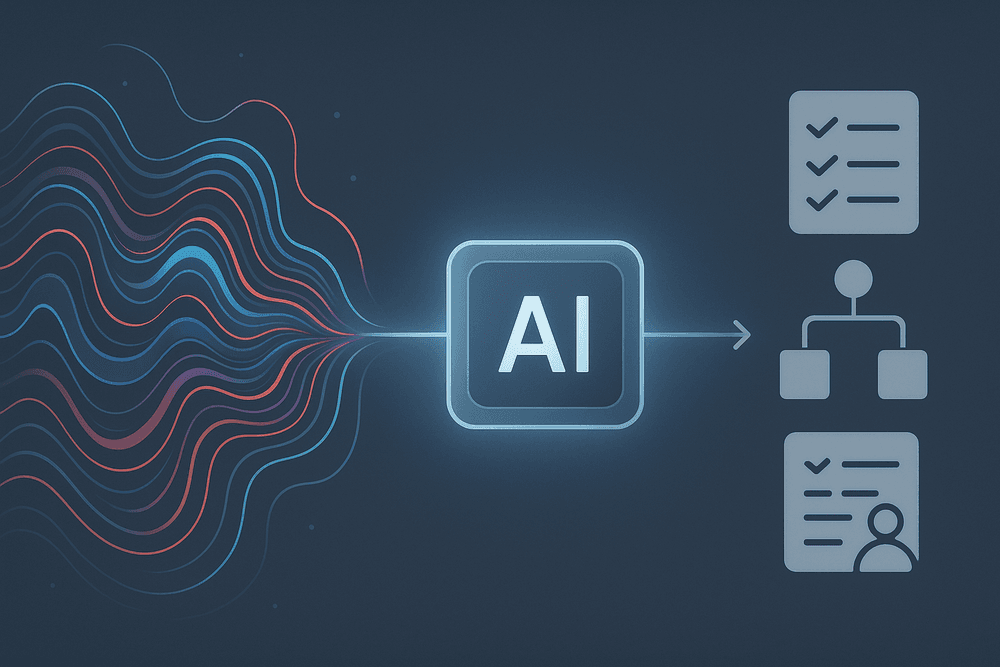
Ever walk out of a meeting feeling like you had a great discussion, only to find that a week later, no one can agree on what was decided or who was supposed to do what? This is the gap that meeting summarization AI is designed to close. It’s not magic; it’s a sophisticated, multi-step process that transforms unstructured conversation into a clear, strategic asset. Let's pull back the curtain and see exactly how this technology turns dialogue into deliverables.
Step 1: Automated Transcription and Speaker Identification
The entire process begins with a foundational, yet critical, step: creating a perfect record of the conversation.
As your meeting happens, the AI listens in and employs advanced Automatic Speech Recognition (ASR) technology to convert spoken words into a written text transcript in real-time. But a great meeting summarization AI goes further than just a wall of text. It uses a process called speaker diarization, or speaker identification, to accurately label who said what.
Instead of a confusing block of dialogue, you get a clean, organized script:
- Sarah: "I think we should push the launch date to Q4 to align with the new marketing budget."
- David: "I agree. That gives my team enough time to finalize the user interface updates."
This initial step is crucial. By accurately capturing every word and attributing it to the correct person, the AI creates a reliable source of truth. This eliminates any "he said, she said" ambiguity and sets the stage for deeper analysis.
Step 2: Using NLP to Pinpoint Key Topics and Decisions
A raw transcript is data, but it isn’t yet information. This is where the "intelligence" in AI truly shines, powered by Natural Language Processing (NLP). NLP is a field of artificial intelligence that gives computers the ability to understand, interpret, and process human language.
The meeting summarization AI scans the entire transcript and uses NLP models to:
- Identify Key Topics: The AI recognizes clusters of related keywords and phrases to determine the main themes of the discussion, such as "Q3 Financial Review," "Project Phoenix Blockers," or "Client Feedback."
- Detect Action Items: This is a game-changer. The AI is trained to identify linguistic cues that signal a task. It picks up on phrases like "I will send out the report," "The next step is to…," or "Can you take the lead on this?" and flags them as actionable items.
- Pinpoint Decisions: The system listens for conclusive language ("We've agreed to move forward with Option B," "Let's approve this design," "The final decision is…") to create a clear log of every resolution made during the meeting.
- Recognize Key Entities: It also pulls out important details like dates, deadlines, budget numbers, and project names, ensuring no critical data is lost.
By structuring the unstructured chaos of conversation, NLP transforms the transcript from a simple record into an organized database of insights.
Step 3: Generating Concise, Actionable Summaries
With the conversation transcribed, speakers identified, and key points extracted, the final step is synthesis. The meeting summarization AI collates all the structured information from the previous steps and assembles it into a format that’s built for action.
Instead of a 30-page transcript, you receive a clean, digestible summary that typically includes:
- A High-Level Overview: A one-paragraph abstract summarizing the meeting's purpose and primary outcomes.
- Key Discussion Points: Bulleted notes on the most important topics covered, allowing anyone who missed the meeting to get up to speed in minutes.
- Decisions Made: A clear and unambiguous list of all resolutions, removing any doubt about the path forward.
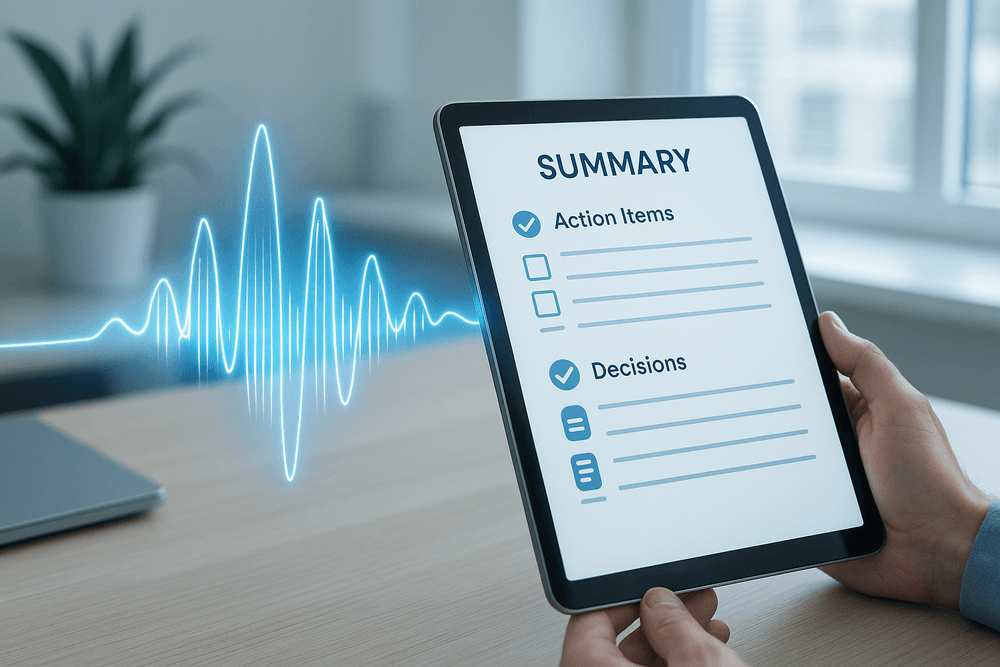
- Action Items & Owners: A checklist of tasks, automatically assigned to the correct person and often with any mentioned deadlines included.
This final output is the bridge from talk to action. It’s easily shareable, searchable, and can often be integrated directly into your project management software, turning meeting commitments into trackable tasks instantly.
Must-Have Features in a Modern Meeting Summarization AI
Navigating the crowded market of AI tools can be overwhelming. While many platforms offer basic transcription, a truly effective meeting summarization AI is a powerhouse of productivity, not just a digital stenographer. To unlock real value, you need a solution that actively participates in your workflow. When evaluating your options, look for these four non-negotiable feature categories that separate the game-changers from the gadgets.
Real-Time Transcription and Multi-Language Support
The foundation of any great meeting assistant is its ability to capture the conversation accurately and instantly. Real-time transcription allows participants to follow along, catch up if they join late, or review a point that was just made without interrupting the flow. This live text stream ensures everyone is on the same page, especially for attendees who are hard of hearing or are visual learners.
In today's global business environment, multi-language support is equally critical. A premier meeting summarization AI should not only accurately transcribe English but also understand and differentiate between various languages and accents spoken during the same call. The best-in-class tools can even provide real-time translation, breaking down communication barriers and fostering a more inclusive and effective meeting environment for international teams.
Automated Action Item and Follow-up Detection
This is where a meeting summarization AI proves its worth and delivers a massive return on investment. A simple transcript is just a wall of text; an intelligent summary is a plan of action. The AI should be sophisticated enough to parse conversations and automatically identify key outputs like:
- Action Items: Detecting phrases like "I will follow up on..." or "Sarah will send the draft by EOD" and converting them into assignable tasks.
- Decisions Made: Highlighting key resolutions and agreements so they are clearly documented and not forgotten.
- Open Questions: Flagging unresolved topics or questions that require a follow-up discussion.
This automated detection transforms passive meeting notes into an active accountability engine, ensuring critical next steps are never lost in the conversation.
Seamless Integrations with Your Workflow
A powerful tool becomes useless if it operates in a vacuum. A top-tier meeting summarization AI must fit into your existing ecosystem to prevent adding another disconnected app to your plate. Look for deep and flexible integrations with the platforms your team already uses every day.
Essential integrations include:
- Communication Hubs: Slack and Microsoft Teams for sharing summaries and highlights directly in project channels.
- Project Management Tools: Asana, Jira, Trello, and Monday.com for automatically creating tasks from detected action items.
- CRMs: Salesforce and HubSpot for logging key customer call notes and follow-ups.
By pushing data directly into these systems, the AI eliminates manual copy-pasting, reduces the risk of human error, and ensures meeting outcomes are embedded directly where the work happens.
Evaluating Security, Privacy, and Compliance
Meeting discussions often contain sensitive, proprietary, or confidential information. Therefore, the security and privacy policies of your chosen meeting summarization AI are not just a feature—they are a fundamental requirement. Before committing, demand clarity on how your data is handled.
Key areas to investigate include:
- Data Encryption: Is data encrypted both at rest (on their servers) and in transit (during upload/download)?
- Compliance Certifications: Does the provider have certifications like SOC 2 Type II and comply with regulations like GDPR and CCPA?
- Data Controls: Can you control data retention policies and permanently delete your information?
- Access Permissions: Does the platform offer granular controls to define who within your organization can view or access specific meeting data?
A trustworthy provider will be transparent about their security posture, ensuring your conversations remain secure and confidential.
Real-World Impact: Use Cases for Meeting Summarization AI
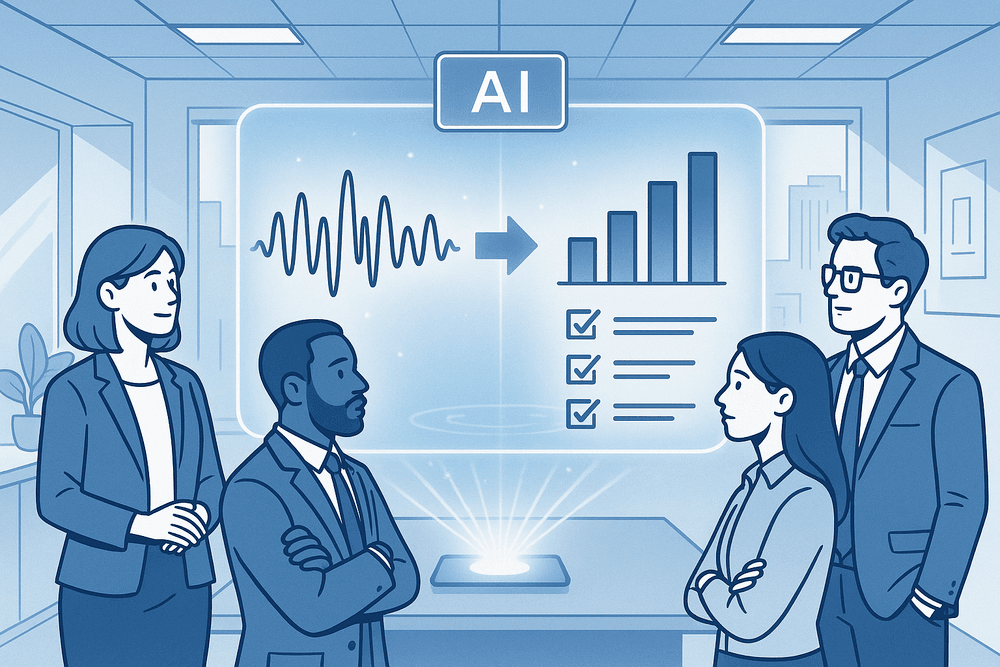
The theoretical benefits of saving time are compelling, but where does meeting summarization AI deliver tangible value in day-to-day operations? The technology's true power is revealed when applied to the specific challenges faced by different professional teams. From ensuring project accuracy to enriching client relationships, an AI meeting summary tool transforms abstract conversations into structured, actionable assets. Let's explore the practical applications that are revolutionizing workflows.
For Project Managers: Never Miss a Requirement or Deadline
Project managers live and breathe details. A single missed requirement in a stakeholder call or a forgotten action item from a team sync can derail a timeline and blow a budget. Manually taking notes while simultaneously guiding a complex discussion is a recipe for error.
This is where meeting summarization AI becomes a project manager's most reliable assistant. By automatically transcribing and analyzing every conversation, the AI ensures that no critical detail falls through the cracks.
- Flawless Requirement Capture: The AI meticulously documents all client requests, technical specifications, and scope changes discussed during kickoff or review meetings, creating an accurate, searchable record.
- Automatic Action Item Tracking: Sophisticated tools can identify tasks, assign them to the correct team members, and even suggest deadlines based on the conversation, streamlining post-meeting project planning.
- Risk Mitigation: By highlighting key decisions and potential roadblocks mentioned in discussions, the AI provides an early warning system, allowing PMs to address issues proactively.
- Single Source of Truth: The AI-generated summary and transcript serve as an objective record, instantly resolving any "he said, she said" disputes about project direction or deliverables.
For Sales Teams: Capturing Actionable Client Insights
In sales, active listening is paramount. A representative who is furiously typing notes is a representative who is not fully engaged, potentially missing subtle buying signals or the true depth of a client's pain point. A meeting summarization AI tool liberates sales professionals to focus entirely on building rapport and understanding customer needs.
The AI works in the background, capturing the entire conversation and turning it into a goldmine of actionable intelligence that can be used to accelerate the sales cycle.
- Voice of the Customer Analysis: The AI automatically pulls out key client questions, objections, and pain points, providing a clear roadmap for crafting the perfect follow-up email or proposal.
- Identify Key Stakeholders: The system can help identify who the key decision-makers are in a group call and what matters most to each of them.
- Enhanced Coaching: Sales managers can review transcripts and AI-powered summaries to provide specific, data-driven feedback and coaching to their team members, scaling best practices across the organization.
- Seamless CRM Integration: The best meeting summarization AI platforms automatically push key notes, action items, and highlights directly into your CRM, eliminating manual data entry and keeping records perfectly up-to-date.
For Remote Teams: Keeping Everyone Aligned Across Time Zones
For distributed and global teams, time zones are a constant challenge. Not everyone can make every meeting. This often leads to information silos, where team members who couldn't attend are left out of key decisions, relying on secondhand information that may be incomplete or inaccurate.
Meeting summarization AI is the ultimate tool for asynchronous collaboration, ensuring every team member stays informed and aligned, regardless of their location or schedule.
- Meetings on Demand: Team members in different time zones can review a concise, well-structured summary—or dive into the full transcript—at a time that works for them, without having to sit through a one-hour recording.
- Consistent Understanding: AI-generated notes provide a standardized, objective record of what was discussed and decided, eliminating misinterpretations and ensuring everyone is working from the same information.
- Increased Inclusivity: It empowers team members who may be less vocal during a live call to fully understand the context and contribute their thoughts afterward, fostering a more inclusive and collaborative environment.
- Reduced Meeting Fatigue: By providing reliable summaries, teams can feel more confident in making some meetings optional, freeing up calendars and combating the burnout of back-to-back video calls.
Best Practices: Getting Maximum Value from Your Meeting Summarization AI
Investing in a meeting summarization AI is the first step. The next is integrating it into your workflow to unlock its full potential. Simply turning it on isn't enough; to get truly transformative results, you need to adopt a few key best practices. By focusing on quality inputs and smart processes, you can turn your AI assistant from a simple note-taker into a strategic asset that drives productivity and clarity across your entire organization.
1. Ensure High-Quality Audio and Transcription
The golden rule of any AI system is "garbage in, garbage out." Your meeting summarization AI is only as good as the audio it receives. Poor audio leads to inaccurate transcription, which in turn creates unreliable summaries and flawed action items. To guarantee a high-quality foundation for your AI, follow these simple audio hygiene tips:
- Use Quality Microphones: Laptop mics are okay, but external USB microphones or dedicated conference room speakerphones capture clearer sound, especially with multiple speakers.
- Minimize Background Noise: Choose a quiet location for your meetings. Close doors, shut windows, and silence notifications on all devices.
- Speak Clearly and One at a Time: Encourage participants to avoid speaking over one another. A moment of pause between speakers gives the AI a clean break to accurately attribute statements.
- Identify Speakers: At the start of a call with new guests, have everyone introduce themselves. This helps the AI’s speaker diarization (identifying who said what) feature work more accurately.
2. Customize Summary Templates for Different Meeting Types
Not all meetings are created equal. A weekly team sync has a different purpose than a client discovery call or a creative brainstorming session. A generic summary might miss the specific information you need. Top-tier meeting summarization AI tools allow you to create and apply custom templates. Tailor them to fit the context:
- Project Check-ins: Create a template that prioritizes
Action Items,Key Decisions, andBlockers. - Sales Calls: Design a template to extract
Client Pain Points,Next Steps, andCustomer Questions. - Brainstorming Sessions: Focus a template on capturing
New Ideas,Core Themes, andOpen Questionsfor future exploration.
Custom templates guide the AI to focus on what matters most, delivering perfectly structured, relevant summaries every time.
3. Train Your Team to Interact with the AI Assistant
User adoption is crucial for maximizing ROI. Treat the AI like a new team member and train your staff on how to interact with it effectively. Most modern tools offer in-meeting commands and features that enhance the final output. Educate your team on:
- Using Wake Words: Teach them how to use verbal cues like, "Hey AI, note this down," or, "AI, create an action item for Sarah to update the project plan."
- Highlighting Key Moments: Show them how to use an in-app button or command to flag important parts of the conversation for the summary.
- Correcting the AI: Explain the importance of correcting the live transcript if they spot an error in a name or technical term. This not only fixes the current record but can also help train the AI model for future meetings.
4. Review and Share AI-Generated Notes Effectively
While a meeting summarization AI is incredibly powerful, it’s an assistant, not a replacement for human oversight. Always conduct a quick post-meeting review. This final human touch ensures 100% accuracy and adds crucial context.
- Review and Edit: Spend two minutes scanning the AI-generated summary. Tidy up phrasing, correct any misattributions, and add any subtle context the AI might have missed.
- Choose Your Sharing Channel: Don't just let notes sit in the AI platform. Share them where your team works. Integrate your AI with Slack, Asana, Trello, or Jira to push action items and notes directly into your project management workflows.
- Standardize Your Process: Create a simple company policy: The meeting host is responsible for a quick review and for sharing the summary within one hour of the meeting's conclusion. This creates a reliable rhythm and ensures everyone has the information they need to move forward.
Conclusion: Make Your Next Meeting Your Most Productive Yet
The era of dreading post-meeting admin is officially over. We've journeyed through the landscape of AI-powered meeting tools, discovering how they are fundamentally reshaping collaboration. The choice is no longer between paying attention and taking notes; it's about leveraging technology to do both better than ever before. By moving beyond manual transcription, you unlock a new tier of efficiency and clarity for your entire team. The future of work isn't about more meetings—it's about more effective ones, and meeting summarization ai is the key that unlocks that potential.
Recap: The Core Benefits of Adopting AI for Meetings
Let's quickly revisit the transformative advantages of integrating a meeting summarization ai into your workflow. This technology is more than a convenience; it's a strategic asset that delivers tangible results:
- Reclaimed Time & Focus: Free your team from the burden of manual note-taking. Participants can fully engage, brainstorm, and problem-solve, knowing every detail is being captured accurately. The hours saved on post-meeting write-ups can be reinvested into high-value, strategic work.
- Perfect Recall & Accountability: AI provides an infallible record. Action items are clearly identified and assigned, key decisions are timestamped, and ambiguity is eliminated. This creates a culture of accountability where follow-through becomes the standard, not the exception.
- A Searchable Knowledge Base: Every meeting becomes a searchable, valuable piece of institutional knowledge. New hires can get up to speed faster, and team members can instantly find critical information from past discussions without having to ask a colleague or sift through old documents.
How to Choose the Right Tool for Your Budget and Needs
Selecting the perfect meeting summarization ai doesn't have to be complicated. The best tool is one that seamlessly integrates into your existing ecosystem and addresses your specific pain points. As you evaluate your options, consider these critical factors:
- Accuracy and Integrations: How well does the tool handle your industry's specific jargon or team members' accents? Crucially, does it integrate with the platforms you already use daily, like Slack, Microsoft Teams, Asana, or your CRM? A well-integrated tool removes friction, while a siloed one adds it.
- Security and Compliance: Meeting data is sensitive. Ensure the provider meets your organization's security standards (e.g., SOC 2 compliance, GDPR). Verify their data handling policies to ensure your confidential discussions remain secure.
- Features vs. Cost: Determine your must-have features. Do you need basic transcription, or advanced capabilities like speaker identification, sentiment analysis, and customizable summary templates? Compare these needs against various pricing models—from generous free tiers to comprehensive enterprise plans—to find the right balance of functionality and value for your budget.
Start Automating Your Meeting Notes Today
The barrier to entry for this revolutionary technology has never been lower. You don't need a massive budget or a complex IT project to get started. The journey begins with a single step.
Take one of the tools we've discussed and sign up for a free trial. Use it for your next internal team huddle or project check-in. Experience firsthand the relief of ending a call and receiving a polished, actionable summary in your inbox minutes later. Witness the clarity it brings to your team's next steps.
Stop letting valuable insights evaporate the moment a meeting ends. It's time to transform your conversations from transient events into lasting assets. Make your next meeting your most productive one yet by embracing the power of meeting summarization ai.