
July 22, 2025
Drowning in Paperwork? How an AI Grading Assistant Can Be
Drowning in Paperwork? How an AI Grading Assistant Can Be Your Lifeline
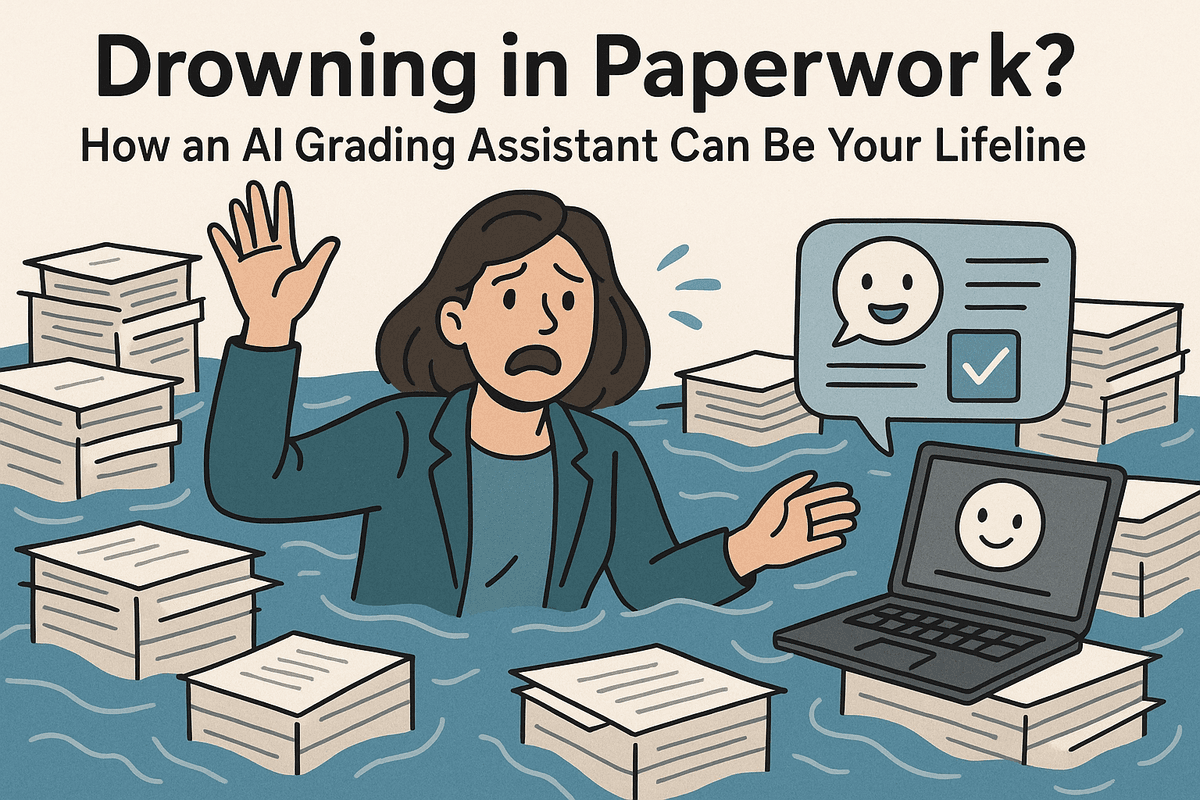
The last school bell rings, hallways empty, and a quiet calm settles over the classroom. For many teachers, however, this is not the end of the day. It’s the beginning of the second shift—the unseen hours spent buried under a mountain of paperwork. This is the reality of the modern educator: a constant battle against a rising tide of essays, quizzes, lab reports, and projects, all demanding careful review and thoughtful feedback. This marathon of marking stretches into evenings and weekends, chipping away at personal time and contributing to the growing crisis of teacher burnout.
The sheer volume of grading doesn't just consume time; it can create a frustrating delay in the learning cycle. By the time a student receives feedback on an assignment submitted a week prior, the class has often moved on to new topics. The teachable moment has passed, and the feedback, no matter how insightful, loses some of its impact. It's a system that strains educators and can slow student progress.
What if Grading Could Be Instant and Insightful?
Imagine a different reality. What if you could leave work at a reasonable hour, confident that your students’ work was being assessed consistently and accurately? What if every student, regardless of when they finished their assignment, received immediate, constructive feedback that helped them understand their mistakes and grasp key concepts right away?
Picture having the freedom to use your expertise not for repetitive marking, but for designing more creative lesson plans, providing one-on-one support to struggling students, or fostering deeper classroom discussions. This isn’t a fantasy; it’s the powerful promise of a new ally in education.
Introducing the AI Grading Assistant Revolution
This is where the AI grading assistant emerges as a true lifeline for overwhelmed educators. An AI grading assistant is a sophisticated software tool designed to automate the assessment process, leveraging artificial intelligence to evaluate student work with speed and precision. Think of it not as a replacement, but as an incredibly capable teaching partner dedicated to handling the most time-consuming aspects of your job.
Here’s how this technology is transforming the classroom:
- Reclaiming Your Time: A powerful AI grading assistant can slash grading time by hours each week. It handles the objective, rule-based components of assessment—from multiple-choice questions to complex coding assignments and even initial drafts of essays—freeing you to focus on the nuanced, subjective elements of student work.
- Providing Instant, Actionable Feedback: These tools deliver immediate feedback to students, reinforcing correct answers and explaining errors the moment they happen. This creates a continuous learning loop that empowers students to take ownership of their education.
- Ensuring Fairness and Consistency: An AI grading assistant applies the same rubric and criteria to every single submission, eliminating unconscious bias and ensuring every student is graded on a level playing field.
- Unlocking Deeper Insights: Beyond just a score, the best AI tools provide valuable analytics. You can quickly identify common misconceptions across the entire class or pinpoint specific areas where an individual student is struggling, allowing for timely and targeted intervention.
By integrating an AI grading assistant into your workflow, you can finally escape the paperwork deluge and dedicate your energy to what truly matters: inspiring the next generation of learners.
Decoding the AI Grading Assistant: Your New Co-Teacher
Forget the days when automated grading was limited to filling in bubbles on a Scantron sheet. Today’s ai grading assistant has evolved into a sophisticated partner capable of understanding the nuances of human language. It’s not about simple keyword matching; it's about deep comprehension. So, how does it go beyond the bubble sheet to assess complex written answers like essays, short responses, and even creative writing?
The magic lies in a combination of powerful technologies, primarily Natural Language Processing (NLP) and Machine Learning (ML).
- Natural Language Processing (NLP): This is the branch of AI that gives computers the ability to read, understand, and interpret human language. An ai grading assistant uses NLP to break down student writing into its core components. It analyzes sentence structure, grammar, syntax, and even the semantic meaning behind the words. It can identify the main thesis, track the development of arguments, and recognize the evidence used to support claims.
- Machine Learning (ML): This is the engine that makes the AI smarter over time. The system is "trained" on a vast dataset of sample essays that have been graded by human educators. It learns to associate certain patterns, phrases, and structural elements with different levels of quality, aligning its assessments with the criteria you set in your rubric. The more it grades, the more refined and accurate its understanding becomes.
The Technology Behind Automated Feedback Generation
A truly effective ai grading assistant doesn’t just deliver a score; it provides targeted, constructive feedback that helps students learn. This isn't a generic "good job" or "needs improvement." Instead, the AI generates specific, actionable comments by pinpointing exact areas in the student's text.
It accomplishes this by cross-referencing its linguistic analysis with your specific rubric. For example, the AI can:
- Highlight grammatical errors and suggest corrections.
- Identify weak topic sentences or a lack of transitional phrases.
- Flag unsupported claims and suggest where more evidence is needed.
- Comment on tone and style, assessing whether it's appropriate for the assignment.
By mapping its findings directly to your grading criteria, the AI provides instant feedback that is both relevant and easy for students to understand. This immediate feedback loop allows students to revise and learn while the material is still fresh in their minds.
Is an AI Grader a Replacement or an Assistant?
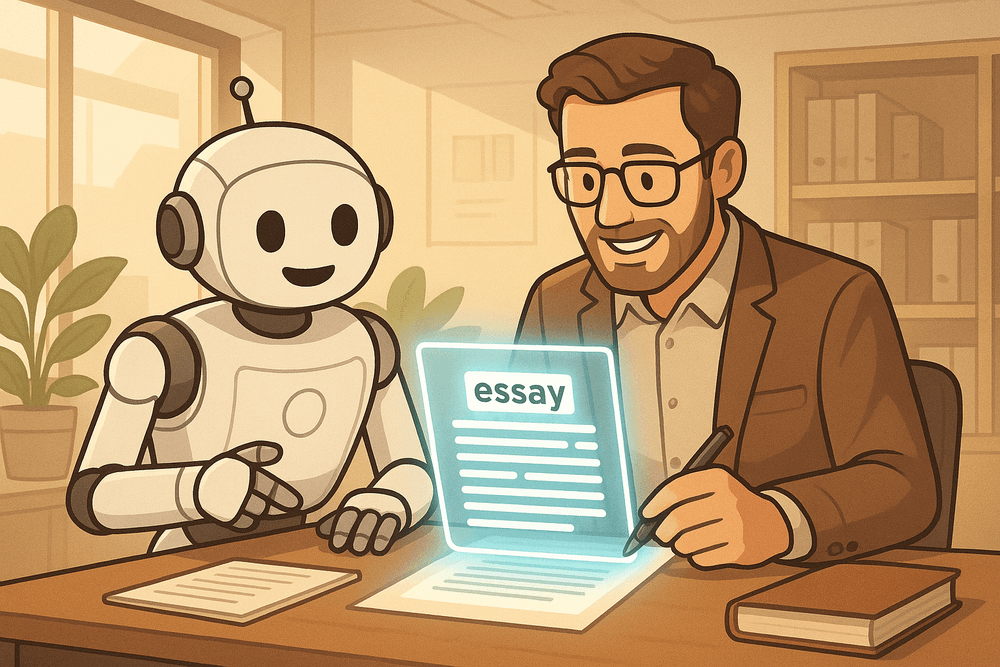
This is the most critical question for educators, and the answer is clear: this tool is an assistant, not a replacement. The term ai grading assistant is intentional. Its purpose is to augment your expertise, not to make you obsolete.
Think of the AI as a diligent co-teacher that handles the first pass of grading. It meticulously checks for grammar, structure, and adherence to the rubric, saving you countless hours of repetitive work. This frees you to focus on what you do best: providing high-level, nuanced feedback on creativity, critical thinking, and the unique voice of each student. The AI manages the data; you provide the wisdom. The final grade and the most meaningful mentorship always come from you.
Comparing the Top AI Grading Assistant Platforms for Educators
Choosing the right AI grading assistant is crucial, as the best platform often depends on your subject matter, institution, and specific pedagogical goals. With a crowded market, knowing where to start can be daunting. We’ve broken down some of the leading platforms to help you find the perfect fit for your classroom.
Gradescope: Best for STEM and Complex Assignments
Gradescope has carved out a powerful niche as the go-to AI grading assistant for STEM subjects and any course involving complex, non-standard answers. Its strength lies in handling everything from handwritten problem sets and diagrams to code submissions and bubble sheets.
The platform’s standout feature is AI-assisted grouping. After you’ve graded one student’s answer, Gradescope’s AI automatically identifies and groups all other stylistically similar responses. This allows you to grade an entire cluster of identical answers at once, applying the same feedback and rubric criteria with a single click. This drastically reduces repetitive work, especially in large classes. With flexible, dynamic rubrics that can be adjusted on the fly, Gradescope ensures consistent, fair, and transparent grading for even the most intricate assignments.
Best for: University and high school educators in math, physics, chemistry, computer science, and engineering.
Turnitin: AI-Powered Writing Feedback and Integrity Checks
While widely known for its industry-leading plagiarism detection, Turnitin has evolved into a comprehensive writing and assessment tool. Its Feedback Studio is a powerful AI grading assistant designed specifically for text-based assignments. It goes beyond simple grammar checks to provide students with rich, formative feedback on writing quality, argumentation, and structure.
Turnitin’s AI helps instructors streamline grading by identifying common writing issues and allowing for the use of pre-written or custom drag-and-drop comments. Its core strength remains academic integrity. The platform not only flags potential plagiarism from its massive database but has also integrated sophisticated AI writing detection to help educators identify submissions generated by large language models.
Best for: Humanities, social sciences, and any discipline where written essays and reports are the primary form of assessment.
Copilot in Education: Integrating AI into Your Existing Workflow
For educators deeply embedded in the Microsoft ecosystem, Copilot in Education offers a different approach. Rather than a standalone platform, it’s an AI assistant integrated directly into the Microsoft 365 tools you already use, such as Teams, OneNote, and Word.
Copilot can accelerate your assessment workflow by generating draft rubrics based on your assignment description, summarizing student progress, and suggesting personalized feedback. For example, you can ask it to create a four-point rubric for a history essay or to highlight the key themes in a student’s submitted work. Because it lives within your existing environment, it lowers the barrier to entry and enhances productivity without requiring you to learn an entirely new system.
Best for: K-12 and higher education institutions standardized on Microsoft 365 seeking to enhance existing processes rather than adopt a separate grading tool.
Free vs. Paid AI Grading Solutions: A Cost-Benefit Analysis
The decision between a free and paid AI grading assistant comes down to a trade-off between cost and capability.
- Free Solutions: These are often limited versions of paid platforms or general-purpose AI tools (like ChatGPT) adapted for grading tasks. They are excellent for individual teachers wanting to experiment with AI for generating rubrics or drafting basic feedback. However, they typically lack crucial features like LMS integration, student roster management, robust data security, and dedicated technical support.
- Paid Solutions: Platforms like Gradescope and Turnitin operate on a subscription model, usually paid at the institutional level. The investment provides a fully integrated, secure, and feature-rich experience. You gain access to advanced analytics, FERPA-compliant data handling, dedicated support, and seamless integration with your school’s Learning Management System (LMS). For widespread, consistent implementation, a paid solution offers the reliability and scalability that free tools cannot match.
Must-Have Features in Your Next AI Grading Assistant
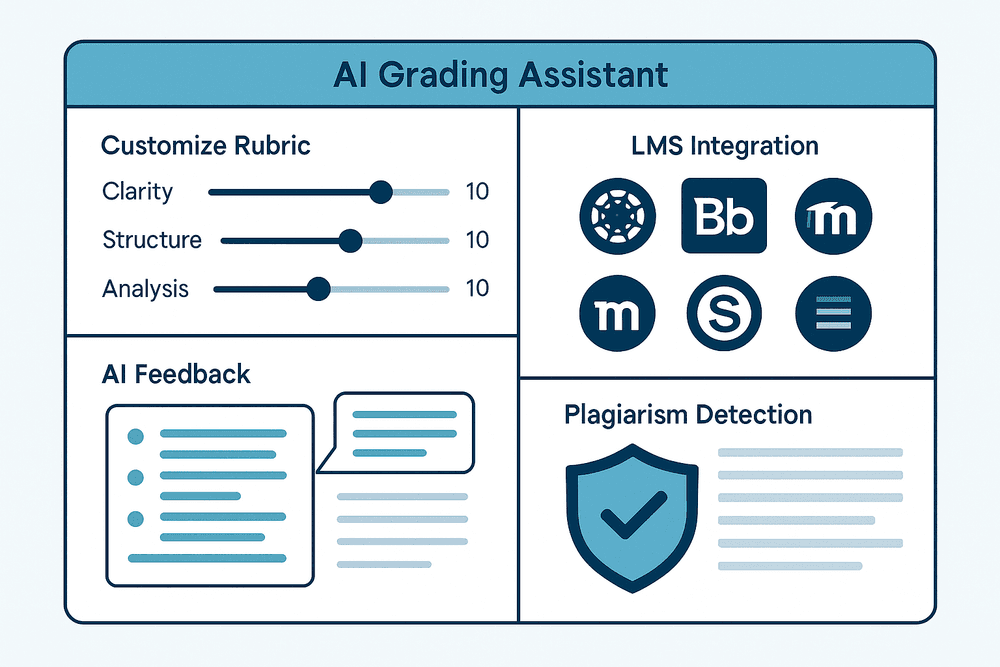
Choosing the right technology is crucial for successfully integrating automated assessment into your workflow. Not all platforms are created equal. As you evaluate your options, look for a powerful and intuitive ai grading assistant that includes these four non-negotiable features. They are the difference between a tool that adds to your workload and one that truly revolutionizes it.
Customizable Rubrics and Grading Criteria
Your expertise and pedagogical approach are unique. A generic, black-box grading algorithm simply cannot replicate the nuanced assessment your students deserve. Therefore, the most critical feature of any effective ai grading assistant is deep customizability. A superior tool will empower you to take full control of the evaluation process. Look for the ability to import your own established rubrics, build new ones from scratch with varying weights and criteria, and fine-tune every detail to match your specific learning objectives. This ensures that the AI is not just a grader but an extension of your teaching philosophy, evaluating student work against the precise standards you have set for your course. This level of control guarantees that the automated grades are fair, consistent, and meaningfully aligned with your curriculum.
Seamless Integration with Your LMS
Technology should simplify your life, not complicate it. The last thing you need is another disconnected platform with a separate login and a clunky workflow that requires manually transferring grades. A top-tier ai grading assistant must offer seamless integration with the Learning Management System (LMS) you already use, whether it’s Canvas, Blackboard, Moodle, D2L Brightspace, or Google Classroom. This integration is essential for a streamlined experience. It means you can deploy AI-graded assignments directly within your LMS, and grades will automatically sync back to your gradebook. This eliminates time-consuming administrative tasks, reduces the risk of human error, and provides a cohesive and familiar interface for both you and your students.
Actionable, AI-Generated Feedback for Students
Saving time on grading is a major benefit, but the true power of a modern ai grading assistant lies in its ability to enhance student learning. A simple score is not enough. The best platforms go beyond grading to provide instant, specific, and actionable feedback. Instead of just pointing out what’s wrong, the AI should explain why it’s wrong and offer constructive suggestions for improvement, directly linked to the rubric criteria. This transforms the grading process from a summative judgment into a formative learning opportunity. Students receive immediate guidance when the material is still fresh in their minds, allowing them to understand their mistakes and improve their skills for the next assignment. This creates a powerful feedback loop that fosters mastery and student growth.
Built-in Plagiarism Detection and Academic Integrity Tools
Upholding academic integrity is fundamental in any educational setting. An ai grading assistant should be your ally in this effort, not a tool that overlooks potential issues. A robust, built-in plagiarism detection feature is essential. This goes beyond simple text matching. Look for a system that scans submissions against a vast database of academic papers, publications, and the entire open internet. The most advanced tools are now also incorporating AI-writing detection, helping you identify work that may not be original to the student. By integrating these academic integrity tools directly into the grading workflow, you can efficiently and consistently check all submissions, deter misconduct, and foster a culture of honesty and original work in your classroom.
How to Ethically and Effectively Use an AI Grading Assistant
Adopting an ai grading assistant isn't just about clicking a button; it's about thoughtfully integrating a powerful tool into your pedagogical practice. The goal is to enhance your teaching, not replace it. By focusing on ethical implementation and effective strategies, you can harness the full potential of AI to provide better, faster feedback while maintaining your essential role as the educational expert in the classroom.
Setting Clear Expectations with Students and Parents
Transparency is the cornerstone of trust when introducing any new technology. Before you use an ai grading assistant for the first time, it's crucial to communicate openly with both students and their parents.
Start by explaining what the tool is and how it will be used. Frame it as a co-pilot designed to provide initial, objective feedback based on a rubric, allowing you to focus on higher-level concepts and personalized guidance. Assure them that you, the teacher, are still the final authority on every grade. Consider adding a clear statement to your syllabus:
- “In this class, we will use an AI grading assistant to help provide quick and consistent feedback on specific assignments. The AI offers suggestions based on the established rubric, but I will personally review, adjust, and finalize all feedback and grades to ensure fairness and accuracy.”
This proactive communication demystifies the process, addresses potential concerns head-on, and highlights the primary benefit to students: more detailed feedback, delivered faster.
The Teacher's Role: Reviewing and Refining AI Suggestions
The most critical principle of using an ai grading assistant is that the educator remains firmly "in the loop." The AI is an assistant, not an arbiter. Your expertise, empathy, and understanding of your students' individual journeys are irreplaceable.
Your primary role shifts from tedious, line-by-line correction to high-level review and refinement. Here’s what that looks like in practice:
- Never "Set It and Forget It": Always review the AI's suggested grades and comments before releasing them to students.
- Look for Nuance: An AI can check for thesis statement placement, but you can assess its originality. An AI can count sources, but you can evaluate their quality and synthesis.
- Add Your Voice: Use the AI's output as a baseline. Add your own personalized comments that encourage, challenge, and recognize a student's unique effort or creative approach.
Think of the AI as handling the first draft of grading, freeing you to provide the final, expert polish that truly fosters student growth.
A Step-by-Step Guide to Your First AI-Assisted Assignment
Feeling ready to start? Follow this simple guide for a smooth first experience.
- Choose the Right Assignment: Begin with a structured assignment that has clear, objective criteria. Short-answer questions, lab reports, or formulaic essays with a very specific structure are excellent starting points. Save the deeply creative or personal narrative essays for later.
- Build a Meticulous Rubric: An ai grading assistant is only as good as the instructions you give it. A detailed, unambiguous rubric is essential. Clearly define each criterion and the markers of success for every performance level.
- Calibrate and Test: Before grading the entire class, run a few sample assignments (ideally with varying levels of quality) through the tool. Compare the AI’s output with your own assessment. Most tools allow you to "teach" them by correcting suggestions, which calibrates the ai grading assistant to your specific standards.
- Review, Finalize, and Release: After the AI processes the batch, perform a final spot-check. Review a few assignments from the high, middle, and low scoring ranges to ensure consistency and fairness. Once you’re confident, finalize the grades with your own refinements and release them.
Strategies for Mitigating Bias in Automated Grading
A valid concern with any AI system is the potential for bias. AI models learn from vast datasets, and if that data contains biases, the AI can perpetuate them. This might unfairly penalize students who use non-standard dialects of English or have unique writing styles.
As an educator, you are the most important defense against this.
- Vet Your Tool: Choose a reputable platform from a company that is transparent about how it trains its models and works to mitigate bias.
- The Power of the Rubric: A clear, objective rubric minimizes the AI's opportunity to make biased judgments based on writing style alone.
- Prioritize Manual Review: Your final review is the ultimate safeguard. Be particularly mindful when reviewing work from English Language Learners or students from diverse linguistic backgrounds. Ensure the feedback is focused on the rubric's criteria, not syntax or dialect.
- Encourage Dialogue: Create a safe and easy way for students to ask questions about their feedback. This not only builds trust but can also help you identify and correct any potential patterns of bias in the AI's suggestions.
Conclusion: Reclaim Your Time and Revolutionize Your Feedback
The conversation surrounding artificial intelligence in education has definitively shifted from a futuristic “if” to a practical “how.” For educators on the front lines, the integration of an ai grading assistant is no longer a novelty but a strategic move toward a more sustainable and impactful teaching practice. As we've explored, the benefits transcend mere efficiency; they represent a fundamental enhancement of the learning cycle for both you and your students. This isn't just about getting through a stack of papers faster; it's about transforming the quality and immediacy of the feedback that fuels genuine academic growth.
More Than Just Speed, It's About Deeper Learning
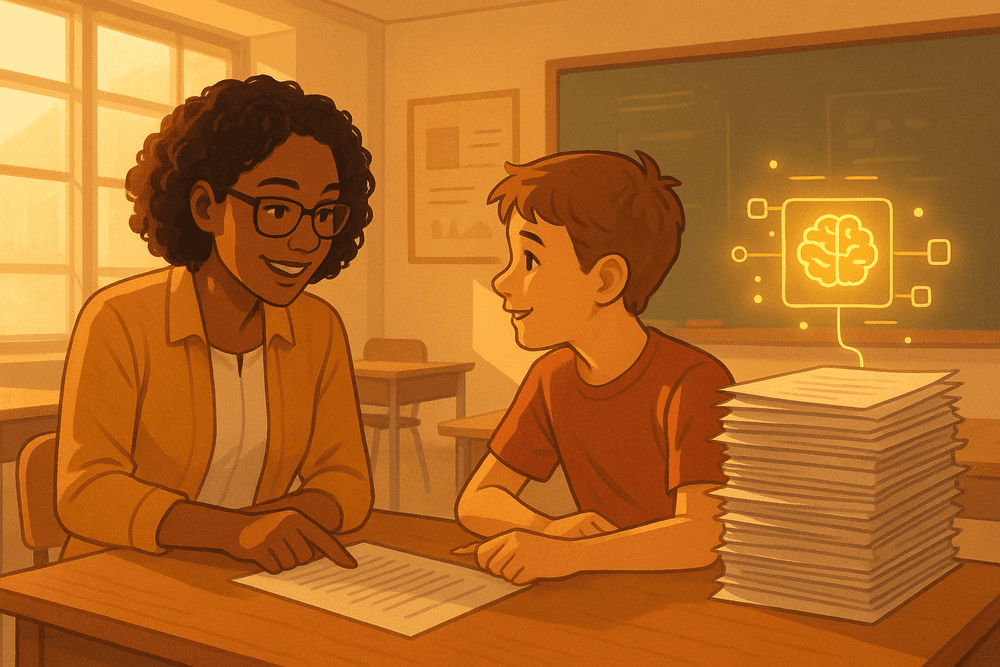
While reclaiming countless hours from the grading grind is a powerful motivator, the true revolution lies in what that recovered time allows you to do. An ai grading assistant automates the consistent, rubric-based assessment of foundational skills, freeing your cognitive energy for what matters most: providing nuanced, high-level feedback that a machine cannot.
When students receive instant feedback on grammar, structure, or calculation errors, they can immediately engage with and correct their mistakes, fostering a dynamic cycle of revision and improvement. This empowers them to take ownership of their learning. Meanwhile, you can shift your focus from being a proofreader to a mentor, guiding students on critical thinking, creative analysis, and the deeper substance of their work. The right AI tool doesn't diminish your role; it elevates it, allowing you to focus on the human elements of teaching that inspire a lifelong love of learning.
Choosing the Right AI Grading Tool for Your Classroom
As you embark on this journey, remember that not all platforms are created equal. The best ai grading assistant is the one that seamlessly integrates into your existing workflow and aligns with your pedagogical goals. Before committing, reflect on the key criteria we've discussed:
- Subject-Matter Expertise: Does the tool specialize in STEM, humanities, or a broad range of subjects?
- LMS Integration: Will it work effortlessly with your school's Canvas, Blackboard, or Google Classroom setup?
- Customization and Control: Can you easily tailor rubrics and feedback to match your specific assignment objectives and teaching style?
- Data Security: Does the platform adhere to strict privacy standards like FERPA to protect student data?
Choosing the right tool is an empowering act that places you in control, ensuring the technology serves your classroom, not the other way around.
Start Your Journey with an AI Grading Assistant Today
The future of assessment is here, and it's more supportive and less burdensome than ever before. Taking the first step can feel daunting, but you don’t need to transform your entire curriculum overnight. Start small. Pilot an ai grading assistant with a single assignment or in one of your classes. Gather feedback from students, observe the results, and build your confidence.
By embracing this technology, you are making a powerful investment in your own well-being and your students' success. You are choosing to replace burnout with balance and tedious repetition with meaningful interaction. Reclaim your evenings and weekends, revolutionize your feedback loop, and rediscover the joy of teaching by letting an ai grading assistant handle the heavy lifting. Your journey toward a smarter, more effective classroom starts now.