
October 19, 2025
Drowning in Data? An Introduction to AI Research Paper
Drowning in Data? An Introduction to AI Research Paper Summarization
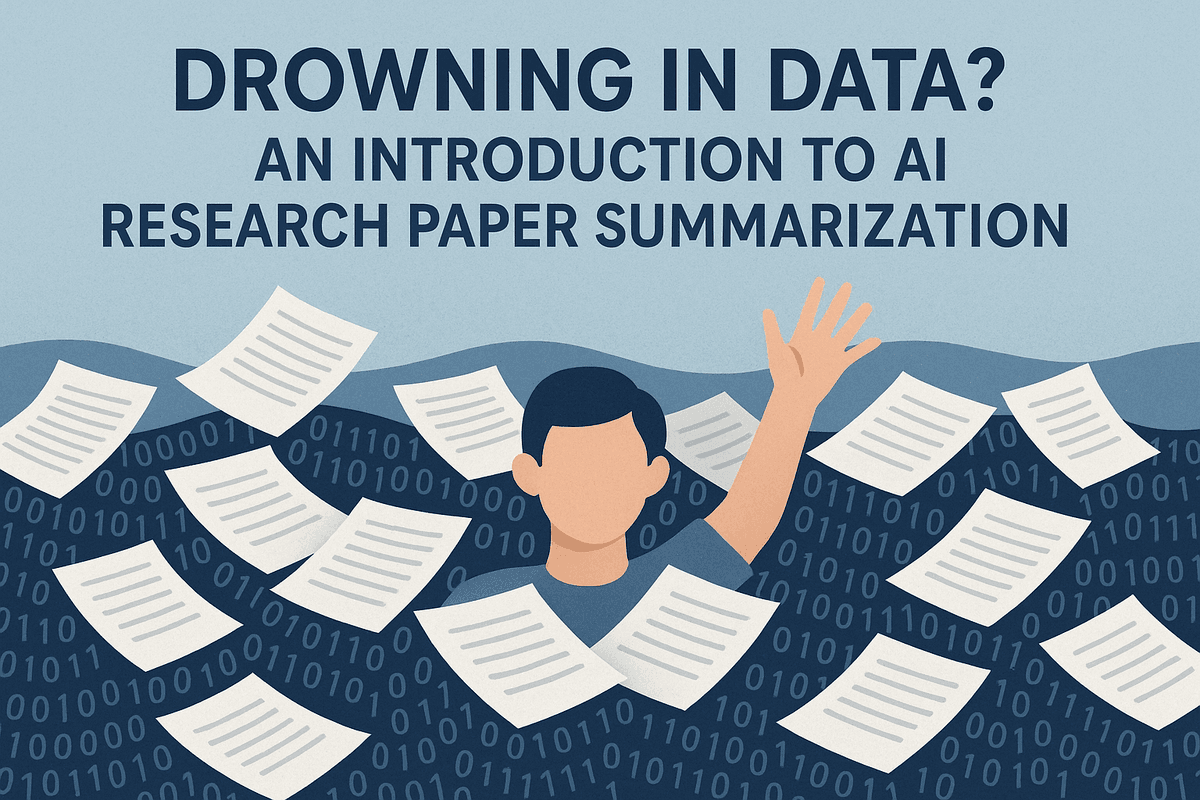
In the world of academia, progress is built on the foundation of existing knowledge. But what happens when that foundation grows so vast and so rapidly that it becomes impossible to navigate? Every year, over two million new research papers are published, creating an overwhelming flood of information. For students, scientists, and academics, the traditional literature review process has transformed from a methodical exploration into a desperate race against time. If you've ever felt buried under a mountain of PDFs, you're not alone. This is where the power of artificial intelligence offers a lifeline.
What is Automated Research Paper Summarization?
Automated research paper summarization is the application of advanced AI, particularly Natural Language Processing (NLP), to distill dense, lengthy academic texts into concise and understandable summaries. Think of it as an expert assistant that can read a 30-page paper and give you the essential "CliffsNotes" version in seconds.
These AI tools work in two primary ways:
- Extractive Summarization: This method identifies and pulls the most critical sentences or phrases directly from the original text to form a summary. It’s like using a highlighter on the most important parts of the paper.
- Abstractive Summarization: This more sophisticated approach uses AI to comprehend the paper's core concepts and then generate new, unique sentences to summarize them. This often results in a more fluid and human-like summary that captures the essence of the research.
The ultimate goal of AI research paper summarization is to provide a clear overview of a paper's purpose, methodology, key findings, and conclusions, allowing you to quickly assess its relevance to your own work.
Why Traditional Literature Reviews are No Longer Enough
The manual literature review process is a cornerstone of academic rigor, but its limitations are becoming increasingly apparent in the digital age. The traditional method—manually searching databases, sifting through hundreds of titles, and painstakingly reading each relevant paper—is fundamentally broken for several reasons:
- It's Incredibly Time-Consuming: A comprehensive literature review can take weeks or even months, significantly delaying the start of new research.
- It's Prone to Human Bias: Researchers may unintentionally favor studies that confirm their existing hypotheses (confirmation bias) or overlook papers from less-known journals.
- It's Impossible to Be Truly Comprehensive: In rapidly evolving fields like medicine or computer science, the sheer volume of new publications makes it humanly impossible to keep up. Important, field-altering studies can easily get lost in the noise.
This bottleneck doesn't just waste time; it slows the pace of innovation and discovery across all disciplines.
How AI is Revolutionizing Academic Research
AI-powered research paper summarization is not about replacing researchers but empowering them. By automating the most tedious parts of the literature review, these tools act as a powerful catalyst for scientific progress. They are transforming the research landscape by enabling academics to:
- Accelerate the Discovery Process: Quickly screen dozens of papers in the time it would traditionally take to read just one, allowing you to zero in on the most relevant literature faster than ever before.
- Enhance Comprehension: AI can pinpoint key data, complex methodologies, and critical arguments that might be buried deep within technical jargon, making complex topics more accessible.
- Identify Novel Connections: By analyzing vast libraries of research, some advanced AI tools can help identify trends, research gaps, and interdisciplinary connections that would be nearly impossible for a single person to spot.
By handling the heavy lifting of information processing, AI frees up the most valuable resource a researcher has: their time. This allows for more focus on critical analysis, experimental design, and the creative thinking that drives true innovation.

Choosing Your AI Research Assistant: Top Tools for Research Paper Summarization Compared
Not all AI tools are created equal, especially when it comes to the nuanced task of research paper summarization. The best choice for you depends entirely on your goal. Are you dissecting a study's methodology for your own experiment, or are you just trying to absorb the key findings from a dozen papers before your next lab meeting? Navigating this landscape is key to an efficient literature review. Let's break down the main categories of tools to help you find your perfect AI research partner.
Tool 1: For In-Depth Methodological Analysis
When your primary goal is to understand the "how" behind the research, you need a tool that goes beyond a simple summary. These specialized AI summarizers are designed to dissect the core components of a study's design.
- What they do best: They excel at identifying and isolating key details from the methodology section. Think of them as AI-powered highlighters that can pull out specific experimental parameters, population characteristics, statistical tests used, and data collection procedures. Some can even structure this information into tables for easy comparison across multiple papers.
- Ideal Use Case: You're a graduate student planning to replicate a study, a researcher critiquing the validity of a paper's methods, or an academic looking to build upon existing experimental frameworks. This level of detailed research paper summarization is crucial for ensuring rigor in your own work.
Tool 2: For Quick, High-Level Overviews
Time is your most valuable asset during a literature review. This category of AI tools is built for speed and efficiency, helping you rapidly screen vast amounts of literature.
- What they do best: These tools generate concise, abstract-style summaries that capture the essence of a paper in seconds. They are masters at extracting the main argument, key findings, and final conclusions, presenting them in an easily digestible format like bullet points or a short paragraph.
- Ideal Use Case: You're at the beginning of a research project and need to survey the existing landscape. You want to quickly determine if a paper is relevant enough for a full read or need to stay current with the latest publications in your field without getting bogged down in details.
Tool 3: For Collaborative Research and Annotation
Research is often a team sport. This new generation of AI tools integrates research paper summarization directly into a collaborative environment, acting as a shared digital lab notebook.
- What they do best: These platforms allow you and your colleagues to upload papers to a shared library, highlight key passages, and add comments. The AI can then generate summaries based on your team's specific annotations, ensuring the output is tailored to your project's focus. It bridges the gap between individual reading and collective understanding.
- Ideal Use Case: You are part of a research group co-authoring a literature review, a lab team analyzing a shared set of papers, or a class working on a group project. These tools streamline collaboration and create a searchable, intelligent archive of your collective knowledge.
General Models (ChatGPT, Claude) vs. Specialized Tools
A common question is whether to use a versatile large language model (LLM) like ChatGPT or a dedicated academic tool. Each has distinct advantages.
Specialized Research Tools:
- Pros: They are purpose-built for academic text, often providing higher accuracy and "traceability" by linking summary points directly to the source text. Many can parse complex PDFs, understand scientific jargon, and extract structured data like tables and figures more reliably.
- Cons: They typically have a narrower feature set and may come with a subscription fee.
General AI Models (ChatGPT, Claude, etc.):
- Pros: Unmatched flexibility. You can ask for a summary in a specific tone, request an explanation of a complex concept "like I'm a beginner," or reformat findings into a blog post. Their conversational nature makes follow-up questions easy and intuitive.
- Cons: They are more prone to "hallucinations" (inventing information or citations) and can struggle to maintain context without direct access to the paper's formatting and metadata. The quality of the research paper summarization can vary depending on the complexity of the document and the prompt used.
Core Features That Accelerate Your Workflow: What to Look for in a Summarization Tool
The market is filled with AI tools, but not all are built to handle the rigors of academic research. To truly accelerate your literature review, you need a platform with features specifically designed for the academic workflow. Choosing a tool with the right capabilities transforms it from a simple text shortener into an indispensable research assistant. When evaluating options for research paper summarization, prioritize these four core features.
Extracting Key Findings, Hypotheses, and Data Sets
A generic summary is helpful, but a structured summary is a game-changer. The most powerful AI tools don’t just condense text; they understand the anatomy of a research paper. Look for a tool that can intelligently identify and isolate the most critical components of a study. This means it should be able to automatically pull out:
- The core hypothesis or research question.
- The key findings and conclusions.
- The methodologies and data sets used.
- The limitations acknowledged by the authors.
By presenting this information in a clear, organized format, the tool allows you to grasp the paper's essence in moments. This targeted extraction is far more efficient than reading a condensed but still unstructured paragraph, letting you quickly decide if a paper is relevant to your work.
AI-Powered Highlighting and Annotation
Passive reading is inefficient. Your summarization tool should function as an interactive workspace where you can actively engage with the material. Go beyond static summaries and look for AI-powered highlighting and annotation features. Advanced tools can automatically color-code different sections of a paper based on your needs—for example, highlighting every mention of a specific statistical method or conceptual framework.
Furthermore, the ability to add your own digital notes, questions, and thoughts directly onto the document is crucial. This keeps your insights contextually linked to the source text, creating a rich, annotated document that is invaluable when you begin the writing process.
Support for Multiple Formats (PDF, DOCX, LaTeX)
Academic research materials come in a variety of file types. A tool’s utility is severely limited if it can’t handle the documents you already have. The most significant friction point is often file compatibility. Therefore, a non-negotiable feature is robust support for multiple formats, especially:
- PDF: The universal standard for published articles.
- DOCX: For pre-prints, drafts, and other Word documents.
- LaTeX (.tex): Essential for researchers in computer science, mathematics, and other technical fields.
A flexible tool that handles these formats seamlessly without requiring tedious manual conversions ensures your research paper summarization process is smooth and uninterrupted.
Integration with Reference Managers (Zotero, Mendeley)
This feature is what closes the loop between reading and writing. A standalone summarizer creates a knowledge silo, but one that integrates with your reference manager becomes a central hub in your research ecosystem. Look for direct, one-click integrations with popular platforms like Zotero, Mendeley, and EndNote.
This connectivity allows you to effortlessly export the generated summary, your annotations, and the paper's full metadata (authors, year, journal) directly into your citation library. It eliminates manual data entry, prevents citation errors, and builds a powerful, searchable knowledge base you can draw upon for your entire project.
Best Practices for Effective AI Research Paper Summarization
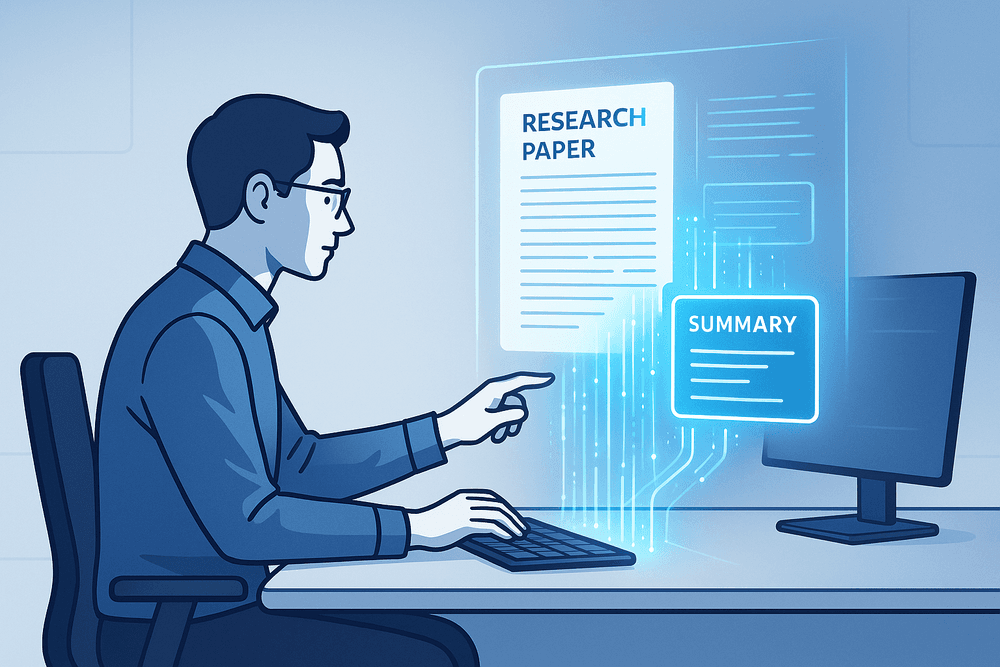
Harnessing the power of AI for research paper summarization is more than just clicking a button. To get accurate, insightful, and truly useful results, you need a strategic approach. Follow these best practices to transform your literature review process from a time-consuming chore into an efficient and effective workflow.
Step-by-Step: From Uploading to Exporting
While every AI tool has a unique interface, the core process for effective summarization follows a clear path. Think of it as a partnership between you and the AI.
- Select and Upload: Begin by choosing the research paper you need to summarize. Most tools accept PDFs, but many also work with direct URLs or plain text. Ensure you have a clean, high-quality version of the paper.
- Run the Initial Summary: Allow the AI to perform its first pass. This will generate a general, high-level overview of the paper, typically covering the abstract, introduction, and conclusion.
- Refine with Specific Prompts: This is where you take control. Use targeted prompts to dig deeper into the sections that matter most to you. (More on this below).
- Critically Review and Edit: Compare the AI-generated summary against the original paper. Pay close attention to the abstract, methodology, and results sections. Correct any inaccuracies and add missing nuances.
- Export and Cite: Once you’re satisfied, export the summary in your preferred format. Crucially, always cite the original research paper in your work. The AI summary is a tool for understanding, not a source in itself.
Crafting Prompts to Refine and Customize Results
The default summary is just a starting point. The real power of AI research paper summarization is unlocked through precise prompting. Your prompts guide the AI to focus on what’s most relevant to your own research.
Try these prompt strategies:
- Focus on Specific Sections: "Summarize the 'Methodology' section in three bullet points, focusing on the sample size and statistical tests used."
- Extract Key Information: "List the top 5 key findings from the 'Results' section." or "What are the main limitations of this study as stated by the authors?"
- Change the Perspective: "Explain the core argument of this paper as if I were a first-year undergraduate student."
- Identify Core Concepts: "What are the three most important technical terms defined in this paper? Provide their definitions based on the text."
Critically Evaluating and Fact-Checking AI-Generated Summaries
An AI is an assistant, not an oracle. It can make mistakes. Never blindly trust an AI-generated summary without performing your own critical evaluation.
Use this checklist to verify the output:
- Accuracy: Does the summary correctly represent the paper's data, claims, and findings? Cross-reference specific numbers, names, and conclusions with the original document.
- Completeness: Has the AI omitted any crucial context or counterarguments? Check the paper’s discussion section for nuances the AI may have missed.
- Source Integrity: Has the AI "hallucinated" or introduced information that isn't in the source text? This is a critical check to prevent the spread of misinformation.
Avoiding Common Pitfalls: Bias and Misinterpretation
Finally, be aware of the inherent limitations of current AI technology.
- Bias Amplification: AI models can unintentionally reflect or even amplify biases present in the research paper or their vast training data. Question the framing of the summary and be alert for loaded language.
- Misinterpretation of Nuance: Complex, ironic, or highly specialized arguments can confuse AI. The model might mistake a critique for an endorsement or oversimplify a multifaceted debate.
- Loss of Context: In the process of condensing information, essential context can be lost. An AI summary might present a finding without the important qualifications or limitations the authors included.
Always treat the AI summary as a highly advanced guide that directs you to the most critical parts of the paper, not as a substitute for engaging with the original research yourself.
Real-World Impact: Use Cases for Automated Research Paper Summarization
The theoretical power of AI is impressive, but its true value lies in practical application. Automated research paper summarization is not just a novelty; it's a transformative tool with tangible benefits across various fields. From the university library to the corporate R&D lab, AI is fundamentally changing how we interact with complex information and accelerate discovery. Let’s explore how different professionals are leveraging this technology today.
For Students: Speeding Up Your Next Literature Review
Every student pursuing a higher degree knows the mountain they must climb: the literature review. Sifting through dozens, sometimes hundreds, of papers to build a foundational understanding of a topic is a rite of passage, but it’s also incredibly time-consuming. This is where AI-powered research paper summarization becomes an indispensable academic ally.
Instead of spending weeks just reading abstracts and getting lost in dense methodologies, students can use AI to perform a rapid triage. In minutes, you can get a high-level overview of a paper's core argument, key findings, and methodology. This allows you to quickly decide which papers are central to your thesis and which are only tangentially related. This accelerated process frees up invaluable time, shifting your focus from laborious reading to the more critical tasks of synthesis, analysis, and constructing your own unique argument. It helps you build a more comprehensive and well-supported review, faster.
For Academics: Staying Current with the Latest Publications
For researchers and professors, staying on the cutting edge of their field is a constant challenge. The sheer volume of new publications released daily can be overwhelming, making it nearly impossible to keep up while juggling teaching, grant writing, and their own research. Failing to stay current means risking redundant work or missing out on groundbreaking discoveries that could shape your next project.
Automated research paper summarization acts as a powerful filter in this flood of information. Academics can set up alerts for new papers in their niche and receive concise, AI-generated summaries directly in their inbox. This allows them to quickly assess the relevance and significance of new work without committing hours to reading the full text. It’s an efficient way to monitor emerging trends, identify potential collaborators, and discover gaps in the current body of literature that your own research can fill. It’s like having a personal research assistant dedicated to keeping you informed and at the forefront of your discipline.
For R&D Professionals: Gaining a Competitive Edge with Faster Insights
In the fast-paced world of corporate research and development, speed and knowledge are direct drivers of innovation and market share. R&D professionals in sectors like pharmaceuticals, tech, and engineering need to constantly monitor scientific advancements to inform product development and corporate strategy. The traditional process of manually reviewing academic journals and patent filings is simply too slow to maintain a competitive advantage.
This is where the strategic implementation of research paper summarization provides a clear return on investment. Teams can use AI tools to rapidly scan and summarize the latest research from universities, competitors, and independent labs. This enables them to identify emerging technologies, validate internal hypotheses with external data, and make faster, more informed decisions about which projects to fund. By accelerating the translation of academic insights into actionable business intelligence, companies can shorten their innovation cycle, get ahead of market trends, and secure a decisive competitive edge.

Conclusion: The Future of Research is Here
The days of drowning in a sea of unread papers and spending countless hours on preliminary literature reviews are coming to an end. The academic landscape is undergoing a fundamental transformation, driven by the power of artificial intelligence. As we've explored, AI is no longer a futuristic concept but a practical, accessible tool that can revolutionize how we engage with scholarly work. The challenge of information overload has met its match, and the solution lies in effective, intelligent research paper summarization.
Making the Right Choice for Your Needs
Throughout this guide, we've navigated the key features and considerations for selecting an AI summarization tool. Remember, the best platform is not a one-size-fits-all solution; it's the one that aligns perfectly with your workflow. Whether you prioritize hyper-detailed summaries, the ability to handle complex tables and figures, seamless integration with reference managers, or robust citation tracking, there is a tool designed for you. The crucial first step is to assess your unique research habits and needs. A powerful research paper summarization tool should feel less like a gadget and more like a natural extension of your own intellectual curiosity, helping you quickly ascertain a paper's relevance and core contributions.
Embracing AI as a Partner in Academic Discovery
It's vital to view these AI tools not as a replacement for critical thinking, but as a powerful partner in the pursuit of knowledge. By automating the initial, often tedious, task of summarizing, you liberate your most valuable asset: your cognitive energy. This newfound efficiency allows you to focus on the higher-order tasks that truly drive discovery—analyzing methodologies, synthesizing ideas across multiple disciplines, identifying gaps in existing literature, and formulating novel hypotheses. AI handles the "what" so you can concentrate on the "so what?" and "what's next?". This collaborative relationship between human intellect and artificial intelligence is the engine that will accelerate scientific breakthroughs and deepen our collective understanding.
Start Your Free Trial and Summarize Your First Paper Today
Reading about the future of research is one thing; experiencing it is another. The theoretical benefits of AI-powered research paper summarization only become tangible when you apply them to your own work. Stop letting promising papers sit unread in your "to-read" folder. Take the definitive step toward a more efficient and insightful research process.
You have the opportunity to join the forefront of this academic revolution right now. See for yourself how quickly you can grasp the essence of a complex study and accelerate your literature review.
[Link: Start Your Free Trial and Experience a Smarter Way to Research]