
July 2, 2025
An Introduction to AI Explainability Tools
Demystifying the Black Box: An Introduction to AI Explainability Tools
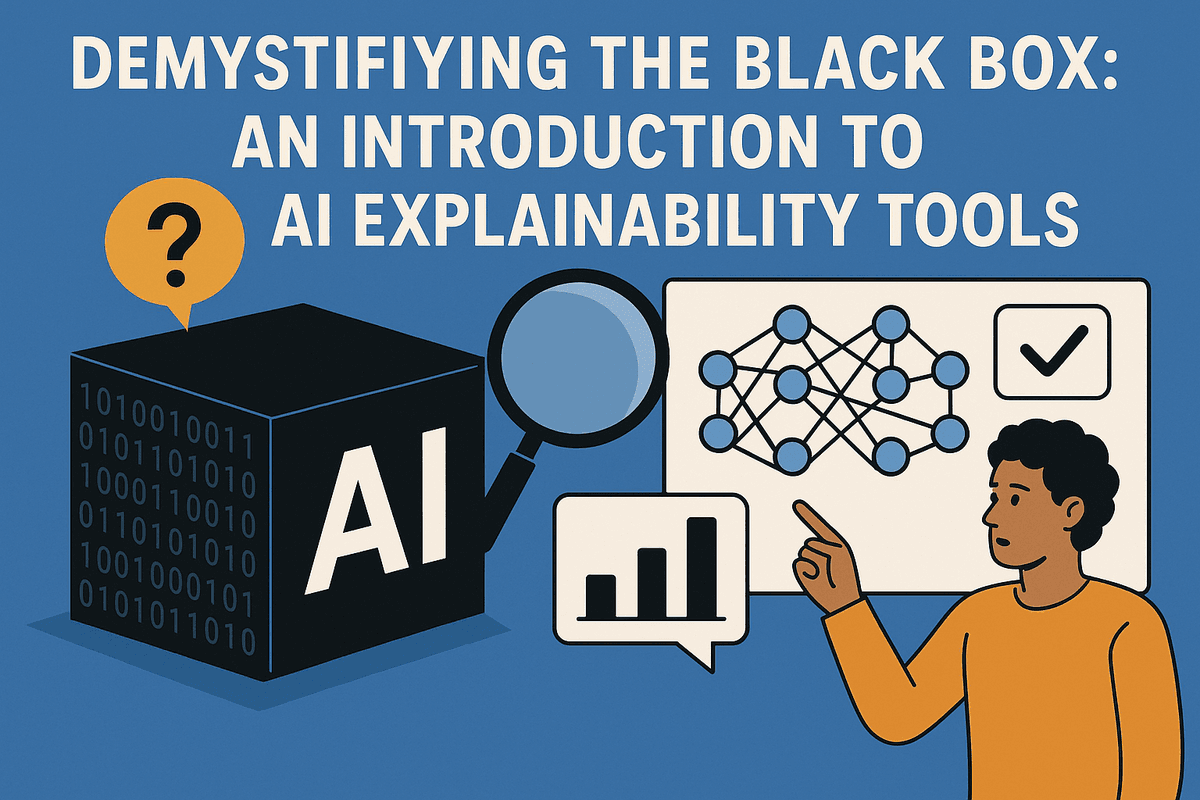
Artificial intelligence often operates like a "black box." We input data, and it produces an output—a prediction, a classification, or a decision—but the internal logic can feel like a complete mystery. This is where AI Explainability (XAI) comes in. XAI is a set of processes and methods that allow human experts to understand, interpret, and trust the results created by machine learning algorithms.
But why is this so important? Imagine an AI system that denies a loan application, flags a medical scan for a serious disease, or influences a hiring decision. Without explainability, we are left with a simple "yes" or "no" and no way to understand the reasoning. XAI answers the critical follow-up questions: Why was this decision made? What factors most influenced the outcome? Was the process fair and free of bias? As AI becomes more integrated into high-stakes environments like finance, healthcare, and justice, the ability to audit its reasoning is not just a technical curiosity—it's an ethical and operational necessity. This is where ai explainability tools become indispensable, providing the key to unlocking these complex models.
How AI Explainability Tools Build Trust and Ensure Regulatory Compliance
Trust is the currency of the digital age, and for AI, it's earned through transparency. When stakeholders—from developers and business leaders to end-users and customers—can see how an AI model arrives at its conclusions, they are more likely to adopt and rely on it. AI explainability tools provide this transparency by translating complex mathematical operations into human-understandable insights. This builds confidence that the system is performing as intended, is free from critical biases, and can be effectively debugged or improved over time.
Beyond building trust, there's a growing web of legal and regulatory requirements. Frameworks like the EU's General Data Protection Regulation (GDPR) establish a "right to explanation," giving individuals the ability to understand automated decisions made about them. The upcoming EU AI Act and similar legislation worldwide are placing even stricter transparency obligations on organizations deploying high-risk AI systems. Using ai explainability tools is no longer just a best practice; it's a fundamental component of modern risk management and regulatory compliance, helping companies avoid steep penalties and protect their reputation.
The Critical Difference: Interpretable Models vs. Post-Hoc Explanations
Not all explainability is created equal. The approach you take depends heavily on the type of machine learning model you're using. Broadly, XAI methods fall into two categories:
- Interpretable Models: Also known as "white-box" models, these are AI systems that are inherently transparent by design. Simple models like linear regression, logistic regression, and decision trees fit this description. Their internal mechanics are straightforward enough for a human to understand and scrutinize directly. The trade-off, however, is that they may not achieve the same level of predictive accuracy as more complex models for certain tasks.
- Post-Hoc Explanations: This is the more common approach for dealing with complex "black-box" models like deep neural networks or gradient-boosted trees. Since the model's internal workings are too intricate to map out, post-hoc techniques are applied after the model is trained. These methods don't explain the entire model but instead analyze its behavior to explain individual predictions. The most prominent ai explainability tools like LIME (Local Interpretable Model-agnostic Explanations) and SHAP (SHapley Additive exPlanations) fall into this category, offering powerful ways to understand why a specific input led to a specific output.
A Comparative Review of the Leading AI Explainability Tools
Navigating the landscape of AI explainability tools can feel overwhelming, but understanding the key players is the first step toward building transparent and trustworthy models. The right tool depends entirely on your goal: Are you trying to understand the model's overall behavior or dissect a single, critical prediction? Let's break down some of the most influential and widely adopted solutions.
SHAP: Unpacking Feature Contributions for Global Insights
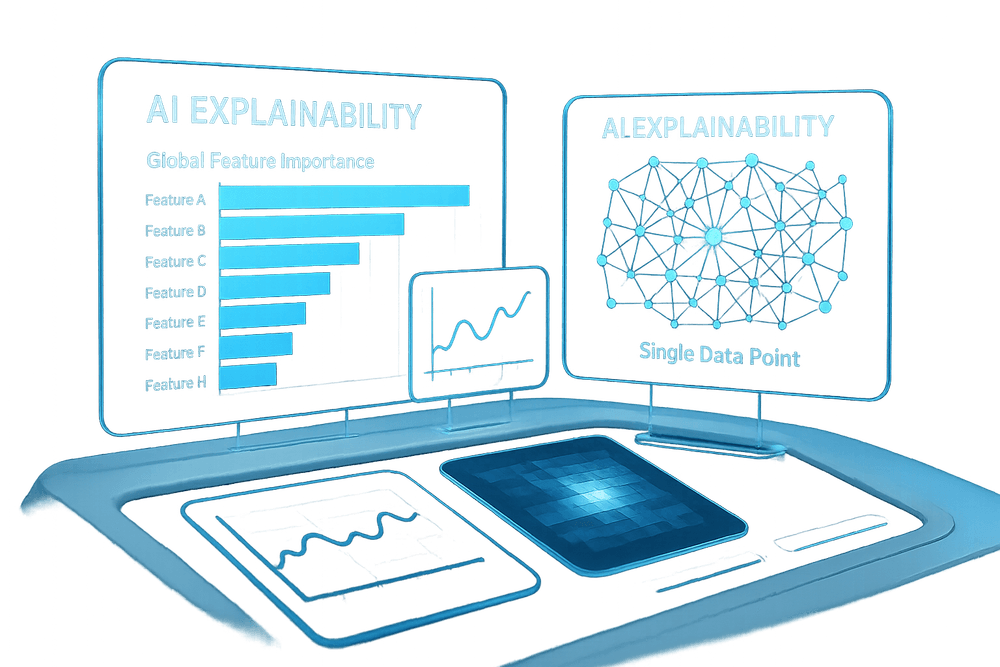
SHAP (SHapley Additive exPlanations) has become a gold standard in model explainability for its robust theoretical foundation based on game theory. It assigns each feature an importance value—a "Shapley value"—for every individual prediction. This value represents the feature's contribution to pushing the model's output away from the baseline average.
The genius of SHAP is its ability to aggregate these individual explanations to create stunningly clear global insights. By plotting the Shapley values for thousands of predictions, you can generate summary plots that reveal not just which features are most important, but how they impact predictions across the entire dataset. This makes SHAP an incredibly powerful tool for understanding overall model behavior, identifying biases, and validating that your model is learning the right patterns.
LIME: Understanding Individual Predictions for Local Clarity
While SHAP provides both local and global views, LIME (Local Interpretable Model-agnostic Explanations) specializes in one thing and does it exceptionally well: explaining individual predictions. LIME works by creating a simple, interpretable model (like linear regression) that approximates the behavior of your complex black-box model around a single data point.
Imagine a bank's AI denies a loan application. You don't need to explain the entire model; you need to explain this specific decision. LIME is perfect for this. It can highlight which features (e.g., "low credit score," "high debt-to-income ratio") were most influential in that single denial. This local clarity is crucial for user trust, debugging unexpected outcomes, and fulfilling regulatory requirements for individual explanations.
Integrated Platforms: TensorFlow's What-If Tool and H2O.ai
Beyond standalone libraries, many ML platforms now offer built-in explainability features.
- TensorFlow's What-If Tool (WIT): Integrated directly into TensorBoard, WIT is an interactive visual interface designed for exploration. It allows developers and even non-technical stakeholders to probe model behavior by visualizing datasets and editing data points to see how predictions change in real-time. It’s an excellent tool for hypothesis testing and building an intuitive understanding of model sensitivities.
- H2O.ai: As an enterprise-grade automated machine learning platform, H2O.ai bakes explainability into its core workflow. It automatically generates a host of interpretations for its models, including SHAP values, partial dependence plots, and human-readable explanations. This approach is geared toward operationalizing responsible AI within a business, providing the documentation and insights needed for governance and compliance.
Open Source vs. Commercial AI Explainability Tools: Which to Choose?
The final decision often comes down to a classic trade-off: flexibility versus convenience.
- Open-Source Tools (SHAP, LIME): These libraries are free, highly flexible, and backed by massive communities. They are ideal for data scientists who need to customize their explainability workflows, conduct research, or integrate interpretability into bespoke systems. The trade-off is that they require more technical expertise to implement and maintain.
- Commercial Platforms (H2O.ai, Fiddler AI): These solutions offer a polished, end-to-end experience with enterprise support, intuitive user interfaces, and features built specifically for governance and risk management. They are designed for teams looking to scale their use of explainable AI quickly and reliably, though they come with licensing costs.
Ultimately, selecting the best AI explainability tools is a strategic decision based on your team's skills, project scale, budget, and regulatory obligations.
Core Features Your Chosen AI Explainability Tools Must Have
Selecting the right platform is more than just picking a name from a list; it's about equipping your team with the capabilities to truly understand and trust your AI. Not all ai explainability tools are built the same, and the most effective ones share a set of core features. As you evaluate your options, scrutinize each platform for these essential characteristics to ensure it meets the complex demands of modern machine learning.
Model-Agnostic vs. Model-Specific Capabilities
Your first major decision point is whether you need a tool that is flexible or one that is highly specialized.
- Model-Specific Tools: These are designed to interpret a particular class of models, like decision trees or deep neural networks. Their strength lies in providing deep, mathematically precise explanations by leveraging the internal architecture of the model. If your organization standardizes on a specific type of complex model, a specialized tool can offer unparalleled detail.
- Model-Agnostic Tools: These treat any machine learning model as a "black box." By analyzing the relationship between inputs and outputs, techniques like LIME (Local Interpretable Model-agnostic Explanations) and SHAP (SHapley Additive exPlanations) can explain any model's predictions, regardless of its internal complexity.
For most organizations, flexibility is key. The best ai explainability tools offer robust model-agnostic methods, giving you the freedom to innovate with different algorithms without having to switch your interpretability stack.
Assessing Visualization and Interactive Dashboard Quality
An explanation is useless if it can't be understood. Raw data outputs and complex statistical tables don't translate to insight for most stakeholders. This is why the quality of visualization is paramount. Look for ai explainability tools that provide a rich, interactive user interface.
Key features to demand include:
- Clear Feature Importance Plots: Simple, intuitive bar charts showing which factors most heavily influenced a prediction.
- Local and Global Explanations: The ability to see why a single prediction was made (local) and understand the model's overall behavior (global).
- Interactive Dashboards: A user-friendly environment where team members—from data scientists to product managers—can drill down into data, filter results, and explore model behavior without writing code.
- "What-If" Scenarios: The functionality to simulate changes to input data and see how it affects the model's output, which is crucial for building intuition.
Ensuring Seamless Integration with Your MLOps Workflow
AI explainability cannot be an afterthought or a manual, ad-hoc process. To be truly effective, it must be embedded directly into your Machine Learning Operations (MLOps) lifecycle. The right ai explainability tools should feel like a natural extension of your existing infrastructure.
Check for critical integration points:
- API and SDK Access: A robust API allows you to programmatically generate explanations and integrate them into your CI/CD pipelines.
- Framework Compatibility: Out-of-the-box support for major ML frameworks like TensorFlow, PyTorch, Scikit-learn, and XGBoost.
- Deployment Environment Support: Seamless operation with your deployment targets, whether they are cloud-based, on-premises, or containerized with Docker and Kubernetes.
The goal is to automate explainability, making it a continuous part of model monitoring and validation.
Checking for Fairness Auditing and Bias Detection Features
Finally, a crucial and non-negotiable feature set revolves around ethical AI. Explainability isn't just about how a model works, but whether it works fairly. Premier ai explainability tools provide dedicated modules for auditing algorithmic bias.
Look for the ability to measure and visualize fairness metrics across different protected groups (e.g., based on race, gender, age, or geography). The tool should help you answer critical questions like:
- Is the model performing equally well for all demographic groups?
- Are prediction outcomes disproportionately affecting one subgroup over another?
Essential features include the calculation of metrics like Demographic Parity, Equalized Odds, and Equal Opportunity. Top-tier platforms go beyond mere detection and provide insights to help you mitigate the identified biases, ensuring your AI systems are not only accurate but also equitable and compliant with regulations.
Putting Theory into Practice: Real-World Use Cases for AI Explainability Tools
The value of AI explainability isn't just theoretical; it’s about solving tangible business and societal challenges. When we move beyond abstract models and into real-world applications, the need to understand the "why" behind an AI's decision becomes critical for trust, compliance, and performance. Let's explore how AI explainability tools are making a significant impact across key industries.
Enhancing Diagnostic Accuracy in Healthcare AI
In medicine, a "black box" diagnosis is unacceptable. While AI models can analyze medical images like X-rays, MRIs, and CT scans with remarkable speed, clinicians need to trust their outputs before making life-altering decisions. This is where explainability is paramount.
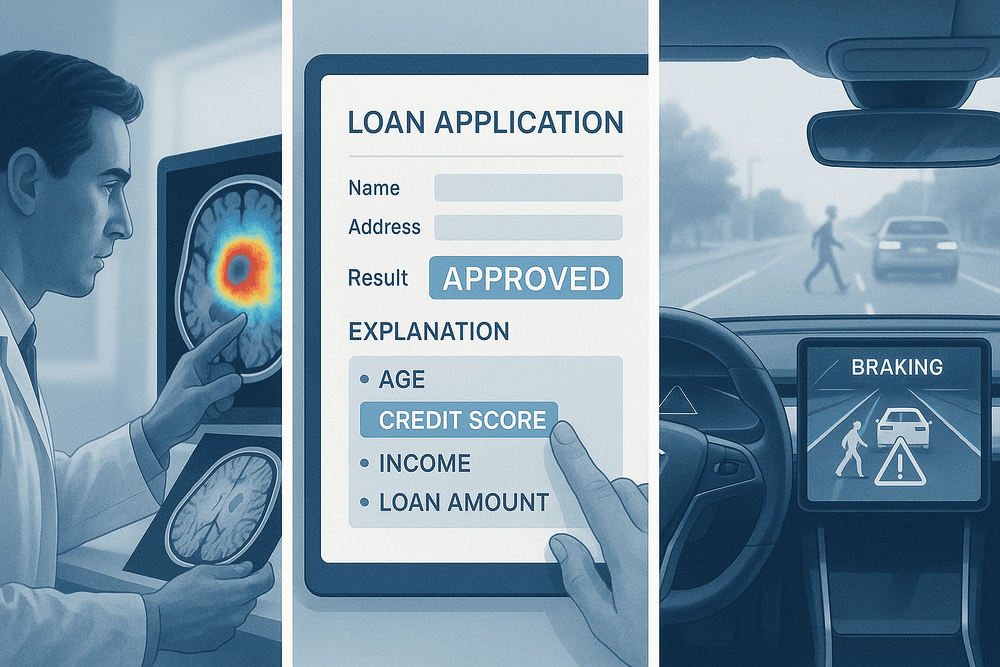
Imagine an AI that flags a chest X-ray for potential signs of pneumonia. Without explainability, it's just an alert. But with AI explainability tools like LIME (Local Interpretable Model-agnostic Explanations) or SHAP (SHapley Additive exPlanations), the system can generate a "heat map" overlay on the image, highlighting the exact pixels and regions that most influenced its decision. This allows a radiologist to instantly validate the AI's reasoning against their own expertise, confirm the finding, and build confidence in the tool as a reliable diagnostic assistant rather than an opaque oracle.
Auditing Loan and Credit Decisions in FinTech for Fairness
The financial sector relies heavily on AI to assess credit risk and approve loans. However, these models can inadvertently learn and amplify historical biases present in the training data, leading to discriminatory outcomes. Regulatory bodies demand fairness and transparency; for example, regulations like the Equal Credit Opportunity Act (ECOA) require lenders to provide specific reasons for denying credit.
AI explainability tools are essential for auditing these models for bias and ensuring regulatory compliance. By analyzing the model, a bank can determine the key factors driving individual decisions. If a model is found to be unfairly weighting a protected characteristic like zip code (which can be a proxy for race), it can be retrained. This not only mitigates legal and reputational risk but also helps financial institutions build more equitable and trustworthy products.
Debugging and Improving Customer Churn Prediction Models
For any subscription-based business, from SaaS to streaming services, predicting which customers are likely to cancel their service (churn) is a top priority. A model might accurately predict that a customer will churn, but without knowing why, retention efforts are a shot in the dark.
This is a classic use case for explainability. By applying tools to a high-churn-risk customer's profile, a company can see which features contributed most to the prediction. The explanation might reveal that the customer's "number of recent support tickets" and "time since last feature usage" were the top two drivers. Armed with this insight, the customer success team can launch a targeted intervention, such as offering personalized training or addressing their support issues, creating a much more effective retention strategy than a generic discount.
Justifying Actions in Autonomous Systems and Robotics
When an AI controls physical machinery, from an autonomous vehicle navigating city streets to a robot on a factory floor, understanding its decision-making process is a matter of safety. If an autonomous car suddenly brakes or swerves, engineers and investigators need to know precisely what triggered that action.
Post-hoc analysis using AI explainability tools is crucial for this. They can reconstruct the AI's "thought process," showing which sensor inputs (e.g., a lidar signal, a specific object in a camera feed) were given the most weight at the moment of decision. This capability is indispensable for debugging system behavior, improving model safety, and providing clear justifications for an autonomous system's actions, especially in the event of an accident.
Best Practices for Implementing and Scaling AI Explainability
Successfully moving from theoretical interest to practical application requires a strategic approach. Implementing AI explainability isn't just about running a script; it's about embedding transparency into your organization's culture and workflows. By following best practices, you can ensure that your efforts build trust, improve models, and deliver real business value.
How to Select the Right Explanation Method for Your Model
The effectiveness of your model interpretation hinges on choosing the appropriate technique. There is no one-size-fits-all solution; the best method depends on your specific context. Consider these factors:
- Model Type: Is your model a simple linear regression, a complex gradient-boosted tree (like XGBoost), or a deep neural network? Methods like SHAP (SHapley Additive exPlanations) are model-agnostic and widely applicable, while others are specific to certain architectures.
- Scope of Explanation: Do you need to understand a single prediction (local explainability) or the model's behavior as a whole (global explainability)? For a loan denial, a local method like LIME (Local Interpretable Model-agnostic Explanations) is ideal. For understanding key market drivers, global feature importance is more useful.
- Audience Needs: Who is the explanation for? A data scientist may require detailed SHAP plots, while a compliance officer needs a simplified report. The best AI explainability tools offer a range of outputs to cater to different stakeholders.
A Guide to Communicating Model Insights to Non-Technical Stakeholders
The ultimate goal of explainability is to build trust with humans. Technical jargon like "feature attribution" or "partial dependence plots" can alienate business leaders and customers. To bridge this gap, focus on translation and storytelling.
- Frame Insights as a Narrative: Instead of saying, "The SHAP value for 'credit history' was 0.4," try, "The most significant factor in this decision was the applicant's strong credit history."
- Use Clear Visualizations: Bar charts showing the top 5 "pros" and "cons" for a decision are far more intuitive than complex scatter plots. Many AI explainability tools now feature user-friendly dashboards designed for this purpose.
- Focus on Actionable Outcomes: Connect the explanation to a business question. What does this insight mean for our strategy? How can we use this information to improve customer service or reduce risk? Always answer the "so what?" question.
Integrating Explainability Throughout the AI Development Lifecycle
To maximize its impact, explainability should not be an afterthought performed only after a model is built. It should be an integral part of the entire development process.
- During Development & Debugging: Use explainability techniques to understand why your model is making errors. Is it relying on spurious correlations or biased data? Interpretation can be your most powerful debugging tool.
- For Model Validation: Before deploying, use global explanations to ensure the model's logic aligns with domain knowledge. If a credit risk model heavily weights a seemingly irrelevant feature, it's a major red flag.
- In Production & Monitoring: Continuously monitor the explanations for live predictions. This helps detect data drift and concept drift, ensuring the model remains fair, accurate, and relevant over time.
Avoiding Common Pitfalls in Model Interpretation and Reporting
While powerful, interpretation methods can be misleading if used incorrectly. Be aware of these common traps:
- Confusing Correlation with Causation: Explanations show what features the model found to be predictive, not necessarily what features cause an outcome in the real world. Always communicate this distinction clearly.
- Over-reliance on a Single Method: Different techniques can highlight different aspects of a model's behavior. Using a combination of methods provides a more holistic and robust understanding.
- Ignoring the "Right to be Wrong": An explanation tells you what the model did, but it doesn't guarantee the model was correct. The explanation for a wrong prediction is often more valuable for debugging than the explanation for a right one.

The Future is Transparent: Next Steps With AI Explainability Tools
Adopting AI explainability is no longer a question of if, but how. As we move from theory to practice, the focus shifts to implementation, integration, and continuous learning. The journey toward transparent and trustworthy AI is an ongoing process, but with the right strategy and resources, it's an achievable goal. This section provides a practical roadmap for your next steps, from selecting the perfect toolkit to launching your first explainability project.
Matching the Right Tool to Your Project's Needs
The market for AI explainability tools is diverse, and choosing the right one is critical for success. There is no single "best" tool—only the best fit for your specific context. Before committing to a platform or library, use this checklist to guide your decision:
- Model Type & Complexity: Is your model a "glass-box" type like a linear regression or decision tree, or a "black-box" model like a deep neural network or gradient boosting machine? Some tools (like LIME) are model-agnostic, while others are optimized for specific architectures.
- Scope of Explanation: Do you need local or global explanations? Local interpretability (e.g., SHAP force plots) explains individual predictions, which is crucial for customer-facing decisions. Global interpretability (e.g., feature importance charts) explains the model's overall behavior, which is vital for regulatory compliance and general debugging.
- Target Audience: Who needs the explanation? Data scientists require detailed, technical outputs with access to feature interactions and model internals. Business stakeholders or non-technical users need high-level, intuitive visualizations and summaries that can be easily understood and acted upon.
- Integration & Scalability: How will the tool fit into your existing MLOps workflow? Consider whether you need a standalone dashboard, a Python library that integrates with Jupyter notebooks, or a full-fledged enterprise solution that can scale across thousands of models in production.
Further Reading: Resources for Mastering Interpretable ML
Continuous learning is key to staying ahead in this rapidly evolving field. To deepen your understanding of interpretable machine learning and the latest AI explainability tools, explore these resources:
- Foundational Books: Christoph Molnar's "Interpretable Machine Learning" is widely considered the definitive guide. It offers a comprehensive overview of concepts, methods, and critical perspectives.
- Online Courses: Platforms like Coursera, edX, and fast.ai offer courses on machine learning that often include modules on model interpretation and ethics. Look for specializations in Trustworthy AI or Responsible AI.
- Academic Papers: For cutting-edge research, browse repositories like arXiv.org. Search for the original papers on LIME (Ribeiro, Singh, Guestrin) and SHAP (Lundberg, Lee) to understand their mathematical foundations.
- Open-Source Communities: Engage with the communities on GitHub for tools like SHAP, LIME, and aihw360. The "Issues" and "Discussions" tabs are treasure troves of practical advice and real-world problem-solving.
How to Get Started with Your First AI Explainability Project
Taking the first step is often the hardest part. Your initial project with AI explainability tools doesn't need to be a massive undertaking. Follow these steps to build momentum and gain valuable hands-on experience:
- Define a Clear Question: Start with a "why." What specific question do you want to answer? Examples: "Why was this customer flagged for churn?" or "What are the top three factors driving our sales forecast model?"
- Select a Pilot Project: Choose a simple, low-risk model. A model built on a well-understood internal dataset or even a classic public dataset (like the Titanic or Boston Housing datasets) is a perfect starting point.
- Choose an Accessible Tool: Begin with a widely used open-source library. The Python
shapandlimelibraries are excellent choices due to their extensive documentation, numerous tutorials, and strong community support. - Generate and Interpret One Explanation: Don't try to explain the entire model at once. Focus on generating a local explanation for a single prediction. Analyze the output: Which features pushed the prediction higher or lower? Does the result align with your domain knowledge?
- Document and Share Your Findings: Create a simple report or notebook that walks through your process and presents the visual explanation. Share it with a colleague to see if your interpretation is clear and intuitive. This feedback loop is crucial for refining your communication and analysis skills.