
July 19, 2026
What Strong Case Study Examples Do for Small Agencies

Small agencies rarely lose deals because prospects “don’t get” the service. They lose them because prospects can’t yet see the business case, the process, or the proof. Strong case study examples close that gap by showing how your thinking translates into outcomes a buyer cares about.
What is a case study in agency marketing?
A case study is a sales asset that turns a client engagement into evidence.
For a creative or digital agency, that means it should do more than showcase attractive work. A portfolio proves taste. A case study proves judgment.
It gives a prospect the confidence that:
- You understand the client’s commercial problem, not just the creative task.
- You can explain why your approach worked.
- You have proof that the work created value.
- You know how to manage a project from messy brief to measurable result.
For small agencies, this matters because buyers are often comparing you against larger firms, freelancers, in-house teams, and “we’ll just use AI” alternatives. A strong case study makes your agency feel lower-risk without needing a huge credentials deck.
The 5 case study examples worth modeling
Not every case study needs to follow the same angle. The best choice depends on the doubt you need to remove from the prospect’s mind.
Case study type | Best for proving | Example angle |
|---|---|---|
The transformation story | You can move a client from an old state to a better one | “How we repositioned a legacy B2B brand for a more premium market” |
The performance story | Your work drives measurable growth | “How a landing page redesign improved demo requests by 38%” |
The complexity story | You can handle messy stakeholders, constraints, or systems | “How we launched a multi-market campaign across five product teams” |
The speed story | You can deliver under pressure without sacrificing quality | “How we built a launch campaign in three weeks for a funded startup” |
The specialization story | You deeply understand a niche audience, channel, or category | “How we helped a fintech brand turn technical features into buyer-ready messaging” |
The strongest agencies usually need a mix. One case study might prove creative strength. Another proves strategic rigor. Another reassures a cautious buyer that your team can manage complexity without constant hand-holding.
That variety is important when your agency serves multiple client types. If every case study sounds the same, prospects may struggle to see themselves in your work.
How to choose the right example for your next sales goal
Start with the deal you want to win next.
If you want more premium brand strategy work, choose an example where your thinking changed the direction of the business, not just the visuals. If you want more conversion projects, lead with a performance case study. If you want to break into a niche, choose a specialized example that uses the language and priorities of that market.
A simple filter helps:
- Does this example match the services we want to sell more of?
- Does it feature a client similar to our best-fit prospects?
- Does it prove something our sales conversations currently lack?
- Can we show a clear before-and-after?
- Will this strengthen our positioning, or just fill a portfolio gap?
The right case study is not always the project with the biggest logo or prettiest creative. It is the one that answers the objection sitting between your prospect and a signed proposal.

Build the Case Study Brief Before You Write
Once you know which win is worth turning into a story, the next move is to make the brief airtight. A loose brief creates the usual agency drag: vague drafts, missing metrics, client rewrites, and a “success story” that sounds nothing like the brand it represents.
The client, project, and proof points to collect
Before interviewing anyone, pull the raw material into one place. The goal is to separate what happened from what you still need to prove.
Capture:
- Client context: industry, size, market position, audience, and any constraints that shaped the work.
- Business challenge: the commercial problem behind the request, not just the deliverable. “Needed a new website” is weaker than “enterprise buyers couldn’t understand the offer, and qualified demo requests were flat.”
- Project scope: services delivered, timeline, stakeholders, channels, and any strategic pivots.
- Before-state evidence: old conversion rates, low engagement, inefficient workflows, poor lead quality, inconsistent brand usage, or sales objections.
- After-state evidence: revenue impact, conversion lift, pipeline influence, time saved, cost reduced, speed improved, or qualitative proof from sales and customer teams.
- Artifacts: strategy docs, creative concepts, screenshots, campaign assets, analytics exports, testimonials, proposal language, and final deliverables.
For small agencies, the strongest proof is often not a single dramatic metric. It might be a cluster: faster launch, cleaner positioning, better sales conversations, and higher-quality inquiries. Collect both numbers and narrative so the final draft has substance.
Questions to ask in the case study interview
A good interview should uncover tension, decision-making, and impact. Avoid asking the client to “tell the story” from scratch. Guide them toward usable detail.
Ask questions like:
- What was happening in the business that made this project urgent?
- What had you already tried, and why wasn’t it working?
- What made you choose our agency instead of another option?
- Which part of the process gave you the most confidence?
- Were there any internal objections or risks we helped reduce?
- What changed after the work launched?
- Which result mattered most to your team or leadership?
- How has this work affected sales, marketing, operations, or customer perception?
- What would you tell another company considering a similar project?
- Is there anything we should avoid mentioning publicly?
The best answers usually come from follow-ups: “Can you give me an example?” “What did that mean commercially?” “How did your team react?” Those prompts turn polite praise into specific evidence.
If you are gathering case study examples across multiple clients, use the same core interview structure each time. It makes comparison easier, speeds up drafting, and helps your team spot repeatable agency strengths.
How to lock the brand voice and approval path early
Before writing, confirm whose voice the case study should carry. Some agencies write in their own confident editorial style; others need the piece to feel closer to the client’s brand because the client will share it heavily. Decide that upfront.
Document:
- Primary voice: agency-led, client-led, or co-branded.
- Tone boundaries: polished, technical, bold, warm, founder-led, enterprise, playful, restrained.
- Required terminology: product names, service names, audience labels, category language, and words to avoid.
- Quote permissions: who can be quoted, job titles, and whether quotes may be edited for clarity.
- Approval owners: agency lead, client marketing contact, legal/compliance if needed, and final signer.
- Review stages: outline approval, draft approval, metric approval, design approval, final publish approval.
This is where AI-assisted drafting can either save hours or create rework. If every client’s approved messaging, tone, and terminology live in one place, your team can generate first drafts that already sound like the right account—not a generic agency template with the names swapped in.
A clear brief protects the story before anyone starts writing. It gives the writer proof, gives the client confidence, and gives your agency a smoother path from raw win to publishable sales asset.
Use a Problem-Solution-Results Framework That Sells Without Overexplaining
With the brief in place, the job is to turn raw material into a narrative a prospect can evaluate quickly: “Do they understand problems like mine, and can they solve them?”
Problem: show the business tension, not just the task
Weak case studies start with the deliverable: “The client needed a new website.” Stronger ones explain why that work mattered.
A redesign, rebrand, paid media overhaul, or content program is rarely the real problem. The real problem is usually commercial pressure:
- Leads were increasing, but quality was dropping.
- The brand looked premium, but the sales team couldn’t explain the offer.
- Paid spend was scaling, but CAC was getting harder to defend.
- The website looked fine, but enterprise buyers didn’t trust it.
- A product launch was approaching, and the internal team lacked capacity.
Frame the problem as a business tension before you name the project. For example:
“After expanding into a higher-value market, the client’s existing positioning still spoke to their original buyer. Sales calls were taking longer, prospects needed more education, and the website wasn’t supporting the new price point.”
That gives your work stakes. It also helps prospects see themselves in the story without forcing you to overexplain the client’s entire background.
Solution: explain the agency thinking behind the work
The solution section should not read like a production checklist. Prospects don’t need every workshop, wireframe, or campaign setting. They need to understand how your agency thinks.
Instead of listing tasks, group the work around strategic choices:
- What did you prioritize first, and why?
- What did you decide not to do?
- How did research, brand strategy, UX, creative, or media insights shape the direction?
- Where did your team make the client’s decision easier?
For example, “We redesigned the homepage, rewrote the copy, and refreshed the visual system” is accurate, but flat.
A stronger version:
“Rather than lead with a full product tour, we repositioned the homepage around the buying committee’s top three objections: implementation risk, internal adoption, and time to value. That shaped the messaging hierarchy, proof points, and page flow.”
This is where small agencies can stand out against bigger competitors. You’re not just showing output; you’re showing judgment. The best case study examples make the agency’s decision-making visible without turning the story into a process manual.
Results and takeaways: connect metrics to client outcomes
Results are more persuasive when they explain what changed for the client, not just what moved on a dashboard.
A metric like “organic traffic increased 62%” is useful. But the business outcome is stronger:
“Organic traffic increased 62%, with the largest gains on bottom-of-funnel service pages. That gave the sales team a steadier source of qualified inbound conversations, reducing dependence on paid campaigns.”
If you have hard numbers, anchor them to client priorities: revenue, pipeline, conversion rate, retention, launch speed, sales efficiency, recruitment, investor confidence, or market positioning.
If the result is qualitative, be specific:
- “The sales team adopted the new deck across all enterprise pitches.”
- “The client used the messaging system to align three regional teams.”
- “The new positioning helped leadership retire two outdated service lines.”
End with the takeaway a prospect should remember: the shift you helped create, and why your approach worked.
Format Case Studies So Busy Prospects Can Scan and Trust Them
Once the story is shaped, the format has one job: help a qualified prospect grasp the win fast, then dig deeper if it feels relevant.
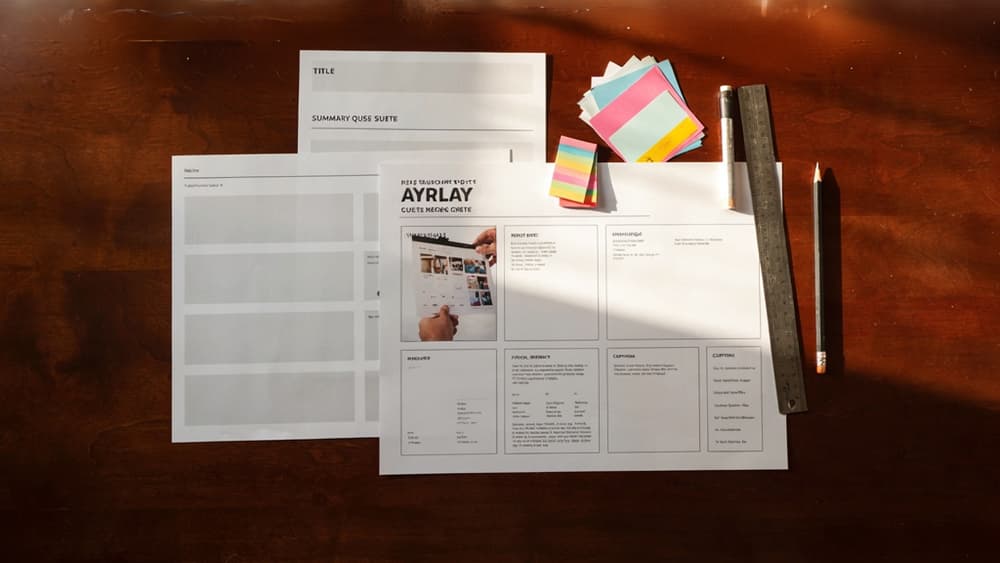
Case study layout: title, summary, sections, and CTA
Lead with a title that combines the client type, the work, and the outcome. Avoid clever-but-vague headlines like “A Bold New Direction.” Use something closer to:
“How a B2B SaaS Rebrand Helped Increase Demo Conversions by 34%”
Then add a short summary block before the full story. For agency buyers, this is often the most-read part of the page. Include:
- Client type or industry
- Service delivered
- Core challenge
- Best result
- Timeline, if impressive
- A link or button to the next step
A simple layout works best:
- Headline
- Snapshot summary
- Client context
- Challenge
- Approach
- Key deliverables
- Results
- Client quote
- CTA
Your CTA should match the case study’s sales role. If it supports lead generation, use “Book a strategy call.” If it supports evaluation, use “See related work” or “Talk to us about a similar project.” Don’t end with a dead page.
Formatting tips for quotes, metrics, visuals, and captions
Trust comes from specificity. Formatting should make that specificity impossible to miss.
Pull one strong client quote into a designed callout, ideally near the point where the reader has just seen your approach or results. Choose quotes that speak to business value, collaboration, or decision confidence — not generic praise like “They were great to work with.”
For metrics, give numbers visual weight. Use large stat blocks for the strongest proof points:
- 34% increase in demo conversions
- 22% reduction in cost per lead
- 3-week launch across web, email, and paid social
If the number needs context, add it directly underneath. A metric without a baseline can feel inflated; a metric with a clear caption feels credible.
Visuals should prove the work, not decorate the page. For creative agencies, that might include before-and-after brand applications, campaign assets, landing page sections, ad variations, or customer journey maps. For digital agencies, show dashboards, funnel diagrams, test variants, or UX flows.
Captions matter. Instead of “Homepage redesign,” write:
“The redesigned homepage moved demo booking above the fold and clarified the product’s primary use case for mid-market operations teams.”
That one sentence helps the prospect understand the strategy behind the visual.
How to keep AI-assisted drafts on-brand across clients
AI can speed up case study formatting, but small agencies hit a common problem fast: every client has a different tone, proof standard, terminology, and approval preference.
The fix is to separate the structure from the brand layer.
Use a repeatable case study template for your agency, then apply the client’s voice rules before drafting page copy, captions, quote framing, and CTA language. For example, a fintech client may need restrained, evidence-led copy. A hospitality brand may allow warmer, more sensory language. The same story structure can serve both, but the final read should feel native to each client.
This is where Aethera helps agencies avoid AI tool sprawl. Ingest the client’s brand once — voice, messaging, approved phrases, banned claims, audience context — and every case study draft, caption, summary, and repurposed snippet can stay aligned without rebuilding the prompt from scratch.
That consistency matters when you’re producing case study examples across multiple accounts. The work scales, but the brand control stays intact.
Turn One Case Study Into a Reusable Sales Asset
Once the story is polished, don’t let it sit as a single portfolio page. A strong case study should keep working across your sales journey: attracting better-fit leads, helping prospects self-qualify, and giving your team proof to use in active deals.
Where to publish case studies on your website
Start with a dedicated case studies or work section, but don’t stop there. Small agencies often bury proof one click too deep, then wonder why prospects miss it.
Place relevant case studies where buying intent is already high:
- Service pages: Add one tightly matched proof block to each core service page. If you sell paid media, show a paid media result—not a broad branding project.
- Industry pages: If you serve SaaS, healthcare, nonprofits, or ecommerce, group case studies by vertical so prospects can quickly see “they understand our world.”
- Homepage: Feature one flagship result above or near the services section, especially if it supports your current positioning.
- Proposal or contact page: Add a short “See similar work” section near the CTA to reduce hesitation before enquiry.
- Blog or resources area: Use case study examples as supporting evidence inside thought leadership, not just as standalone proof.
The goal is simple: wherever a prospect is forming an opinion about your agency, give them a relevant win to anchor that opinion.
How to repurpose examples for proposals, email, and social
A full case study is the source asset. From there, break it into smaller proof points your team can reuse without rewriting from scratch every time.
For proposals, create a one-slide version with the client context, the challenge, three actions your team took, and the outcome. Keep it modular so account leads can drop in the most relevant example by service, sector, or problem.
For sales emails, pull out one specific moment:
“We recently helped a B2B SaaS team turn a low-converting demo funnel into a clearer acquisition path, which led to a 32% lift in qualified demo requests. Thought it might be relevant given your current site rebuild.”
For social, avoid posting “new case study live” and calling it done. Turn the story into:
- A before/after carousel showing the shift in positioning, design, UX, or performance
- A short founder or strategist post about the decision behind the work
- A metric-led post that explains what changed and why it mattered
- A client quote graphic tied to a specific business outcome
- A behind-the-scenes lesson your ideal client would recognize
If you use AI to help adapt the content, keep the client’s brand voice, confidentiality rules, and your agency’s tone attached to the source material so each derivative asset still sounds intentional—not like generic marketing filler.
What to measure after the case study goes live
Measure more than pageviews. The real question is whether the asset helps move the right prospects closer to a sales conversation.
Track:
- Entrances and assisted conversions: Are people landing on the case study, then visiting service or contact pages?
- CTA clicks: Are readers booking calls, downloading related assets, or viewing similar work?
- Sales usage: Which case studies are your team actually sending in proposals and follow-ups?
- Deal influence: Do opportunities that view or receive a case study progress faster or close at a higher rate?
- Repurposed content performance: Which email snippets, social posts, or proposal proof blocks generate replies and engagement?
Review this quarterly. Keep the assets that support revenue, update the ones with outdated positioning, and retire anything that no longer reflects the agency you’re trying to sell.