
July 1, 2025
Meet Your New AI Grading Assistant
Beyond the Red Pen: Meet Your New AI Grading Assistant
Every educator knows the feeling: the ever-growing stack of papers, the late nights fueled by coffee, and the challenge of providing fair, consistent, and meaningful feedback to every single student. While the red pen has been a trusty companion for decades, a powerful new ally is transforming the landscape of assessment. Enter the AI grading assistant, a sophisticated tool designed not to replace educators, but to empower them.
So, what exactly is an AI grading assistant? It’s far more than a simple grammar or spell-checker. This technology leverages advanced artificial intelligence, particularly Natural Language Processing (NLP), to understand and analyze student work on a deeper level. Instead of just flagging errors, it comprehends context, evaluates the structure of an argument, identifies key concepts, and assesses the work against a specific, pre-defined rubric.
The process is remarkably intuitive. An educator uploads their grading rubric and assignment criteria. The AI then "learns" these standards. As students submit their work—be it essays, short-answer questions, or reports—the AI analyzes the text, comparing it to the rubric’s requirements. It can score assignments, highlight areas of strength and weakness, and even generate targeted, constructive comments.
Why Educators are Turning to AI for Smarter Assessment
The shift towards using an AI grading assistant is driven by benefits that go far beyond simply saving time. While reclaiming countless hours is a significant advantage, the real power lies in creating a smarter, more equitable assessment process.
- Unwavering Consistency: Even the most diligent educator can have variations in their grading, especially over long sessions. An AI applies the rubric with perfect consistency to every single paper, eliminating unconscious bias and ensuring every student is evaluated on the exact same terms.
- Actionable Classroom Insights: An AI grading assistant can act as a powerful data analyst. It can instantly identify trends across an entire class, revealing common misconceptions or areas where the majority of students struggled. This allows educators to adapt their teaching in real-time, re-addressing difficult topics to improve overall comprehension.
- Immediate Feedback Loop: In traditional grading, students might wait days or even weeks for feedback, by which time the lesson has moved on. AI tools can provide instant feedback, allowing students to see their results, understand their mistakes, and learn from them while the material is still fresh in their minds.
From Manual Grading to Automated, Insightful Feedback
The transition from manual grading to AI-assisted assessment marks a fundamental change in an educator's workflow—a move from tedious repetition to strategic oversight. The AI handles the heavy lifting of initial evaluation and comment generation, freeing up the educator to focus on what truly matters: providing higher-level, personalized guidance. The teacher remains in full control, with the ability to review, override, and add their own nuanced comments to the AI's suggestions. This synergistic relationship turns the grading process from a solitary chore into a dynamic tool for enhancing both teaching and learning.

How an AI Grading Assistant Revolutionizes Teacher Workflow
The modern educator's to-do list is endless, with grading often consuming the most time and energy. It's a critical task, yet the sheer volume can turn it into a race against the clock, leaving little room for the impactful work of teaching. This is where an ai grading assistant steps in, not as a replacement for the educator's expertise, but as a powerful partner. It's a tool designed to transform the entire assessment workflow, shifting it from a time-consuming chore to a source of valuable insight and an opportunity for deeper student engagement.
Reclaim Your Time: Slashing Hours Spent on Grading
Imagine cutting your grading time in half—or even more. The traditional cycle of collecting assignments, spending late nights with a red pen, and returning papers days or weeks later is a significant source of teacher burnout. An ai grading assistant automates the most repetitive aspects of this process. For objective questions like multiple-choice or fill-in-the-blanks, the grading is instantaneous. For more complex, subjective work like essays or reports, the AI provides a comprehensive first-pass analysis against a custom rubric, highlighting key areas and suggesting scores. This allows you to focus your expertise on providing nuanced feedback and higher-level evaluation, rather than getting bogged down in foundational checks.
Achieve Unparalleled Consistency in Student Assessment
Even the most dedicated teacher can struggle with grading consistency. Fatigue, unconscious bias, or simply the order in which papers are graded can subtly influence outcomes. An ai grading assistant eliminates this variability entirely. It applies the exact same rubric and criteria to the first paper it grades and the last, ensuring every student's work is evaluated against an identical, objective standard. This level of fairness is crucial for building student trust in the assessment process. They can be confident that their grade reflects the quality of their work, not external factors. This consistency provides a solid, equitable foundation for all student evaluations.
Deliver Instant, Personalized Feedback at Scale
The "feedback gap"—the delay between a student submitting work and receiving constructive comments—is a major obstacle to learning. By the time students get their papers back, they may have already moved on to new topics. An effective ai grading assistant closes this gap by providing immediate, targeted feedback. As soon as an assignment is processed, the student can receive detailed comments linked directly to the rubric criteria. This isn't just a generic "good job." The AI can pinpoint specific grammatical errors, highlight where an argument lacks evidence, or praise a particularly well-structured paragraph, all based on the parameters you set. This instant feedback loop empowers students to learn from their mistakes in the moment, dramatically accelerating their growth.
Leverage AI Data to Identify Class-Wide Learning Gaps
A powerful ai grading assistant does more than just grade individual papers; it acts as a data analyst for your entire classroom. By aggregating performance data across all submissions, the tool can generate powerful insights. You can quickly see which concepts the majority of students mastered and, more importantly, where common misconceptions lie. Did 70% of the class struggle with a specific essay prompt or a particular math problem? The AI dashboard can visualize this data, allowing you to identify class-wide learning gaps in real-time. This information is invaluable for adapting your teaching strategy, planning targeted review sessions, and ensuring no student gets left behind.
Essential Features of a Top-Tier AI Grading Assistant
Not all AI-powered grading tools are created equal. While basic automation can save some time, a truly transformative ai grading assistant is defined by a suite of sophisticated, integrated features. These capabilities move beyond simple scoring to offer deep insights and comprehensive support for educators. When evaluating options, these are the non-negotiable features that separate a helpful gadget from an indispensable teaching partner.
Automated Scoring for Diverse Question Types
The foundation of any effective AI grader is its ability to handle more than just multiple-choice questions. A top-tier platform offers the versatility to automatically score a wide array of assessment formats with speed and consistency. This includes:
- Objective Questions: Multiple-choice, true/false, and matching are scored instantly and accurately.
- Fill-in-the-Blank: Advanced systems can recognize multiple correct variations of an answer.
- Short-Answer Questions: Using Natural Language Processing (NLP), the AI can analyze short written responses for keywords, concepts, and semantic meaning to determine correctness, saving hours of manual review.
- Numerical and Formulaic Answers: For STEM subjects, the AI can validate complex mathematical equations and scientific formulas.
This broad capability ensures that educators can use a single, unified platform for nearly all their quantitative assessment needs, freeing them to focus on more complex, qualitative evaluation.
Advanced Rubric Integration for Essays and Projects
Grading subjective work like essays, lab reports, and creative projects is often the most time-consuming task for educators. This is where a premier ai grading assistant demonstrates its true power through intelligent rubric integration. Instead of offering a generic score, the system allows you to upload your own detailed, nuanced rubrics.
The AI then learns to apply your specific criteria, analyzing student submissions for elements like thesis strength, evidentiary support, critical analysis, organization, and clarity. It doesn't just assign a grade; it provides criterion-level feedback, highlighting for the student exactly how their work aligns with each component of the rubric. This delivers feedback that is not only consistent but also highly personalized and instructive.
Built-in Plagiarism Detection and Originality Reporting
Maintaining academic integrity is a fundamental responsibility. A world-class ai grading assistant must have robust, seamlessly integrated plagiarism detection. This feature automatically scans every submission and compares it against a vast database containing billions of web pages, academic journals, publications, and previously submitted student papers.
The platform then generates a clear, intuitive originality report for each submission. This report highlights passages that match external sources, providing direct links to the original material. This empowers educators to quickly identify potential plagiarism, facilitate conversations about proper citation, and uphold a culture of academic honesty without adding another tool or step to their workflow.
Actionable Analytics and Student Performance Dashboards
The ultimate purpose of assessment is to inform instruction and improve learning outcomes. The most valuable AI grading tools transform raw performance data into actionable insights through dynamic visual dashboards. These analytics move beyond individual grades to reveal the bigger picture, allowing educators to:
- Identify Class-Wide Trends: Instantly see which concepts or skills the entire class is struggling with, indicating a need for re-teaching.
- Analyze Item-Level Performance: Pinpoint specific questions that were confusing or overly difficult, helping refine future assessments.
- Track Individual Student Progress: Monitor a student’s performance over time to identify learning gaps or recognize significant growth, enabling timely and targeted interventions.
This data-driven feedback loop turns the assessment process from a summative endpoint into a formative, strategic tool for enhancing teaching effectiveness.
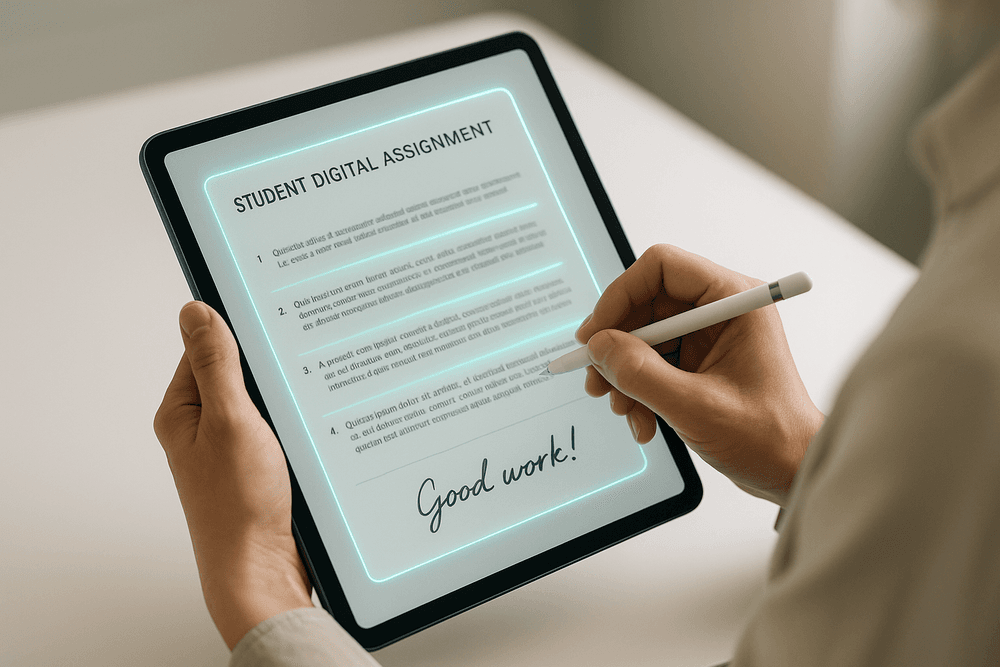
Best Practices for Implementing an AI Grading Assistant
Adopting new technology in the classroom requires a thoughtful and strategic approach. An ai grading assistant can be a powerful ally, but its success hinges on proper implementation. By following these best practices, you can seamlessly integrate this tool, enhance your feedback process, and maintain a supportive, human-centered learning environment.
Set Clear Expectations with Students and Parents
Transparency is your most important tool when introducing an ai grading assistant. Students and parents may have questions or concerns about a machine evaluating work, so it’s crucial to address these proactively.
Start by explaining the "why." Frame the tool not as a replacement for you, but as a support system designed to give you more time for what matters most: one-on-one teaching and providing in-depth, personalized feedback. Clearly communicate that the ai grading assistant provides a first-pass analysis based on the established rubric, helping to ensure consistency and speed. Reassure them that you, the educator, will always review the AI's suggestions, make final adjustments, and have the ultimate say on every single grade. This approach builds trust and demystifies the technology.
Customize Rubrics for Effective AI Analysis
An ai grading assistant is only as smart as the instructions you give it. The foundation of effective AI-powered assessment is a clear, detailed, and objective rubric. Vague criteria like "shows good understanding" are difficult for an AI—and even humans—to interpret consistently.
To get the most out of your tool, invest time in refining your rubrics.
- Use Specific, Actionable Language: Instead of "analyzes the text," try "identifies and explains three distinct literary devices with supporting quotes."
- Define Performance Levels Clearly: Describe exactly what constitutes "Exemplary," "Proficient," or "Developing" work for each criterion.
- Keep it Objective: Focus on observable evidence in the student's work. A well-designed rubric acts as the brain for the ai grading assistant, guiding it to provide accurate and relevant initial feedback.
The Human Touch: Review and Augment AI-Generated Feedback
The goal of using an ai grading assistant is not to automate your job, but to augment your capabilities. Think of the AI's output as a first draft of the grading process. Your role as the educator is to be the final editor and validator, bringing nuance, empathy, and pedagogical insight to the feedback.
Always review the AI's comments. While it excels at identifying grammatical errors or checking for rubric components, it can't understand a student's unique voice, personal growth, or the "aha!" moment that shines through a slightly flawed paragraph. Your job is to add that essential human layer—the encouraging note about a creative idea, the question that pushes a student's thinking further, or the connection to a recent class discussion. This hybrid approach combines the efficiency of AI with the irreplaceable value of your professional judgment.
Navigate Data Privacy and Ethical Use
When entrusting student work to a third-party tool, data privacy and ethics are paramount. Before adopting any ai grading assistant, perform due diligence. Choose a reputable provider that is transparent about its data policies and is compliant with regulations like FERPA and COPPA. Understand what data is collected, how it is stored, and who has access to it.
Furthermore, be mindful of potential algorithmic bias. Periodically review the AI's feedback across different assignments and student populations to ensure it is being applied fairly. Remember, you are the responsible authority in the classroom. By selecting a secure tool and remaining an active, critical user, you can harness the power of AI ethically and effectively.
Real-World Success: An AI Grading Assistant in Action
The theoretical benefits of an AI grading assistant are compelling, but how do these tools perform in real classrooms? From saving time to enhancing student feedback, educators are already experiencing transformative results. Here’s a look at how this technology is being successfully implemented across different educational landscapes.
Case Study: Streamlining Essay Feedback in a High School English Class
The Challenge: Ms. Albright, a dedicated 10th-grade English teacher, faced a familiar mountain of work: 130 five-page essays analyzing Shakespearean tragedy. Providing meaningful, in-depth feedback on grammar, structure, and argumentation for each student was a multi-week endeavor. This delay meant students received feedback long after the concepts had been discussed in class, diminishing its impact.
The Solution: Ms. Albright integrated an AI grading assistant into her workflow. She began by configuring a detailed rubric within the tool, outlining her expectations for thesis strength, evidence use, and stylistic conventions. Students submitted their essays directly through the platform.
The Outcome: The AI performed an immediate first-pass analysis, highlighting grammatical errors, citation inconsistencies, and repetitive phrasing. This initial layer of feedback was available to students within minutes. Freed from correcting common mechanical errors, Ms. Albright could dedicate her time to higher-order concerns. Her comments became more focused on the substance of each student's argument and their unique analytical voice. She cut her overall grading time by over 50%, enabling her to return essays within a single week and fostering a more dynamic feedback loop that significantly improved the quality of student revisions.
Case Study: Scaling Assessment in a University STEM Course
The Challenge: Dr. Kenji Tanaka taught a foundational engineering course with an enrollment of over 400 students. The weekly problem sets and lab reports were critical for assessing comprehension, but providing timely, consistent feedback at that scale was nearly impossible for him and his two teaching assistants (TAs).
The Solution: The university adopted an AI grading assistant designed for technical and quantitative assessments. Dr. Tanaka uploaded his problem sets and solution keys, and the AI was trained to recognize correct formulas, evaluate procedural steps, and even parse short written explanations for key concepts.
The Outcome: The results were immediate and profound. The AI handled the grading for over 80% of the quantitative problems, providing students with instant feedback on where their calculations went wrong. This allowed students to self-correct and learn from mistakes while the material was still fresh. Dr. Tanaka and his TAs could then focus their efforts on the more complex, open-ended portions of the lab reports and use the AI's performance analytics to identify class-wide conceptual misunderstandings, which they would address in the next lecture. The AI grading assistant made high-quality, scalable assessment a reality, ensuring every student received consistent and rapid feedback.
Voices from the Classroom: What Educators Are Saying
"The AI grading assistant didn't replace me; it gave me back my evenings. I now spend less time on the tedious aspects of grading and more time designing creative, engaging lesson plans. It’s been a revolution for my work-life balance and my effectiveness in the classroom." — Samuel Jones, 8th Grade Social Studies Teacher
"Fairness and equity in grading are my top priorities. The AI tool provides an objective baseline for every submission, ensuring that all students receive the same level of scrutiny for grammar and structure. This consistency has empowered me to focus my subjective feedback on their critical thinking, knowing the foundational checks are handled impartially." — Dr. Anika Sharma, University Composition Professor

The Future is Now: Is an AI Grading Assistant Right for You?
The conversation around artificial intelligence in education has moved from theoretical to practical. The question is no longer if AI will impact the classroom, but how you can strategically leverage it to enhance your teaching. An AI grading assistant is one of the most powerful tools available, promising to reclaim hours of your time and provide deeper insights into student performance. But is it the right move for you?
Deciding to integrate a new technology can feel daunting. This final checklist and guide will help you determine if an AI grading assistant fits your needs and show you how to begin your journey, empowering you to step confidently into a new era of teaching.
Your Checklist: Choosing the Perfect AI Grading Assistant
Not all AI tools are created equal. Before committing, run through this checklist to ensure you find a solution that works as a true partner in your classroom.
- LMS Integration: Does the tool seamlessly connect with your current Learning Management System (LMS) like Canvas, Google Classroom, Blackboard, or Moodle? Smooth integration is key to avoiding logistical headaches.
- Subject and Assignment Versatility: Is the AI grading assistant built for your subject matter? A tool designed for coding assignments will have different strengths than one optimized for grading essays or short-answer history questions. Verify that it supports the types of assessments you use most often.
- Educator Control and Customization: The best tools put you in the driver's seat. Can you easily customize grading rubrics to match your specific criteria? Crucially, can you review, edit, and override every suggestion the AI makes? You should always have the final say.
- Data Privacy and Security: This is non-negotiable. Investigate the platform's data privacy policy. Is it transparent about how it handles student data? Ensure it is compliant with regulations like FERPA and GDPR to protect your students and your institution.
- User Experience and Support: Is the interface intuitive, or does it require extensive technical knowledge? A steep learning curve can defeat the purpose of saving time. Look for platforms that offer robust onboarding, clear tutorials, and responsive customer support.
- Trial Period and Pricing: Can you test the AI grading assistant before you buy? A free trial or a pilot program is the best way to see if the tool delivers on its promises within your actual classroom environment.
How to Start Your Journey Today
Ready to take the first step? Embark on your journey with an AI grading assistant thoughtfully to ensure a successful transition.
- Start Small: Don't try to overhaul your entire workflow overnight. Select a single, low-stakes assignment for your first run. This allows you to learn the software and its nuances without the pressure of a major exam.
- Calibrate the AI: Think of the AI as a new teaching assistant who needs training. Grade a small batch of assignments manually within the tool to "teach" it your style and priorities. The more feedback you give it, the more accurately it will reflect your grading standards.
- Review, Don't Rely: Use the AI's output as a first draft, not a final verdict. Review its suggestions, check for consistency, and make adjustments. The goal is assistance, not abdication. You are, and always will be, the lead educator.
By starting with a measured and intentional approach, you can build confidence in the technology and seamlessly integrate it into your grading process, unlocking its full potential to support you and your students.