
August 13, 2025
Why AI Performance Monitoring is Essential
Beyond the Launch: Why AI Performance Monitoring is Essential
The confetti has settled, the press release is out, and your AI model is live. It’s a moment of triumph, but it’s the starting line, not the finish. Deploying a model without a plan to watch over it is like launching a rocket without a mission control. The initial success can quickly fade as the model encounters the unpredictable chaos of real-world data. This is where AI performance monitoring becomes the most critical component of your MLOps lifecycle, ensuring your intelligent system remains an asset, not a liability.
What is AI Performance Monitoring?
At its core, AI performance monitoring is the continuous, systematic process of tracking, analyzing, and managing the behavior and effectiveness of AI models in a production environment. It goes far beyond simple server uptime or API availability. Instead, it focuses on the quality of the AI's outputs and its operational integrity.
This involves observing a spectrum of key metrics:
- Model Accuracy & Quality: Is the model still making correct predictions? Metrics like precision, recall, and F1-score are tracked over time to detect degradation.
- Data & Concept Drift: Is the incoming real-world data significantly different from the training data? Drift is a primary cause of performance decay.
- Latency & Throughput: How quickly is the model responding? Slow predictions can ruin the user experience and create operational bottlenecks.
- Bias & Fairness: Is the model treating all user segments equitably? Monitoring for bias is crucial for ethical compliance and avoiding reputational damage.
Effective AI performance monitoring provides the data-driven insights needed to know precisely when a model needs to be retrained, debugged, or retired.
The Hidden Costs of Unmonitored AI
Ignoring post-deployment monitoring is a high-stakes gamble. The consequences of "silent failure"—where a model degrades without any obvious alarms—can be severe and ripple across the entire organization.
Consider the hidden costs:
- Eroding Revenue: A product recommendation engine that slowly loses its accuracy can quietly drive down sales. A fraud detection system that starts missing new patterns can lead to direct financial losses.
- Damaged Customer Trust: Imagine a loan-approval model that develops a bias against a certain demographic or a chatbot that provides increasingly nonsensical answers. Without AI performance monitoring, this damage occurs in the dark, leading to customer churn and a tarnished brand reputation.
- Operational Chaos: An inventory forecasting model that drifts from reality can cause stockouts or overstocking, disrupting the entire supply chain. These are not IT issues; they are core business problems triggered by unmonitored AI.
- Compliance Nightmares: In regulated industries, an AI model that exhibits discriminatory behavior can result in hefty fines and legal battles. Proactive monitoring is a form of risk management.
From 'Black Box' to Reliable System: The Goal of Monitoring
One of the biggest hurdles to AI adoption is the "black box" problem. Business stakeholders are often hesitant to trust a system whose decision-making process is opaque. AI performance monitoring is the key to unlocking that box.
By providing clear, consistent dashboards and alerts on model behavior, monitoring builds a bridge of transparency. It transforms the AI from an enigmatic algorithm into a predictable and accountable system. You can see how it's performing, why it's making certain decisions (through explainability metrics), and when it needs intervention. This visibility fosters trust among technical teams, business leaders, and even end-users.
Ultimately, the goal of AI performance monitoring is to ensure your AI initiative delivers on its promise long after the initial launch. It's about maintaining reliability, upholding fairness, and maximizing the business value of your intelligent systems in a constantly changing world.
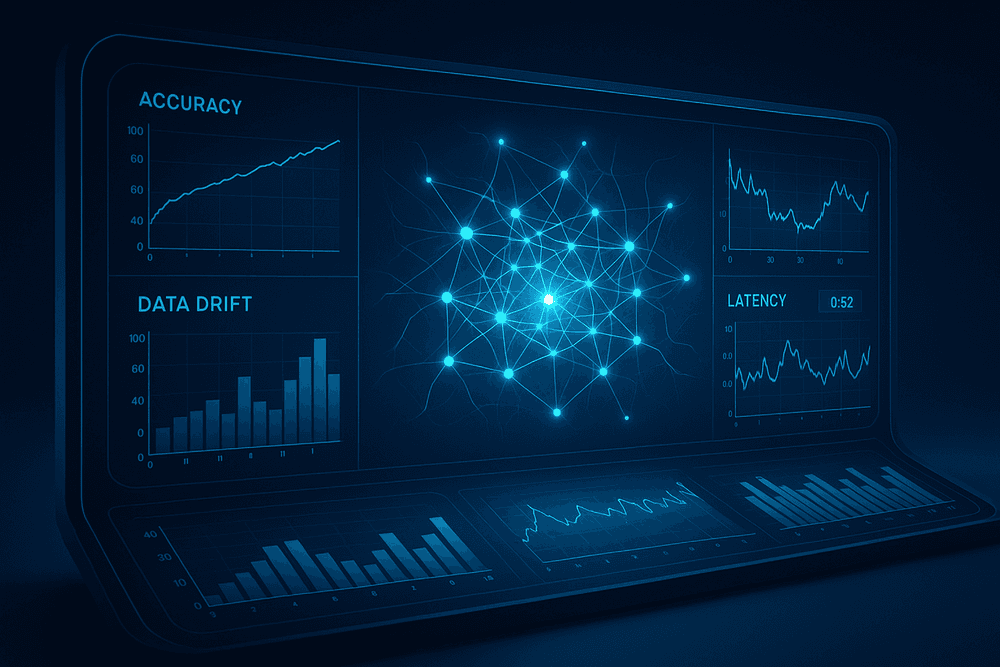
Decoding Your Model: Key Metrics for AI Performance Monitoring
Once your AI model is deployed, the real work begins. A model in the wild is a dynamic entity, constantly interacting with new, evolving data. Simply launching it and hoping for the best is a recipe for failure. Effective AI performance monitoring is an active, ongoing process that hinges on tracking the right set of key metrics. These indicators are your dashboard, providing a clear view into your model's health, efficiency, and fairness, ensuring it delivers value long after its initial training.
Core Performance Metrics: Accuracy, Precision, and Recall
While often used interchangeably, these foundational metrics tell different stories about your model's correctness. Tracking them over time is the first step in identifying performance degradation.
- Accuracy: This is the most straightforward metric—it measures the percentage of correct predictions out of all total predictions. While useful for balanced datasets, it can be misleading when one class heavily outweighs another (e.g., in fraud detection where non-fraudulent transactions are the vast majority).
- Precision: This answers the question: "Of all the predictions we made for the positive class, how many were actually correct?" High precision is crucial when the cost of a false positive is high. For instance, you want high precision in an email spam filter to avoid sending important emails to the spam folder.
- Recall (or Sensitivity): This answers a different question: "Of all the actual positive instances, how many did our model correctly identify?" High recall is vital when the cost of a false negative is significant, such as in medical diagnoses where failing to detect a disease can have severe consequences.
The Silent Killers: Concept and Data Drift
Drift is one of the most common reasons a high-performing model begins to fail in production. It happens when the real-world data starts to diverge from the data the model was trained on.
- Data Drift: This occurs when the statistical properties of the input features change. Imagine an e-commerce model trained to predict demand based on user demographics. If a new marketing campaign suddenly attracts a younger audience, the input data has "drifted," and the model's performance may suffer.
- Concept Drift: This is more subtle. Here, the relationship between the input features and the target variable changes. For example, during an economic downturn, a customer's past high spending (an input feature) may no longer be a good predictor of future purchases (the target concept). A comprehensive AI performance monitoring strategy must include tools to detect these shifts, flagging the need for model retraining or recalibration.
Operational Excellence: Latency and Throughput
A model can be perfectly accurate but useless if it’s too slow. Operational metrics measure the efficiency and responsiveness of your AI system.
- Latency: This is the time it takes for the model to return a prediction after receiving an input. For real-time applications like recommendation engines or autonomous driving systems, low latency is non-negotiable.
- Throughput: This measures how many predictions the model can process in a given timeframe (e.g., predictions per second). High throughput is essential for systems that handle large volumes of data, such as processing millions of financial transactions for fraud analysis.
Upholding Responsibility: AI Fairness and Bias
An AI model is only as unbiased as the data it learns from. Monitoring for fairness is an ethical imperative and a critical component of responsible AI. Bias occurs when a model consistently produces prejudiced outcomes against specific demographic groups (e.g., based on gender, race, or age). Measuring this involves using specialized fairness metrics like:
- Demographic Parity: Ensures the model's prediction rates are equal across different groups.
- Equalized Odds: Checks that the true positive rates and false positive rates are equal for each group.
Detecting and mitigating bias isn't a one-time check at the training stage; it requires continuous AI performance monitoring to ensure the model remains fair as it interacts with new data over time.
The Strategist's Toolkit for AI Performance Monitoring
Effective AI performance monitoring isn’t about passively watching metrics; it’s about actively equipping your team with the right tools to diagnose, predict, and act. As a strategist, your choice of tools will define your organization's ability to maintain high-performing and reliable AI systems. This toolkit outlines the critical components you need to build a robust monitoring framework.
Open-Source vs. Commercial Platforms: Choosing Your Foundation
The first strategic decision is whether to build on an open-source foundation or invest in a commercial platform. There's no single right answer—the best choice depends on your team's expertise, budget, and scalability needs.
- Open-Source Solutions (e.g., Evidently AI, MLflow, Prometheus/Grafana): These platforms offer maximum flexibility and control. They are ideal for teams with strong engineering capabilities who want to avoid vendor lock-in and build a highly customized AI performance monitoring system. The trade-off is the significant investment in setup, maintenance, and a steeper learning curve. You own the infrastructure, which means you are also responsible for its uptime and scalability.
- Commercial Solutions (e.g., Fiddler, Arize AI, WhyLabs): These platforms are built for rapid deployment and ease of use. They provide polished user interfaces, dedicated customer support, and advanced, out-of-the-box features like automated root cause analysis and sophisticated explainability. While they come with subscription costs, they can accelerate your time-to-value and free up your data science and MLOps teams to focus on building models rather than monitoring infrastructure.
Must-Have Features in an AI Monitoring Solution
Regardless of your choice between open-source and commercial, any best-in-class AI performance monitoring solution must include these core features:
- Drift Detection: Monitors for both data drift (changes in input data distributions) and concept drift (changes in the relationship between inputs and outputs).
- Performance & Quality Metrics: Tracks standard metrics like accuracy, precision, and recall, but also business-specific KPIs that tie model performance directly to outcomes.
- Explainability (XAI): Provides tools (like SHAP or LIME) to understand why a model made a specific prediction, which is crucial for debugging and building trust.
- Bias and Fairness Auditing: Actively scans for performance disparities across different demographic segments to ensure equitable and ethical AI behavior.
- Real-Time Alerting: Configurable alerts that notify the right teams via Slack, email, or PagerDuty when a key metric breaches a predefined threshold.
Integrating Monitoring into Your Existing MLOps Pipeline
AI performance monitoring should not be a siloed, post-deployment activity. To be effective, it must be woven directly into the fabric of your MLOps pipeline. Modern monitoring platforms achieve this through robust APIs and SDKs that integrate seamlessly with your existing infrastructure.
For instance, your monitoring tool should connect to your model registry to automatically pull new model versions for tracking. It should integrate with your feature store to understand input data lineage. When a performance issue is detected and a model needs retraining, the monitoring system should be able to trigger a CI/CD pipeline to automate the retraining, validation, and redeployment process, creating a closed-loop system of continuous improvement.
Building a Custom AI Performance Monitoring Dashboard
While off-the-shelf dashboards are useful, a custom dashboard serves as your mission control center, tailored to your specific needs. It consolidates metrics from various sources into a single pane of glass, providing different views for different stakeholders.
- Data Scientists may need granular views of feature drift and prediction distributions.
- Product Managers might want to see the impact of model performance on user engagement and business KPIs.
- Compliance Officers will require a dedicated view for fairness and bias reports.
Tools like Grafana, Tableau, or Looker can pull data from your monitoring system's backend to create these bespoke views. A well-designed dashboard transforms raw monitoring data into actionable intelligence, empowering every team member to play a role in maintaining the health of your AI ecosystem.
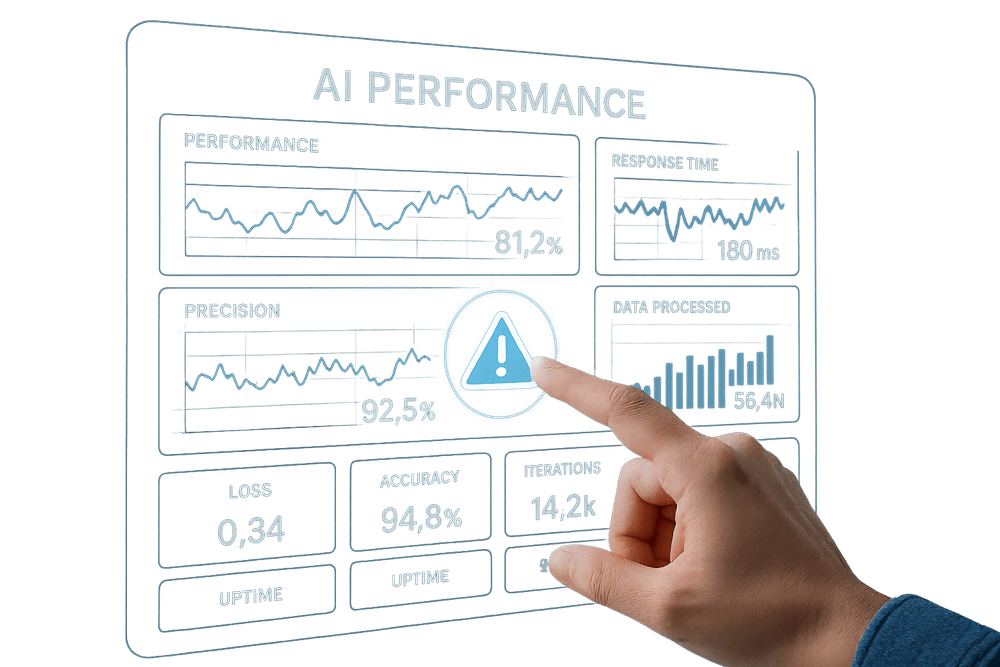
Implementing AI Performance Monitoring: A Best Practices Guide
Deploying an AI model is not the finish line; it’s the starting block. To ensure your AI continues to deliver value and operates as intended, a systematic approach to AI performance monitoring is essential. Moving from theory to practice involves setting up a robust framework built on clear benchmarks, proactive alerts, human oversight, and transparent communication. Here are the best practices to guide your implementation.
Establish a Baseline for Model Performance
You can't know if your model's performance is degrading if you haven't defined what "good" looks like. Establishing a performance baseline is the foundational step in any effective AI performance monitoring strategy. This baseline is your model’s "gold standard," typically determined during the final stages of training and validation before deployment.
To create a meaningful baseline, capture a range of key metrics using your holdout or validation dataset. This should include:
- Efficacy Metrics: Accuracy, precision, recall, F1-score, or mean absolute error, depending on your use case.
- Operational Metrics: Latency (inference speed) and throughput.
- Fairness Metrics: Measurements of bias across different demographic segments.
This initial snapshot serves as the benchmark against which all future, real-world performance will be measured. Without it, you’re flying blind.
Set Up Automated Alerts for Performance Degradation
Waiting for a customer to report an issue or for a quarterly review to discover your model is failing is a recipe for disaster. A proactive AI performance monitoring system relies on automated alerts to flag problems in real-time.
Configure your monitoring platform to trigger alerts when key metrics breach predefined thresholds. For example, an alert could be sent if:
- Model accuracy drops by more than 5% from the baseline.
- Data drift or concept drift scores exceed an acceptable level.
- Prediction latency spikes, impacting user experience.
- A fairness metric indicates a growing bias against a specific user group.
These alerts should be routed directly to the responsible teams via channels like Slack, email, or PagerDuty. This transforms monitoring from a passive, manual task into an active, automated defense system that enables rapid response and resolution.
Create a Human-in-the-Loop Feedback System
Automation is powerful, but human expertise is irreplaceable. A human-in-the-loop (HITL) system creates a symbiotic relationship between your AI and human experts. This is particularly crucial for handling edge cases or low-confidence predictions where the model is uncertain.
In a HITL workflow, predictions that fall below a certain confidence score are automatically routed to a human for review. The expert can then verify, correct, or re-label the output. This corrected data is invaluable; it serves as a high-quality, curated dataset that can be fed back into the system to retrain and fine-tune the model. Implementing a HITL process turns AI performance monitoring into a continuous improvement engine, making your model smarter and more resilient over time.
Visualize Performance Data for Non-Technical Stakeholders
The insights from your AI performance monitoring efforts shouldn't live in a silo, accessible only to data scientists. To secure ongoing buy-in and demonstrate ROI, you must make performance data understandable to business leaders, product managers, and other non-technical stakeholders.
The key is effective data visualization. Create intuitive dashboards that translate complex metrics into clear, actionable insights. Use charts and graphs to illustrate trends over time for:
- Overall model accuracy and its business impact.
- Data drift patterns and their potential causes.
- Latency and its effect on customer satisfaction.
- Fairness reports that confirm ethical compliance.
By visualizing this information, you make the health and value of your AI tangible, fostering trust and enabling informed, data-driven decisions across the entire organization.
AI Performance Monitoring in Action: Real-World Use Cases
Theory is valuable, but seeing AI performance monitoring in practice reveals its true business impact. These systems are not just about charts and alerts; they are fundamental to maintaining revenue, upholding ethical standards, and delivering a superior customer experience. Let's explore how organizations across different industries leverage AI monitoring to solve critical, real-world challenges.
Case Study: Preventing Model Decay in Financial Fraud Detection
A leading fintech company deployed a sophisticated machine learning model to detect fraudulent credit card transactions in real-time. Initially, the model performed exceptionally well, saving the company millions. However, after six months, the team noticed a rise in both false negatives (missed fraud) and false positives (legitimate transactions declined).
The Challenge: Fraudsters constantly change their tactics, a phenomenon known as concept drift. The patterns the model was trained on were becoming obsolete, causing its predictive power to decay.
The Solution: The company implemented a comprehensive AI performance monitoring platform. The system continuously tracked key indicators:
- Data Drift: It monitored the statistical properties of incoming transaction data, flagging significant deviations from the training data's distribution.
- Model Accuracy: It compared model predictions against confirmed fraud reports, providing a real-time view of precision and recall metrics.
The Outcome: The monitoring system automatically alerted the MLOps team when performance metrics dipped below a predefined threshold and when significant data drift was detected. These alerts served as a trigger for model retraining, using newly labeled data that included the latest fraud patterns. This proactive approach transformed their process from reactive to predictive, ensuring the model remained effective, minimizing financial losses, and maintaining customer trust.
Use Case: Ensuring Fairness and Equity in AI Hiring Tools
A large corporation adopted an AI tool to help screen thousands of resumes for engineering roles, aiming to improve efficiency. While the tool was effective at identifying strong technical keywords, an internal audit raised concerns about potential bias against underrepresented groups.
The Challenge: The AI was trained on a decade of historical hiring data, which inadvertently reflected past societal and organizational biases. Without oversight, the tool could perpetuate these biases, unfairly penalizing qualified candidates from diverse backgrounds.
The Solution: A specialized AI performance monitoring framework focused on AI ethics and fairness was integrated. This system was configured to analyze the model's decisions across various demographic segments (e.g., gender, ethnicity, age group), which were self-reported by applicants for EEO compliance. It specifically tracked:
- Demographic Parity: Whether the rate of positive recommendations was equal across different groups.
- Bias Metrics: Advanced statistical tests to identify and quantify discriminatory patterns in model outputs.
The Outcome: The monitoring dashboard revealed that the model was disproportionately down-ranking resumes from female applicants who had attended all-women's colleges. This insight allowed the data science team to identify and mitigate the bias by re-weighting features and adding more representative data. Continuous AI performance monitoring now acts as an ethical safeguard, helping the company build a more diverse workforce and avoid significant legal and reputational risks.
Example: Optimizing Latency in Real-Time Recommendation Engines
An e-commerce giant relies on its recommendation engine to drive user engagement and sales, suggesting products to shoppers as they browse. The core business goal is to present these recommendations instantly; even a half-second delay can cause a user to scroll past, resulting in a lost opportunity.
The Challenge: As the product catalog grew and site traffic fluctuated, the model's response time (latency) became inconsistent, especially during peak shopping events like Black Friday.
The Solution: The engineering team implemented AI performance monitoring with a focus on operational metrics. The system was set up to track:
- P99 Latency: The response time for the slowest 1% of requests, ensuring the vast majority of users have a fast experience.
- Throughput: The number of requests the model could process per second.
- Resource Utilization: CPU and memory usage of the servers running the model.
The Outcome: The real-time monitoring dashboard provided a clear view of the system's operational health. When latency began to approach the 100-millisecond threshold, automated alerts were sent to the on-call team. This allowed them to proactively scale resources or optimize inefficient model code before users were impacted. This rigorous monitoring ensures a seamless, instantaneous user experience, directly supporting higher engagement and conversion rates.
Conclusion: Future-Proofing Your Strategy with Proactive Monitoring
The era of "deploy and forget" is over. As we've explored, AI models are not static assets; they are dynamic systems that exist in a constantly changing data environment. Leaving them unobserved is a direct path to performance decay, biased outcomes, and eroded user trust. Effective AI performance monitoring is the critical discipline that transforms your AI initiatives from high-risk gambles into reliable, value-generating engines for your business. It’s the essential bridge between a model’s potential in the lab and its sustained success in the real world. By embracing a proactive approach, you shift from firefighting unexpected failures to strategically guiding your AI systems toward continuous improvement and long-term ROI.
Your AI Performance Monitoring Checklist
To build a robust and comprehensive strategy, use this checklist as a starting point. It ensures you cover the essential pillars of monitoring for resilient and trustworthy AI.
- ☑ Define Core Performance Metrics: Have you established clear, measurable KPIs for your model? This includes operational metrics like latency and throughput, as well as model-specific metrics like accuracy, precision, and recall.
- ☑ Track for Data and Concept Drift: Are you actively monitoring the statistical properties of your input data and the relationship between inputs and outputs? Set up automated alerts for significant drift detection.
- ☑ Assess Bias and Fairness: Have you identified sensitive attributes and established fairness metrics (e.g., demographic parity, equal opportunity)? Regularly audit your model’s predictions across different user segments.
- ☑ Monitor Infrastructure Health: Are you tracking resource utilization like CPU/GPU load, memory consumption, and associated costs? Ensure your infrastructure can handle real-world demand efficiently.
- ☑ Establish Clear Baselines and Alerts: Do you know what "good" looks like? Establish baseline performance benchmarks and configure intelligent alerts to notify the right teams when key metrics deviate.
- ☑ Implement a Feedback Loop: Have you created a mechanism to capture user feedback or expert validation? This human-in-the-loop process is invaluable for identifying subtle failures and gathering labeled data for retraining.
The Future of AI Observability and Autonomous Systems
The discipline of AI performance monitoring is rapidly evolving into the broader concept of AI observability. While monitoring tells you when something is wrong, observability helps you understand why. This deeper insight is the bedrock for the next generation of autonomous AI.
The future isn't just about sending an alert when data drift occurs; it's about systems that can perform automated root cause analysis to pinpoint the source of the drift. It’s about models that can self-diagnose biases and suggest mitigation strategies. Ultimately, we are moving toward self-healing AI systems that can autonomously trigger retraining pipelines with newly validated data, A/B test a challenger model, or automatically roll back to a more stable version in response to a critical performance drop—all with minimal human intervention. Achieving this level of autonomy is impossible without a foundation of deep, granular observability.
How to Start Implementing AI Monitoring Today
Getting started with AI performance monitoring doesn't require a massive, overnight overhaul. You can begin delivering value with a few focused, incremental steps:
- Start Small: Choose one high-value model to focus on first. Don't try to monitor everything at once. Select one or two critical metrics—like prediction latency or a key accuracy score—to track initially.
- Log Everything: The foundation of all monitoring is good data. Begin logging all model inputs, predictions, and metadata. Even if you don't analyze it immediately, this historical record will be invaluable for future debugging and analysis.
- Visualize and Baseline: Use simple, accessible tools (like open-source dashboards or even a shared spreadsheet) to plot your chosen metric over time. This simple act of visualization will help you establish a performance baseline and make it easy to spot anomalies.
- Iterate and Expand: Once you have a basic monitoring workflow, gradually expand its scope. Add more metrics like drift and bias detection, set up automated alerts, and begin applying your learnings to other models in your portfolio.