September 23, 2025
How an AI-Powered Collaboration Platform Redefines Teamwork
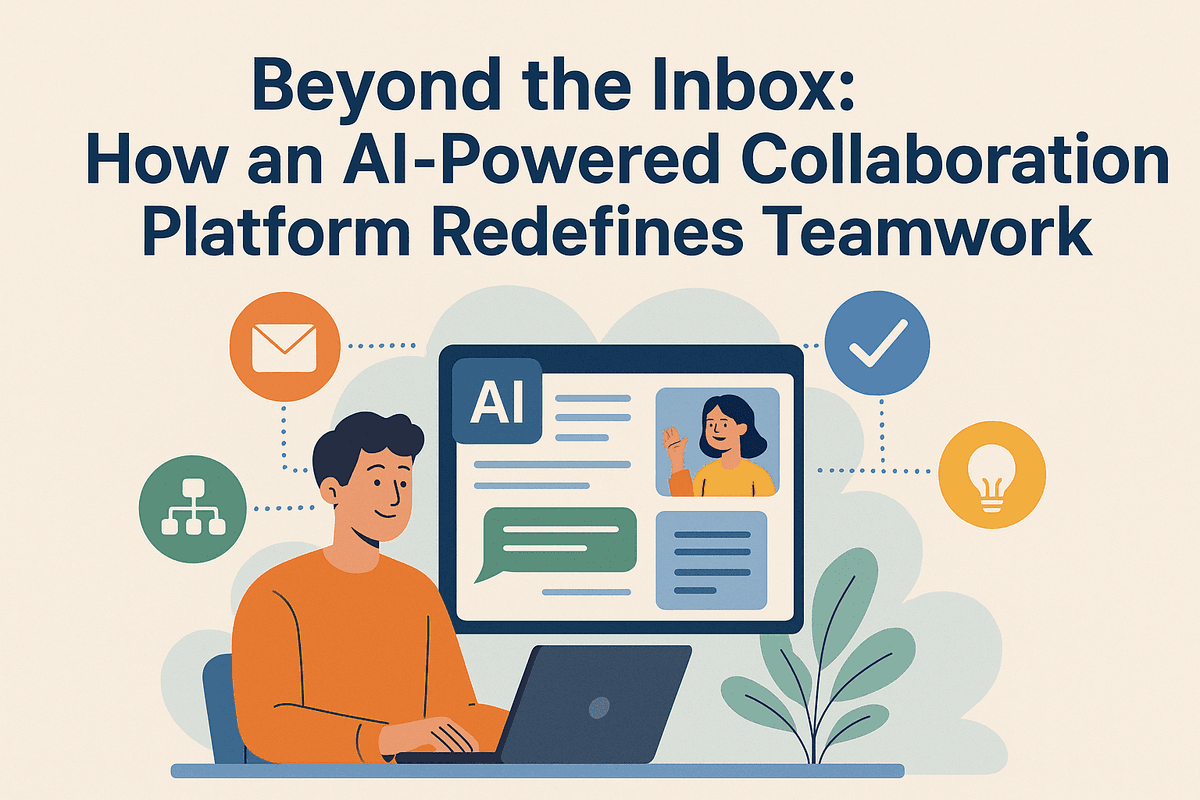
Beyond the Inbox: How an AI-Powered Collaboration Platform Redefines Teamwork
The modern workday is a battle against digital friction. We toggle between a dozen tabs, hunt for that one crucial file buried in a sea of folders, and decipher endless email chains to find a single decision. This isn't just inefficient; it's a silent drain on creativity and momentum. Every minute spent searching for context or manually updating a project board is a minute not spent on high-impact work. This is the core problem that an AI-powered collaboration platform is built to solve: it targets the costly fragmentation of information and communication that plagues even the most organized teams.
It’s not about a lack of tools. In fact, most teams suffer from an overabundance of them. The real issue is the disconnect between these tools, which forces team members to act as human bridges, constantly copying, pasting, and translating information from one system to another.
The Evolution from Digital Filing Cabinets to Intelligent Workspaces
To understand the leap forward that an AI-powered collaboration platform represents, consider the evolution of our digital work environments.
- Generation 1: Email & Local Servers. The original digital office. It was revolutionary but quickly became a black hole of siloed information, creating bottlenecks and cc-all chaos.
- Generation 2: Cloud Storage & Basic Chat. Tools like Google Drive and early versions of Slack brought our files and conversations into a centralized, accessible space. This was a massive improvement, but these platforms were largely passive. They were digital filing cabinets—organized and searchable, but they required you to do all the work of connecting the dots.
- Generation 3: The Intelligent Workspace. This is the new frontier. An AI-powered collaboration platform doesn't just store your data; it understands it. It acts as an active participant in your workflow, capable of understanding context, automating routine tasks, and surfacing insights. It's the shift from a passive repository to a dynamic, intelligent partner.
Why Your Team Needs an Intelligence Layer, Not Just Another App
Adding another productivity app to your stack is like giving a construction worker a new, specialized hammer. It might be useful for one task, but it doesn't fundamentally change how they build the house. An AI-powered collaboration platform is different. It's not another tool; it's the intelligent blueprint that guides the entire project.
Where a standard tool might offer a shared to-do list, an intelligent platform can analyze a meeting transcript, automatically identify and assign action items to the right people, and set deadlines based on the conversation's context. Where a basic chat app lets you search for old messages, an AI-powered platform can summarize an entire channel's discussion on a specific topic, giving a new team member instant context without them needing to read hundreds of messages.
This is the key distinction: it moves your team from a reactive state—constantly searching and catching up—to a proactive one. It reduces cognitive load by anticipating needs, automating coordination, and transforming a chaotic flood of information into a clear, actionable stream of intelligence. It’s no longer just about working faster; it's about working smarter, with a system that amplifies your team's collective brainpower.
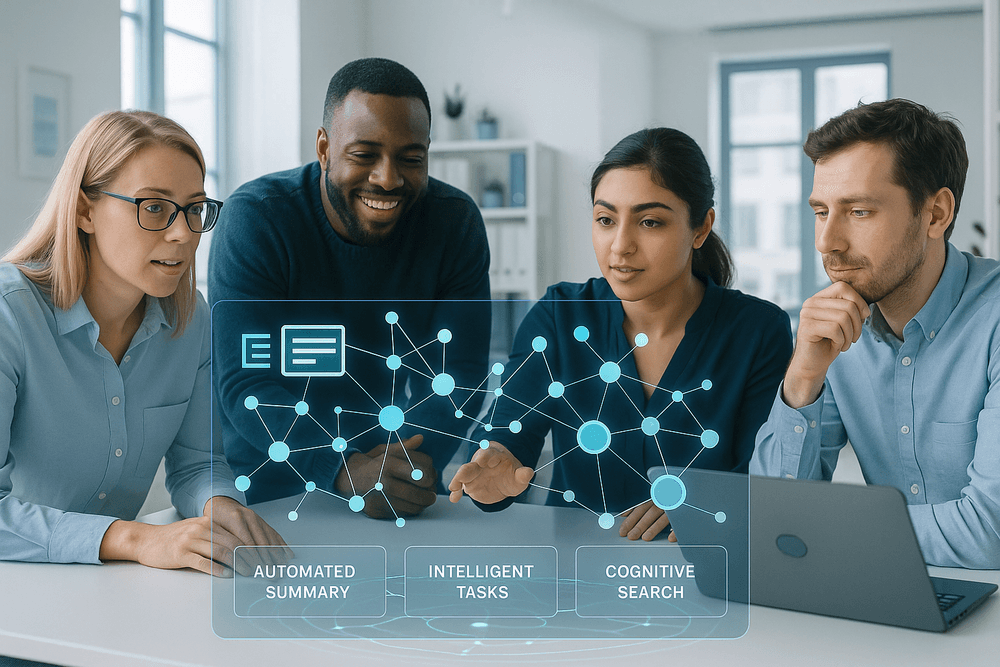
Core Features of a Leading AI-Powered Collaboration Platform
A truly transformative ai powered collaboration platform does more than just centralize communication; it actively participates in the workflow. It acts as an intelligent partner, anticipating needs and automating the administrative burdens that slow teams down. The core features that set these leading platforms apart are not just about convenience—they are about fundamentally reshaping how teams work together for maximum efficiency and impact. Let's explore the key capabilities that define the next generation of team collaboration.
Automated Meeting Summaries and Action Item Generation
The days of frantically typing notes while trying to participate in a discussion are over. A premier ai powered collaboration platform can record and transcribe meetings in real-time. But its true power lies in what happens next. The AI analyzes the entire conversation to generate a concise, easy-to-read summary, highlighting key decisions, open questions, and critical takeaways. More importantly, it intelligently identifies action items and automatically assigns them to the correct team members with proposed deadlines, creating tasks directly within your project management tools. This eliminates "meeting amnesia" and ensures that valuable momentum is never lost between conversations.
Intelligent Task Delegation and Predictive Workflow Management
Assigning the right task to the right person is crucial for project success. Instead of relying on guesswork, AI can offer data-driven recommendations. By analyzing an individual's skills, current workload, and past performance on similar tasks, the platform suggests the optimal team member for each new assignment. This intelligent delegation ensures balanced workloads and leverages the unique strengths of your team. Furthermore, these platforms can provide predictive insights into your workflows, identifying potential bottlenecks or resource conflicts before they derail a project. This foresight allows managers to proactively adjust timelines and reallocate resources, keeping projects on track and on budget.
AI-Driven Sentiment Analysis in Team Communications
In a digital-first environment, tone and intent can easily be lost in translation. AI-driven sentiment analysis provides a crucial layer of emotional intelligence to team communications. The system can discreetly analyze the language used in public channels and project comments to gauge the overall mood and identify early signs of frustration, confusion, or potential conflict. This isn't about surveillance; it's about providing team leaders with anonymized, high-level insights to foster a more positive and psychologically safe environment. By understanding the undercurrents of communication, leaders can intervene constructively, clarify misunderstandings, and proactively maintain team morale.
Smart Search Across All Integrated Documents and Conversations
How much time does your team waste searching for a specific file, message, or decision? Information silos are a major productivity killer. A leading ai powered collaboration platform breaks them down with a powerful, unified search function. This isn't just a keyword search; it's a cognitive search that understands natural language and context. You can ask questions like, "Show me the final designs for the Project Phoenix logo" or "What was our decision on the Q4 budget?" The AI will instantly pull relevant information from chat logs, documents, spreadsheets, and integrated apps, delivering the precise knowledge you need, exactly when you need it.
The Tangible Benefits: Slashing Inefficiency and Boosting Output
Moving beyond theoretical advantages, an ai powered collaboration platform delivers concrete, measurable results that directly impact your bottom line. It's not just about working differently; it's about working smarter, faster, and more effectively. By integrating intelligent automation and data analysis into the core of your team's daily operations, these platforms transform workflows from sources of friction into engines of productivity. Let's explore the tangible benefits that redefine what your team can achieve.
Eliminate Administrative Overhead with Workflow Automation
How much time does your team lose to repetitive, low-value tasks each week? Scheduling meetings, sending follow-up reminders, transcribing notes, and routing approvals are necessary evils that drain focus from strategic work. An ai powered collaboration platform tackles this head-on by automating administrative overhead.
Imagine an AI assistant that scans everyone's calendars to find the perfect meeting time, generates an agenda, and sends invites automatically. After the call, it provides a full transcript, identifies key action items, and assigns them to the correct team members with deadlines. This intelligent automation frees your team from the mire of manual coordination, allowing them to dedicate their valuable time and cognitive energy to problem-solving, creativity, and driving projects forward.
Enhance Decision-Making with Data-Driven Insights
In today's fast-paced environment, making decisions based on gut feelings or outdated information is a recipe for failure. AI-enhanced platforms act as a central nervous system for your projects, constantly gathering and analyzing data from chats, task boards, and documents.
Instead of manually digging through spreadsheets to gauge project health, you get real-time, AI-generated dashboards. These tools can predict potential bottlenecks by analyzing task dependencies and team workload, perform sentiment analysis on team communications to flag potential morale issues, and identify which projects are delivering the highest ROI. This layer of intelligence empowers leaders to move from reactive problem-solving to proactive, data-informed strategic planning, ensuring every decision is backed by clear, actionable insights.
Break Down Silos and Improve Cross-Functional Visibility
Departmental silos are the silent killers of organizational agility. When the marketing, sales, and product teams operate in separate information vacuums, wires get crossed, efforts are duplicated, and opportunities are missed. An ai powered collaboration platform dismantles these walls by creating a unified, transparent workspace.
AI-powered search functions allow an employee in one department to instantly find relevant information from another, whether it's buried in a project plan or a chat thread. The platform can automatically generate cross-functional project summaries, giving all stakeholders a clear view of progress without needing to sit through endless status meetings. This seamless flow of information ensures everyone is aligned on shared goals, fostering a cohesive culture and dramatically accelerating cross-departmental initiatives.
Foster Innovation with AI-Facilitated Brainstorming Tools
True innovation requires more than just getting people in a room; it requires a spark. AI tools can act as the ultimate creative catalyst during brainstorming sessions. These features go beyond simple whiteboarding, offering intelligent prompts to overcome creative blocks and suggesting novel connections between disparate ideas. For example, generative AI can produce initial campaign slogans, product concepts, or content outlines based on a simple prompt, giving your team a powerful starting point. By analyzing brainstorming notes in real-time, the AI can also identify emerging themes and highlight unique perspectives, ensuring the most promising ideas rise to the top. This transforms brainstorming from a blank-page exercise into a dynamic, AI-assisted process of discovery.
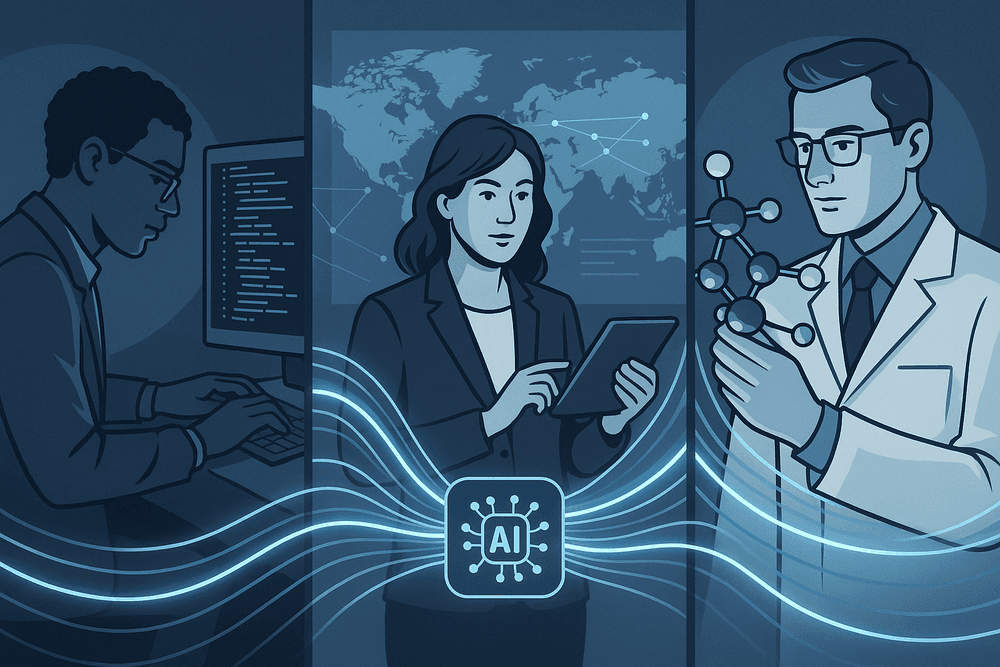
Real-World Use Cases: An AI-Powered Collaboration Platform in Action
The true measure of any technology is its practical impact. While the features of AI-enhanced collaboration are impressive on paper, their real power is unlocked when applied to specific industry challenges. An ai powered collaboration platform isn't just a futuristic concept; it's a tangible asset that is already transforming how teams work. Let's explore how different professional teams are leveraging these platforms to achieve remarkable results.
Accelerating Development Cycles for Software Teams
For software engineering teams, speed and accuracy are paramount. The development lifecycle is a complex dance of coding, testing, and deployment, often bogged down by manual tracking and communication bottlenecks.
- The Challenge: Coordinating sprints, triaging bugs, conducting code reviews, and keeping documentation updated across a distributed team.
- The AI Solution: An ai powered collaboration platform automates key processes. It can intelligently assign bug tickets to the developer best equipped to handle them based on their past work and codebase expertise. AI assistants can summarize complex code merges and pull requests, saving senior developers valuable review time. Furthermore, predictive analytics can flag potential risks in the development timeline, allowing project managers to proactively adjust resources and prevent delays.
- The Outcome: Teams experience significantly shorter development cycles, a reduction in critical bugs making it to production, and more time for developers to focus on innovation instead of administrative tasks.
Streamlining Global Marketing Campaigns for Remote Teams
Marketing teams operating across different continents face unique hurdles, from time zone conflicts to cultural nuances in messaging. A unified, intelligent platform is essential for creating cohesive global campaigns.
- The Challenge: Aligning on strategy, managing content approvals, localizing assets for different markets, and tracking campaign performance across dozens of channels.
- The AI Solution: AI features like automated meeting transcription and summarization ensure that team members in different time zones never miss key decisions. AI-driven sentiment analysis can gauge public reaction to a campaign in real-time, while natural language processing (NLP) tools can suggest culturally appropriate localizations for ad copy and social media posts. The platform becomes the central source of truth for all campaign assets and performance data.
- The Outcome: Marketing teams can launch synchronized, impactful global campaigns faster and with greater confidence. They gain deeper insights into audience reception, allowing for agile adjustments that boost ROI.
Improving Client Project Management for Creative Agencies
Creative agencies live and die by their ability to manage client expectations, timelines, and budgets effectively. Juggling multiple projects, constant feedback, and resource allocation is a high-stakes balancing act.
- The Challenge: Accurately capturing client feedback, preventing scope creep, ensuring projects remain profitable, and assigning the right creative talent to each task.
- The AI Solution: An AI-powered collaboration platform can transcribe client calls, automatically identify action items, and create tasks from the conversation. Predictive analytics monitor project health, flagging potential budget overruns or timeline slips before they become critical. Smart resource management tools suggest the best team members for a new project based on their current workload, skills, and past performance.
- The Outcome: Agencies build stronger client relationships through enhanced transparency and responsiveness. Projects are delivered on time and within budget more consistently, leading to improved profitability and less burnout for creative teams.
Powering Academic Research and Cross-Institutional Projects
In the world of academia, collaboration is the engine of discovery. Researchers often work with massive datasets and collaborate with peers from institutions around the globe, making efficient information sharing and synthesis crucial.
- The Challenge: Sifting through thousands of research papers, analyzing complex data, coordinating experiments between different labs, and co-authoring publications and grant proposals.
- The AI Solution: AI tools embedded in the collaboration platform can perform semantic searches to find the most relevant literature in minutes, not days. They can assist in analyzing and visualizing large datasets, uncovering patterns that might be missed by the human eye. Collaborative writing assistants provide real-time suggestions for grammar, clarity, and style, streamlining the process of drafting high-impact papers.
- The Outcome: Research teams can accelerate their discovery process, foster more effective cross-institutional partnerships, and produce higher-quality publications. The platform removes administrative friction, allowing researchers to focus on what they do best: pushing the boundaries of knowledge.
Best Practices for Implementing Your New Collaboration Hub
Selecting a powerful tool is only half the battle; successful implementation is what transforms potential into productivity. A strategic rollout of your new ai powered collaboration platform ensures a smooth transition, maximizes user adoption, and delivers a tangible return on investment. Follow these best practices to integrate your new hub seamlessly into the fabric of your organization.
Choosing the Right Platform for Your Team
Not all AI collaboration tools are created equal. The ideal choice depends entirely on your unique operational landscape. Before committing, evaluate potential platforms against these core criteria:
- Team Size and Scalability: Will the platform grow with you? A startup of ten has different needs than an enterprise of a thousand. Look for flexible pricing tiers and architecture that supports future expansion.
- Core Functionality: Identify your primary pain points. Do you need to automate project management, streamline communication, or centralize knowledge? Prioritize platforms that excel in the areas most critical to your team's success.
- Integration Capabilities: Your new hub must play well with others. Ensure it offers robust, native integrations with your existing tech stack—your CRM, cloud storage, calendars, and other essential business applications.
- Security and Compliance: Non-negotiable. Verify that the platform meets industry-standard security protocols and compliance requirements (like GDPR or HIPAA, if applicable) to protect your sensitive data.
A Step-by-Step Guide to Seamless Integration
A rushed rollout can lead to confusion and resistance. A phased, methodical approach guarantees a smoother transition.
- Plan and Prepare: Conduct a thorough audit of your current workflows. Identify inefficiencies and map out exactly how the new ai powered collaboration platform will address them. Set clear goals and establish key performance indicators (KPIs) for the implementation.
- Launch a Pilot Program: Select a small, tech-savvy team to be your pilot group. Let them test the platform in a real-world environment. Their feedback is invaluable for identifying potential challenges and refining your training materials before a company-wide launch.
- Configure and Customize: Work with your IT team to set up integrations, user permissions, and custom workflows. Tailor the platform to mirror your company’s structure and processes, making it feel intuitive and familiar from day one.
- Migrate Data Strategically: Plan the migration of existing projects, files, and communications. Clean up and archive old data before moving essentials to the new system to ensure a fresh, organized start.
Driving User Adoption and Mastering the Learning Curve
The most powerful tool is useless if no one uses it. Overcoming resistance to change is critical.
- Communicate the "Why": Clearly articulate the benefits for every team member. Explain how the platform will reduce tedious tasks, make information easier to find, and foster a more connected work environment.
- Invest in Training: Offer comprehensive training sessions tailored to different roles. Provide a mix of live workshops, on-demand video tutorials, and a rich knowledge base so users can learn at their own pace.
- Appoint Internal Champions: Identify enthusiastic users in each department to act as go-to experts. These champions can provide peer-to-peer support, share success stories, and build momentum from the ground up.
Measuring the ROI of Your AI Collaboration Investment
To justify the investment and secure future budget, you must demonstrate value. Track a combination of quantitative and qualitative metrics to paint a complete picture of your ROI.
- Quantitative Metrics:
- Time Saved: Measure the reduction in time spent on administrative tasks like creating meeting summaries, searching for documents, or manually updating project timelines.
- Project Velocity: Track the average time to complete projects before and after implementation.
- Tool Consolidation: Calculate cost savings from retiring redundant software licenses.
- Qualitative Metrics:
- Employee Engagement: Use pulse surveys to gauge team satisfaction and perceived ease of collaboration.
- Quality of Work: Monitor for improvements in cross-functional communication and a reduction in errors caused by misinformation.

The Future is Collaborative: Your Next Steps with AI
The fusion of artificial intelligence and human teamwork is no longer a distant concept—it's the new competitive edge. As AI becomes more sophisticated, its role is shifting from a simple assistant to a strategic partner that anticipates needs, streamlines complexity, and unlocks creative potential. Embracing this evolution is key to building a resilient, innovative, and high-performing team. Here’s what the future holds and how you can prepare to lead the charge.
Key Trends Shaping the Future of AI in Teamwork
The horizon for AI-enhanced collaboration is expanding rapidly. Keep an eye on these transformative trends that will soon define how we work together:
- Proactive Intelligence: Tomorrow's AI won't just respond to your commands; it will anticipate them. Imagine a platform that flags potential project bottlenecks before they occur, suggests optimal task assignments based on current workloads, and even analyzes communication sentiment to gauge team morale and prevent burnout. This shift from reactive to proactive support will make teams more agile and forward-thinking.
- Hyper-Personalization: Generic workflows are becoming a thing of the past. Future AI will deeply understand individual work styles, learning preferences, and daily rhythms. It will deliver personalized task lists, curate relevant information, and adapt its interface to help each team member perform at their peak, creating a truly bespoke work environment.
- Seamless Generative AI Integration: Generative AI will become an invisible, indispensable partner. Instead of toggling between apps, you’ll draft project briefs, summarize complex discussions, and generate creative first drafts directly within your primary collaboration hub. This deep integration will eliminate friction and supercharge content creation and strategic planning.
Your Final Checklist for Selecting an AI-Powered Collaboration Platform
Choosing the right tool is critical for success. Before you commit, run your top contenders through this essential checklist to ensure you're selecting the best ai powered collaboration platform for your unique needs.
- Integration Ecosystem: Does the platform connect flawlessly with your existing tech stack (e.g., Slack, Google Workspace, Salesforce, Jira)? Siloed tools create more work, so seamless integration is non-negotiable.
- Scalability and Performance: Can the platform grow with you? Ensure it can handle an increase in users, projects, and data without sacrificing speed or reliability.
- Security and Data Privacy: How does the vendor protect your sensitive information? Look for robust security protocols, data encryption, and compliance with standards like GDPR and SOC 2.
- User Experience (UX) and Adoption: Is the interface intuitive and easy to navigate? A powerful platform is useless if your team finds it too complex to use. Prioritize a clean design and a gentle learning curve.
- Relevant AI Features: Move beyond the hype. Do the AI capabilities solve your team’s specific pain points? Focus on practical features like automated meeting summaries, intelligent task management, and advanced search functions.
Take the First Step: How to Trial a Platform Today
Theory is one thing; practice is everything. The best way to understand the impact of an AI-powered collaboration platform is to experience it firsthand.
- Form a Pilot Group: Select a small, forward-thinking team or a single, well-defined project to run a trial. This minimizes risk and provides a focused environment for evaluation.
- Define Your Goals: What do you want to achieve? Set clear success metrics, such as a 15% reduction in time spent in meetings, faster project completion, or improved cross-departmental communication.
- Activate a Free Trial: Nearly every top-tier provider offers a free trial or a guided demo. Sign up and use the platform for real-world tasks. Assign projects, run meetings, and test the AI features with your pilot team.
- Gather Actionable Feedback: At the end of the trial, survey your pilot group. What did they love? What frustrated them? This qualitative data is just as important as your quantitative metrics and will be invaluable in making your final decision.