
October 6, 2025
How AI Tools for Business Are Redefining Operations
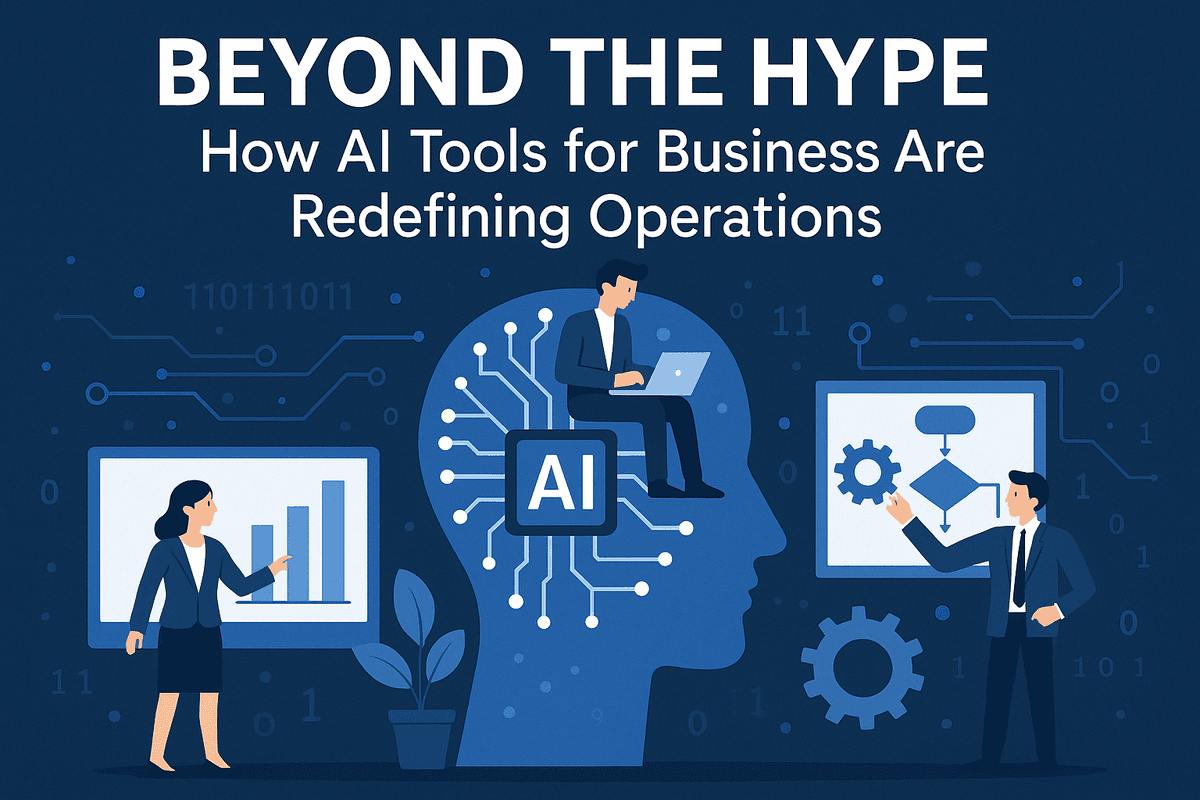
Beyond the Hype: How AI Tools for Business Are Redefining Operations
The term "AI" is everywhere, often associated with futuristic robots or viral content generators. But beyond the headlines, a more profound transformation is underway within organizations. Strategic AI tools for business are moving past simple automation to become core engines of operational intelligence, fundamentally changing how companies plan, execute, and compete. This shift requires a new understanding of what these tools are, what they can do, and why transparency is non-negotiable.
What Are Strategic AI Tools (and What They Are Not)?
When we talk about strategic AI, we aren't referring to a simple chatbot that answers basic customer queries or an app that generates a clever social media post. While useful, those are applications of AI, not strategic deployments.
A strategic AI tool is a system designed to address a core business challenge by integrating into complex operational workflows. It doesn't just perform a task; it analyzes vast datasets to optimize processes, forecast outcomes, and empower human decision-making.
- It is not: A standalone gadget or a novelty content creator.
- It is: A deeply integrated system for supply chain optimization that predicts disruptions before they happen.
- It is not: A basic email filter that sorts spam.
- It is: A predictive analytics platform that identifies high-risk accounts for financial compliance teams, saving millions in potential fines.
Strategic AI tools for business are about creating a durable competitive advantage by embedding intelligence directly into your most critical operations.
Moving from Task Automation to True Operational Intelligence
The first wave of AI in the workplace focused on task automation—handling repetitive, predictable work like data entry, scheduling, or transcribing meetings. This frees up human capital for more valuable work and is an important first step. However, the real revolution lies in the move toward true operational intelligence.
Operational intelligence is the ability to not only see what is happening in your business but to understand why it's happening and predict what will happen next. This is where modern AI tools for business excel. Instead of merely processing invoices, an intelligent system analyzes spending patterns across the entire organization to recommend budget reallocations. Instead of just tracking inventory levels, it models demand based on market signals, weather patterns, and competitor pricing to prevent stockouts and reduce carrying costs. This evolution is the difference between an AI that functions as a digital assistant and one that acts as a strategic advisor.
The Critical Role of Explainability in Business AI
As AI systems take on more responsibility for critical decisions, a crucial question emerges: can you trust their recommendations? A major risk with some AI models is the "black box" problem—they provide an output without revealing the logic behind it. For a business, making a multi-million dollar decision based on an answer you can't question is unacceptable.
This is why Explainable AI (XAI) is no longer a niche feature but a core requirement. Explainability is the ability of an AI system to articulate the reasoning behind its conclusions in a way that humans can understand. This transparency is vital for several reasons:
- Trust and Adoption: Leaders are more likely to trust and act on AI-driven insights if they understand the "why" behind the recommendation.
- Compliance and Auditing: In regulated industries like finance and healthcare, you must be able to prove to auditors that your decisions are fair, unbiased, and compliant. An unexplainable AI is a compliance nightmare.
- Accountability and Debugging: When an AI makes a mistake, explainability allows you to trace the error back to its source—whether it was flawed data, a biased assumption, or a model drift—and correct it.
Ultimately, explainability transforms AI tools for business from mysterious black boxes into transparent, accountable partners in strategic decision-making.
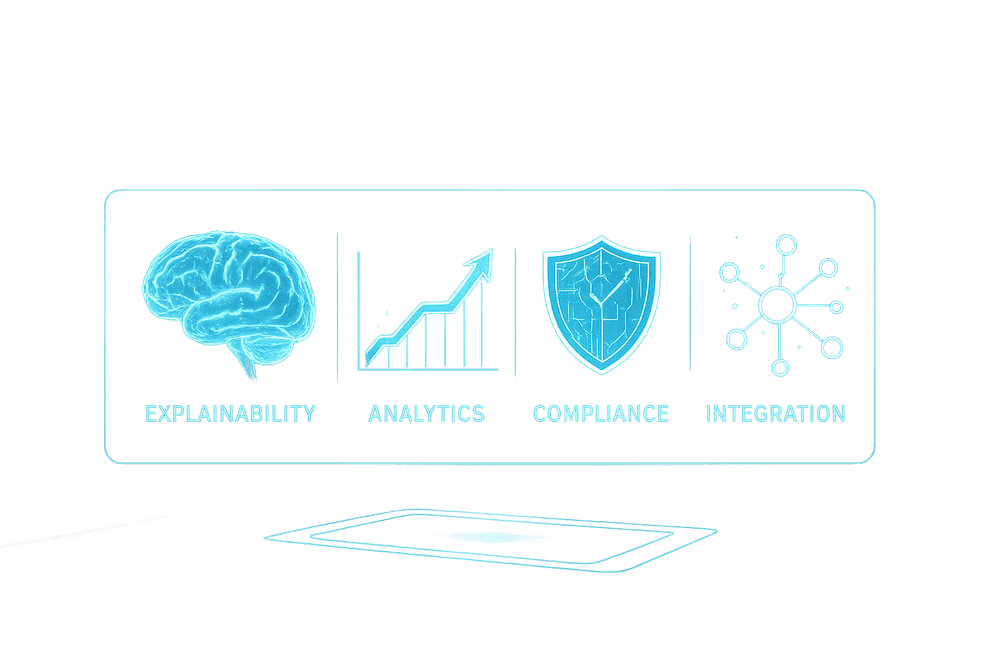
Decoding the Must-Have Features of Modern AI Tools for Business
The market is saturated with options, but the most effective AI tools for business are distinguished by a core set of powerful, strategic features. Moving beyond basic automation, these capabilities transform how you operate, make decisions, and manage risk. When evaluating solutions, look past the hype and focus on features that deliver tangible, transparent value. Here’s a breakdown of the non-negotiables for any forward-thinking organization.
Ensuring Transparency with Explainable AI (XAI) Features
Gone are the days of the AI "black box." For any business serious about accountability and trust, Explainable AI (XAI) is a critical feature. XAI refers to a set of processes and methods that allow human users to comprehend and trust the results and output created by machine learning algorithms. Why did the AI model flag a transaction as fraudulent? What factors led to a specific sales forecast? XAI provides clear, human-readable answers. This transparency is vital for debugging models, ensuring fairness, meeting regulatory requirements, and building confidence among stakeholders—from your C-suite to your customers. An AI tool without explainability is a liability waiting to happen.
Predictive Analytics for Proactive Decision-Making
The best AI tools for business don't just report on what happened yesterday; they provide a clear view of what’s likely to happen tomorrow. Predictive analytics capabilities leverage historical data, statistical algorithms, and machine learning techniques to identify the likelihood of future outcomes. This empowers you to shift from a reactive to a proactive stance. Imagine pre-emptively addressing potential supply chain disruptions, identifying customers at risk of churning before they leave, or optimizing inventory levels for an upcoming seasonal spike. This foresight is a game-changer, turning raw data into a strategic asset for proactive, data-driven decision-making.
Automating Compliance and Mitigating Risk
Navigating the complex web of industry regulations and internal policies is a significant operational burden. Modern AI tools can automate much of this heavy lifting, drastically reducing both risk and manual effort. Look for features that can continuously monitor transactions for signs of fraud, audit processes against compliance frameworks like GDPR or HIPAA, and flag anomalies in real-time. By automating these critical checks, you minimize the potential for human error, ensure consistent adherence to standards, and free up your compliance and legal teams to focus on more strategic initiatives instead of getting bogged down in repetitive audits.
Seamless Integration with Your Existing Tech Stack
An AI tool, no matter how powerful, is useless if it lives on an island. Seamless integration is arguably the most practical feature to consider. The best platforms are built with an API-first approach, offering robust connectors to your existing systems—be it your CRM, ERP, data warehouse, or marketing automation software. This ensures a smooth flow of data, prevents information silos, and allows the AI to learn from the full breadth of your business operations. Without easy integration, you risk a costly, time-consuming implementation and a tool that never reaches its full potential. True value is unlocked when AI becomes a natural, connected part of your existing technological ecosystem.
A Curated Look at Top-Tier AI Tools for Business Operations
Navigating the crowded market of AI solutions can be daunting. The key is to focus on platforms that directly address core operational challenges and align with your strategic goals. The most effective AI tools for business are not just about automation; they are about creating a more intelligent, resilient, and compliant organization. Here, we categorize and explore some of the most impactful types of AI tools transforming business operations today.
Enhancing Decision Intelligence and Forecasting
Modern business moves too fast for reactive decision-making. AI-powered decision intelligence platforms shift the paradigm from historical reporting to predictive and prescriptive analytics. These tools analyze vast, complex datasets to uncover hidden patterns, forecast future outcomes with remarkable accuracy, and even recommend the best course of action.
Leading business intelligence platforms like Tableau and Microsoft Power BI have embedded powerful AI features that allow users to run "what-if" scenarios and generate predictive models without deep data science expertise. For more advanced applications, dedicated machine learning platforms like DataRobot automate the model-building process. Crucially, top-tier tools in this category offer explainability features, revealing the key drivers behind a forecast. This transparency is vital for building trust and ensuring that leaders can confidently act on the AI's recommendations.
Automating and Optimizing Workflows
Operational efficiency often hinges on freeing your team from repetitive, manual tasks. This is where Intelligent Process Automation (IPA) and Robotic Process Automation (RPA) platforms excel. Solutions from providers like UiPath and Automation Anywhere deploy software "bots" that mimic human actions to handle high-volume tasks such as data entry, invoice processing, and customer data updates.
By integrating these AI tools for business into your daily workflows, you can dramatically reduce human error, accelerate process cycle times, and liberate your employees to focus on strategic, creative, and customer-facing responsibilities. This isn't just about cost savings; it's about reallocating your most valuable resource—your people—to where they can create the most value.
Solutions for Ensuring Governance, Risk, and Compliance (GRC)
In today's complex regulatory environment, maintaining compliance is a critical operational function. AI-powered GRC solutions provide a powerful, vigilant oversight mechanism. These platforms can continuously monitor transactions for fraudulent activity, scan internal communications for compliance breaches, and analyze third-party data to identify potential supply chain risks in real time. Unlike manual spot-checks, AI offers comprehensive and tireless monitoring. The key differentiator for a strategic GRC tool is its auditability. The system must be able to clearly explain why it flagged a specific activity as high-risk, providing a transparent and defensible trail for both internal audits and external regulators.
How to Evaluate the Right AI Tool for Your Specific Needs
Choosing the right platform is as important as the decision to adopt AI itself. Before committing, assess potential solutions against these critical criteria:
- Integration and Scalability: How easily does the tool connect with your existing technology stack (e.g., ERP, CRM)? A valuable tool should augment, not replace, your core systems. Ensure it can scale to accommodate future growth in data volume and user demand.
- Explainability and Transparency: Does the tool operate as a "black box," or does it provide clear insights into its reasoning? For strategic and regulated functions, transparent, explainable AI (XAI) is non-negotiable.
- Security and Data Governance: Scrutinize the tool’s security protocols. Ensure it meets industry standards (like SOC 2 or GDPR) and aligns with your company's data governance policies to protect sensitive information.
- Total Cost of Ownership (TCO): Look beyond the subscription price. Factor in the costs of implementation, employee training, necessary integrations, and ongoing maintenance to understand the true investment required.

Real-World Impact: How Businesses are Winning with AI Tools
Theory is one thing, but the true value of strategic AI tools for business operations shines through in real-world application. Across industries, companies are leveraging artificial intelligence to solve complex problems, drive efficiency, and create a competitive edge. These examples showcase how businesses are not just adopting technology, but fundamentally transforming their operations for the better.
Case Study: How a Retail Giant Optimized Its Supply Chain with AI
A multinational retail corporation, "OmniRetail," faced a classic, multi-billion-dollar problem: inefficient supply chain management. They were constantly battling stockouts of popular items, leading to lost sales and frustrated customers, while simultaneously being overstocked on slow-moving products, which tied up capital and warehouse space.
To break this cycle, OmniRetail integrated a sophisticated AI-powered platform for demand forecasting and inventory optimization. This system didn't just look at historical sales; it analyzed hundreds of variables in real-time, including local weather patterns, social media trends, competitor promotions, and macroeconomic indicators. The AI could accurately predict a surge in demand for raincoats in a specific region a week in advance or anticipate a dip in sales for a seasonal product. The platform’s explainability features were crucial for adoption, as they allowed supply chain managers to understand the "why" behind a forecast, building trust and enabling smarter, data-backed inventory decisions.
The result was transformative. Within a year, OmniRetail reduced stockouts by 30% and cut excess inventory costs by 25%, directly boosting their bottom line.
Use Case: A Financial Firm's Journey to Transparent AI-Powered Lending
For a mid-sized financial firm, "Innovate Finance," the loan application process was a major bottleneck. It was slow, labor-intensive, and carried the inherent risk of unconscious human bias, creating significant compliance challenges. The firm needed to accelerate its decisions while ensuring fairness and transparency.
They turned to a set of AI tools for business specifically designed for lending, with a core focus on explainable AI (XAI). Their new platform could analyze an applicant's financial data and deliver a credit risk assessment in minutes. Critically, for every decision—whether an approval or a denial—the system generated a clear, human-readable report. This report outlined the key factors that influenced the outcome, such as debt-to-income ratio or credit utilization history.
This transparency revolutionized their process. Loan officers could now give applicants clear, actionable feedback. More importantly, the firm could easily audit its lending decisions, demonstrating full compliance with fair lending regulations. Innovate Finance cut its loan processing time by over 60% and significantly improved customer trust through its transparent and accountable system.
Boosting Marketing ROI with Predictive Customer Analytics
In the competitive e-commerce space, marketing teams are moving beyond generic campaigns by leveraging predictive analytics. Instead of spending their budget on broad advertising, businesses are using AI tools for business marketing to analyze customer behavior and predict future actions. These platforms sift through purchase history, website clicks, and engagement data to identify high-value customer segments.
By using these insights, a company can predict which customers are most likely to churn and proactively offer them a loyalty discount. They can identify users who are on the verge of making a purchase and target them with a timely, personalized ad. This shift from reactive to predictive marketing leads to a dramatic increase in campaign ROI, lowers customer acquisition costs, and builds stronger, more personalized relationships with the customer base, ensuring long-term growth and loyalty.
Best Practices for Implementing AI Tools in Your Business
Successfully integrating AI into your operations is less about the technology itself and more about strategic planning and execution. Adopting powerful AI tools for business without a clear roadmap can lead to wasted resources and underwhelming results. By following a structured approach, you can ensure your AI initiatives deliver tangible value, enhance efficiency, and foster a culture of innovation.
Start with a Clear Problem Statement, Not Just a Tool
The biggest pitfall in AI adoption is "shiny object syndrome"—chasing the latest technology without a clear purpose. Before you even research a single tool, you must define the specific business problem you are trying to solve. A well-defined problem acts as your North Star, guiding your selection, implementation, and measurement processes.
Instead of saying, "We need an AI chatbot," a better approach is to state the problem: "Our customer support team is overwhelmed, leading to an average response time of 12 hours. We need to reduce this to under 2 hours for 90% of inquiries." This problem-first mindset ensures you select a tool that directly addresses your pain point.
- Weak Goal: "Let's implement an AI for marketing."
- Strong Problem Statement: "Our content marketing team spends 20 hours per week on routine SEO keyword research and first drafts. We need to automate these tasks to free them up for high-level strategy and creative work."
Building an AI-Ready Culture: Training and Adoption Strategies
The most sophisticated AI tool will fail if your team doesn't understand, trust, or use it. Building an AI-ready culture is critical for long-term success. This involves addressing the human element of technological change head-on.
1. Secure Executive Buy-In and Communicate Clearly: Leadership must champion the AI initiative, clearly communicating the "why" behind the change. Explain how the tools will augment employees' roles and benefit the company, rather than replace them.
2. Implement Tiered Training Programs:
- AI Literacy for All: Provide foundational training for the entire organization on what AI is, its benefits, and its ethical implications.
- Role-Specific Training: Offer in-depth, hands-on training for the teams who will be using the new AI tools for business daily.
- Appoint AI Champions: Identify and empower enthusiasts within different departments to act as go-to resources, provide peer support, and drive grassroots adoption.
A Framework for Measuring the ROI of Your AI Investment
To justify your investment and guide future decisions, you need a clear framework for measuring the Return on Investment (ROI). This goes beyond simple cost savings and should be tied directly to your initial problem statement.
Step 1: Define KPIs Before Implementation Based on your problem, identify the key performance indicators (KPIs) you expect the AI tool to impact. Examples include:
- Efficiency: Time saved on specific tasks (in hours), reduction in manual errors.
- Revenue: Increase in lead conversion rates, growth in customer lifetime value.
- Cost Savings: Reduced operational costs, lower customer acquisition cost.
- Customer Experience: Improved Customer Satisfaction (CSAT) scores, faster ticket resolution times.
Step 2: Establish a Baseline Measure your chosen KPIs for a set period before the AI tool is introduced. This baseline data is essential for a credible before-and-after comparison.
Step 3: Track and Analyze Post-Implementation Continuously monitor your KPIs after the tool is live. Don't forget to account for qualitative benefits, such as improved employee morale from reduced tedious work or enhanced strategic decision-making. This comprehensive view provides the true ROI of your chosen AI tools for business.

The Future Is Automated: Your Next Steps with AI Business Tools
The journey from understanding AI to strategically implementing it is the single most important step you can take to future-proof your organization. The shift isn't about replacing human ingenuity but augmenting it, turning operational data into your most valuable strategic asset. As we've explored, the right AI tools for business don't just automate tasks—they illuminate pathways to smarter decisions, streamlined workflows, and rock-solid compliance. Now, it's time to move from theory to action. This final section provides a clear roadmap for your next steps, ensuring you're not just adopting technology, but building a true competitive advantage.
Key Takeaways for Strategic AI Adoption
Integrating AI is a marathon, not a sprint. To ensure a successful and sustainable rollout, keep these core principles at the forefront of your strategy:
- Purpose-Driven Integration: The most effective AI adoption starts with a clear "why." Identify specific operational bottlenecks, decision-making challenges, or compliance risks that AI can directly address. Avoid adopting technology for technology's sake.
- Explainability is Non-Negotiable: Black-box AI systems are a liability. Prioritize AI tools for business that offer robust explainability features. Transparent, auditable models build internal trust, satisfy regulatory requirements, and ensure you remain in control of your automated processes.
- Data is the Foundation: The quality of your AI-driven insights is directly dependent on the quality of your data. A successful AI strategy includes a commitment to data governance, cleanliness, and accessibility.
- Augment, Don't Just Replace: Frame AI as a collaborative partner for your team. The goal is to free up your employees from repetitive, low-value tasks so they can focus on creativity, strategic thinking, and complex problem-solving where human insight excels.
Checklist: Are You Ready to Integrate AI into Your Operations?
Before you invest in new platforms, use this checklist to gauge your organization's readiness. An honest assessment today will prevent costly missteps tomorrow.
- ☐ Strategic Alignment: Have we identified at least two key business objectives (e.g., reduce customer service response time by 30%, improve supply chain forecast accuracy) that AI can directly impact?
- ☐ Data Maturity: Is our data accessible, relatively clean, and stored in a way that can be fed into new systems? Do we have a clear understanding of our data sources?
- ☐ Team & Skillset: Do we have in-house talent with data science or analytics skills? If not, have we planned for training, upskilling, or partnering with external experts?
- ☐ Ethical & Compliance Framework: Have we discussed the ethical implications of using AI and established preliminary guidelines for fairness, transparency, and accountability?
- ☐ Tech Infrastructure: Can our current IT infrastructure support the integration of modern AI tools for business, or do we need to plan for upgrades?
- ☐ Change Management: Is leadership prepared to champion this change? Do we have a communication plan to ensure employee buy-in and address their concerns?
Book a Consultation to Build Your AI Strategy
If you answered "no" or "I'm not sure" to any of the checklist items, you're not alone. Navigating the complex landscape of AI integration is a significant challenge, but you don't have to do it by yourself.
Moving forward requires a clear, customized roadmap tailored to your unique business goals, data landscape, and operational needs. Our experts specialize in helping businesses like yours cut through the noise, select the right AI tools for business, and build a strategy grounded in transparency and tangible ROI.
Let us help you turn your AI ambitions into a reality.
[Book Your Free AI Strategy Consultation Today]