
July 10, 2025
An Introduction to Trend Forecasting AI
Beyond the Crystal Ball: An Introduction to Trend Forecasting AI
For decades, businesses have tried to predict the future. They’ve relied on a mix of historical data, expert intuition, and painstaking market analysis—a process often more art than science. But in today’s hyper-fast, digitally-driven world, looking backward to guess what's next is like trying to navigate a highway by only using the rearview mirror. The pace of change is simply too rapid. Enter the game-changer: a powerful new approach that replaces the crystal ball with data-driven clarity. The engine behind this revolution is trend forecasting AI.
What is AI-Powered Trend Forecasting?
At its core, trend forecasting AI is the use of artificial intelligence, particularly machine learning (ML) and natural language processing (NLP), to analyze vast quantities of data to identify and predict emerging trends. It’s not about magic; it’s about math and meaning at an unprecedented scale.
Instead of just looking at last quarter's sales figures, AI models sift through a firehose of real-time, unstructured data from across the digital landscape:
- Social media conversations and viral content
- Search engine query patterns
- Product reviews and customer feedback
- News articles and industry reports
- Patent filings and academic research
By processing this information, AI can detect subtle shifts in consumer sentiment, pinpoint nascent patterns, and connect seemingly unrelated dots to forecast what will become significant tomorrow. It identifies the "what," the "who," and the "why" behind a trend's momentum, giving businesses a concrete, evidence-based look into the future.
From Reactive Analysis to Predictive Strategy
The most significant shift that trend forecasting AI enables is the move from a reactive posture to a predictive one. Traditionally, businesses operated reactively. A competitor would launch a successful product, and the market would scramble to catch up. A sudden dip in sales would trigger an investigation into what went wrong after the fact.
Predictive strategy flips this model on its head. By identifying emerging consumer needs and market shifts before they hit the mainstream, businesses can:
- Innovate Proactively: Develop products and services that meet a future demand, positioning themselves as industry leaders rather than followers.
- Mitigate Risk: Foresee potential market disruptions or shifts in consumer values (like a growing demand for sustainability) and adjust their strategies to avoid being caught off guard.
- Optimize Marketing: Allocate resources to campaigns and channels that align with emerging trends, ensuring messaging resonates with the zeitgeist.
This isn’t just about knowing what’s coming; it’s about having the foresight to act on it, turning future possibilities into a present-day competitive advantage.
How AI is Reshaping Market Research
Traditional market research methods like surveys, interviews, and focus groups, while valuable, have limitations. They can be slow, expensive, and often capture what people say they do, not what they actually do. AI-powered trend forecasting supercharges this field by providing a faster, broader, and more authentic view of the consumer landscape. It moves market research from the sterile environment of a focus group room to the chaotic, honest reality of the entire digital world.
AI uncovers the "unspoken truths" by analyzing raw, unfiltered consumer behavior. It can spot a micro-trend—like a specific skincare ingredient gaining traction in niche online communities—long before it’s mentioned in a survey. It provides an objective, data-backed foundation that complements traditional research, allowing businesses to validate hypotheses, discover "unknown unknowns," and make strategic decisions with a level of confidence that was previously impossible.

How Trend Forecasting AI Deciphers Market Dynamics
Beneath the surface of every market shift and consumer craze is a complex web of data points, conversations, and hidden signals. While humans can spot obvious patterns, a sophisticated trend forecasting AI delves deeper, processing information at a scale and speed that is simply impossible to replicate manually. It achieves this by combining powerful computational techniques to not just see what’s happening, but to understand why it's happening and predict what comes next.
At the heart of this intelligence are two core pillars: machine learning for quantitative analysis and Natural Language Processing (NLP) for qualitative understanding.
The Machine Learning Engine: Powering Predictive Analytics
Think of machine learning (ML) as the computational brain of the operation. The core of any effective trend forecasting AI platform is its ability to learn from data. These systems are fed colossal datasets that can include everything from historical sales figures and website traffic to competitor pricing, supply chain movements, and macroeconomic indicators.
Using advanced algorithms like time-series analysis and regression modeling, the AI sifts through this information to identify subtle correlations and recurring patterns that would be invisible to the human eye.
- Pattern Recognition: It can detect that a 2% increase in social media mentions of "sustainable packaging" in one region correlates with a 5% sales lift for eco-friendly products three months later.
- Predictive Modeling: By learning from these historical patterns, the AI builds predictive models to forecast future outcomes with a high degree of accuracy. It doesn't just guess; it calculates probabilities based on vast evidence.
This machine learning engine transforms raw data into a forward-looking map, allowing businesses to anticipate demand and allocate resources proactively.
Hearing the Market's Voice: NLP and Consumer Sentiment
Data and numbers only tell half the story. The other, arguably more important, half lies in the unstructured conversations happening every second across the internet. This is where Natural Language Processing (NLP) comes in. NLP is a branch of AI that gives machines the ability to read, understand, and interpret human language.
A trend forecasting AI uses NLP to analyze millions of data points from:
- Social media posts (TikTok, Instagram, X, Facebook)
- Product reviews and forum discussions
- News articles and blog posts
- Customer support chats
By analyzing this text, the AI performs sentiment analysis—determining whether the public feeling around a topic, brand, or product is positive, negative, or neutral. It can identify emerging slang, pinpoint customer pain points, and detect the subtle cultural nuances that signal a new trend is about to break. For example, it could spot a sudden spike in TikTok comments combining "retro gaming" with "cozy aesthetic," flagging a nascent micro-trend for a home decor or apparel brand to explore.
The AI Advantage Over Traditional Forecasting
When compared to traditional methods like manual surveys, focus groups, and expert intuition, the advantages of using AI for trend forecasting are stark.
- Speed and Scale: AI operates 24/7 in real-time, analyzing billions of data points simultaneously. Traditional methods are slow, expensive, and limited to a small sample size.
- Objectivity: AI removes human bias and preconceived notions, often uncovering counter-intuitive trends that experts might have dismissed.
- Depth and Granularity: AI can identify hyper-niche micro-trends within specific communities, providing a level of detail that broad surveys could never capture.
Ultimately, trend forecasting AI doesn’t just offer a better crystal ball. It provides a dynamic, data-driven understanding of market dynamics, empowering businesses to move from a reactive stance to a predictive, strategic one.
Top Tools and Platforms for Trend Forecasting AI
Navigating the landscape of trend forecasting AI solutions can be daunting. The right platform is the engine that transforms raw data into strategic foresight, but the choice depends heavily on your scale, industry, and technical capabilities. From comprehensive enterprise suites to highly specialized custom models, understanding the options is the first step toward unlocking predictive power.
Comparing Leading Enterprise-Level AI Forecasting Solutions
For large organizations, integrated enterprise platforms offer robust, scalable solutions that often plug directly into existing workflows like supply chain management and financial planning. While many platforms exist, a few leaders stand out for their advanced AI capabilities:
- IBM Planning Analytics with Watson: A powerhouse in the space, IBM leverages its Watson AI to go beyond simple extrapolation. It excels at analyzing unstructured data—like news reports, social media sentiment, and weather patterns—and integrating it with internal sales and operational data. This makes it a formidable tool for holistic and dynamic trend forecasting AI.
- SAP Integrated Business Planning (IBP): Primarily focused on supply chain optimization, SAP IBP uses machine learning for sophisticated demand sensing and forecasting. It can detect short-term demand signals, identify patterns in customer behavior, and automatically adjust forecasts, helping businesses reduce inventory costs and avoid stockouts.
- Oracle Fusion Cloud EPM (Enterprise Performance Management): Oracle's suite uses embedded AI and machine learning for predictive planning. It's particularly strong in financial forecasting, scenario modeling, and long-range strategic planning, allowing businesses to simulate the impact of potential market shifts identified by its AI algorithms.
Key Features to Look For in a Trend Forecasting Platform
Whether you choose an enterprise suite or a more specialized tool, certain core features are non-negotiable for effective trend forecasting AI:
- Robust Data Integration: The platform must seamlessly connect to and ingest data from diverse sources, including internal databases (CRM, ERP), external market data, social media APIs, and IoT sensor feeds.
- Advanced AI/ML Model Library: Look for access to a range of algorithms (e.g., ARIMA, Prophet, LSTMs for time-series) and the ability to test, compare, and deploy the best-performing model for your specific use case.
- Real-Time Analysis: The ability to process data streams in real-time is crucial for industries where trends emerge and fade quickly. This allows for immediate alerts and agile decision-making.
- Intuitive Visualization and Dashboards: Complex AI-driven insights are useless if they can't be understood. A quality platform provides clear, interactive visualizations and customizable dashboards that empower business users, not just data scientists, to interpret the forecasts.
- Scalability and Performance: As your data volume grows, your platform must be able to scale without a drop in performance. Cloud-native solutions often provide the best flexibility in this regard.
Leveraging Custom Models for Niche Industries
While enterprise platforms are powerful, they are often built for common use cases. For businesses in highly specialized or emerging industries—such as biotech, advanced materials, or avant-garde fashion—a generic model may miss the subtle, industry-specific signals that predict the next big thing.
This is where custom-built trend forecasting AI models provide a significant competitive advantage. By leveraging cloud machine learning platforms like Amazon SageMaker, Google AI Platform, or Azure Machine Learning, companies can:
- Train models on unique, proprietary datasets.
- Focus on niche data sources that off-the-shelf tools ignore.
- Develop algorithms tailored to specific industry dynamics and product life cycles.
Building a custom model creates a proprietary forecasting engine that competitors cannot replicate, turning predictive insights into a powerful and defensible strategic asset.
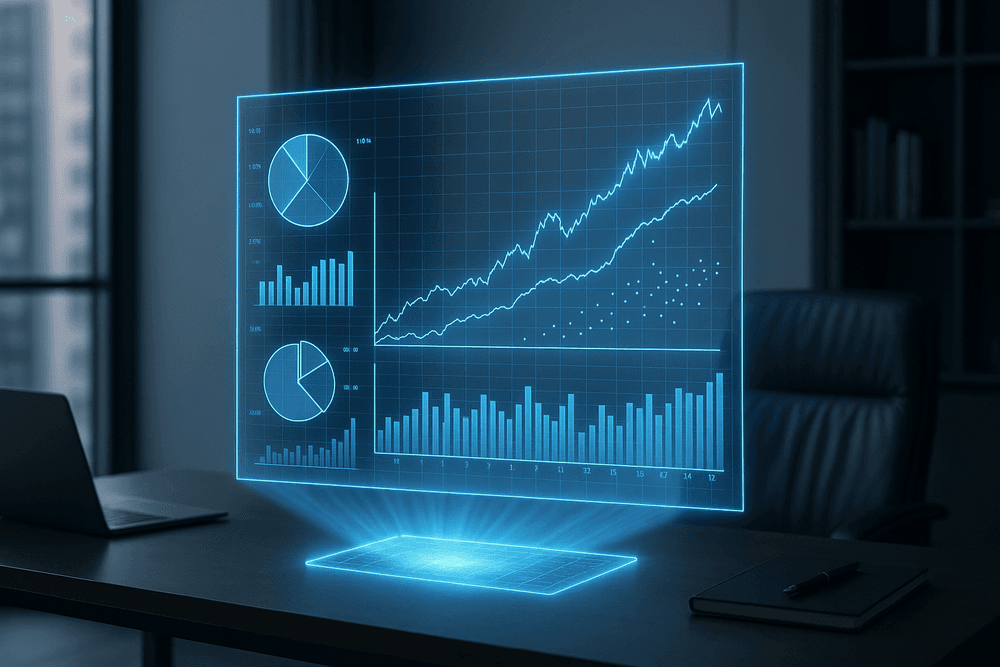
A Strategic Blueprint for Implementing Trend Forecasting AI
Moving from understanding the potential of trend forecasting AI to successfully deploying it requires a clear, actionable strategy. An ad-hoc approach can lead to wasted resources and missed opportunities. This blueprint outlines the critical steps for weaving AI into the fabric of your business, from data collection to strategic implementation.
Integrating AI Insights into the Product Development Lifecycle
To truly unlock its value, trend forecasting AI should not be a siloed function but an integrated partner at every stage of product development.
- Ideation & Discovery: At the very beginning, AI can analyze vast datasets—from social media chatter and search engine queries to patent filings and academic papers—to identify white-space opportunities and nascent consumer needs before they become mainstream. This data-driven approach replaces guesswork with validated starting points.
- Concept Validation: Once you have a product idea, predictive models can be used to forecast its potential market reception. By analyzing historical data on similar product launches and current market sentiment, the AI can score a concept's likelihood of success, helping you prioritize the most promising ventures.
- Go-to-Market Strategy: AI insights are invaluable for optimizing your launch. Trend analysis can pinpoint the perfect market timing, identify the most receptive audience segments for initial targeting, and even suggest marketing language that will resonate most strongly.
- Post-Launch Iteration: The work isn't over after launch. Real-time trend forecasting AI can monitor consumer feedback, competitor movements, and shifting market dynamics, providing continuous insights to guide product updates, feature enhancements, and lifecycle management.
Best Practices for Data Collection and Model Training
The predictive power of your AI is directly proportional to the quality of its data and training. The principle of "garbage in, garbage out" has never been more relevant.
- Diversify Your Data Sources: Relying on a single data stream creates blind spots. A robust trend forecasting AI system should ingest data from multiple sources: social listening tools, e-commerce sales data, search trends, customer service logs, industry reports, and economic indicators. The richer the dataset, the more nuanced the predictions.
- Prioritize Data Hygiene: Raw data is often messy, incomplete, and inconsistent. Invest in processes to clean, normalize, and structure your data before feeding it to the model. This critical step prevents inaccuracies and ensures your AI learns from a reliable foundation.
- Embrace Continuous Training: Trends evolve, and so should your AI model. Implement a feedback loop where the model is continuously retrained with new, incoming data. This agility ensures your trend forecasting AI remains relevant and sharp, adapting to the ever-changing market landscape instead of relying on outdated patterns.
Avoiding Common Pitfalls in Your AI Forecasting Strategy
As you implement your strategy, be mindful of these common challenges:
- The Black Box Problem: Some AI models deliver predictions without explaining their reasoning, making it difficult to trust or act on the insight. Whenever possible, opt for explainable AI (XAI) models that provide transparency into their decision-making process.
- Inherent Data Bias: If your historical data contains biases (e.g., skewed toward a specific demographic), your AI will learn and amplify them. Actively work to de-bias your datasets to ensure fair and accurate forecasts.
- Over-reliance on Automation: Trend forecasting AI is a powerful decision-support tool, not a replacement for human expertise. Use AI to augment your team's intuition and strategic thinking, not to supplant it. The most successful strategies combine machine-scale analysis with human creativity and domain knowledge.
Real-World Impact: Trend Forecasting AI Case Studies
Theory is one thing, but the true power of trend forecasting AI is revealed through its application in the real world. Across diverse industries, businesses are leveraging artificial intelligence to move from reactive decision-making to proactive, data-driven strategy. Let's explore how this technology is creating a tangible impact in fashion, consumer goods, and finance.
How the Fashion Industry Predicts the Next Big Style
The fashion world moves at a breakneck pace, where today’s trend is tomorrow’s old news. Traditionally, designers relied on runway shows, industry insiders, and gut instinct. Today, trend forecasting AI provides a powerful competitive edge. AI platforms analyze millions of data points in real-time, from TikTok videos and Instagram posts to e-commerce search queries and street-style blogs.
By processing this visual and textual data, AI can identify nascent trends before they hit the mainstream. For example, an algorithm might detect a spike in user-generated content featuring a specific shade of green, a particular sleeve style like "puff sleeves," or a renewed interest in a vintage silhouette. Fast-fashion giants and luxury brands alike use these insights to:
- Validate design choices: Confirm that a new collection aligns with emerging consumer tastes.
- Optimize inventory: Produce more of what’s predicted to sell and avoid overstocking on items with waning interest.
- Target marketing campaigns: Reach a specific audience that is already showing organic interest in a micro-trend.
This allows brands to reduce waste, shorten design-to-market cycles, and deliver the styles customers want, exactly when they want them.
Using AI to Forecast Consumer Packaged Goods (CPG) Trends
In the crowded aisles of a supermarket, product success is a battle for consumer attention. Launching a new CPG product is a multi-million dollar gamble. Trend forecasting AI helps stack the odds in a company’s favor by decoding the subtle shifts in consumer behavior.
AI systems sift through an ocean of data, including online grocery carts, product reviews, social media discussions, and health and wellness search trends. The AI might identify a growing conversation around "gut health," connecting it to increased searches for "probiotic snacks" and positive reviews for products containing kombucha or kimchi.
A CPG leader can use this intelligence to confidently invest in developing a new line of fermented beverages or probiotic-infused granola bars. The same trend forecasting AI can also inform packaging design, flavor profiles, and marketing messaging, ensuring the new product resonates deeply with its target demographic long before a single competitor has even noticed the shift.
AI's Role in Anticipating Financial Market Shifts
Nowhere is the speed of information more critical than in financial markets. Here, trend forecasting AI is used to analyze signals that are impossible for human analysts to process at scale. These AI models are trained on decades of historical market data, but their real power lies in processing unstructured, real-time information.
AI algorithms use Natural Language Processing (NLP) to gauge sentiment from news articles, regulatory filings, earnings call transcripts, and even social media platforms like Twitter and Reddit. The AI can detect subtle shifts in tone—from optimistic to cautious—regarding a specific stock or an entire industry sector. By correlating this sentiment data with market movements, the AI can generate predictive alerts for potential volatility or emerging investment opportunities. For hedge funds and investment banks, this form of trend forecasting AI isn't just an analytical tool; it’s an essential component of modern risk management and alpha generation, enabling them to act on market-moving information moments before it becomes common knowledge.

The Future Is Predictive: Your Next Steps in AI Forecasting
The transition from reactive analysis to proactive prediction is no longer a futuristic concept—it’s the new competitive battleground. Embracing this shift means fundamentally rewiring your organization to anticipate what's next. The businesses that thrive will be those that integrate trend forecasting AI into their core strategy, moving from asking "what happened?" to "what will happen, and how can we prepare?" Taking the first steps can feel daunting, but with a strategic approach, you can build a powerful predictive engine that drives growth and innovation. The journey begins with preparing your foundation, choosing a smart starting point, and committing to a cycle of continuous improvement.
Preparing Your Business for a Predictive-First Future
Before you deploy a single algorithm, you must lay the groundwork. Successful AI implementation is built on three pillars: culture, data, and talent.
- Foster a Data-Driven Culture: A predictive-first mindset must permeate every level of your organization. Leadership needs to champion decisions based on data insights rather than solely on gut feelings. Encourage experimentation and create a culture where it's safe to test hypotheses and learn from the results, both good and bad.
- Fortify Your Data Infrastructure: Your trend forecasting AI models are only as good as the data they consume. Break down internal data silos to create a unified, accessible source of truth. Invest in data hygiene processes to ensure your information is clean, accurate, and structured. This initial effort is non-negotiable and pays massive dividends by ensuring your predictions are built on a solid foundation.
- Invest in Human Expertise: Technology alone is not a silver bullet. You need people who can interpret the outputs of AI, ask the right questions, and translate complex insights into actionable business strategies. This may involve upskilling your current teams in data literacy or hiring data analysts and scientists who can bridge the gap between technology and business objectives.
Choosing the Right AI Forecasting Project to Start With
Don't try to boil the ocean. The key to gaining momentum and internal buy-in is to start with a well-defined pilot project that offers a high probability of success. Look for the "low-hanging fruit"—problems where a small, accurate prediction can deliver a significant, measurable impact.
When selecting your first project, consider these criteria:
- High-Impact & Low-Complexity: Target a specific challenge, such as optimizing inventory for a top-selling product category to reduce waste or predicting customer churn for a key segment.
- Data Availability: Choose a problem where you already have a rich, reliable dataset to work with.
- Clear Success Metrics: Define what success looks like before you begin. Will you measure it by a percentage decrease in stockouts, an increase in marketing campaign ROI, or a reduction in customer acquisition costs?
For example, a retail company could use trend forecasting AI to analyze social media mentions, search trends, and past sales data to predict demand for a seasonal product line. A successful forecast would directly lead to optimized stock levels, maximizing sales while minimizing costly overstock.
How to Stay Ahead with Continuous Learning and Adaptation
Implementing your first AI model isn't the finish line; it’s the starting gun. The market, consumer behavior, and technology itself are in a constant state of flux. Long-term success depends on creating a feedback loop of continuous learning and adaptation.
Think of your AI forecasting system as a living entity. You must continuously monitor its performance to detect "model drift"—a decline in accuracy as new, real-world data deviates from the data it was trained on. Schedule regular retraining and refinement to ensure your models remain sharp and relevant.
Furthermore, foster an organizational culture of curiosity. Encourage your teams to stay informed about emerging AI techniques, tools, and platforms. The world of trend forecasting AI is evolving at a breakneck pace. By committing to this ongoing journey of learning and iteration, you don’t just deploy a tool; you build a lasting, adaptive capability that will keep you one step ahead of the curve.