
June 27, 2025
An Introduction to AI Reading Comprehension
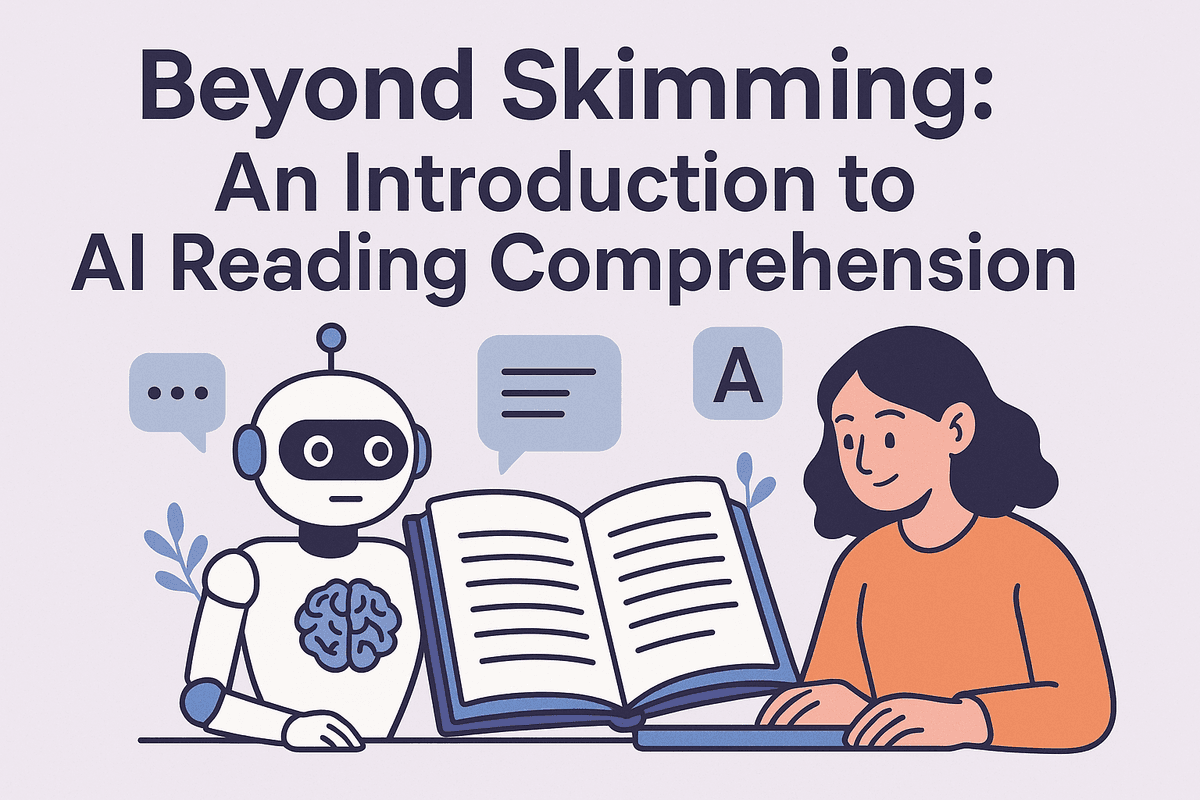
Beyond Skimming: An Introduction to AI Reading Comprehension
We live in an age of information overload. From dense academic papers and lengthy business reports to complex legal documents, the sheer volume of text we’re expected to consume is overwhelming. For decades, our primary coping mechanism has been skimming—a frantic dash for keywords and main ideas that often leaves crucial details behind. But what if we could move beyond this superficial engagement and truly understand complex texts in a fraction of the time? This is the promise of AI reading comprehension.
What is AI Reading Comprehension, Really?
At its core, AI reading comprehension is the advanced capability of artificial intelligence to read, process, and understand human language with a high degree of nuance and contextual awareness. This goes far beyond a simple keyword search (Ctrl+F) or basic text summarization. Powered by sophisticated technologies like Natural Language Processing (NLP) and Large Language Models (LLMs), these AI systems don't just identify words; they grasp concepts, recognize relationships between ideas, interpret tone, and infer meaning.
Think of it as the difference between looking up a word in a dictionary and having an expert explain a complex concept to you. The AI isn’t just pulling out sentences—it’s synthesizing information to provide meaningful, coherent, and accurate insights, much like a human expert would.
How AI is Changing the Way We Interact with Text
Traditionally, reading is a one-way street: we passively consume information from a static document. AI transforms this into a dynamic, two-way conversation. Instead of just reading a 100-page report from start to finish, you can now directly ask it questions:
- "What were the top three risks identified in the third quarter?"
- "Summarize the methodology section of this research paper."
- "Explain the key liabilities in this contract in simple terms."
This interactive approach turns every document into a searchable, intelligent database. It empowers users to instantly locate specific information, clarify complex points, and extract critical insights without getting bogged down in irrelevant details. The focus shifts from the tedious act of finding information to the valuable work of using it.
Why This Matters: A Game-Changer for Students, Researchers, and Professionals
The practical impact of advanced AI reading comprehension is profound and cuts across various fields.
- For Students: It’s like having a personal tutor available 24/7. Students can upload dense textbook chapters or academic articles and ask the AI to explain difficult concepts, generate study questions, or create concise summaries for exam revision. This fosters a deeper understanding and makes learning more efficient and accessible.
- For Researchers: The "publish or perish" culture demands sifting through mountains of existing literature. AI can accelerate this process exponentially, analyzing thousands of studies to identify trends, synthesize findings, and highlight research gaps in minutes. This frees up researchers to focus on what matters most: discovery and innovation.
- For Professionals: In the business world, time is a critical resource. Lawyers can analyze contracts for potential risks, financial analysts can dissect market reports for key data points, and marketers can distill customer feedback for strategic insights. AI delivers the crucial "signal" from the informational "noise," enabling faster, better-informed decisions that drive success.
How Does AI Reading Comprehension Actually Work?
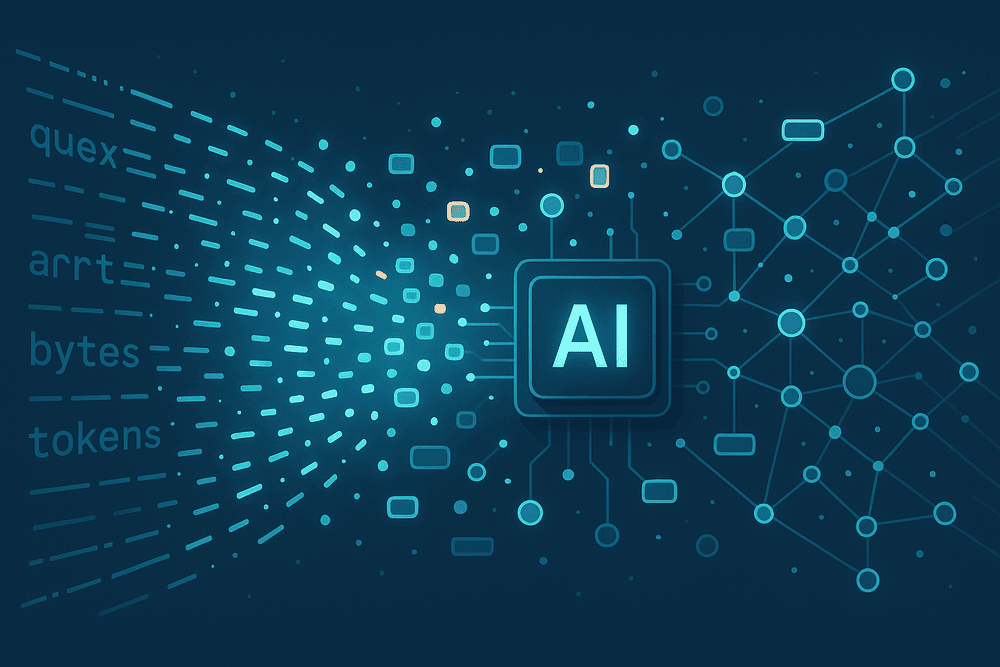
Ever wondered how an app can digest a dense, 20-page report and give you the key takeaways in seconds? It isn't magic; it's a sophisticated field of artificial intelligence called Natural Language Processing (NLP). This is the core technology that gives machines the power of ai reading comprehension, transforming a chaotic jumble of text into structured, meaningful information. It’s the engine that drives a machine’s ability to read, interpret, and understand human language.
The Foundation: Natural Language Processing (NLP)
At its heart, NLP is the bridge that connects human language to computer understanding. Before an AI can comprehend a paragraph, it must first deconstruct it into manageable parts, much like a student learning grammar rules. This process involves several key steps:
- Tokenization: The AI begins by breaking the text down into smaller units called "tokens." These can be words, phrases, or even individual characters. For example, the sentence "AI enhances reading" becomes the tokens "AI," "enhances," and "reading."
- Part-of-Speech (POS) Tagging: Next, each token is tagged with its grammatical role—as a noun, verb, adjective, and so on. This helps the AI understand the sentence's structure and the function of each word.
- Named Entity Recognition (NER): The system then scans for and categorizes proper nouns into predefined groups, such as names of people (Elon Musk), organizations (OpenAI), or locations (California). This creates a structured map of the key players and places within the text.
Deconstructing Complexity with AI Models
Understanding the individual words is just the first step. The true breakthrough in modern ai reading comprehension comes from the ability of advanced AI models, like those based on the "Transformer" architecture, to understand context.
Think of the AI as a meticulous detective. It doesn't just see the word "it"; it actively works to figure out what "it" refers to based on the preceding sentences. It analyzes the relationships between every word in a passage to grasp nuance, irony, and complex sentence structures. This contextual awareness allows the AI to differentiate between "The new policy will impact the budget" and "The asteroid will impact the Earth," understanding the vastly different meanings of "impact" in each context. This deep-seated analysis is what allows AI to move from simply processing words to genuinely comprehending ideas.
From Understanding to Action: What's Possible?
Once an AI model has this deep, contextual grasp of a text, it can perform a stunning range of practical tasks. This is where ai reading comprehension transforms from a technical concept into a powerful, real-world tool.
- Text Summarization: By identifying the most critical sentences and central arguments, the AI can generate concise, accurate summaries that distill lengthy documents into their essential points.
- Sentiment Analysis: The AI can gauge the emotional tone of a text, classifying it as positive, negative, or neutral. This is incredibly useful for businesses analyzing customer reviews or gauging public opinion on social media.
- Question Answering: You can ask direct questions about a document, and the AI will scan its contents to find or even generate the precise answer, acting as an on-demand research assistant.
- Topic Extraction: The model can quickly identify the main themes and keywords within a large body of text, giving you a high-level overview of its contents in an instant.
Unlocking Benefits: Who Gains the Most from AI Reading Comprehension?
The power of AI reading comprehension isn't limited to a single field or demographic; it's a versatile technology that unlocks efficiency and deeper understanding for a wide array of users. From the classroom to the boardroom, artificial intelligence is reshaping how we interact with written information. It acts as a tireless assistant, capable of sifting through mountains of text to find the golden nuggets of insight. Let's explore which groups are positioned to gain the most from this revolutionary tool.
For Students: Mastering Difficult Subjects and Boosting Grades
Students today face an avalanche of information. Between dense textbooks, complex academic journals, and extensive online resources, simply keeping up can be a monumental task. This is where AI reading comprehension becomes a game-changing study partner. Imagine you're tackling a challenging chapter on quantum physics or a 50-page historical document. Instead of rereading paragraphs multiple times, you can use an AI tool to:
- Generate Instant Summaries: Get the core concepts of a chapter in seconds, allowing you to build a foundational understanding before diving into the details.
- Clarify Complex Concepts: Ask the AI to explain a difficult passage in simpler terms or provide an analogy, bridging the gap between confusion and clarity.
- Create Study Aids: Automatically generate flashcards, multiple-choice questions, and key-takeaway lists directly from your study materials. This transforms passive reading into active learning, making exam preparation more effective and less stressful.
By offloading the mechanical aspects of reading and analysis, students can focus their mental energy on critical thinking and mastering the subject matter, leading to better retention and higher grades.
For Professionals: Accelerating Research and Data Analysis
In the professional world, time is money, and information is power. Legal teams, financial analysts, market researchers, and medical professionals spend a significant portion of their day digesting long-form content—from legal contracts and financial reports to clinical studies and competitor analyses. AI reading comprehension streamlines these workflows with incredible speed and accuracy. Professionals can leverage this technology to:
- Expedite Data Extraction: Quickly pull specific figures, names, dates, and clauses from hundreds of pages of documents, minimizing manual effort and human error.
- Identify Trends and Insights: Feed multiple reports into an AI tool to synthesize information and spot emerging market trends, sentiment shifts, or critical research findings that might otherwise be missed.
- Enhance Due Diligence: Rapidly analyze contracts, compliance documents, and case law to identify potential risks, inconsistencies, or key precedents.
This accelerated insight allows professionals to make faster, more informed decisions, giving their organizations a significant competitive edge. It’s no longer about who can read the most, but who can understand the most, the fastest.
For Lifelong Learners: Exploring New Topics Faster Than Ever
Curiosity doesn't end with a diploma. For lifelong learners, the world is a library of endless subjects to explore, from ancient philosophy to the latest advancements in biotechnology. The biggest barrier is often time and the initial learning curve of a new field. AI reading comprehension acts as a powerful catalyst for curiosity, making self-directed education more accessible and enjoyable. A lifelong learner can:
- Get the Gist Instantly: Quickly understand the core arguments of a new book or a complex scientific paper without committing hours to a full read-through.
- Build Foundational Knowledge: Use AI to define key jargon and summarize foundational texts in a new area of interest, making it easier to engage with more advanced material.
- Follow Curiosity's Path: Effortlessly jump between related topics by asking the AI to find and summarize relevant articles, enabling a more dynamic and personalized learning journey.
This technology empowers anyone to dive into new domains with confidence, breaking down barriers and making the pursuit of knowledge a more efficient and rewarding adventure.
The Top AI Reading Comprehension Tools Reviewed
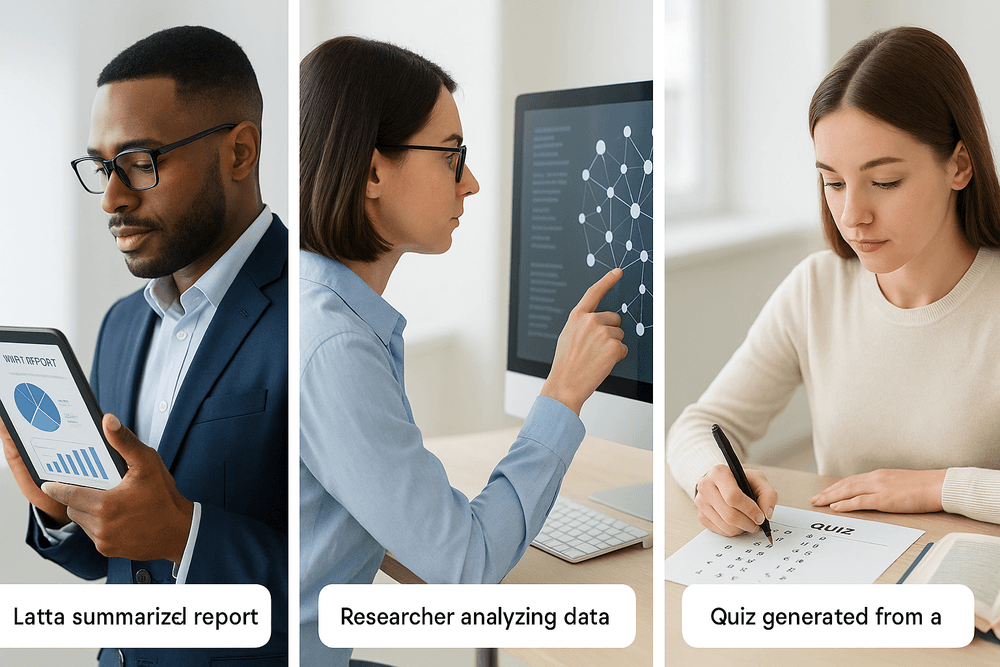
The world of AI reading comprehension tools is expanding rapidly, but not all tools are created equal. The best choice for you depends entirely on your goal. Are you trying to quickly digest a long report before a meeting, conduct a deep dive into academic literature, or actively study for an exam? We’ve broken down the top tools into three distinct categories to help you find the perfect fit for your needs.
Best for Quick Summaries: AI-Powered Summarizers
For professionals, students, and anyone facing information overload, AI summarizers are a game-changer. These tools are designed to distill lengthy documents, articles, or reports into concise, digestible summaries. By leveraging Natural Language Processing (NLP), they identify the core arguments, key talking points, and essential data, saving you hours of reading time.
Most summarizers allow you to paste text or upload a file and receive a summary in seconds. Leading tools in this space often provide customization options, letting you control the length of the summary. For example, you can shrink a 10-page report into a single paragraph for a quick overview or a more detailed one-page brief for a deeper understanding. General AI assistants like ChatGPT and Claude are also exceptionally skilled at this task, making summarization one of the most accessible applications of AI reading comprehension.
Who it's for:
- Busy professionals needing to grasp the essence of reports and emails.
- Students looking for a high-level overview of assigned readings.
- Anyone wanting to stay informed without dedicating hours to reading.
Best for Deep Analysis: Tools for Researchers and Academics
When a simple summary isn’t enough, you need tools built for deep, methodical analysis. This category of AI is specifically designed for researchers, academics, and analysts who must go beyond the surface and interrogate texts for nuanced information. These platforms can scan thousands of documents, identify thematic patterns, extract specific data points, and even help you map out the existing literature on a given topic.
Tools like Elicit and SciSpace act as powerful research assistants. Instead of just shortening a text, they help you ask questions of it. For example, you can upload a dense scientific paper and ask the AI to explain its methodology in simple terms or extract all mentions of a specific variable into a table. This advanced form of AI reading comprehension doesn't just save time; it augments your analytical capabilities, helping you uncover connections and insights you might have otherwise missed.
Who it's for:
- Academics and PhD students conducting literature reviews.
- Legal and financial analysts sifting through complex contracts or reports.
- Market researchers identifying trends from large datasets of text.
Best for Interactive Learning: AI That Generates Questions from Text
Reading is one thing; remembering and understanding is another. The most effective way to solidify knowledge is through active recall, and a new wave of AI tools is built around this principle. These platforms take any piece of text—from a textbook chapter to an online article—and automatically generate a variety of questions, such as multiple-choice, fill-in-the-blank, and open-ended prompts.
This transforms passive reading into an active study session. By engaging with AI-generated questions, you are forced to think critically about the material, check your understanding, and identify areas where you’re still weak. This interactive approach is incredibly effective for students preparing for exams or for professionals needing to master new information for a certification. It’s a practical and powerful application that uses AI to directly enhance your own cognitive skills.
Who it's for:
- Students of all levels studying for tests.
- Corporate trainers and educators creating learning materials.
- Self-learners looking to master new subjects.
Real-World Applications of AI Reading Comprehension
The theoretical power of artificial intelligence is impressive, but its true value is measured by its impact on the real world. AI reading comprehension is no longer a futuristic concept; it's a practical tool actively transforming industries, empowering individuals, and creating new efficiencies. From the high-stakes legal field to the personalized world of education, its applications are both diverse and profound. Let's explore three case studies that showcase how this technology is making a tangible difference today.
Case Study: Analyzing Legal Contracts in Minutes, Not Days
The Challenge: For legal teams, contract review is a critical but notoriously time-consuming process. A single complex agreement can take days or even weeks to analyze, requiring meticulous attention to detail to identify risks, obligations, and non-standard clauses. This manual effort is not only costly in terms of billable hours but also prone to human error, which can have significant financial and legal consequences.
The AI Solution: Legal firms and corporate legal departments are now leveraging advanced ai reading comprehension platforms. Trained on millions of legal documents, these tools can ingest and analyze a 100-page contract in minutes. The AI scans for specific provisions, flags ambiguous language, identifies missing clauses, and even compares the document against a company’s standard playbook. It pinpoints key information like renewal dates, liability caps, and indemnification clauses, presenting them in a clear, digestible dashboard. This application of ai reading comprehension doesn't replace the lawyer but supercharges their ability, handling the painstaking preliminary review with incredible speed and accuracy.
The Impact: The result is a dramatic acceleration of the deal cycle. Lawyers are freed from tedious grunt work, allowing them to focus on higher-value strategic tasks like negotiation and client counsel. Risk is minimized, compliance is easier to verify, and businesses can operate with greater agility and confidence.
Case Study: Helping Students Overcome Reading Challenges
The Challenge: In any classroom, students have a wide range of reading abilities and learning styles. Those with dyslexia, ADHD, or who are learning a new language often face significant hurdles. Traditional teaching methods can struggle to provide the one-on-one, adaptive support each student needs to thrive, potentially leading to frustration and a widening achievement gap.
The AI Solution: Educational technology powered by ai reading comprehension is creating a more inclusive and personalized learning environment. These tools act as a digital reading companion. They can read text aloud at various speeds, highlight words as they are spoken, and provide instant, context-aware definitions for difficult vocabulary. More advanced systems can simplify complex sentences or summarize entire paragraphs on demand, helping students grasp the core ideas without getting bogged down. The technology adapts to the user, offering just enough support to build confidence and foster independent learning.
The Impact: Students are empowered to tackle challenging texts at their own pace. This technology reduces anxiety and builds foundational literacy skills, making learning more accessible and engaging. Teachers can use the data from these tools to better understand individual student needs and tailor their instruction accordingly.
Case Study: Streamlining Market Research for Business Insights
The Challenge: Modern businesses are inundated with a tidal wave of unstructured text data—customer reviews, social media chatter, survey responses, news articles, and industry reports. Manually sifting through this mountain of information to find actionable insights is a Herculean task, making it difficult for companies to keep a real-time pulse on market sentiment and competitive landscapes.
The AI Solution: Market intelligence platforms now use sophisticated ai reading comprehension to automate this entire process. These systems can analyze thousands of data sources simultaneously, performing complex tasks like sentiment analysis to gauge public opinion, topic modeling to identify key themes of discussion, and trend detection to spot emerging consumer needs or competitive threats. Instead of reading endless reports, an analyst can simply ask the AI, "What are the main complaints about our competitor's new product?" and receive a concise, evidence-backed summary in seconds.
The Impact: Businesses can make faster, more data-driven decisions. Marketing teams can refine their messaging based on real-time customer feedback, product developers can identify features that truly resonate with users, and strategists can anticipate market shifts before they become mainstream. This strategic application turns information overload into a distinct competitive advantage.

Conclusion: Your Next Steps to Smarter Reading with AI
We've journeyed through the transformative landscape of AI-powered reading, exploring how this technology deciphers complex texts and delivers powerful insights. But the true value isn't just in understanding how it works—it's in applying it to your daily life. The era of passive reading is ending, replaced by a dynamic, interactive partnership between human intellect and artificial intelligence. Here’s how you can take the next steps to make smarter reading a reality.
Choosing Your AI Reading Companion
Selecting the right tool is the first crucial step. With a growing market, the best choice depends entirely on your unique needs. Don't just pick the most popular option; consider these factors to find your perfect fit:
- Identify Your Primary Goal: Are you a student needing to digest dense textbooks, a researcher sifting through academic papers, or a professional trying to stay ahead of industry reports? A tool designed for academic analysis will have different strengths than one built for quick web article summaries. Your purpose dictates the necessary features.
- Evaluate Core Functions: Do you need robust summarization, deep thematic analysis, a question-answering feature, or data extraction? Make a list of your must-have capabilities. This will help you filter out tools that don’t align with your goals for ai reading comprehension.
- Check for Compatibility: Ensure the tool works with your preferred formats, whether they are PDFs, web pages, EPUBs, or even audio files. Seamless integration into your existing workflow is key to long-term adoption.
- Test the User Experience: A powerful tool is useless if it's clunky and difficult to use. Take advantage of free trials to find an interface that feels intuitive and enhances, rather than complicates, your reading process.
Best Practices for Integrating AI into Your Reading Workflow
Once you’ve chosen a tool, effective integration is essential for maximizing its benefits. AI is a powerful co-pilot, not an autopilot.
- Start Small and Specific: Begin by using your AI tool for a single, low-stakes task, like summarizing a news article or defining key terms in a report. As you grow comfortable, you can expand its role to more complex analytical tasks.
- Be an Active Participant: Never blindly accept an AI's output. Use its summaries as a preview, its analysis as a starting point for your own thoughts, and its Q&A feature to challenge your understanding. The goal of ai reading comprehension is to deepen your engagement, not eliminate it.
- Refine Your Prompts: The quality of your results depends on the quality of your instructions. Instead of a generic "summarize," try "Explain the core argument of this paper and identify its three main supporting points." Specificity is your greatest asset.
- Always Verify Crucial Information: Remember that AI models can make mistakes or "hallucinate" facts. For critical data, quotes, or claims, always cross-reference the output with the source text.
The Future of Reading: What's Next for AI Comprehension?
The current state of ai reading comprehension is just the beginning. The horizon is bright with innovations that will further blur the lines between reading and understanding. We can anticipate AIs that can:
- Grasp Nuance and Intent: Future models will excel at detecting sarcasm, irony, and authorial intent, providing a much deeper and more human-like analysis.
- Synthesize Knowledge Proactively: Imagine an AI that not only understands the document you’re reading but also connects its concepts to your entire library of previously read material, uncovering hidden patterns and fostering unprecedented insight.
- Create Adaptive Learning Paths: AI will personalize the reading experience by identifying your knowledge gaps in real-time and generating custom explanations, examples, and quizzes to ensure you truly master the material.
By embracing these tools thoughtfully and strategically, you are not just keeping pace with technology; you are fundamentally upgrading your ability to learn, innovate, and understand the world. Your journey to smarter reading starts now.