
October 18, 2025
An Introduction to Generative AI Document Retrieval
Beyond Search: An Introduction to Generative AI Document Retrieval
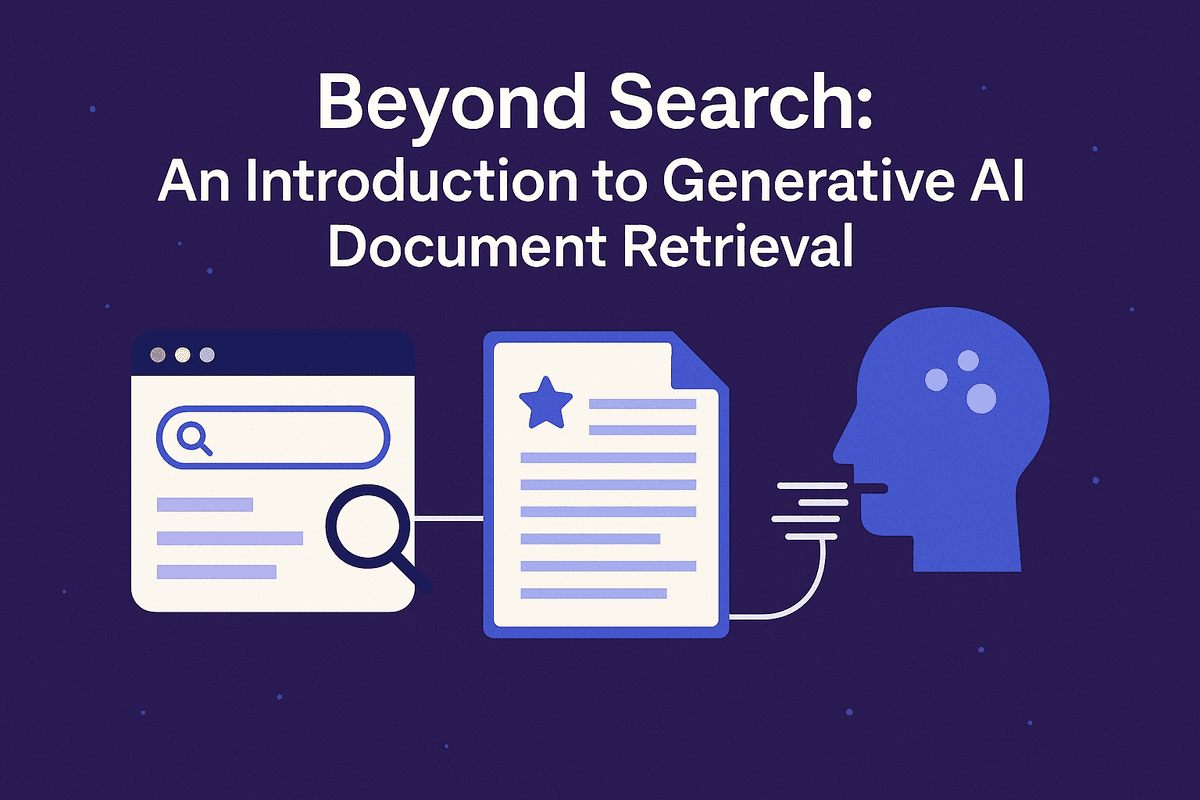
Remember the days of endless Ctrl+F searches? You’d spend hours digging through folders, guessing at keywords, and scanning dense documents, all to find one specific piece of information. You knew the answer was somewhere in your company's digital archives, but finding it felt like a chore. This traditional method of information retrieval is reactive and rigid; you have to think like a machine to get what you need. Today, that paradigm is being completely rewritten. We are moving from the era of manual searching to the age of AI conversations.
What is Generative AI Document Retrieval and Question Answering?
At its core, Generative AI Document Retrieval is a sophisticated system that allows you to have a natural conversation with your documents. Instead of feeding a search bar with keywords and getting a list of links, you ask a direct question in plain language and receive a precise, contextually-aware answer.
This technology operates on a powerful two-step process:
- Intelligent Retrieval: When you ask a question—like "What were our key marketing KPIs in Q4 2023?"—the system first employs advanced algorithms to scan your entire knowledge base (reports, PDFs, presentations, etc.). It doesn't just look for keyword matches; it understands the semantic meaning and intent behind your query to find the most relevant paragraphs and data points, even if they use different wording.
- Generative Answering: This is where Large Language Models (LLMs) come into play. The AI takes the relevant information it just retrieved, synthesizes it, and generates a brand new, coherent, human-like answer. It doesn't just point you to a document; it extracts the exact insight you need and presents it clearly.
This seamless fusion of finding and explaining is the essence of generative AI document retrieval and question answering with LLMs. It transforms your static document repository into a dynamic, interactive knowledge expert.
Why LLMs are a Game-Changer for Accessing Your Data
The integration of LLMs is what elevates this technology far beyond traditional search. They are a game-changer for three primary reasons:
- Deep Contextual Understanding: LLMs grasp nuance, context, and relationships between concepts. You can ask complex, multi-part questions like, "Summarize the legal implications from the latest compliance report and compare them to last year's findings." The model understands each component of the request and how they relate.
- Information Synthesis: An LLM can pull data from multiple sources simultaneously and weave it into a single, comprehensive answer. It can compare clauses from two different contracts, consolidate project updates from a dozen status reports, or create a summary based on hundreds of customer feedback emails—tasks that would take a human hours or even days.
- Conversational Interface: The barrier to accessing information is eliminated. Anyone, regardless of their technical skill, can now query vast and complex datasets simply by asking questions. This democratizes knowledge, empowering every team member to make faster, more data-driven decisions without needing to navigate complex software or folder structures.
How Generative AI and LLMs Power Document Retrieval and Question Answering
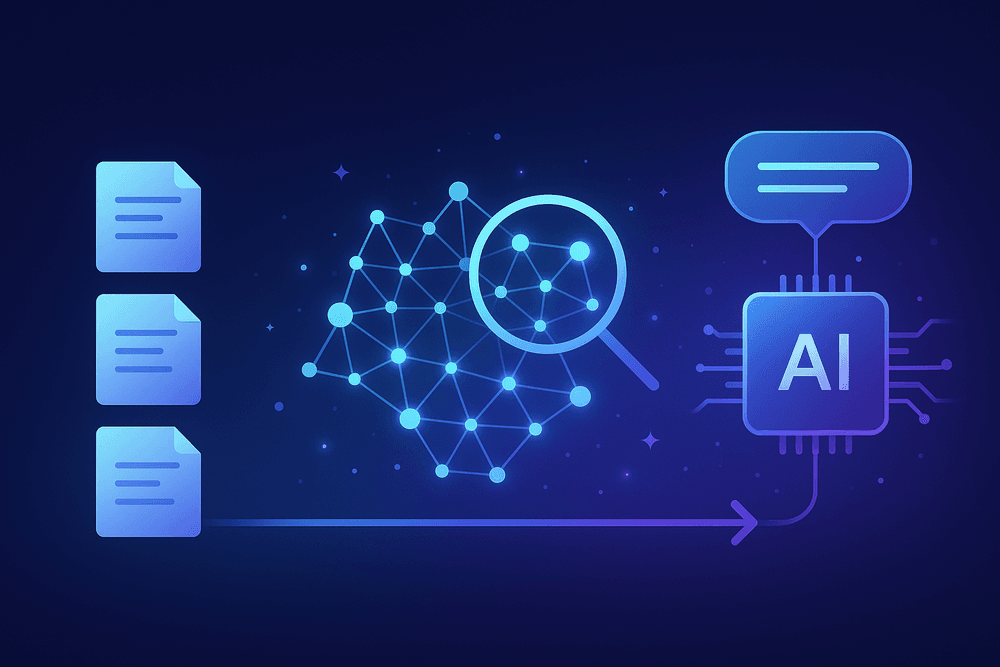
Ever wonder what happens behind the screen when you ask a complex question about a 500-page report and get a perfect, concise answer in seconds? The magic lies in a sophisticated process that blends the best of information retrieval and artificial intelligence. This powerful synergy enables the advanced generative AI document retrieval and question answering with LLMs that is transforming how we interact with data. Let's break down the core engine driving this technology, a framework known as Retrieval-Augmented Generation (RAG).
The Core Concept: Understanding Retrieval-Augmented Generation (RAG)
Retrieval-Augmented Generation, or RAG, is the architectural backbone of modern AI Q&A systems. Think of it as giving a brilliant, open-book exam to a Large Language Model (LLM). Instead of relying solely on its vast but generic pre-trained knowledge, the LLM is first given the specific "book" (your documents) to find the relevant facts.
This two-step process—first retrieving relevant information, then generating an answer based on it—is crucial. It grounds the LLM's response in factual, verifiable data from your document set, dramatically reducing the risk of "hallucinations" (the AI inventing information) and ensuring the answers are accurate and contextually relevant to your specific needs.
Step 1: Creating Vector Embeddings to Index Your Documents
Before you can ask any questions, the AI needs to read and understand your documents. It does this not by memorizing words, but by capturing meaning. This is achieved through a process called "embedding."
First, your documents are broken down into manageable chunks of text. Then, a specialized AI model called an embedding model converts each chunk into a numerical representation known as a "vector embedding." This vector is essentially a long list of numbers that acts as a unique semantic fingerprint for that piece of text. Chunks with similar meanings will have mathematically similar vectors, regardless of the specific keywords used. All these vectors are then stored and organized in a specialized "vector database," creating a highly efficient, searchable map of your entire document library based on meaning.
Step 2: Using Semantic Search to Find Relevant Context
This is the "Retrieval" phase of RAG. When you ask a question, the system doesn’t perform a simple keyword search. Instead, it first converts your question into its own vector embedding using the same model.
Next, it performs a "semantic search" by comparing your question's vector against all the document vectors in the database. The system calculates the "distance" or "similarity" between the vectors, instantly identifying the document chunks whose meanings are closest to your query. This is far more powerful than a keyword search, as it understands intent and context. For example, a query about "last year's earnings" will find sections discussing "annual financial performance for 2023." The most relevant text snippets are then collected to serve as the context for the final step.
Step 3: Generating Human-Like Answers with LLMs
With the most relevant context in hand, we move to the "Generation" phase. The system takes the retrieved text snippets and bundles them with your original question into a new, highly specific prompt for a Large Language Model (LLM) like GPT-4.
The instruction to the LLM is precise: "Using only the provided information, answer this user's question." The LLM then synthesizes the facts from the retrieved context, weaving them into a coherent, well-structured, and human-like answer. This final step is what makes the system so effective—it doesn't just point you to a relevant page; it delivers the exact answer you're looking for, backed by the data in your own documents.
Key Capabilities Unlocked by Generative AI Document Retrieval
Traditional document search is a relic of a bygone era, forcing you to think like a machine—guessing keywords and sifting through endless lists of results. Generative AI document retrieval revolutionizes this process, transforming your document repository from a static archive into a dynamic, interactive knowledge base. It’s not just about finding documents faster; it’s about understanding the information within them on a completely new level. Here are the core capabilities that make this technology a game-changer.
Ask Complex, Natural Language Questions—Not Just Keywords
The most significant leap forward is the ability to communicate with your data conversationally. Instead of typing restrictive keywords like "Q3 sales report," you can now ask nuanced, complex questions just as you would ask a human expert.
For instance, you can pose a query like: "Compare the key findings from our latest market research report with the customer feedback trends from the last six months, and identify any conflicting insights."
This is the power of advanced question answering with LLMs. The system doesn't just match words; it comprehends intent, context, and the relationships between different concepts across your documents. It understands what you’re truly looking for, enabling a far more intuitive and effective search experience.
Receive Precise, Context-Aware Answers with Source Citations
Forget wading through entire documents to find a single sentence. A generative AI document retrieval system synthesizes information from one or multiple sources to provide a direct, concise, and contextually relevant answer. When you ask about the primary risks outlined in a project proposal, you get a clear, synthesized list of those risks—not just a link to the document.
Crucially, these systems provide verifiable trust. Every generated answer is accompanied by citations that point directly to the source passages in the original documents. This transparency is vital for business-critical applications, allowing you to validate information, dig deeper when needed, and maintain complete confidence in the accuracy of the results.
Automate Document Summarization and Insight Extraction
Beyond answering specific questions, this technology acts as a tireless analyst. You can instantly generate executive summaries of lengthy reports, distill the key takeaways from hours of meeting transcripts, or get the gist of complex legal contracts in seconds. This capability dramatically accelerates research and decision-making.
Furthermore, it excels at insight extraction. The AI can be tasked to systematically scan thousands of documents to pull out specific information—like identifying all contractual obligations due in the next quarter, extracting key financial metrics from earnings reports, or detecting emerging themes from a mountain of customer support tickets.
Integrate with APIs for Seamless Workflow Automation
The true power of generative AI document retrieval is unlocked when it’s integrated into your existing workflows. Using APIs, you can embed this intelligent search capability directly into the applications your team uses every day. Imagine a customer support agent’s CRM automatically surfacing relevant troubleshooting steps from a technical knowledge base based on a new ticket’s description. Or a Slackbot that can instantly summarize a project’s status by pulling data from meeting notes, project plans, and status reports. This integration transforms the technology from a standalone tool into an embedded intelligence layer that boosts productivity across your entire organization.
Best Practices for Implementing Your Q&A System with LLMs
Building a powerful document Q&A system goes beyond simply connecting a model to your data. Success hinges on a series of deliberate choices and best practices that ensure accuracy, relevance, and reliability. From selecting your core technology to refining your prompts, here’s how to build a state-of-the-art system.
Choosing the Right LLM and Vector Database for Your Project
Your technology stack is the foundation of your system. The right choices depend on your project's specific needs for performance, cost, and control.
- Large Language Models (LLMs): You have two primary paths.
- Proprietary Models: Services like OpenAI's GPT-4 or Anthropic's Claude 3 offer top-tier performance and are easy to integrate via APIs. They are ideal for projects that prioritize cutting-edge accuracy and rapid development over cost and data privacy.
- Open-Source Models: Models like Llama 3 or Mistral provide greater control, enhanced privacy (as you can host them yourself), and can be more cost-effective at scale. This path requires more technical expertise for setup, maintenance, and potential fine-tuning.
- Vector Databases: This is where the "memory" of your documents lives. A vector database stores document embeddings for fast and scalable similarity searches.
- Managed Services: Pinecone and Weaviate offer cloud-based, scalable solutions that are easy to manage.
- Self-Hosted Options: ChromaDB and FAISS are excellent choices if you want to run the database within your own infrastructure, giving you full control over your data environment.
Best Practices for Preparing and Chunking Your Documents
The principle of "garbage in, garbage out" is especially true here. The quality of your data preparation directly impacts the quality of your answers.
- Data Cleaning: Start by pre-processing your documents. This involves removing irrelevant content like headers, footers, and advertisements; correcting errors from OCR (Optical Character Recognition) scans; and standardizing the text format.
- Strategic Chunking: LLMs have limited context windows, so you must break large documents into smaller, semantically meaningful pieces. Avoid arbitrary fixed-size chunks that can split sentences or ideas. Instead, use more sophisticated methods:
- Recursive Chunking: This method attempts to keep paragraphs and sentences intact by recursively splitting the text along natural boundaries.
- Content-Aware Chunking: For structured documents like HTML or Markdown, chunking based on headings or sections preserves the document's logical structure.
Crafting Effective Prompts for Accurate Question Answering
Your prompt is the instruction set that guides the LLM's reasoning process. A well-crafted prompt is critical for extracting accurate, context-bound answers. A standard Retrieval-Augmented Generation (RAG) prompt should include:
- Clear Instruction: Explicitly tell the model its role. For example: "You are a helpful assistant. Answer the user's question based only on the provided context."
- Context: Insert the relevant document chunks retrieved from your vector database. Use clear delimiters like
---CONTEXT---to separate it from the rest of the prompt. - The Question: The user's original query.
To further improve accuracy, add constraints like, "If the information is not present in the context, respond with 'I do not have enough information to answer that question.'" This simple instruction is one of the most effective ways to reduce model hallucinations.
Evaluating Answer Quality and Mitigating Hallucinations
Deploying your system is just the beginning. Continuous evaluation is essential for building a trustworthy generative AI document retrieval and question answering with LLMs solution.
- Evaluation Frameworks: Use frameworks like RAGAs (Retrieval-Augmented Generation Assessment) to measure performance. Key metrics include:
- Faithfulness: Does the answer contradict the provided context?
- Answer Relevancy: Is the answer directly relevant to the user's question?
- Context Precision: Were the retrieved chunks actually relevant to the question?
- Mitigating Hallucinations: Beyond strong prompting, you can ground the model in reality by forcing it to cite its sources. Program the system to return both the answer and a reference to the specific document chunk(s) it used. This allows users to verify the information and builds trust in your system's output.
Real-World Use Cases: Generative AI Document Retrieval in Action
The theory behind AI-powered document analysis is impressive, but its true value emerges when applied to solve tangible business problems. Across industries, organizations are deploying generative AI document retrieval systems to transform complex, data-intensive workflows into simple, conversational queries. Let's explore how this technology is making a significant impact in four key sectors, showcasing the power of question answering with LLMs on specialized datasets.
Legal Tech: Instantly Find Precedents in Case Law Archives
The legal profession runs on precedent. Historically, legal research involved paralegals and junior associates spending countless hours sifting through immense archives of case law, statutes, and legal opinions. This process was not only time-consuming but also prone to human error, where a critical but obscure case could be easily missed.
Generative AI document retrieval revolutionizes this process. Law firms can now build systems that ingest terabytes of legal documents. A lawyer can simply ask a natural language question like, "Find all appellate court decisions in the Ninth Circuit regarding copyright fair use for educational materials in the last decade." The system doesn't just return a list of documents; it uses an LLM to synthesize the findings, highlight key arguments, and provide direct quotes with citations, dramatically accelerating research and case preparation.
Customer Support: Powering Chatbots with Your Internal Knowledge Base
Standard chatbots often frustrate customers with rigid, pre-programmed responses that fail to address specific issues. They can't understand nuance and typically fall back to, "Let me connect you with a human agent," increasing wait times and operational costs.
This is where question answering with LLMs changes the game. By connecting a generative AI model to a company’s internal knowledge base—including product manuals, troubleshooting guides, FAQs, and policy documents—a simple chatbot transforms into a hyper-intelligent virtual agent. A customer can ask, "My Model X-45 printer is showing error code B204 after I replaced the ink. How do I fix it?" The AI can retrieve the relevant steps from multiple documents, synthesize a clear, step-by-step solution, and present it conversationally, providing 24/7, expert-level support.
Healthcare: Answering Complex Queries from Medical Research Papers
The pace of medical innovation is staggering, with thousands of new research papers published weekly. It's impossible for clinicians and researchers to stay fully abreast of every development. This information overload can delay the adoption of new treatments and research breakthroughs.
With a specialized generative AI document retrieval system, medical institutions can index vast libraries of clinical trials, pharmaceutical studies, and peer-reviewed journals. This allows a researcher to ask highly specific questions, such as, "What is the documented efficacy of immunotherapy combination therapies for non-small cell lung cancer in patients with a PD-L1 expression over 50%?" The system can provide a synthesized summary of the latest findings, compare results from different studies, and link directly to the source papers, empowering evidence-based medicine and accelerating research.
Finance: Analyzing Financial Reports and Compliance Documents at Scale
Financial analysts and compliance officers are tasked with navigating a sea of dense, unstructured data—from quarterly 10-K reports and earnings call transcripts to constantly evolving regulatory frameworks. Extracting critical insights for due diligence, risk assessment, and compliance checks is a monumental task.
AI-powered retrieval systems can ingest and understand this complex financial and regulatory language. An analyst can instantly query a collection of reports: "Summarize the primary risk factors related to supply chain disruptions mentioned in the last five annual reports for Company ABC." The LLM can extract and consolidate this information in seconds. Similarly, a compliance officer can verify adherence to a new regulation across thousands of internal policy documents, mitigating risk and ensuring an agile response to market changes.

Conclusion: Your Next Steps in AI-Powered Document Analysis
We've journeyed through the powerful landscape of AI-driven document intelligence, moving far beyond traditional keyword searches into an era of conversational, contextual understanding. Your organization's vast repositories of contracts, reports, and manuals are no longer static archives but dynamic sources of knowledge waiting to be unlocked. The path forward is clear: harnessing this technology is a critical step toward a more efficient, informed, and competitive future. Now, let’s translate that potential into action.
Recap: The Transformative Power of Generative AI for Documents
At its core, the revolution lies in shifting from "finding documents" to "getting answers." By implementing generative AI document retrieval and question answering with LLMs, you empower your teams to ask complex questions in natural language and receive synthesized, accurate answers pulled directly from your proprietary data. This technology doesn't just locate a file; it reads, understands, and reasons with the information inside, saving countless hours and surfacing insights that were previously buried. It’s the difference between being handed a library and having a conversation with the librarian who has read every book.
How to Build a Proof-of-Concept for Your Business
Embarking on this journey doesn't require a massive, enterprise-wide overhaul. A targeted Proof-of-Concept (PoC) is the most effective way to demonstrate value and build momentum.
- Identify a High-Impact Use Case: Start small. Choose a domain with clear pain points, such as HR teams answering policy questions, support agents referencing technical manuals, or legal departments reviewing contracts.
- Select a Focused Document Set: Gather a clean, representative collection of 50-100 documents relevant to your chosen use case.
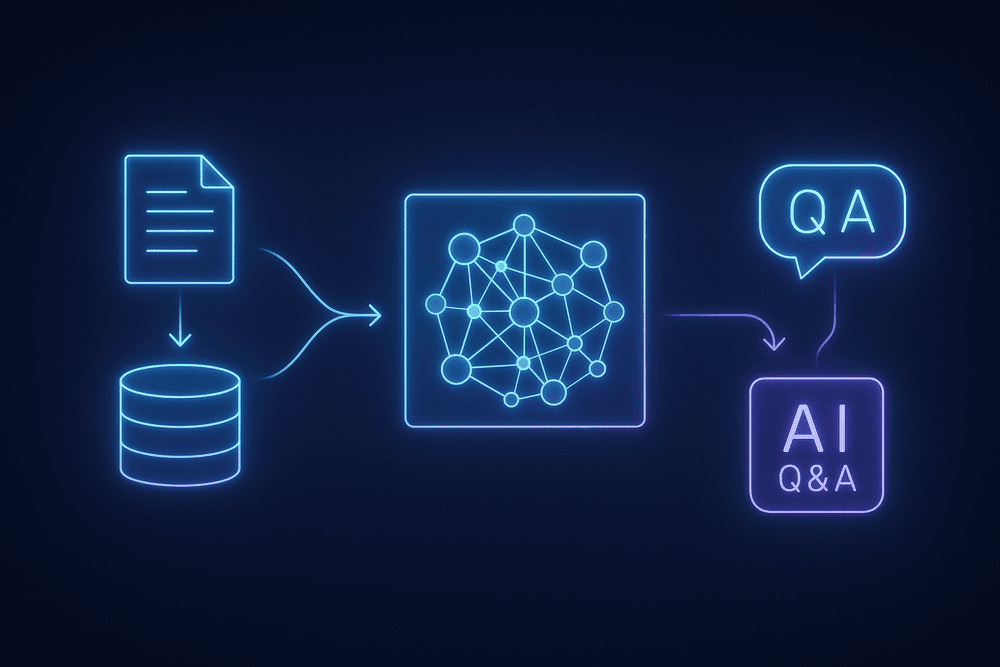
- Leverage an Accessible Tech Stack: Use open-source frameworks to build a simple retrieval-augmented generation (RAG) pipeline. This involves embedding your documents, storing them in a vector database, and connecting them to an LLM.
- Test and Gather Feedback: Deploy the PoC to a small group of users. What questions are they asking? Are the answers accurate and helpful? Use this feedback to refine your system and prove its ROI.
The Future Outlook for LLMs in Enterprise Knowledge Management
The current capabilities are just the beginning. The future of enterprise knowledge management is proactive, not just reactive. We can expect to see LLM-powered systems that automatically summarize daily changes in project documentation, proactively flag conflicting information across different reports, and even anticipate questions before they are asked. Furthermore, multi-modal systems will emerge, allowing you to ask questions about images, charts, and tables within your documents, creating a truly unified and intelligent knowledge base that powers every facet of your business.
Start Your Journey: Recommended Tools and Frameworks
Ready to build? The ecosystem of tools is mature and accessible. Here are the key components to explore for your first project in generative AI document retrieval and question answering with LLMs:
- Orchestration Frameworks: These are the "glue" that connects all the components.
- LangChain: A versatile framework for developing applications powered by language models.
- LlamaIndex: A data framework specifically designed for connecting custom data sources to LLMs.
- Vector Databases: These specialized databases store your document embeddings for efficient and scalable retrieval.
- Pinecone, Weaviate, ChromaDB: Popular choices offering both cloud and self-hosted options.
- LLM Providers: The "brains" of the operation.
- OpenAI, Anthropic, Cohere, Google: Leading API providers for powerful, state-of-the-art models.
- Hugging Face: A hub for thousands of open-source models that you can host yourself for greater data privacy and control.