
August 31, 2025
What is AI Contract Review?
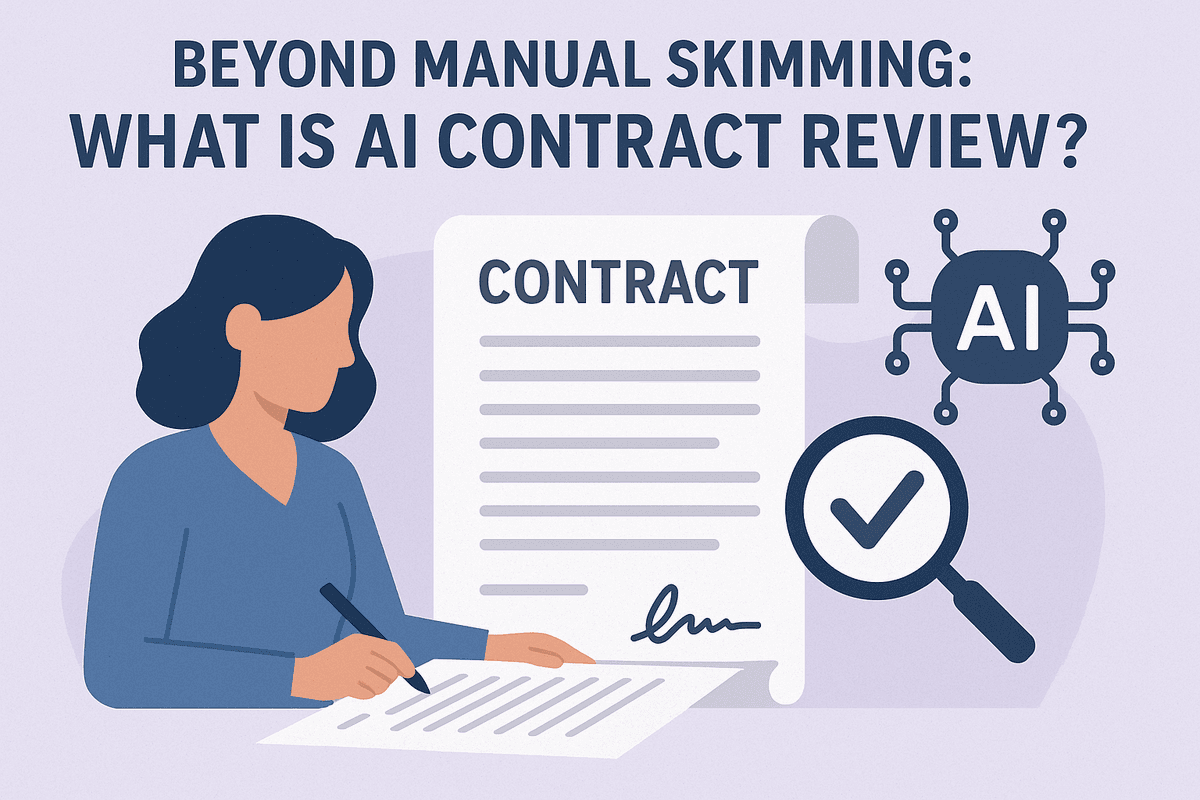
Beyond Manual Skimming: What is AI Contract Review?
For decades, contract review has been a rite of passage for legal professionals—a meticulous, often grueling process involving red pens, late nights, and the ever-present risk of human error. The traditional method involves manually reading every line of dense legal text to identify risks, obligations, and non-standard clauses. While diligent, this approach is slow, expensive, and simply can't keep pace with the modern speed of business.
Enter AI contract review.
At its core, AI contract review is the use of artificial intelligence technology to automate the analysis of legal agreements. It’s not just a sophisticated search function; it’s a cognitive technology that reads, understands, and interprets contract language much like a human lawyer would, but with unparalleled speed and accuracy. This technology transforms the review process from a reactive, manual task into a proactive, data-driven strategy.
The Engine Under the Hood: NLP and Machine Learning
The magic behind AI contract review isn’t magic at all—it's a powerful combination of two core technologies:
- Natural Language Processing (NLP): This is the branch of AI that gives computers the ability to understand text and spoken words in the same way human beings can. In contract review, NLP allows the software to go beyond keywords to comprehend context, semantics, and legal nuances. It can differentiate between an "indemnity" clause that favors you versus one that puts you at significant risk, or identify a "termination for convenience" clause even if the exact phrase isn't used.
- Machine Learning (ML): This is what makes the AI smart and adaptable. AI contract review platforms are trained on massive datasets containing hundreds of thousands or even millions of legal documents. Through this training, the ML models learn to recognize patterns, identify standard clause language, and flag deviations or anomalies that could represent risk. The system continuously improves, learning from new contracts and user feedback to become even more precise over time.
Why Spreadsheets and Ctrl+F Fall Short
Many teams still rely on a patchwork of older tools, believing they are "good enough." However, these methods create significant blind spots.
A spreadsheet, for instance, is a static tracking tool. It’s useful for logging key dates and obligations after a human has manually identified them. But it cannot proactively find that information for you, nor can it analyze the risk level of a limitation of liability clause. It’s a passive repository, entirely dependent on error-prone manual data entry.
Similarly, the simple "find" command (Ctrl+F) is critically limited. It can only locate exact keyword matches. If you search for "confidentiality," you will miss any clause titled "Proprietary Information" or "Non-Disclosure." It lacks the contextual understanding to grasp concepts. This is where AI contract review provides a quantum leap forward. It doesn’t just find words; it identifies legal concepts, clauses, and risks, regardless of the specific phrasing used, ensuring nothing critical is ever missed.

The Business Case: Top Benefits of AI Contract Review
Adopting AI for contract review isn't just about implementing new technology; it’s a strategic business decision that delivers a powerful return on investment. By moving beyond the limitations of manual processes, organizations can unlock significant improvements in speed, risk management, cost efficiency, and compliance. The business case is clear: leveraging AI contract review transforms your legal function from a cost center into a strategic business enabler. Here are the top benefits that drive this transformation.
Accelerate Review Cycles from Weeks to Minutes
Traditional contract review is a notorious bottleneck. Legal and procurement teams can spend days, or even weeks, poring over dense legal documents, creating delays that stall sales cycles, slow down partnerships, and frustrate stakeholders. This is where AI delivers its most immediate and dramatic impact.
An AI contract review platform can perform an initial analysis of a complex, 50-page agreement in a matter of minutes. The system automatically flags key clauses, identifies deviations from your standard playbook, and presents a summarized risk assessment. This incredible speed slashes review times by over 90%, empowering your team to clear backlogs, accelerate deal velocity, and recognize revenue faster. Instead of being a roadblock, the legal review becomes a swift and efficient checkpoint.
Mitigate Risks with Comprehensive Clause Analysis
Even the most diligent human reviewer can miss a critical detail when faced with a mountain of contracts. Fatigue, time pressure, and the sheer complexity of legal language make human error a significant and unavoidable risk. AI, however, is tireless and exceptionally thorough.
AI platforms analyze contracts with a level of scrutiny that is impossible to replicate manually. They meticulously scan every line, identifying non-standard terms, ambiguous wording, and missing critical clauses (like limitation of liability or data privacy protections). By comparing the document against your pre-defined risk policies and a massive database of market standards, the AI provides a comprehensive and objective risk score. This ensures that no hidden liabilities or unfavorable terms go unnoticed, dramatically strengthening your negotiation position and protecting your business from future disputes.
Reduce Legal Spend and Operational Overhead
The financial impact of implementing an AI contract review solution is tangible and multifaceted. By automating the time-consuming first-pass review, you significantly reduce your reliance on expensive outside counsel for routine contract work. This translates directly to lower legal bills and more predictable budgeting.
Internally, the efficiency gains reduce operational overhead. When your in-house counsel and contract managers can finalize reviews in a fraction of the time, they are free to focus on high-value, strategic initiatives—like complex negotiations, corporate governance, and proactive risk mitigation—instead of administrative tasks. This optimization of valuable resources maximizes the productivity and impact of your entire legal department.
Ensure Organization-wide Compliance and Standardization
For any growing business, maintaining consistency and compliance across all agreements is a monumental challenge. Without a centralized system, different departments or individuals may accept varying levels of risk, leading to a fragmented and unpredictable contractual landscape.
AI enforces standardization by acting as a central guardian of your legal playbook. The platform ensures that every single contract—from sales agreements to vendor contracts—is automatically vetted against the same set of approved standards and policies. This creates an unparalleled level of organizational consistency, simplifies audit preparations, and provides leadership with a clear, data-driven overview of the company’s contractual obligations and overall risk exposure.
Core Features to Look For in AI Contract Review Software
Navigating the market for AI contract review software can be overwhelming. While many tools promise to accelerate your legal workflows, the most impactful platforms share a set of core functionalities. These features are what transform AI from a simple document scanner into a strategic partner for your legal and business teams. When evaluating solutions, prioritize these four non-negotiable capabilities.
Automated Redlining and Deviation Analysis
The days of manually comparing a third-party contract against your company’s standard agreement, line by line, are over. A top-tier AI contract review platform automates this entire process. It instantly redlines the incoming document, highlighting every clause that deviates from your approved templates or legal positions.
But simple redlining is just the start. Advanced systems provide deviation analysis, which goes a step further by explaining how and why a clause is problematic. For example, it won’t just flag an unfamiliar limitation of liability clause; it will identify it as non-standard, assess its risk level based on your playbook, and may even suggest pre-approved fallback language to propose as an alternative. This capability dramatically reduces the time reviewers spend on initial assessment, allowing them to focus immediately on substantive negotiation points.
Customizable Risk Scoring and Alert Systems
Not all contractual risks are created equal. An effective AI tool acts as a sophisticated risk barometer, not just a proofreader. Look for software that offers customizable risk scoring. This allows you to configure the system according to your company’s specific risk appetite. You can define what constitutes a high, medium, or low-risk issue—for instance, an unlimited indemnity clause might be automatically tagged as "High-Risk," while a non-standard notice period is flagged as "Low-Risk."
This scoring system should be coupled with an intelligent alert system. High-risk agreements can be automatically escalated to senior counsel, while low-risk contracts, like standard NDAs, can be routed for faster approval. This triage functionality ensures that legal experts spend their valuable time on the most complex and dangerous agreements, mitigating risk far more effectively across the organization.
Centralized Clause Library and Playbook Integration
The "brain" behind any powerful AI contract review software is its integration with your legal playbook. A centralized clause library serves as the single source of truth for your organization's negotiating positions. It houses all your standard clauses, preferred fallback options, and crucial negotiation guidance.
When the AI identifies a non-compliant clause in a third-party contract, it doesn't just flag it; it cross-references it with your playbook. The system can then instantly suggest the approved replacement language directly within the document. This seamless integration ensures consistency across all contracts, standardizes your company’s legal posture, and empowers commercial teams to handle minor negotiations confidently without constant legal oversight.
Advanced Data Extraction for Key Dates and Obligations
A contract's life doesn't end at signature. Its true value—and risk—is realized over its entire lifecycle. That's why advanced data extraction is a critical feature. After a contract is finalized, the AI should be able to automatically parse the document and extract key metadata and obligations.
This includes critical information like renewal dates, termination notice periods, payment terms, confidentiality expiration, insurance requirements, and reporting deadlines. By pulling this data out of a static PDF and structuring it, the software transforms the contract into an actionable asset. This information can then be fed into a contract lifecycle management (CLM) system or dashboard to trigger reminders, monitor compliance, and provide a clear overview of your entire portfolio of contractual obligations, preventing costly missed deadlines and ensuring you capture all entitled revenue.

Putting Theory into Practice: AI Contract Review Use Cases
The true power of AI contract review technology becomes clear when you see it in action. While the applications are vast, several key use cases demonstrate how businesses are transforming their legal and operational workflows. By moving from manual, time-intensive processes to automated, intelligent analysis, companies can unlock significant value and gain a powerful competitive edge.
Streamlining M&A Due Diligence
Mergers and acquisitions live and die by the due diligence process. Traditionally, this involves armies of lawyers and paralegals manually sifting through thousands of contracts in a data room—a process that is incredibly slow, expensive, and susceptible to human error. A single missed change of control clause or an unusual indemnification term can have catastrophic financial consequences post-acquisition.
This is where AI contract review acts as a force multiplier. An AI platform can ingest and analyze an entire data room in a matter of hours, not weeks. It automatically identifies and flags critical provisions, risks, and deviations from standard terms. This allows the M&A team to focus their expertise on strategic analysis rather than document discovery, dramatically accelerating the deal timeline, reducing legal spend, and providing a far more comprehensive risk profile.
Managing High-Volume Procurement and Sales Agreements
For sales and procurement departments, contract velocity is everything. Delays in reviewing Master Service Agreements (MSAs), Statements of Work (SOWs), or Non-Disclosure Agreements (NDAs) can stall revenue and disrupt supply chains. Legal teams often become a bottleneck, struggling to keep up with the sheer volume of incoming agreements.
By implementing an AI contract review solution, businesses can automate the initial pass of these high-volume contracts. The AI checks incoming third-party paper against the company’s pre-approved legal playbook, instantly highlighting non-compliant clauses or missing language. This allows legal professionals to practice "management by exception," focusing only on the high-risk issues that require human negotiation. The result is a faster sales cycle, more consistent risk management, and a legal team freed up for more strategic work.
Automating Lease Abstraction for Real Estate Portfolios
Commercial real estate portfolio management depends on accurate data extracted from complex lease agreements. Manually abstracting key dates, financial obligations, and tenant rights (like renewal options or CAM charges) is a tedious, repetitive, and error-prone task.
An AI contract review platform automates this entire process. The software intelligently scans lease documents, accurately extracts dozens of critical data points, and populates them into a centralized database or property management system. This not only saves thousands of hours of manual labor but also ensures the data driving financial forecasts and operational decisions is accurate and reliable, preventing costly mistakes like missed rent escalations or renewal deadlines.
Ensuring Compliance for Regulatory Audits
Navigating the complex web of regulations like GDPR, CCPA, and HIPAA is a major challenge. Preparing for an audit or responding to a regulatory inquiry often requires a frantic search through countless contracts to find specific data processing clauses, liability limitations, or security obligations.
With AI contract review, this process becomes proactive and streamlined. The software can be trained to conduct a comprehensive search across the entire contract repository for specific regulatory language. It can quickly identify agreements that lack necessary data privacy addendums or contain non-compliant terms, allowing for swift remediation. This capability is crucial for demonstrating compliance, minimizing the risk of hefty fines, and building a robust, defensible compliance posture.
Implementing AI Contract Review: A Practical Guide
Transitioning to an AI-powered workflow is more than just buying software; it's about strategic implementation. A thoughtful approach ensures you not only select the right tool but also maximize its value from day one. This practical guide breaks down the process into four critical stages, from selection to seamless integration.
Choosing the Right AI Contract Review Software
Not all AI platforms are created equal. The best ai contract review tool is the one that aligns perfectly with your unique operational needs. Before you commit, evaluate potential solutions against these key criteria:
- Contract Specialization: Does the software excel at analyzing the contract types you handle most frequently? Whether it's NDAs, MSAs, SOWs, or complex procurement agreements, ensure the AI has been trained on relevant data sets.
- Customization and Training: A crucial feature is the ability to train the AI on your organization's specific legal playbook. Can you teach it to recognize your preferred clauses, flag unacceptable terms, and understand your unique risk tolerance?
- Integration Capabilities: The software must fit into your existing tech stack. Look for native integrations with your Contract Lifecycle Management (CLM) system, document repositories (like SharePoint or Google Drive), and CRM platforms (like Salesforce).
- User Experience (UX): An intuitive interface is essential for adoption. The platform should be easy for both legal professionals and business users (such as sales or procurement teams) to navigate and understand its outputs.
Launching a Successful Pilot Program
A pilot program is the best way to validate your chosen solution and build internal momentum. Instead of a company-wide rollout, start with a controlled test to prove the concept and refine your process.
- Define Clear Objectives: What does success look like? Aim for specific, measurable goals, such as "Reduce NDA review time by 40%" or "Increase compliance with our standard payment terms by 95%."
- Assemble a Pilot Team: Select a small, dedicated group of users who are representative of the larger team. Include an internal champion who can advocate for the technology.
- Start with a High-Volume, Low-Complexity Use Case: NDAs are a classic starting point. Their high volume and standardized nature provide an excellent opportunity to demonstrate quick wins and build confidence in the ai contract review process.
- Measure, Gather Feedback, and Iterate: Track your predefined metrics closely. Actively solicit feedback from your pilot team on what works and what doesn't. Use this data to fine-tune your workflows before a broader launch.
Best Practices for Training the AI on Your Legal Playbook
An AI is only as smart as the data it learns from. To get precise and reliable results, you must effectively teach it your company's rules of engagement.
- Codify Your Standards: Your legal playbook must be clear, consistent, and documented. Define your standard positions, acceptable fallbacks, and non-negotiable deal-breakers for key clauses.
- Use High-Quality Examples: Feed the AI a curated set of your best-executed contracts. A clean data set of 20-50 high-quality agreements is far more valuable than thousands of inconsistent or poorly drafted ones.
- Involve Legal Experts: The training process should be overseen by your experienced legal professionals. They are the only ones who can validate the AI's suggestions and ensure its analysis aligns with your company's risk appetite.
Integrating with Your Existing CLM or Document Repository
To maximize adoption and efficiency, your ai contract review software shouldn't be a standalone island. It needs to become a seamless part of your daily workflow. Integration is the key to removing friction and making the tool a natural extension of how your team already works. Connect it to:
- Your CLM: Allow the AI to act as the intelligent "review engine" within your broader contract management system.
- Document Repositories: Enable one-click analysis of contracts stored in SharePoint, Google Drive, or other cloud storage, eliminating the need for manual uploads and downloads.
- Business Systems: Link the tool to your CRM so the sales team can initiate reviews without leaving their native platform, dramatically accelerating the sales cycle.
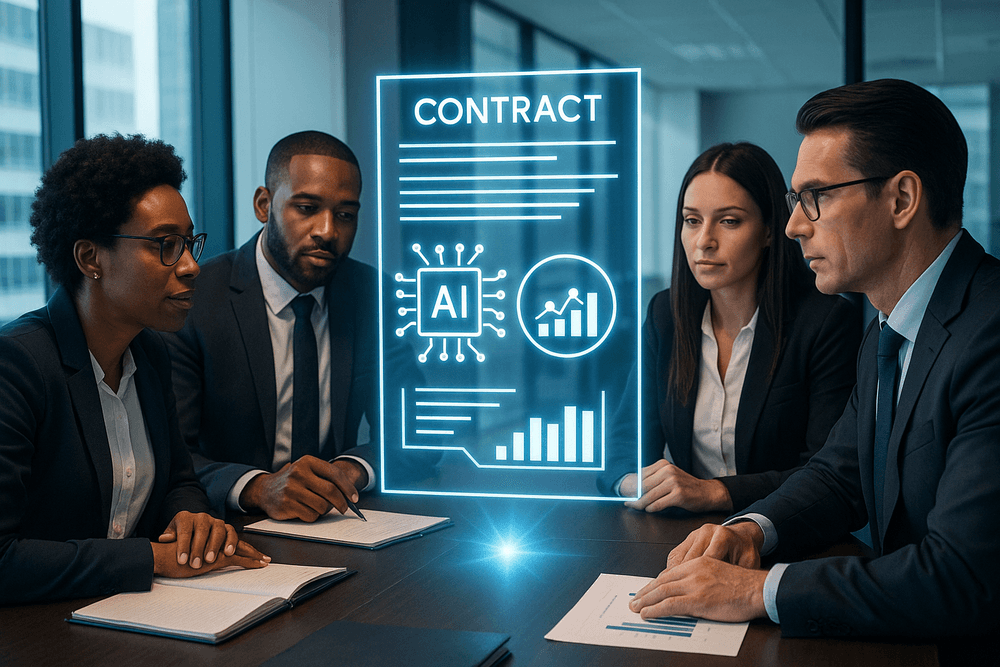
The Future-Proof Law Department: Your Next Steps in AI Contract Review
You’ve seen the potential. You understand the technology. Now it’s time to move from theory to action. Embracing AI contract review is more than just a technological upgrade; it’s a fundamental shift that transforms your legal department from a cost center into a strategic business driver. In a world where speed and precision dictate success, clinging to manual processes is a risk you can no longer afford. The future of legal work is here, and taking the next step is crucial to securing your competitive advantage.
Why AI Contract Review is Your New Competitive Edge
In today's fast-paced business environment, the speed of your legal team directly impacts the speed of the entire company. A slow contract cycle can delay sales, stall partnerships, and frustrate stakeholders. This is where AI contract review delivers its most immediate impact.
- Accelerated Deal Velocity: Teams leveraging AI can analyze agreements in minutes, not days. This radical reduction in turnaround time means sales can close deals faster, procurement can onboard vendors quicker, and your business can seize opportunities before competitors even get their contracts out for signature.
- Proactive Risk Mitigation: Human error is inevitable, but its consequences in a contract can be catastrophic. AI provides a systematic, tireless safety net, flagging non-standard clauses, identifying missing provisions, and ensuring every agreement aligns with your company’s playbook. This shifts your team from reactive problem-solving to proactive risk management.
- Elevated Strategic Value: When your talented legal professionals are freed from the monotonous task of line-by-line review, they can dedicate their expertise to what matters most: complex negotiations, strategic counsel, and high-value legal challenges. This not only boosts morale but also maximizes the ROI on your legal talent.
Building a Bulletproof Business Case for Adoption
Gaining buy-in from leadership requires a clear, data-driven argument. Move beyond the "it's more efficient" talking point and present a compelling business case that speaks to the bottom line.
- Quantify the Current Pain: Start by benchmarking your existing processes. How many hours per week does your team spend on routine contract review? What is your average contract turnaround time? Calculate the cost of this time, including the opportunity cost of deals delayed or lost. Frame the "cost of inaction" in clear financial terms.
- Highlight the Tangible ROI: Present a clear cost-benefit analysis. On one side, list the subscription and implementation costs. On the other, detail the returns:
- Hard ROI: Calculate projected savings from reduced reliance on outside counsel, increased productivity (e.g., an 80% reduction in review time for NDAs), and faster revenue recognition.
- Soft ROI: Emphasize the invaluable benefits of enhanced compliance, strengthened negotiation positions, improved cross-departmental collaboration, and higher job satisfaction for your legal team.
- Propose a Pilot Program: Suggest a controlled, low-risk pilot project to demonstrate value. Choose a specific, high-volume contract type, like Master Service Agreements or Non-Disclosure Agreements. Define clear metrics for success before you begin, such as a target reduction in review time or the number of critical risks identified by the AI that were previously missed. A successful pilot provides undeniable proof and builds momentum for a full-scale rollout.
The transition to an AI-powered legal department is a journey, but it begins with a single, decisive step. Don't let your organization fall behind the curve.
Ready to see how **AI contract review can transform your workflow? Schedule a personalized demo of today’s leading platforms and witness the future of legal tech firsthand.**