
September 12, 2025
An Introduction to AI Cost Optimization
Beyond Budget Cuts: An Introduction to AI Cost Optimization
For decades, the go-to strategy for tightening the financial belt has been the same: across-the-board budget cuts, hiring freezes, and painstaking manual reviews of departmental spending. While necessary at times, this approach is a blunt instrument in a world that demands surgical precision. It often stifles innovation, demoralizes high-performing teams, and fails to address the root causes of inefficiency. But what if you could trim expenses not by cutting, but by optimizing? This is the fundamental promise of AI cost optimization.
What is AI-Driven Cost Optimization, Really?
At its core, AI cost optimization is the strategic use of artificial intelligence and machine learning to identify, predict, and eliminate financial waste within an organization. It moves beyond simple automation. Instead of just doing the same tasks faster, AI analyzes vast, complex datasets—from supply chain logistics and energy consumption to cloud computing usage and customer support tickets—to uncover patterns and opportunities invisible to the human eye.
Think of it as a proactive financial co-pilot. It doesn’t just report on what was spent last quarter; it predicts future demand, recommends optimal resource allocation, and flags potential overspending before it ever hits the balance sheet. This intelligent approach transforms cost management from a reactive, often painful exercise into a continuous, data-driven strategy for boosting financial health and competitive advantage.
Why Traditional Cost-Saving Methods No Longer Suffice
In today's fast-paced digital economy, traditional methods are simply too slow and too shallow. A manual audit of vendor contracts might take months, by which time market conditions have already changed. A 10% budget cut for every department treats a vital R&D team the same as an underperforming administrative unit, harming long-term growth for a short-term gain.
These legacy approaches fail for three key reasons:
- Lack of Data Granularity: They rely on high-level summaries, missing the granular details where true inefficiencies hide.
- Reactive Nature: They address problems after the money has already been spent, rather than preventing the waste in the first place.
- Human Bias and Limitation: They are limited by the capacity of a team to analyze data, often leading to decisions based on gut feelings rather than empirical evidence.
AI cost optimization overcomes these hurdles by processing real-time data at scale, providing predictive insights, and delivering objective, data-backed recommendations for smarter spending.
The Immediate ROI of Smart AI Implementation
The shift to an AI-driven approach isn't a far-off, futuristic goal; it delivers a tangible and often immediate return on investment. Smart implementation targets high-impact areas first, creating quick wins that fund further innovation.
Consider these examples:
- Predictive Maintenance: AI algorithms can predict when industrial machinery is likely to fail, allowing for maintenance to be scheduled during off-peak hours, preventing catastrophic downtime that can cost millions.
- Supply Chain Optimization: AI can analyze shipping routes, carrier performance, and demand forecasts to dynamically re-route shipments, reduce fuel costs, and minimize inventory holding expenses.
- Optimized Cloud Spend: For tech-heavy companies, AI tools can continuously monitor cloud resource usage, automatically shutting down idle instances and scaling capacity to precisely match demand, cutting monthly bills by up to 30% or more.
The ROI isn't just measured in dollars saved. It's found in reclaimed employee time, more resilient operations, and the ability to reallocate capital from wasteful processes to strategic, revenue-generating initiatives.
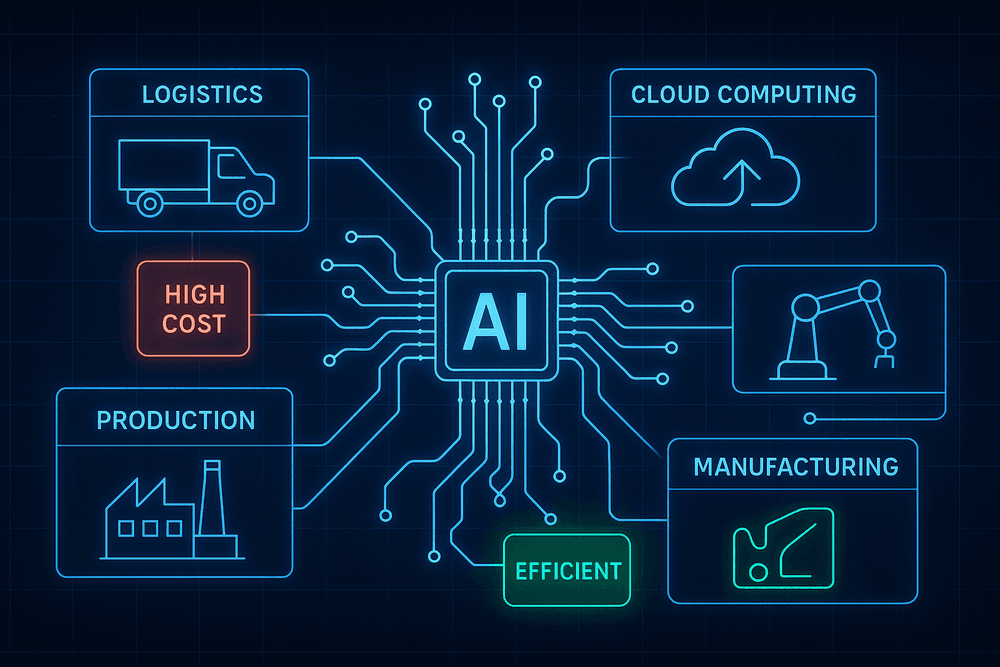
Where to Unleash Savings: Key Areas for AI Cost Optimization
True AI cost optimization isn't about a single, sweeping change; it's a strategic application of intelligent technology across the core functions of your business. By targeting specific high-spend, high-inefficiency areas, you can unlock significant and sustainable savings. The real power of AI lies in its ability to move beyond simple automation and introduce predictive, adaptive intelligence where it matters most. Let’s explore the most fertile grounds for planting the seeds of AI-driven financial efficiency.
Automating Operational Workflows and Reducing Manual Overhead
Repetitive, rule-based tasks are a primary source of hidden costs, consuming valuable employee hours and introducing the risk of human error. AI-powered intelligent automation goes a step further than traditional scripting by handling complex workflows and adapting to variations.
- Intelligent Document Processing (IDP): AI can read, understand, and process invoices, purchase orders, and contracts, automatically extracting key data and routing it to the correct systems. This slashes data entry time and reduces payment cycle delays.
- Customer Service Bots: Advanced chatbots and virtual assistants can resolve a high volume of customer queries 24/7, freeing up human agents to focus on complex, high-value interactions.
- HR and Finance Automation: From screening resumes to processing expense reports, AI can automate administrative functions, ensuring compliance and significantly reducing the manual workload on your back-office teams.
Optimizing Supply Chain Logistics and Inventory Waste
The supply chain is a complex network ripe with opportunities for AI cost optimization. Inefficiencies here directly translate to wasted capital, whether it's tied up in excess inventory or burned on inefficient shipping routes. AI introduces a layer of predictive insight that traditional methods lack.
- AI-Driven Demand Forecasting: By analyzing historical sales data, market trends, seasonality, and even external factors like weather patterns, AI models can predict product demand with stunning accuracy. This prevents costly overstocking and avoids stockouts that lead to lost revenue.
- Route Optimization: AI algorithms can calculate the most efficient delivery routes in real-time, considering traffic, fuel costs, vehicle capacity, and delivery windows. This leads to substantial savings on fuel and labor while improving delivery times.
Slashing Cloud Computing Spend with Predictive Analytics
For many modern businesses, cloud infrastructure is a major operational expense. Without careful management, costs can quickly spiral out of control. AI provides the tools for intelligent cloud financial operations (FinOps), ensuring you only pay for what you truly need. It analyzes usage patterns to identify idle or underutilized resources, recommends right-sizing for virtual machines, and automates the process of scaling resources up or down based on predicted demand. This proactive approach to AI cost optimization transforms your cloud bill from a reactive expense into a finely tuned, efficient investment.
Implementing Predictive Maintenance to Eliminate Costly Downtime
Waiting for critical machinery to fail is one of the most expensive maintenance strategies. Unplanned downtime brings operations to a halt, causing cascading delays and massive revenue loss. Predictive maintenance is a game-changer. By deploying IoT sensors that feed real-time data to AI models, you can monitor the health of your equipment continuously. The AI learns the normal operating parameters and can detect subtle anomalies that signal an impending failure. This allows you to schedule maintenance proactively, ordering parts just in time and performing repairs during planned downtime, effectively turning catastrophic failures into manageable operational tasks.
The Strategist's Toolkit for AI Cost Optimization
To effectively implement AI-driven cost reduction, leaders need a powerful set of tools and strategies. Moving beyond theory requires a practical toolkit designed for tangible results. This involves leveraging predictive models, intelligent platforms, and making crucial decisions about technology acquisition. True AI cost optimization is achieved by selecting and deploying the right instruments for your specific business challenges.
Harnessing Machine Learning for Predictive Demand Forecasting
Inaccurate forecasting is a primary driver of unnecessary costs, leading to either expensive overstocking or revenue-damaging stockouts. Machine learning (ML) models transform this process from a guessing game into a data-driven science. By analyzing complex variables—including historical sales data, seasonality, competitor pricing, market trends, and even weather patterns—ML algorithms can predict demand with remarkable accuracy. This precision allows businesses to:
- Optimize Inventory Levels: Reduce capital tied up in excess stock and minimize holding costs.
- Streamline Supply Chains: Align procurement and production schedules with anticipated demand, preventing bottlenecks and rush-order fees.
- Improve Staffing: Schedule labor more effectively to meet customer traffic without being overstaffed.
Dynamic Resource Allocation with AI-Powered Platforms
Static budgets and manual resource planning are no match for today's dynamic business environment. AI-powered platforms offer a revolutionary approach by continuously analyzing real-time data to allocate resources where they'll deliver the most value. Consider these applications:
- Cloud Computing: AI tools can automatically scale server capacity up or down based on user traffic, eliminating massive overspending on idle resources.
- Fleet Management: Algorithms can optimize delivery routes in real-time based on traffic and fuel costs, slashing operational expenses.
- Project Management: AI can intelligently assign tasks to team members based on their current workload and skills, maximizing productivity and project velocity.
This dynamic approach ensures that every dollar, hour, and asset is deployed with maximum efficiency.
Build vs. Buy: Off-the-Shelf vs. Custom AI Solutions
A critical strategic decision is whether to purchase a ready-made AI solution or build a custom one. Each path has distinct implications for AI cost optimization.
- Off-the-Shelf (SaaS) Solutions: These tools are generally faster to implement and have a lower initial cost. They are ideal for common business problems like marketing analytics or CRM optimization. However, they offer limited customization and may involve ongoing subscription fees.
- Custom AI Solutions: Building a bespoke model offers a powerful competitive advantage by perfectly aligning with your unique operational data and processes. While the upfront investment in talent and time is higher, the long-term ROI can be substantial for core business functions.
The best choice depends on your specific goals, in-house expertise, and the uniqueness of the problem you aim to solve.
Key Features to Look for in an AI Analytics Tool
When evaluating AI tools for cost control, prioritize platforms that move beyond simple data presentation. Look for these essential features:
- Predictive Anomaly Detection: The system should proactively flag potential cost overruns and operational inefficiencies before they escalate.
- Scenario Modeling: The ability to run "what-if" analyses to simulate the financial impact of different strategic decisions.
- Actionable Recommendations: A truly valuable tool doesn't just show you a problem; it suggests specific, data-backed solutions.
- Seamless Integration: The platform must easily connect with your existing enterprise systems (ERP, CRM, SCM) to create a single source of truth for analysis.
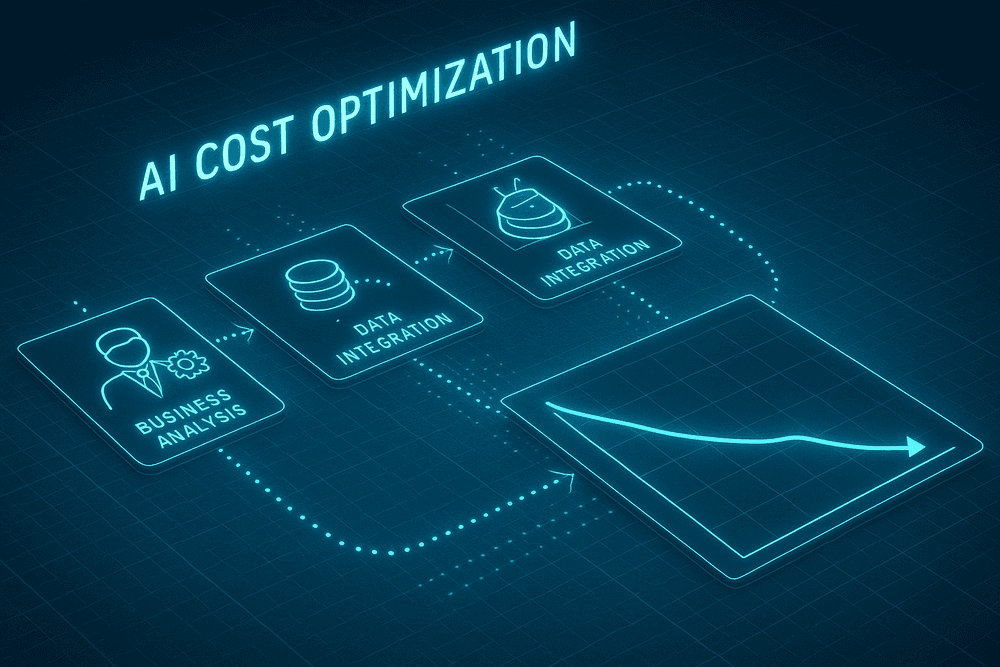
A Blueprint for Success: Implementing Your AI Cost Optimization Strategy
Transitioning from theory to practice requires a clear, strategic roadmap. A successful AI cost optimization initiative isn't about flipping a switch; it's about a deliberate, phased implementation that aligns technology with core business objectives. By following a structured blueprint, you can de-risk your investment, build momentum, and ensure your AI solutions deliver tangible financial returns. This three-step process, coupled with proven best practices, will guide you from initial concept to sustained, data-driven savings.
Step 1: Identify and Prioritize High-Impact Business Cases
Before writing a single line of code or purchasing any software, you must know where to aim your efforts. The first step in any effective AI cost optimization strategy is to pinpoint the areas where AI can deliver the most significant and immediate value.
- Audit Your Operations: Collaborate with department leaders across finance, operations, supply chain, and IT to identify the most significant cost centers and operational bottlenecks. Are you overspending on cloud resources? Is inventory management inefficient? Are energy costs spiraling?
- Quantify the Opportunity: For each potential use case, estimate the potential financial impact. For example, "Reducing fraudulent transactions by 2% could save $500,000 annually," or "Optimizing delivery routes could cut fuel costs by 15%."
- Prioritize with an Impact/Effort Matrix: Map each opportunity based on its potential savings (high/low impact) and the complexity of implementation (high/low effort). Start with the "quick wins"—high-impact, low-effort projects. These early successes will build confidence and secure executive buy-in for more ambitious initiatives down the line.
Step 2: Integrate AI with Your Existing Data Infrastructure
Your AI models are only as intelligent as the data they learn from. A seamless integration with your data ecosystem is non-negotiable for achieving reliable and scalable AI cost optimization.
- Assess Data Readiness: Conduct a thorough audit of your data sources. Is your data clean, accessible, and comprehensive? Identify any silos or gaps that could hinder the performance of AI algorithms. You may need to invest in data cleansing and consolidation before proceeding.
- Ensure Infrastructure Compatibility: Evaluate whether your current IT infrastructure—be it on-premise servers or cloud platforms—can handle the demands of AI workloads. This includes sufficient processing power (CPUs/GPUs), scalable storage, and robust data pipelines.
- Prioritize Seamless Connectivity: Select AI tools and platforms that offer pre-built connectors or flexible APIs to easily integrate with your existing systems, such as your ERP, CRM, and data warehouse. The goal is to create a unified flow of information that empowers your AI to make holistic, cost-saving decisions.
Step 3: Measure, Analyze, and Refine Your Key Performance Indicators
Implementation is not the finish line; it's the start of a continuous cycle of improvement. To maximize ROI, you must relentlessly track performance, derive insights, and iterate on your approach.
- Establish a Baseline: Before you deploy your AI solution, document your current performance metrics. What is your average cloud spend? What is your current customer churn rate? This baseline is the yardstick against which you will measure success.
- Define Clear KPIs: Set specific, measurable, achievable, relevant, and time-bound (SMART) goals for your AI cost optimization project. Examples include "Reduce inventory carrying costs by 10% within six months" or "Improve marketing campaign ROI by 15% in the next quarter."
- Implement Monitoring and Feedback Loops: Use real-time dashboards to track your KPIs. Regularly analyze the results to understand what’s working and what isn’t. Use these insights to retrain your AI models and refine your strategy, ensuring your cost-saving efforts evolve and improve over time.
Real-World Wins: Case Studies in AI Cost Optimization
Theory is one thing, but tangible results are what truly demonstrate the power of technology. The strategic implementation of AI cost optimization is not just a futuristic concept; it's a present-day reality that is reshaping industries and delivering a significant competitive edge. Let’s explore three compelling case studies where businesses turned complex challenges into remarkable financial victories.
The Retail Revolution: Slashing Inventory Costs by 30%
The Challenge: A multinational retail leader was grappling with a classic, costly problem: inefficient inventory management. Their stores were plagued by overstocked warehouses for slow-moving products and frequent stockouts of popular items. This imbalance tied up millions in capital, inflated carrying costs, and led to lost sales and dissatisfied customers. Traditional forecasting methods were simply too slow and inaccurate to keep up with dynamic consumer behavior.
The AI Solution: The company deployed an AI-powered demand forecasting platform. This system ingested and analyzed a vast array of data points, including historical sales, seasonality, promotional calendars, social media trends, and even local weather forecasts. By identifying complex patterns, the AI model could predict product demand with a level of accuracy previously unattainable. This data-driven insight enabled an automated, intelligent approach to AI cost optimization, ensuring each store was stocked with the right products at the right time.
The Result: The impact was transformative. Within 18 months, the retailer reduced its overall inventory holding costs by 30%. Markdowns on unsold goods decreased significantly, while product availability on high-demand items improved, directly boosting revenue and customer loyalty.
The Smart Factory: Achieving Near-Zero Unplanned Downtime
The Challenge: A large automotive manufacturing plant was losing hundreds of thousands of dollars annually due to unplanned equipment downtime. A single critical machine failure could halt an entire production line, triggering a cascade of expensive emergency repairs, overtime labor, and missed delivery deadlines. Their maintenance schedule was purely reactive.
The AI Solution: To shift from a reactive to a predictive model, the plant integrated an AI-driven predictive maintenance system. IoT sensors were installed on critical machinery to monitor key performance indicators like vibration, temperature, and power consumption in real-time. An AI algorithm continuously analyzed this data stream, learning the unique operational signature of each machine. It could detect subtle anomalies that were precursors to failure, automatically alerting the maintenance team days or even weeks in advance.
The Result: This proactive strategy for AI cost optimization virtually eliminated unplanned downtime, increasing Overall Equipment Effectiveness (OEE) by over 20%. The plant reduced its maintenance budget by 40% by scheduling repairs during planned shutdowns and optimizing its spare parts inventory.
Sustainable Scaling: Taming Cloud Spend for a Tech Startup
The Challenge: A rapidly growing SaaS startup found its success threatened by its own growth. As their customer base and product features expanded, their monthly cloud infrastructure bill from providers like AWS and Google Cloud was spiraling out of control, eating into their profit margins and jeopardizing their financial runway.
The AI Solution: The startup implemented an AI-powered cloud cost management and optimization platform. The tool provided deep visibility into their complex cloud environment, using machine learning to identify wasteful spending. It automatically flagged underutilized virtual machines, recommended more cost-effective instance types, and identified orphaned storage resources for deletion. This continuous, automated oversight was a game-changer for AI cost optimization.
The Result: The platform enabled the startup to reduce its monthly cloud spend by 25% without sacrificing performance or scalability. These crucial savings were redirected to product development and marketing, fueling further growth and establishing a financially sustainable path to scale.
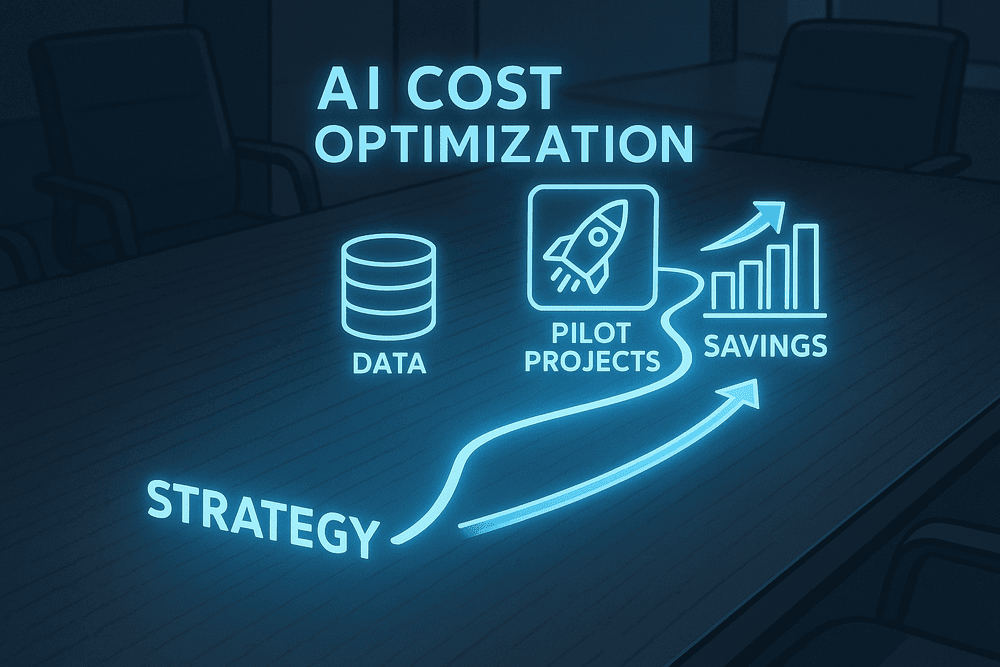
The Future of Your Bottom Line: Next Steps in AI Cost Optimization
You've explored the immense potential of AI-driven cost optimization. Now, it's time to move from theory to action. This final step is about transforming knowledge into tangible savings and a more resilient, efficient business. Seizing the competitive advantage offered by AI cost optimization requires a clear plan, an awareness of potential hurdles, and a commitment to starting small and scaling smart. Let's map out your immediate next steps to ensure your journey is a success.
Your Quick-Start Checklist for AI Savings
To recap the core principles, keep this checklist handy as you begin. It's your blueprint for a successful initiative.
- Identify High-Impact Areas: Pinpoint business functions with significant variable costs, such as supply chain logistics, energy consumption, or inventory management.
- Gather Quality Data: Consolidate clean, relevant, and comprehensive data. The power of your AI solution is directly proportional to the quality of your data input.
- Select the Right AI Tools: Choose a solution that fits your specific problem. This could range from predictive analytics platforms for demand forecasting to machine learning models for process automation.
- Start with a Pilot Project: Don’t try to boil the ocean. Select one well-defined problem for a pilot project to prove the concept and demonstrate ROI.
- Measure Everything: Establish clear Key Performance Indicators (KPIs) before you start. Track cost savings, efficiency gains, and resource utilization to build a strong business case.
Avoiding Common Pitfalls on Your Optimization Journey
Many organizations stumble on their path to AI integration. By anticipating these common challenges, you can navigate them effectively.
- Ignoring Data Governance: Poor data quality and siloed information are the primary reasons AI cost optimization projects fail. Establish a clear data governance framework from day one.
- Lacking Clear Objectives: Don't implement AI for its own sake. Define a specific business problem you are trying to solve and the exact financial outcome you expect. Is it reducing waste by 15% or cutting shipping costs by 10%? Be specific.
- Underestimating Change Management: AI will change workflows and roles. Involve your teams early, communicate the benefits clearly, and provide necessary training to ensure smooth adoption and turn employees into advocates.
- Focusing Solely on Technology: The best algorithm is useless without the right processes and people to support it. True optimization is a synthesis of technology, strategy, and culture.
How to Start Your First AI Cost Optimization Project This Quarter
Ready to make an impact? Here is a practical 12-week timeline to launch your first project and secure a quick win.
- Weeks 1-2: Assemble Your Team & Identify a Target. Form a small, cross-functional team with members from IT, finance, and the target operational department. Together, select a single, high-impact pilot project, such as optimizing a specific factory's energy usage or a single warehouse's inventory levels.
- Weeks 3-6: Data Audit & Tool Selection. Your team’s first task is to audit the availability and quality of the data for your chosen project. Concurrently, research and select a scalable AI tool or platform that aligns with your technical capabilities and project goals.
- Weeks 7-10: Launch the Pilot. Implement the AI solution on a limited scale. Run the models, monitor the system's recommendations, and gather performance data against your pre-defined KPIs. Focus on learning and iterating.
- Weeks 11-12: Analyze, Report, and Plan for Scale. Analyze the pilot results. Did you achieve the expected savings? What did you learn? Compile a concise report to share with stakeholders, highlighting the ROI and building a data-backed case for a wider rollout in the following quarter.