
August 15, 2025
An Introduction to AI in Identity and Access Management
The New Frontier: An Introduction to AI in Identity and Access Management
In today's hyper-connected digital landscape, the question of "who gets access to what?" is the bedrock of cybersecurity. Answering it has traditionally been the job of Identity and Access Management (IAM) systems. But as digital environments become infinitely more complex, the old rulebook is being rewritten by a powerful new author: artificial intelligence. This section will explore the evolution from legacy systems to the new era of intelligent, predictive security.
What is Traditional Identity and Access Management (IAM)?
At its core, traditional Identity and Access Management is the digital gatekeeper for an organization. It’s a framework of policies and technologies designed to ensure that the right individuals have appropriate access to the right resources at the right times, and for the right reasons. Think of it as the bouncer, the front desk, and the records office of your digital world, all rolled into one.
Its primary functions include:
- Authentication: Verifying that a user is who they claim to be, typically through passwords, multi-factor authentication (MFA), or biometrics.
- Authorization: Granting verified users specific permissions to access certain data, applications, or systems based on their role and responsibilities.
- User Lifecycle Management: Managing a user's digital identity from onboarding (provisioning) to offboarding (de-provisioning).
For years, these rule-based systems served us well, operating on a straightforward "if-then" logic. If a user is in the "Sales" group, then grant them access to the CRM. Simple, predictable, and effective—for a simpler time.
Why Legacy IAM Systems Are No Longer Enough
The digital world is no longer simple. The explosion of cloud services, remote work, IoT devices, and SaaS applications has shattered the traditional network perimeter. Today, identities are the new perimeter, and legacy IAM systems are struggling to defend it.
These static, rule-based systems face several critical challenges:
- Scale and Complexity: The sheer volume of users, devices, and applications is overwhelming. Manually managing access rules for thousands of identities across hundreds of platforms is unsustainable, error-prone, and slow.
- Dynamic Threats: Cybercriminals are no longer using simple brute-force attacks. They employ sophisticated, multi-stage tactics like credential stuffing and social engineering to compromise legitimate accounts. A rule-based system can't distinguish between a real user and a clever imposter exhibiting subtle, abnormal behavior.
- Alert Fatigue: Legacy systems often generate a flood of low-priority security alerts, burying critical threats in a sea of noise. Security teams become desensitized, and real attacks slip through the cracks.
The Paradigm Shift: How AI Supercharges Security and Efficiency
This is where the paradigm shifts. The introduction of AI in identity and access management isn't just an incremental upgrade; it's a fundamental reinvention of how we approach digital trust. Instead of relying on rigid, pre-defined rules, AI-powered IAM systems learn, adapt, and predict.
Artificial intelligence transforms IAM by introducing capabilities that were previously impossible:
- Behavioral Analytics: AI establishes a baseline of normal behavior for every user—what time they usually log in, from what location, which files they access, and on what devices. It can then instantly flag deviations from this pattern as high-risk, catching compromised accounts in real time.
- Adaptive Authentication: Instead of a one-size-fits-all approach, AI can implement risk-based authentication. A low-risk login from a known device might proceed seamlessly, while a high-risk attempt from an unusual location could trigger a step-up authentication challenge, like biometrics.
- Automated Governance: AI can analyze roles and access patterns to recommend optimized permissions, revoking unnecessary access rights that pose a security risk (the principle of least privilege). This automates and streamlines what was once a painstaking manual process.
Ultimately, the core promise of using AI in identity and access management is to turn a reactive security posture into a proactive, intelligent, and self-governing one. It empowers organizations to grant access with confidence, not just control.

Core Capabilities: Exploring AI's Role in Identity and Access Management
Artificial intelligence is not just an add-on to traditional IAM; it's a fundamental force multiplier that redefines what’s possible. By infusing machine learning and advanced analytics into core IAM functions, organizations can move from a reactive, rule-based security posture to a proactive, intelligent, and adaptive one. The true power of AI in identity and access management is revealed through its ability to handle complexity and scale far beyond human capacity. Let's explore the key capabilities driving this transformation.
AI-Powered Behavioral Analytics for Anomaly Detection
At its heart, effective security is about distinguishing the normal from the abnormal. AI excels at this through User and Entity Behavior Analytics (UEBA). The system first establishes a dynamic baseline of normal behavior for every user and entity—what applications they access, from which devices, at what times, and from which locations.
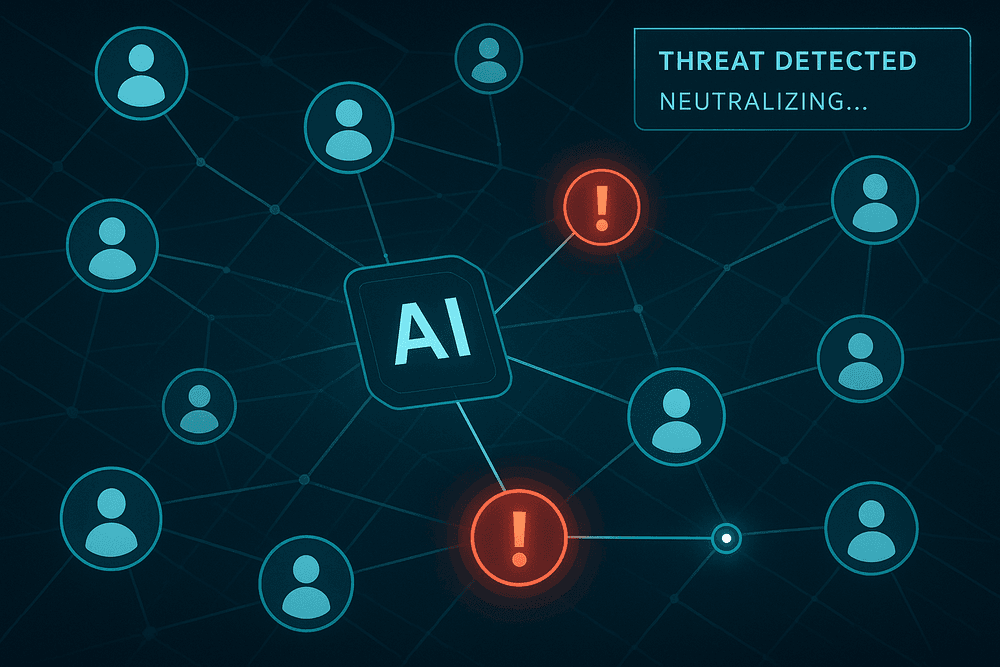
Once this baseline is set, the AI continuously monitors activity in real-time, instantly flagging deviations. This could be anything from a login at an unusual hour, access to a sensitive file for the first time, or an "impossible travel" scenario where a user logs in from two geographically distant locations in a short period. By analyzing these subtle signals, AI can detect compromised accounts, insider threats, and sophisticated attacks that would bypass static security rules entirely.
Automating User Provisioning and Deprovisioning at Scale
The employee lifecycle is a major source of IAM complexity. Manually provisioning access for new hires is slow and error-prone, while failing to deprovision access for departing employees creates significant security risks.
AI-driven IAM systems automate this entire process. By analyzing an employee's role, department, and team data, an AI model can intelligently recommend and assign the precise access rights needed to perform their job—adhering to the Principle of Least Privilege from day one. When an employee's role changes or they leave the company, the system automatically revokes all relevant permissions instantly and comprehensively. This eliminates the risk of orphaned accounts and lingering access, ensuring the digital environment remains secure and efficient.
Adaptive Multi-Factor Authentication (MFA) for Smarter Access
While traditional MFA is a crucial security layer, it can introduce friction for users. Adaptive MFA, powered by AI, offers a smarter solution. Instead of applying the same authentication requirements to every login, an AI engine assesses the real-time risk of each access request.
It analyzes a wide range of context-based signals, including user location, device reputation, IP address, and time of day. A low-risk request, such as a user logging in from their usual office device, might be granted access seamlessly. However, a high-risk attempt—like a login from a new country on an unrecognized device—will automatically trigger a "step-up" challenge, requiring a more robust form of verification like a biometric scan or a physical security key. This approach optimizes both security and user experience.
Streamlining Access Reviews and Compliance Reporting
Periodic access reviews are a cornerstone of security governance and regulatory compliance, but they are notoriously time-consuming and tedious. AI transforms this process from a manual burden into an automated, intelligence-driven workflow.
AI algorithms can analyze existing access permissions and usage patterns to identify and flag redundant, excessive, or unused privileges. Instead of forcing managers to sift through endless lists, the system presents them with clear, prioritized recommendations for revoking unnecessary access. Furthermore, AI in identity and access management can generate comprehensive, audit-ready reports on demand, providing verifiable proof that access controls are being effectively managed to meet compliance standards like SOX, HIPAA, and GDPR.
AI in Identity and Access Management: Real-World Use Cases
The theoretical benefits of AI are compelling, but its true value is proven in the field. Across industries, organizations are deploying advanced AI in identity and access management to solve complex security challenges that legacy systems can no longer handle. From stopping financial fraud to securing patient data, these real-world examples illustrate the transformative impact of AI-powered IAM.
How a Financial Services Firm Prevents Fraudulent Access
The Challenge: A leading investment bank was battling a surge in sophisticated account takeover (ATO) attacks. While traditional multi-factor authentication (MFA) was in place, it created friction for high-value clients and was being bypassed by clever phishing and social engineering tactics. The firm needed a security layer that could distinguish a legitimate user from a skilled imposter without disrupting the client experience.
The AI-IAM Solution: The bank integrated an IAM platform supercharged with AI-driven behavioral analytics. The system created a unique dynamic profile for each user by learning their typical patterns—including typing cadence, mouse movements, login times, and device preferences. This solution for AI in identity and access management runs silently in the background, analyzing every session against this established baseline. If a user logs in with the correct credentials but exhibits anomalous behavior, like uncharacteristic hesitation or unusual navigation, the AI instantly flags the session as high-risk.
The Outcome: The system automatically triggers step-up authentication, such as a biometric check or a call from a security agent, only for the riskiest sessions. This adaptive approach stopped over 98% of targeted ATO attempts within three months of deployment, drastically reducing fraud losses. Crucially, it maintained a seamless, low-friction experience for the vast majority of legitimate clients.
Securing a Hybrid Workforce in a Global Tech Company
The Challenge: A multinational tech company with a globally distributed, hybrid workforce struggled with access control at scale. The manual process of provisioning and de-provisioning access for thousands of employees, contractors, and partners was slow and riddled with errors. This created security vulnerabilities, such as lingering "orphan" accounts and excessive user permissions.
The AI-IAM Solution: They deployed an AI engine to automate the entire identity lifecycle. The AI integrated with their HR systems, analyzing job roles, departments, and project assignments to automatically grant appropriate, least-privilege access from day one. For its hybrid workforce, the system implemented a Zero Trust model powered by continuous risk assessment. The AI constantly evaluated signals—like network location, device security posture, and application usage—to dynamically adjust access rights in real-time.
The Outcome: The company reduced employee onboarding time by 80% and nearly eliminated the security risks associated with manual de-provisioning. The dynamic, risk-based access controls ensured that remote and in-office employees had secure access to the resources they needed, precisely when they needed them, strengthening the organization's overall security posture.
Enhancing Patient Data Protection in Healthcare with AI-IAM
The Challenge: A large hospital network faced the critical task of protecting sensitive electronic health records (EHR) while giving clinicians fast, reliable access in life-or-death situations. Adhering to strict HIPAA compliance rules made this balancing act even more difficult. They needed a system that could proactively detect insider threats and unauthorized access without impeding patient care.
The AI-IAM Solution: The hospital implemented an advanced AI-IAM platform focused on user and entity behavior analytics (UEBA). The system learned the normal data access patterns for every role. For example, it knew which types of records a specific nurse on the cardiology ward typically accessed, from which workstations, and during what hours. Any deviation—such as a user attempting to access the records of a VIP patient unrelated to their duties—would trigger an immediate, high-priority alert to the security team.
The Outcome: This proactive application of AI in identity and access management allowed the hospital to move from a reactive to a predictive security model. It successfully identified and thwarted several potential data breaches, ensuring HIPAA compliance and safeguarding patient trust. The AI-generated audit trails also simplified compliance reporting, saving hundreds of hours of manual work.

Best Practices for Implementing AI in Your IAM Framework
Successfully deploying artificial intelligence into your Identity and Access Management framework is more than a simple technology upgrade; it requires a strategic approach that balances innovation with practicality. Adopting these best practices will help ensure a smooth, secure, and effective transition.
Choosing the Right AI-Powered IAM Vendor
The success of your AI implementation hinges on selecting the right partner. Not all AI is created equal. When evaluating vendors, look beyond the marketing buzzwords and dig into the specifics of their technology. A critical first step for leveraging AI in identity and access management effectively is asking targeted questions. How transparent are their machine learning models? What specific datasets are used for training, and how do they mitigate inherent biases? Prioritize solutions that offer robust behavioral analytics, adaptive multi-factor authentication (MFA), and intelligent, automated user provisioning. Ensure the platform is scalable to grow with your organization and has a clear roadmap for future enhancements. A vendor should be able to demonstrate a clear track record of reducing false positives and providing actionable insights, not just more alerts.
Integrating AI Tools with Your Existing Security Stack
An AI-powered IAM solution should not operate in a silo. To unlock its full potential, it must seamlessly integrate with your existing security infrastructure. The power of AI in identity and access management is magnified when it enriches your Security Information and Event Management (SIEM) and Security Orchestration, Automation, and Response (SOAR) platforms with high-fidelity context. For example, an AI-detected risk score for a user's login can be passed to a SIEM to prioritize alerts. Look for vendors that offer robust APIs and pre-built integrations. This ensures that when the AI detects a high-risk anomaly—like an impossible travel scenario or unusual data access—it can automatically trigger workflows in other systems, creating a unified and responsive defense mechanism.
Addressing Data Privacy and Algorithmic Bias Concerns
Implementing AI introduces new considerations around data privacy and fairness. AI-driven IAM systems analyze vast amounts of user data, including personally identifiable information (PII) and behavioral patterns, to function. It is imperative to ensure your chosen solution complies with regulations like GDPR and CCPA, offering features like data anonymization and clear consent management. Furthermore, algorithmic bias is a significant risk. If an AI model is trained on biased data, it can make discriminatory access decisions. A responsible approach to AI in identity and access management involves working with vendors who are transparent about their models and conducting regular audits. Crucially, maintain a "human-in-the-loop" protocol, where high-stakes decisions flagged by the AI are always reviewed by a person before final action is taken.
Training Your Team to Manage an AI-Driven System
Introducing AI transforms the roles of your IT and security teams. They shift from performing repetitive manual tasks to becoming supervisors of an intelligent system. To maximize your investment in AI in identity and access management, you must invest in your people. Training should go beyond basic user manuals. Your team needs to understand the fundamentals of how the AI works, how to interpret its outputs, and how to fine-tune its models. Start with a phased rollout to allow staff to adapt gradually. Establish clear feedback loops so your team can report issues and help improve the AI's accuracy over time. Fostering skills in data analysis and AI oversight will ensure your team can harness the technology's full capabilities.
The Future Outlook: Trends Shaping AI in Identity and Access Management
The fusion of artificial intelligence and IAM is not merely an upgrade to existing systems; it is actively forging a new paradigm for digital identity. As we look to the horizon, the reactive security measures of today are giving way to a future that is predictive, seamless, and fundamentally more secure. The ongoing evolution of AI in identity and access management is spearheaded by several transformative trends that promise to redefine how we manage and protect digital identities.
Predictive Analytics for Proactive Threat Hunting
While current AI models excel at detecting anomalies as they happen, the next frontier is predicting them before they occur. Predictive analytics represents a monumental shift from a defensive to an offensive security posture. By leveraging machine learning algorithms, future IAM systems will analyze vast and diverse datasets—encompassing historical user behavior, network telemetry, global threat intelligence feeds, and contextual data—to identify subtle patterns that signal an impending attack.
Imagine an AI system flagging an account as having a high probability of takeover days before any malicious activity is attempted. It might correlate a user's uncharacteristic login location with low-level malware alerts on their device and chatter from dark web forums discussing similar targets. This allows security teams to move from asking "What happened?" to "What is likely to happen?" By proactively hardening controls, revoking sessions, or initiating step-up authentication for at-risk accounts, organizations can neutralize threats before they ever materialize.
The Rise of Passwordless Authentication through AI
The password has long been the weakest link in the security chain, vulnerable to phishing, brute-force attacks, and human error. Passwordless authentication aims to eliminate this vulnerability, and AI is the engine making it a secure and scalable reality. This trend goes far beyond simple biometrics like fingerprints or facial scans.
The future of passwordless is rooted in AI-powered behavioral biometrics and continuous authentication. Your identity signature will become a composite of unique behaviors: the cadence of your typing, the way you move a mouse, the angle at which you hold your phone, and even your gait as you walk. An AI engine will continuously and invisibly authenticate you throughout your session. If your behavior suddenly changes—indicating a different person may have taken over the device—the AI can instantly challenge the session or lock the account. This creates a truly frictionless user experience while providing a dynamic, resilient, and virtually impenetrable layer of security.
Decentralized Identity and the Role of Artificial Intelligence
A foundational shift is underway with the emergence of decentralized identity and Self-Sovereign Identity (SSI), where users control their own identity data using technologies like blockchain. In this new ecosystem, AI's role evolves from a centralized analyzer to a distributed trust broker. The challenge in a decentralized world is verifying claims without a central authority.
AI will be crucial for powering intelligent verification systems that can assess the trustworthiness of a "verifiable credential" presented by a user. For instance, an AI agent could validate a digital diploma's authenticity by checking its cryptographic signature and the reputation of the issuing institution without ever needing to see the user's other private data. Furthermore, AI in identity and access management will drive sophisticated risk analysis for decentralized transactions, ensuring that even in a "trustless" environment, organizations can confidently grant access based on a mosaic of verified, user-controlled credentials. This synergy will build the foundation of trust for the next generation of the internet.
Conclusion: Securing Your Future with AI-Powered IAM
The digital frontier is no longer a static landscape; it's a dynamic, ever-expanding ecosystem of users, devices, and data. In this environment, traditional, rule-based Identity and Access Management is like a fortress wall in an age of aerial threats—necessary, but insufficient. The evolution to a proactive, intelligent, and adaptive security posture is not just an advantage; it's a necessity. As we've explored, the strategic integration of AI in identity and access management is the linchpin for building this next-generation defense, transforming IAM from a reactive gatekeeper into a predictive guardian of your digital assets.
Key Takeaways: Why AI in IAM is Now Non-Negotiable
The case for infusing artificial intelligence into your IAM strategy is clear and compelling. Manual processes are too slow, human oversight is prone to error, and the sheer volume of access requests and security signals has surpassed our ability to manage them effectively. AI-powered IAM addresses these challenges directly by:
- Automating with Intelligence: Moving beyond simple automation to intelligent user provisioning and de-provisioning, ensuring access is granted based on real-time context and the principle of least privilege.
- Enabling Predictive Threat Detection: Leveraging behavioral analytics and machine learning to identify anomalous activities—like impossible travel or unusual data access—that signal a compromised account or insider threat long before a breach occurs.
- Streamlining Compliance and Governance: Simplifying access reviews and certification campaigns through AI-driven recommendations, drastically reducing administrative overhead and strengthening your compliance posture.
Ultimately, leveraging AI in identity and access management means shifting from a posture of defense to one of cyber resilience.
The First Step: Assess Your Organization's IAM Maturity
Before you can build the future, you must understand your present. Where does your organization currently stand on the IAM maturity curve? Ask yourself these critical questions:
- How much of our user lifecycle management (joiner, mover, leaver) is still manual?
- Can we confidently and quickly identify who has access to our most sensitive data right now?
- How effective is our current system at detecting and responding to sophisticated threats like credential stuffing or insider privilege abuse?
An honest assessment of your current capabilities, gaps, and pain points is the essential first step. Recognizing the limitations of your existing framework will illuminate the precise areas where an AI-driven approach can deliver the most significant impact on your security, efficiency, and operational excellence.
Request a Consultation to Build Your AI Security Roadmap
Navigating the transition to an AI-powered security framework doesn't have to be a journey you take alone. The next logical step is to transform your assessment into a concrete, actionable plan. A personalized consultation with our IAM experts can help you chart a clear path forward. We'll work with you to understand your unique challenges, business objectives, and technical environment to co-create a tailored AI security roadmap. This isn't just a technology discussion; it's a strategic partnership focused on future-proofing your organization.
Contact us today to schedule your consultation and take the definitive step toward a more secure, intelligent, and autonomous future with AI-powered Identity and Access Management.