
November 20, 2025
Why AI in Identity and Access Management is a Game-Changer
The New Guard: Why AI in Identity and Access Management is a Game-Changer
For decades, Identity and Access Management (IAM) has been the digital gatekeeper, relying on a rigid set of rules to decide who gets access to what. But in a world of cloud computing, remote workforces, and increasingly sophisticated cyber threats, these traditional, manual systems are straining at the seams. Enter the new guard: a smarter, more adaptive approach powered by artificial intelligence. This isn't just an upgrade; it's a fundamental reinvention of how we secure digital identities.
What is AI-Driven IAM?
At its core, AI-driven IAM integrates machine learning (ML) and other artificial intelligence capabilities into the fabric of access control. Instead of relying solely on pre-defined, static rules like "this user role can access these applications," it introduces a layer of intelligence that learns, adapts, and predicts.
This system continuously analyzes massive volumes of data in real-time—login times, geographic locations, device types, user behavior, and network information. By establishing a baseline of normal activity for each user, it can instantly spot deviations that signal a potential threat. Think of it as moving from a simple lock-and-key system to a sentient security guard that knows everyone's normal routines and immediately notices when something is amiss. The core value of AI in identity and access management lies in its ability to provide this dynamic, context-aware security.
From Manual Rules to Intelligent Security: The Evolution of Access Control
Traditional IAM is defined by its manual nature. Administrators spend countless hours setting up and maintaining Role-Based Access Control (RBAC) policies, reviewing access requests, and conducting periodic certification campaigns. This process is not only time-consuming but also prone to human error. A forgotten permission or a rubber-stamped approval can easily create a critical security vulnerability. The system is reactive, often catching a breach long after it has occurred.
The evolution to AI-driven IAM marks a pivotal shift from a reactive to a proactive and predictive security posture. Instead of waiting for an anomaly to be reported, the AI engine identifies it as it happens. For example:
- Traditional IAM: A rule allows a marketing manager to access a specific database. If their credentials are stolen and used by a hacker from a different continent at 3 AM, the system sees a valid login and grants access.
- AI-Driven IAM: The AI recognizes that the login location, time, and device are highly unusual for this user. It calculates a high-risk score and can automatically trigger a response, such as requiring enhanced multi-factor authentication (MFA) or blocking access and alerting security teams.
Why This Transformation is Critical for Modern Security
The digital perimeter has dissolved. Employees, partners, and customers access critical resources from anywhere in the world, using a multitude of devices. This complex, distributed environment makes it impossible for human-managed, rule-based systems to keep up with the sheer volume and velocity of modern threats.
This is where the transformation becomes essential. Implementing AI in identity and access management is no longer a luxury but a necessity for robust security. The key advantages include:
- Superior Threat Detection: AI can identify sophisticated threats like credential stuffing, insider threats, and account takeovers that would otherwise fly under the radar.
- Increased Operational Efficiency: By automating routine tasks like access provisioning, certification, and anomaly investigation, AI frees up IT and security teams to focus on strategic initiatives.
- Frictionless User Experience: AI enables adaptive authentication, where security measures are applied dynamically based on risk. A low-risk login is seamless, while a high-risk attempt is met with stronger verification, ensuring security without frustrating legitimate users.
Core Use Cases for AI in Identity and Access Management
Artificial intelligence is no longer a futuristic concept in cybersecurity; it's a practical and powerful tool that is fundamentally reshaping how organizations manage digital identities. The application of AI in Identity and Access Management moves beyond simple automation, introducing intelligent, adaptive, and predictive capabilities. Here are the core use cases that are transforming IAM from a reactive gatekeeper to a proactive security powerhouse.
Automating User Provisioning and Deprovisioning at Scale
In any dynamic organization, employees join, leave, and change roles constantly. Manually managing their access rights is not only time-consuming but also prone to human error, often leading to "privilege creep"—where users accumulate unnecessary access over time.
AI-driven IAM systems automate this entire lifecycle. By analyzing a user's role, department, seniority, and project involvement, AI algorithms can instantly and accurately grant the appropriate access permissions based on the principle of least privilege. When an employee leaves or changes roles, the AI system automatically revokes obsolete permissions in real-time. This eliminates the security gaps left by lingering accounts, reduces the administrative burden on IT teams, and ensures access policies are enforced consistently across the entire organization.
Detecting Real-Time Threats with Behavioral Anomaly Detection
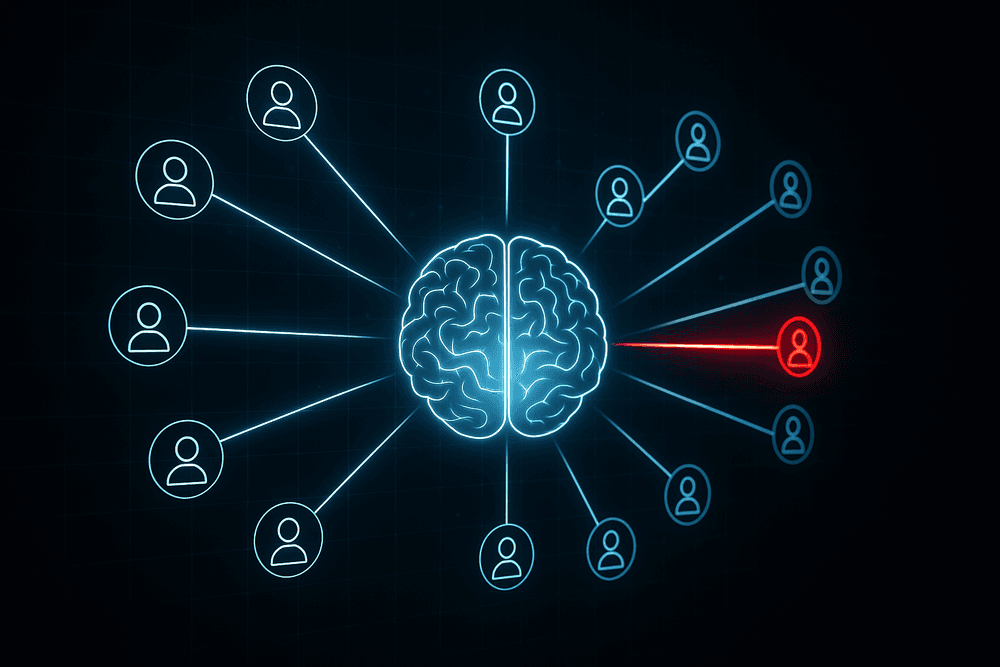
Traditional IAM systems rely on static rules, which are ineffective against sophisticated threats like insider attacks or account takeovers. AI excels where rules fall short. By applying machine learning, the system establishes a unique behavioral baseline for every user, learning their typical login times, locations, devices used, and data access patterns.
This is where the real power of AI in Identity and Access Management shines. The system continuously monitors activity against this baseline, instantly flagging anomalies that signal a potential threat. Examples include:
- A user logging in from two different countries within an hour ("impossible travel").
- An employee suddenly accessing sensitive files they've never touched before at 3 a.m.
- An administrator executing an unusual sequence of high-privilege commands.
This real-time detection allows security teams to investigate and neutralize threats before they can escalate into a full-blown breach.
Enhancing Security with AI-Powered Multi-Factor Authentication (MFA)
While MFA is a critical security layer, it can sometimes lead to user friction and "authentication fatigue." AI introduces adaptive MFA, a smarter approach that balances security and convenience. Instead of challenging every login, an AI-powered system assesses the risk of each access request in real-time.
It analyzes contextual signals like geolocation, device reputation, IP address, and time of day. A low-risk login—say, an employee using their corporate laptop on the office network during business hours—might proceed seamlessly. However, a high-risk attempt—like a login from an unrecognized device in a different country—will trigger a more stringent authentication step, such as a biometric scan or a security key verification. This ensures robust security where it’s needed most without inconveniencing legitimate users.
Predicting and Preventing Breaches with Predictive Risk Analysis
The most advanced use case for AI in IAM is its ability to shift security from a reactive to a proactive posture. By analyzing vast datasets—including historical access logs, user behavior trends, and external threat intelligence—AI models can identify subtle patterns that often precede a security breach.
The system calculates a dynamic risk score for each user, which fluctuates based on their recent activities and other contextual factors. For example, a user whose credentials have appeared in a known data breach dump or who has been repeatedly clicking on phishing links would receive a higher risk score. This allows security teams to take preemptive action, such as automatically enforcing a password reset, restricting access to critical systems, or enrolling the user in additional security training before their account can be compromised.
Unlocking Key Benefits: How AI Strengthens Your IAM Framework
Integrating artificial intelligence into your Identity and Access Management (IAM) framework isn't just an upgrade; it's a fundamental transformation. By leveraging machine learning and advanced analytics, AI moves your security from a reactive, rule-based model to a proactive, intelligent, and adaptive system. This shift delivers tangible benefits across security, efficiency, and user experience.
Achieving a Frictionless User Experience Without Sacrificing Security
Traditionally, robust security came at the cost of user convenience, forcing employees and customers to navigate cumbersome login processes. AI flips this script by enabling adaptive, risk-based authentication. Instead of applying the same rigid authentication rules to everyone, AI analyzes contextual clues in real-time—such as user behavior, device health, geolocation, and network—to assess the risk of each access request.
If a user logs in from their usual device during normal work hours, the system can grant seamless, passwordless access. However, if the same user attempts to log in from an unrecognized location at 3 a.m., AI can instantly trigger a step-up challenge, like multi-factor authentication (MFA). This intelligent approach creates an "invisible" security layer that remains unobtrusive during low-risk activities but becomes formidable when a threat is detected, ensuring a secure yet frictionless user journey.
Boosting Operational Efficiency and Reducing Administrative Overhead
IAM administration is often burdened with repetitive, manual tasks that consume valuable IT resources. From onboarding and offboarding employees to handling password resets and access requests, these processes are time-consuming and prone to human error. AI-powered automation eliminates this administrative drain.
AI can automate the entire identity lifecycle, from provisioning access for new hires based on their role to instantly de-provisioning access when they leave, closing critical security gaps. Furthermore, AI-driven chatbots can handle common helpdesk requests, such as password resets, 24/7. By automating these routine functions, your IT and security teams are freed from manual drudgery, allowing them to focus on high-value strategic initiatives that strengthen your organization's security posture.
Gaining Deeper Insights for a Proactive Security Posture
Legacy IAM systems are effective at enforcing predefined rules but struggle to identify sophisticated, unknown threats. The true power of AI in identity and access management lies in its ability to analyze massive datasets and uncover patterns that would be invisible to human analysts. By continuously monitoring user activity logs, access patterns, and other data streams, machine learning algorithms establish a baseline of normal behavior for every user.
When a deviation from this baseline occurs—such as a user accessing sensitive files at an unusual time or an account exhibiting "impossible travel" by logging in from two different continents simultaneously—the AI flags it as a high-risk anomaly. This allows security teams to move from a reactive stance (cleaning up after a breach) to a proactive one, investigating and neutralizing potential threats before they can cause damage.
Ensuring Compliance with AI-Powered Auditing and Reporting
Meeting stringent regulatory requirements like GDPR, HIPAA, and SOX demands meticulous auditing and reporting, a process that is historically manual, expensive, and error-prone. AI revolutionizes compliance management by automating these critical tasks.
AI-powered systems can continuously monitor access privileges and user activities, automatically identifying and flagging policy violations or instances of excessive permissions. For audits, AI can generate comprehensive, context-aware reports in minutes, clearly demonstrating who has access to what resources and why. This not only dramatically simplifies audit preparation but also ensures a state of continuous compliance, helping your organization confidently meet its regulatory obligations while minimizing risk.
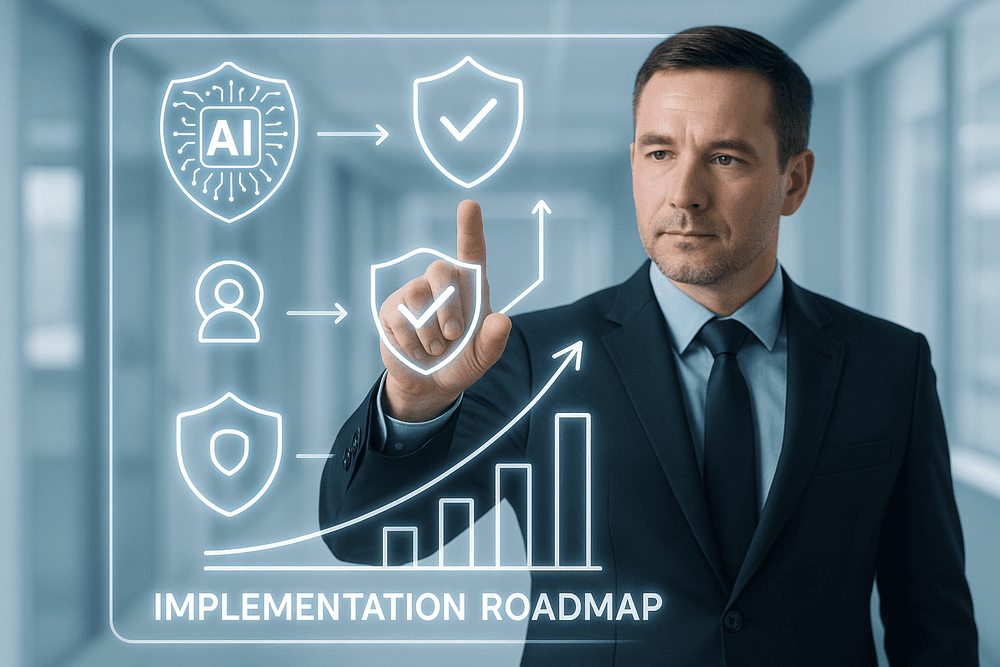
Implementation Roadmap: Best Practices for Adopting AI in IAM
Integrating artificial intelligence into your identity and access management framework is a transformative step, not a simple software update. It requires a strategic, phased approach to unlock its full potential while mitigating risks. A well-planned roadmap ensures your transition is smooth, secure, and aligned with your business objectives. Follow these best practices to successfully deploy AI in identity and access management.
Start with Strategy: Define Your "Why"
Before evaluating a single AI tool, you must anchor your initiative in a clear strategy. Jumping into AI without defined goals is a recipe for wasted resources and a solution that doesn’t solve any real problems. Start by asking critical questions:
- What are our primary IAM pain points? Are you struggling with slow user provisioning, an overwhelming number of security alerts, or sophisticated phishing attacks that bypass traditional defenses?
- What are our specific objectives? Define measurable Key Performance Indicators (KPIs). For example, your goal might be to "reduce access request resolution time by 40%," "decrease false-positive threat alerts by 30%," or "automate 90% of role-based access assignments for new hires."
A successful strategy for AI in identity and access management is built on solving specific challenges, not just adopting new technology.
Select the Right Tools: Not All AI is Created Equal
The market for AI-powered security solutions is vast. The right platform for your organization depends entirely on the goals you’ve just defined. When evaluating vendors and tools, consider these factors:
- Integration Capabilities: How seamlessly will the AI solution integrate with your existing IAM infrastructure, such as your SSO, IGA, and PAM systems? A tool that requires a complete overhaul of your current stack is often less practical than one that enhances it.
- Scalability: Will the solution grow with your organization? Ensure the platform can handle an increasing number of users, devices, and access requests without a drop in performance.
- Specialization vs. Platform: Do you need a highly specialized tool for a single purpose, like behavioral biometrics, or a comprehensive platform that applies AI across multiple IAM functions?
Navigate the Ethics: Mitigating Bias in Access Decisions
When an algorithm makes decisions about who gets access to what, ethical oversight is non-negotiable. AI models learn from historical data, and if that data contains hidden biases, the AI will perpetuate and even amplify them. This could lead to certain user groups being unfairly flagged as high-risk or denied access.
To address this, prioritize Explainable AI (XAI). Choose solutions that can provide clear, human-understandable reasons for their decisions. This transparency is crucial for auditing, troubleshooting, and ensuring fairness. Regularly audit your AI models and the data they are trained on to identify and correct any emergent bias, ensuring your use of AI in identity and access management is both effective and equitable.
Empower Your People: Training for the AI-Powered Future
The most advanced AI system will fail without a team that understands how to manage it. Your implementation roadmap must include a comprehensive training plan for your IT and security staff. This isn’t just about learning a new dashboard. Your team needs to develop new skills in interpreting AI-driven insights, managing automated workflows, and responding to sophisticated alerts generated by the system.
Frame the transition as an augmentation of their roles, not a replacement. AI handles the repetitive, data-heavy tasks, freeing up your human experts to focus on strategic initiatives, complex threat investigation, and policy governance. A well-prepared and empowered team is the ultimate key to maximizing the value of your investment.
Real-World Examples: AI in Identity and Access Management in Action
The theoretical benefits of AI in security are compelling, but its true power is revealed in practical application. Across various industries, organizations are already deploying intelligent IAM solutions to solve critical challenges, from preventing financial fraud to streamlining corporate operations. These real-world examples showcase how AI in identity and access management is moving from a futuristic concept to a present-day necessity.
How Financial Services Use AI to Prevent Fraudulent Access
The financial sector is a primary target for cybercriminals, making robust identity verification paramount. Traditional security measures are no longer enough to combat sophisticated fraud schemes. This is where AI-driven IAM makes a significant impact.
Leading banks and fintech companies now use AI to perform continuous, real-time risk analysis. Instead of just verifying a password at login, the system analyzes a stream of contextual data:
- Behavioral Biometrics: The AI learns a user's unique typing cadence, mouse movement patterns, and even how they hold their phone. A fraudster might have the correct password, but they won't be able to replicate this unique behavioral fingerprint.
- Geospatial and Device Analysis: If a user logs in from their usual location in Chicago and then, ten minutes later, a login attempt is made from a different continent, the AI immediately flags it as a "superhuman" or impossible travel event.
- Transaction Context: An AI model can recognize when a transaction is out of character for a user—such as a large international money transfer from an account that has only ever made small, domestic purchases.
When the AI detects such an anomaly, it can trigger an adaptive response, such as requiring step-up authentication via a biometric scan or a one-time code, effectively stopping fraudulent access before any damage is done.
Securing Patient Data in Healthcare with Predictive IAM Models
In healthcare, protecting patient data is not just a security priority—it's a legal requirement under regulations like HIPAA. Data breaches can lead to massive fines and irreparable damage to patient trust. To counter this, healthcare organizations are implementing predictive IAM models.
The core of this approach is using AI in identity and access management to establish a baseline of normal behavior for every user. An AI system learns the typical access patterns of a clinician, administrator, or nurse, including what types of records they view, from which workstations, and during what hours.
When a user's activity deviates from this established norm—for instance, a nurse suddenly attempting to access the records of a VIP patient outside their ward or an administrator downloading hundreds of patient files at 3 AM—the AI flags the behavior as high-risk. This allows security teams to intervene proactively, investigate potential insider threats or compromised accounts, and prevent a data breach before sensitive information is exfiltrated.
Streamlining Employee Onboarding and Offboarding in Large Enterprises
For large enterprises, managing user access throughout the employee lifecycle is a complex and resource-intensive task. Manual provisioning and de-provisioning are slow and notoriously prone to human error, often leaving dangerous security gaps.
AI-powered IAM automates and optimizes this entire process.
- Automated Onboarding: When a new employee joins, the AI analyzes their role, department, and seniority level defined in the HR system. Based on this profile, it automatically grants the appropriate "birthright" access to all necessary applications, from email and internal comms to specialized software. This reduces a process that once took days or weeks to mere minutes.
- Intelligent Offboarding: Even more critical is offboarding. When an employee resigns or is terminated, the AI ensures that their access to every single corporate system is revoked simultaneously and completely. This eliminates the risk of "orphaned accounts," a common vulnerability that ex-employees or attackers can exploit to gain unauthorized access to the network.
The Future of Security: Your Next Steps with AI in IAM
The integration of artificial intelligence into identity and access management isn't a final destination; it's the beginning of a new, more intelligent era in cybersecurity. As AI models become more sophisticated, their role will evolve from a helpful assistant to a core strategic component of your security infrastructure. To stay ahead of the curve, it's crucial to understand where the technology is headed and how you can prepare your organization to harness its full potential.
Emerging Trends: What's Next for AI in Identity Management?
The current applications of AI in identity and access management are already transformative, but the horizon holds even more promise. Keep an eye on these groundbreaking trends that are set to redefine the industry:
- Predictive Identity Governance: Moving beyond real-time analysis, future AI systems will forecast future access risks. By analyzing career trajectories, project assignments, and organizational changes, AI will predict which access rights an employee will need—or which ones will become a liability—before a formal request is ever made.
- Hyper-automated Identity Lifecycle Management: AI will take automation to the next level, managing the entire identity lifecycle from onboarding to offboarding with minimal human oversight. This includes dynamically adjusting permissions based on real-time project involvement and risk posture, ensuring a continuous state of least privilege.
- AI-Powered Zero Trust Architectures: AI will become the central brain of Zero Trust models. Instead of relying on static rules, AI will continuously calculate a trust score for every user, device, and access request based on a massive array of contextual data points, granting or denying access with unparalleled precision.
How to Evaluate Your Organization's Readiness for an AI-IAM Solution
Adopting an AI-powered IAM solution is more than a simple software upgrade. It requires a solid foundation. Before you invest, ask yourself these critical questions to gauge your organization's preparedness:
- Is Your Data House in Order? AI thrives on high-quality, accessible data. Do you have centralized logs, clean user directories, and a clear data governance policy? An AI system is only as smart as the data it learns from.
- How Mature is Your Current IAM Framework? AI is a powerful amplifier, not a magic fix for a broken system. If your basic IAM processes—like provisioning, access reviews, and MFA—are inconsistent or poorly defined, you must strengthen this foundation first.
- What Are Your Specific Goals? Define what success looks like. Are you trying to reduce analyst alert fatigue, accelerate access approvals, or detect sophisticated insider threats? A clear objective will guide your strategy and vendor selection.
Getting Started: Resources and Recommended First Steps
Embarking on your AI-IAM journey can feel daunting, but a strategic, phased approach makes it manageable and ensures early wins.
- Launch a Pilot Project: Don't try to overhaul your entire system at once. Start with a focused pilot program. A great initial use case for AI in identity and access management is implementing advanced anomaly detection for a specific group of high-privilege users. This allows you to demonstrate value quickly with limited risk.
- Educate and Upskill Your Team: Your security team needs to understand how to interpret and act on AI-driven insights. Invest in training to build confidence and ensure the new tools are used effectively.
- Engage with Leading Vendors: Research vendors who specialize in AI-IAM. Request demos that are tailored to your specific use cases and challenges. A true partner will work with you to build a business case and a clear roadmap for success.