
June 29, 2025
Why AI for Knowledge Management is Your New Competitive
The Future is Here: Why AI for Knowledge Management is Your New Competitive Edge
In today's fast-paced business world, the most valuable asset isn't your product or your factory—it's your collective knowledge. Yet for most organizations, this asset is scattered, siloed, and frustratingly difficult to access. This is where the revolution begins. So, what exactly is AI for knowledge management?
Think of traditional knowledge management as a library. You have shelves, categories, and a card catalog. It works, but it’s manual, slow, and relies on everyone knowing the system. Now, imagine that library has an intelligent librarian who has read every book, understands the context of every sentence, and can instantly connect disparate ideas to answer your most complex questions. That’s AI-powered knowledge management. It uses technologies like machine learning (ML) and natural language processing (NLP) to automate and supercharge how your organization captures, shares, and leverages information. It’s not just about storage; it’s about creating a living, breathing, and intelligent “brain” for your entire company.
From Chaotic Data to Intelligent Insights
The core problem in any growing organization is the explosion of unstructured data. Information is buried in endless email threads, Slack channels, Microsoft Teams chats, Google Docs, and project management tools. Finding the right answer to a specific question can feel like searching for a needle in a haystack—a haystack that’s on fire.
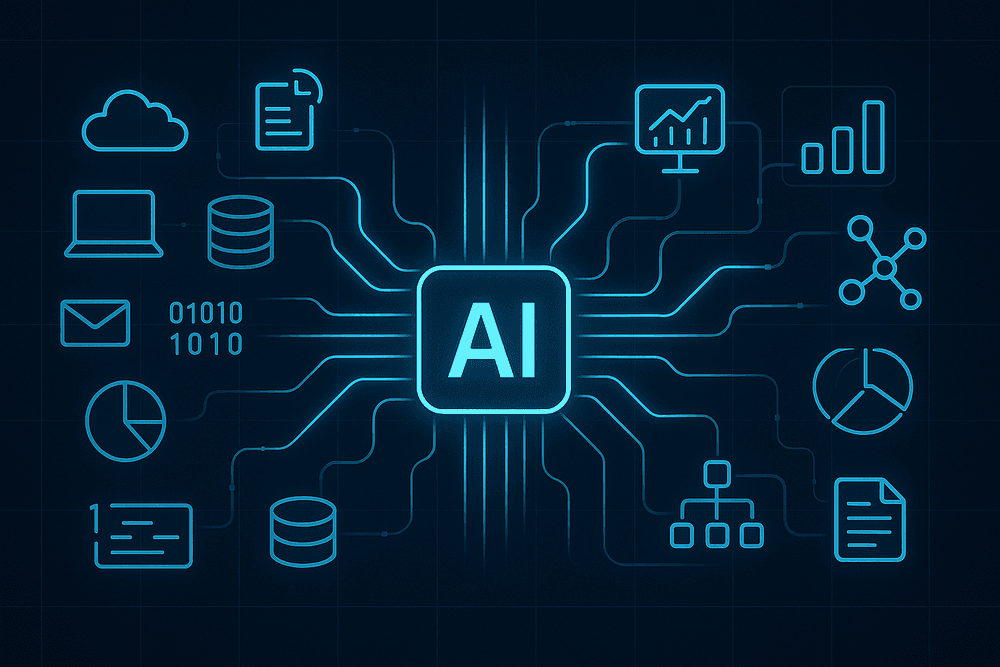
This is the chaos that AI for knowledge management is built to solve. It transforms your disconnected data streams into a cohesive, intelligent ecosystem by:
- Understanding Context: Instead of relying on simple keyword matching, AI-powered semantic search understands the intent behind your query. Asking for "best practices for Q4 enterprise sales" won't just pull up documents with those words; it will find relevant presentations, successful case studies, and conversation transcripts that match the concept of your request.
- Automating Organization: AI algorithms can automatically read, tag, and categorize new information as it’s created. A new project proposal is instantly classified, a new support ticket is linked to relevant technical documents, and a sales discovery call summary is tagged with key client pain points—all without human intervention.
- Surfacing Hidden Insights: Your data holds secrets. AI can connect the dots across thousands of documents to identify emerging trends, pinpoint recurring customer issues, or even suggest subject matter experts within your organization you didn't know existed.
Is Your Organization Ready for an AI Knowledge Revolution?
You don't need to be a tech giant to benefit from this shift. The need for intelligent knowledge management is universal. Ask yourself these questions:
- Do your teams spend more time searching for information than actually using it?
- Is crucial expertise lost forever when a key employee leaves the company?
- Do you struggle to onboard new hires efficiently because training materials and resources are scattered?
- Are you missing opportunities for innovation because insights from one department are invisible to another?
If you answered "yes" to any of these, your organization isn't just ready for a change—it needs one to stay competitive. Implementing AI for knowledge management is no longer a futuristic luxury; it's a fundamental strategy for unlocking efficiency, fostering innovation, and building a truly intelligent enterprise.

Unlocking Potential: Key Use Cases of AI in Knowledge Management
The true power of AI for knowledge management lies in its ability to transform how organizations interact with their most valuable asset: information. By moving beyond manual, labor-intensive processes, AI introduces a new layer of intelligence and efficiency that actively works for you. This isn't about replacing human expertise but augmenting it, allowing your teams to find what they need faster, understand complex data effortlessly, and collaborate more effectively. Let's explore the key use cases that are making this revolution a reality for businesses today.
Automating Content Tagging and Categorization
Imagine every new document, report, or support ticket being instantly analyzed, understood, and filed in the right place with the perfect set of tags—all without human intervention. This is a foundational application of AI in knowledge systems. Using Natural Language Processing (NLP), AI models can read content, identify key themes, entities, and sentiment, and then automatically apply consistent metadata and categorization.
This process eliminates the tedious and error-prone task of manual tagging, which often leads to inconsistent taxonomies and lost information. With automated categorization, your knowledge base becomes a highly organized, self-maintaining library where content is seamlessly discoverable, ensuring employees can always find the most relevant and up-to-date information.
Leveraging Semantic Search for Smarter Answers
Traditional keyword search is fundamentally limited. It finds documents that contain your exact search terms, but it doesn't understand your intent. Semantic search changes the game entirely. Powered by AI, it comprehends the context and meaning behind a query, delivering results that are conceptually related, not just textually matched.
An employee can ask a complex question like, “What were our key marketing takeaways for the European launch last quarter?” and the system will understand the concepts of "marketing," "takeaways," and "European launch." It will then surface relevant presentation slides, meeting summaries, and performance reports, even if they don't contain those exact keywords. This evolution from a simple search bar to a conversational answer engine is a core benefit of modern AI for knowledge management, providing direct answers instead of just a list of links.
Generating Summaries and Insights on Demand
Information overload is a major drain on productivity. Employees don't have time to read every 50-page report or watch every hour-long meeting recording. Generative AI excels at tackling this challenge by providing on-demand summarization.
With a single click, AI can distill lengthy documents, complex technical manuals, or dense customer feedback threads into concise, easy-to-digest summaries. It can pull out key action items from meeting transcripts or identify the overarching sentiment from a batch of client reviews. This capability doesn't just save countless hours; it accelerates decision-making by giving stakeholders the critical insights they need, precisely when they need them.
Proactively Identifying Knowledge Gaps and Experts
A truly intelligent knowledge management system doesn't just store information; it actively works to improve itself. AI can analyze search patterns and user behavior across the organization to identify knowledge gaps—topics that employees are frequently searching for but failing to find quality answers on.
Once a gap is identified, the system can take the next step: recommending a subject matter expert (SME) to fill it. By analyzing content creation history, project involvement, and internal communications, the AI can pinpoint the best person within the company to create the missing content. This transforms knowledge management from a passive repository into a proactive, self-healing ecosystem that continuously captures and refines an organization's collective intelligence.
The Modern Toolkit: Exploring Types of AI for Knowledge Management
Choosing the right tool is the first step toward transforming your organization’s intellectual capital into a competitive advantage. The market for AI for knowledge management is bustling with innovative solutions, but they generally fall into two main categories. Understanding the distinction is key to finding the perfect fit for your team's needs.
Enterprise Search Platforms vs. Integrated AI Assistants
At first glance, these two types of tools might seem similar, but their core functions and user experiences are fundamentally different.
- Enterprise Search Platforms: Think of these as a supercharged, private Google for your company. Powered by AI, platforms like Glean or Coveo index information across all your disparate applications—from Google Drive and Confluence to Slack and Salesforce. When an employee has a question, they use a central search bar. The AI uses Natural Language Processing (NLP) to understand the query's intent and context, delivering a ranked list of the most relevant documents, conversations, and data points. Its primary strength is discovery: helping users find the exact file or resource they need, wherever it lives.
- Integrated AI Assistants: This is the next evolution. Instead of just pointing you to a document, integrated assistants like Guru or Microsoft Copilot aim to deliver a direct answer. They live inside the applications your team already uses, like Slack, Microsoft Teams, or your web browser. These tools don't just search; they read, understand, and synthesize information to provide concise summaries, answer follow-up questions, and even draft content based on your internal knowledge base. The focus shifts from finding information to using it instantly.
The choice depends on your primary goal. If your biggest challenge is locating siloed documents, an enterprise search platform is an excellent start. If your goal is to eliminate search time entirely by delivering verified answers directly within your team's workflow, an integrated AI assistant is the more powerful solution.
What to Look For: A Key Features Checklist
When evaluating AI for knowledge management software, keep an eye out for these critical features:
- Seamless Integrations: The tool is only as good as the data it can access. Ensure it connects effortlessly with your entire tech stack (cloud storage, communication apps, CRMs, wikis).
- Generative AI Capabilities: Does the AI simply find sources, or can it synthesize information to provide direct answers, summarize long documents, and help draft new content?
- Contextual Understanding: Look for sophisticated NLP that goes beyond keywords to grasp intent, acronyms, and industry-specific jargon.
- Robust Security & Permissions: The AI must inherit and respect your existing user permissions, ensuring sensitive information is only accessible to authorized personnel.
- Analytics and Insights: A great platform provides a dashboard showing what information users are searching for, what content is most valuable, and where knowledge gaps exist.
- Verification & Trust: Top-tier tools include features that allow experts to verify information, giving users confidence that the AI-provided answers are accurate and up-to-date.
Your Implementation Blueprint: Best Practices for Adopting AI for Knowledge Management
Transitioning to an AI-powered system requires more than just buying new software; it demands a strategic approach. Adopting AI for knowledge management is a journey, and this blueprint will guide you through each critical phase, from preparing your data to proving the value of your investment.
Phase 1: Prepare Your Data for an AI-First System
AI systems are powerful, but they operate on a simple principle: garbage in, garbage out. The quality of your AI's output is directly tied to the quality of the data it learns from. Before you even look at a vendor, focus on your internal knowledge hygiene.
- Conduct a Knowledge Audit: Where does your information live? Identify all your knowledge repositories—wikis, shared drives, Slack channels, support tickets, and documents.
- Clean and Consolidate: Remove outdated, irrelevant, and duplicate content (ROT). Standardize formats and consolidate scattered information into a more centralized structure. Tagging content with clear, consistent metadata is crucial for helping the AI understand context.
- Establish Governance: Create clear guidelines for how new knowledge is created, reviewed, and archived. A well-governed knowledge base is an ever-improving asset for your AI.
Phase 2: Choosing and Launching Your First AI Tool
With a cleaner data foundation, you can confidently select and implement a tool.
- Define a Specific Problem: Don't try to boil the ocean. Start with a single, high-impact use case. Is your goal to reduce support ticket volume? Speed up new hire onboarding? Or empower your sales team with instant answers? A clear objective makes it easier to choose the right tool.
- Evaluate Vendors: Look for solutions that integrate with your existing tech stack. Key features to consider include natural language search, automated content tagging, and robust analytics. Ask for demos tailored to your specific use case.
- Run a Pilot Program: Select a small, enthusiastic team to test the tool. This controlled experiment allows you to gather real-world feedback, identify potential issues, and build a case for a wider rollout without disrupting the entire organization.
- Scale and Integrate: Use the insights from your pilot to refine your implementation plan. Provide comprehensive training and communicate the benefits clearly as you expand access across the company.
Phase 3: Avoiding Common Pitfalls
Even the best technology can fail without proper planning. Focus on two key areas:
Ensuring User Adoption
A new tool is useless if nobody uses it. Drive adoption by making the AI system the single, most reliable source of truth. Integrate it directly into workflows—for example, within your CRM for sales or your ticketing system for support. Champion its use from the top down and celebrate early wins to build momentum.
Upholding Data Security
When you leverage AI for knowledge management, you're connecting it to your most valuable intellectual property. Ensure any potential tool meets your security standards. Prioritize solutions with role-based access controls, robust data encryption, and a clear privacy policy. Vet the vendor’s security credentials as thoroughly as you vet their features.
Phase 4: Measuring ROI: Metrics That Matter
To prove the value of your AI investment, track metrics that go beyond simple cost savings.
- Efficiency Gains: Measure the reduction in "time-to-information"—how long it takes an employee to find the answer they need.
- Productivity Boost: Track metrics like support ticket deflection rates, reduced agent handling time, or faster sales cycle completions.
- Employee Satisfaction: Survey employees on their experience. A successful implementation should reduce frustration and empower them to work more autonomously.
Real-World Wins: Case Studies of AI for Knowledge Management in Action
Theory is one thing, but tangible results are what drive adoption. The true power of AI for knowledge management shines when you see how organizations are applying it to solve real, pressing challenges. From accelerating complex research to improving daily workflows, these case studies demonstrate the transformative impact of intelligent knowledge systems.
The Consulting Powerhouse: Slashing Research Time by 50%
A leading global consulting firm faced a significant productivity bottleneck. Its consultants, some of the brightest minds in the industry, were spending nearly half their project kickoff time on foundational research. They had to manually sift through a vast, decentralized repository of past project reports, market analyses, expert interviews, and client presentations to gather baseline information. Knowledge was siloed, and finding relevant precedents was a time-consuming and often frustrating task.
The Solution: The firm implemented a sophisticated AI for knowledge management platform. This system used Natural Language Processing (NLP) and machine learning to ingest, index, and understand the content and context of their entire knowledge base.
The Outcome: The results were immediate and profound. Consultants could now pose complex questions in natural language, such as, "What were the primary supply chain risks and mitigation strategies we recommended for retail clients in Europe post-2020?" The AI would instantly synthesize information from dozens of documents, generating a concise summary with cited sources. This move cut initial research time by an average of 50%, freeing up consultants to focus on high-value strategic thinking and client-facing activities.
The Tech Innovator: A Smarter Internal Help Desk
For a rapidly scaling tech company, growth came with internal friction. Their IT and HR help desks were overwhelmed with repetitive queries from a growing employee base. Questions about software permissions, benefits enrollment, and company policies flooded their ticketing systems, leading to long resolution times and frustrated employees who couldn't find answers in their sprawling intranet.
The Solution: They deployed an AI-powered conversational assistant integrated directly into their internal messaging platform (like Slack or Microsoft Teams). This AI was trained on the company’s entire knowledge base, including policy documents, how-to guides, and historical support tickets.
The Outcome: The AI chatbot successfully resolved over 70% of all incoming queries without human intervention, providing instant, accurate answers and links to official documentation 24/7. For more complex issues, the bot seamlessly escalated the ticket to the appropriate human agent, complete with a full transcript of the initial conversation. This strategic use of AI for knowledge management drastically reduced the support team's workload, cut resolution times from hours to seconds, and significantly boosted employee satisfaction.
The Healthcare Provider: Enhancing Patient Care Through Connected Knowledge
A multi-hospital healthcare network struggled to ensure that life-saving knowledge was accessible at the point of care. Critical information on rare conditions, innovative treatment protocols, and ongoing clinical trial results was fragmented across electronic health records (EHRs), research databases, and departmental wikis. Physicians on the front lines didn't have an efficient way to tap into this collective intelligence during critical decision-making moments.
The Solution: The provider adopted a specialized AI knowledge management tool designed for the medical field. The platform created a unified knowledge graph that connected anonymized patient data with the latest medical research, internal best practices, and clinical guidelines.
The Outcome: Physicians can now make queries like, "Show evidence-based treatment pathways for patients over 65 with diabetes and hypertension." The AI provides a synthesized view of recommended protocols, relevant internal case studies, and links to supporting peer-reviewed research. This system empowers clinicians with comprehensive, data-driven insights, leading to more consistent, high-quality patient care and improved outcomes.
Getting Started with AI for Knowledge Management Today
We've journeyed through the what, why, and how of AI for knowledge management, uncovering its power to transform scattered data into a strategic, intelligent asset. The shift from static repositories to dynamic, learning ecosystems is no longer a future vision—it’s a present-day opportunity. AI doesn't just help you find information; it helps you understand, connect, and create knowledge in ways that were previously impossible. It automates tedious tasks, surfaces hidden expertise, and empowers every employee with the collective intelligence of your entire organization.
Now, it's time to move from understanding to action. The path forward involves building a compelling case and integrating AI thoughtfully into your existing framework.
Your Next Steps: Building a Strong Business Case
Securing buy-in for any new technology requires a clear, data-backed argument. To build an undeniable business case for AI for knowledge management, focus on translating organizational pain points into tangible value.
- Identify and Quantify the Problem: Where is knowledge friction costing you the most? Is it in slow employee onboarding, redundant work, repeated mistakes, or long customer support resolution times? Quantify this. For example, calculate the hours your team spends searching for information instead of executing on tasks. A study by McKinsey found that employees spend, on average, 1.8 hours every day searching for and gathering information. Frame AI as the solution to reclaim that lost productivity.
- Align with Strategic Goals: Connect your proposal to high-level business objectives. If your company aims to accelerate innovation, explain how an AI-powered knowledge platform can connect R&D teams with relevant patents, past project data, and subject matter experts instantly. If the goal is to improve customer satisfaction, show how AI can equip support agents with immediate, accurate answers, reducing wait times and improving first-call resolution.
- Propose a Pilot Project: A full-scale enterprise rollout can be daunting. Instead, propose a targeted pilot program. Choose a department with a clear and measurable need, such as a sales team that needs faster access to product specifications or a technical support team struggling with complex queries. A successful pilot provides concrete ROI data and creates internal champions for a wider implementation.
How to Seamlessly Integrate AI into Your Knowledge Strategy
Integrating AI isn't about replacing your current systems overnight; it's about augmenting them with intelligence. Follow these steps for a smooth and effective rollout.
- Step 1: Audit Your Current Knowledge Ecosystem. Before implementing a new solution, you need a clear map of your existing landscape. Where does your knowledge live? Is it in a CRM, a shared drive, Confluence, Slack, or email inboxes? Identify the silos and the sources of truth. This audit will reveal the most critical areas where AI can bridge gaps and unify information.
- Step 2: Define Clear, Phased Objectives. What do you want to achieve first? Don’t try to do everything at once. Your initial goal might be to implement an intelligent search function across all platforms. The next phase could be to roll out automated content tagging and summarization. A later phase might involve deploying a generative AI-powered chatbot for employee self-service.
- Step 3: Foster a Culture of Knowledge Sharing. Technology is the vehicle, but people are the drivers. The most sophisticated AI for knowledge management tool will fail if the organizational culture doesn’t support it. Encourage and reward employees for documenting their work, asking questions in public channels, and updating information. Communicate the benefits of the new AI tools—less time searching, more time for meaningful work—to ensure enthusiastic adoption.
- Step 4: Measure, Iterate, and Scale. For your pilot and subsequent rollouts, track key performance indicators (KPIs). Measure metrics like time-to-information, search query success rates, employee satisfaction scores, and case resolution times. Use this data to refine your approach, demonstrate value to leadership, and strategically scale your AI-powered knowledge management initiative across the organization.